BP Price Soars 300% in 2 Weeks: What Is Backpack Betting On?

Foresight NewsPublished on 2026-06-15Last updated on 2026-06-15

Abstract

"BP, the native token of the Backpack exchange, surged over 300% in two weeks to $0.475, driven by the launch of its new regulated stock brokerage and asset tokenization arm, Backpack Securities. The platform enables users to trade U.S. stocks and tokenize them on Solana, with the SpaceX tokenized stock (SPCX) generating significant on-chain volume. This expansion into bridging traditional finance with DeFi aligns with the RWA narrative. BP's unique tokenomics, where 25% was airdropped at TGE with zero allocation to the team, and a staking mechanism allowing conversion to equity upon a company IPO, underpins its value proposition. Over 66% of the circulating supply is currently staked."


Author: Ma He, Foresight News


On June 15, the exchange token of Backpack, BP, surged over 30% again within 24 hours, currently quoted at $0.475, with a market cap of $118.48 million and an FDV of $473.94 million. BP has skyrocketed significantly from around $0.16 in early June this year, peaking above $0.48.
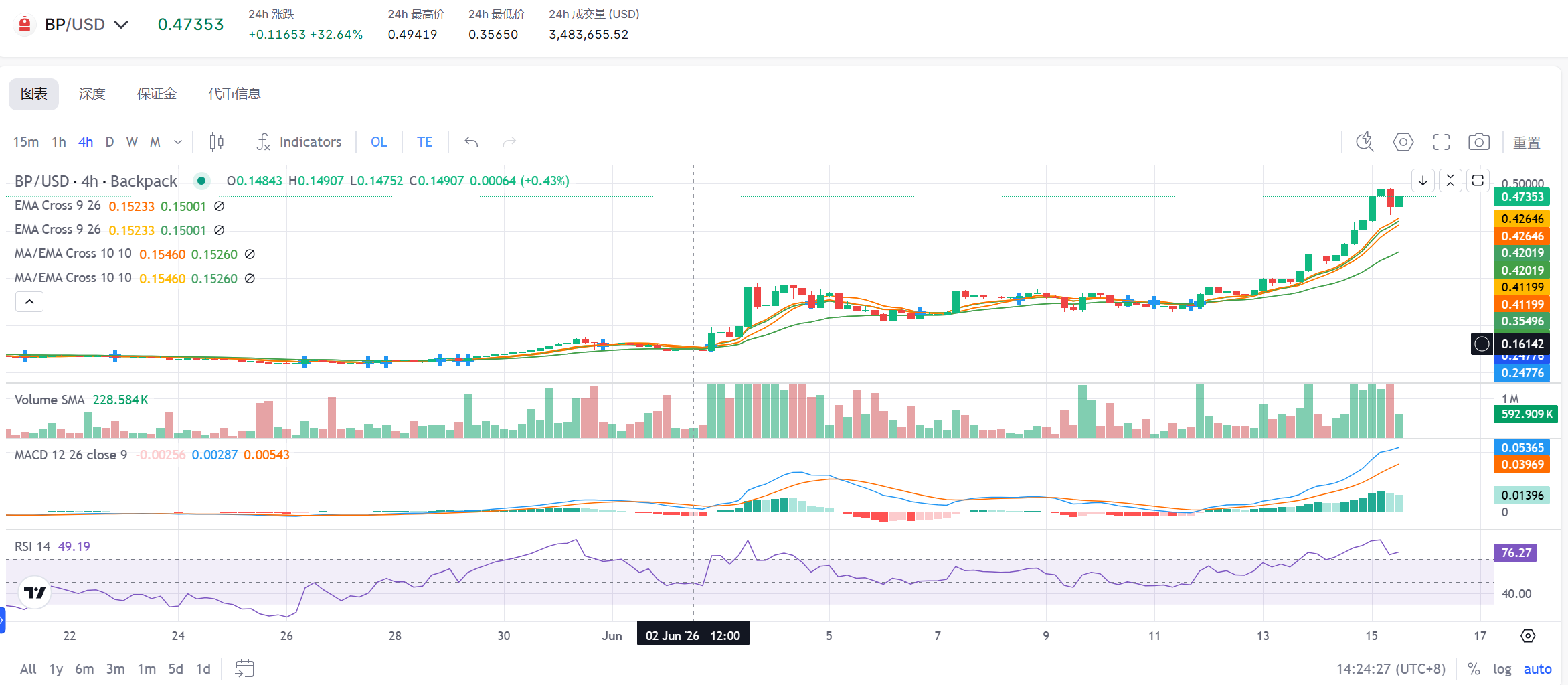


The immediate driving force behind this rally comes from the platform's latest breakthrough in traditional U.S. stock brokerage and asset tokenization services.


Entering U.S. Stock Brokerage and Tokenization Business


In March 2026, BP completed its TGE on Solana, with a total supply of 1 billion tokens and an initial circulating supply of 250 million. After listing, the price briefly hit a high before quickly retracing, with a single-day maximum drop exceeding 40%, filling the market with profit-taking pressure. For several weeks thereafter, the price consolidated at lower levels until the turn-around in early June.


On June 2, Backpack announced the launch of the Backpack Securities platform, which will offer regulated U.S. stock brokerage services while also supporting the tokenization of traditional stocks for circulation on the blockchain, enabling seamless conversion between traditional securities and on-chain assets. The brokerage services are planned for a gradual rollout in June, with initial tokenized products launched on the Solana ecosystem through a partnership with Sunrise. BP surged over 80% in a single day, rapidly climbing from the $0.14-0.15 range to around $0.27, with its market cap approaching $70 million at one point.


On June 12, the same day SpaceX listed on NASDAQ, its tokenized product SPCX went live on Solana. BP subsequently rose approximately 27% within the next 24 hours, reaching above $0.347. This token is pegged 1:1 to real SpaceX shares, supports 24/7 on-chain trading, and can be redeemed to a traditional securities account via Backpack's brokerage account, achieving interoperability between on-chain and off-chain assets. On its first day, the product generated approximately $35-38 million in on-chain trading volume across DEXs like Jupiter and Raydium. According to the latest official data, the total on-chain trading volume for SPCX exceeded $86 million.
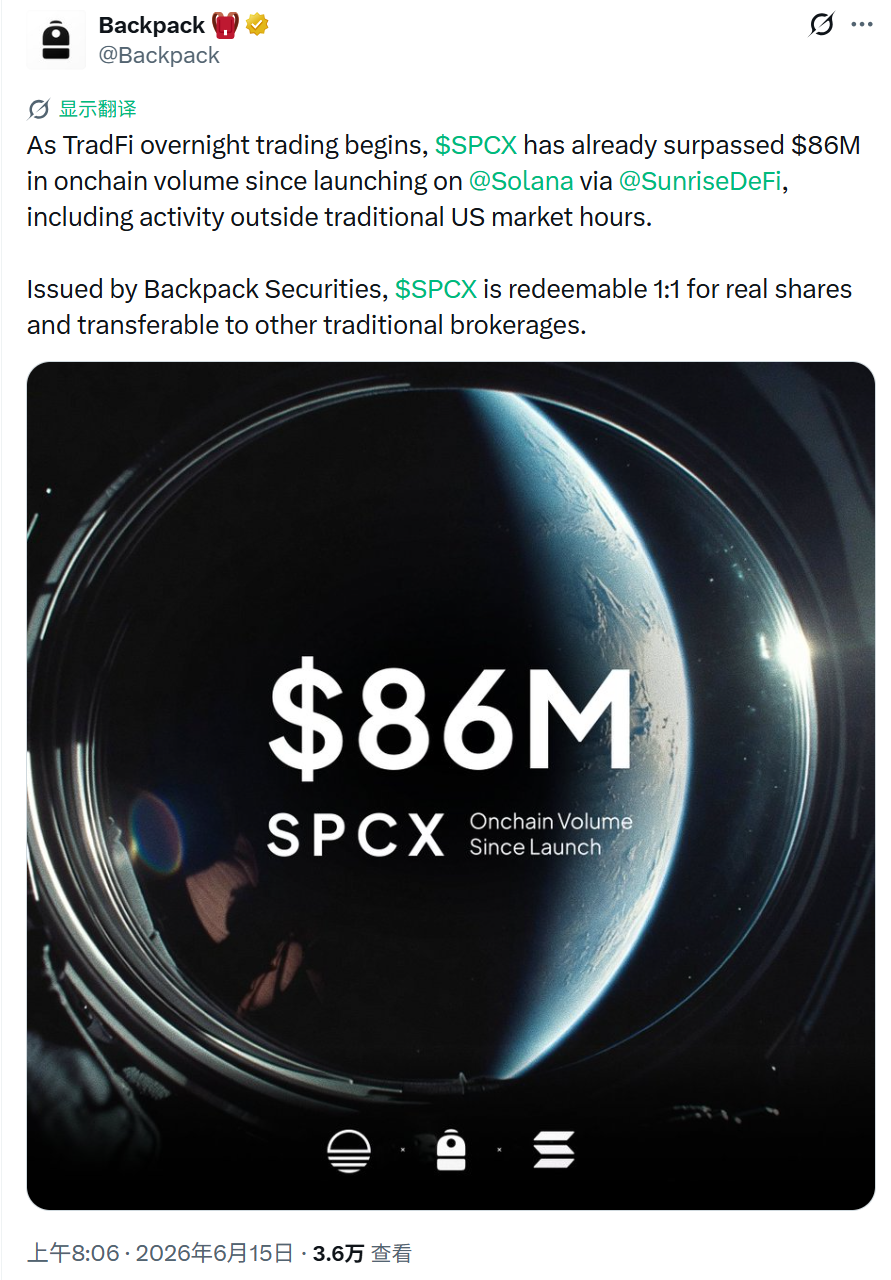


Backpack is building a bridge between traditional U.S. stocks and Solana DeFi. Users can not only trade crypto assets on the platform but also access real stocks through the same account, and tokenize some of those assets for on-chain use, trading, or composability. This path aligns well with the current RWA narrative and has also provided the BP token with clearer use cases and demand support.
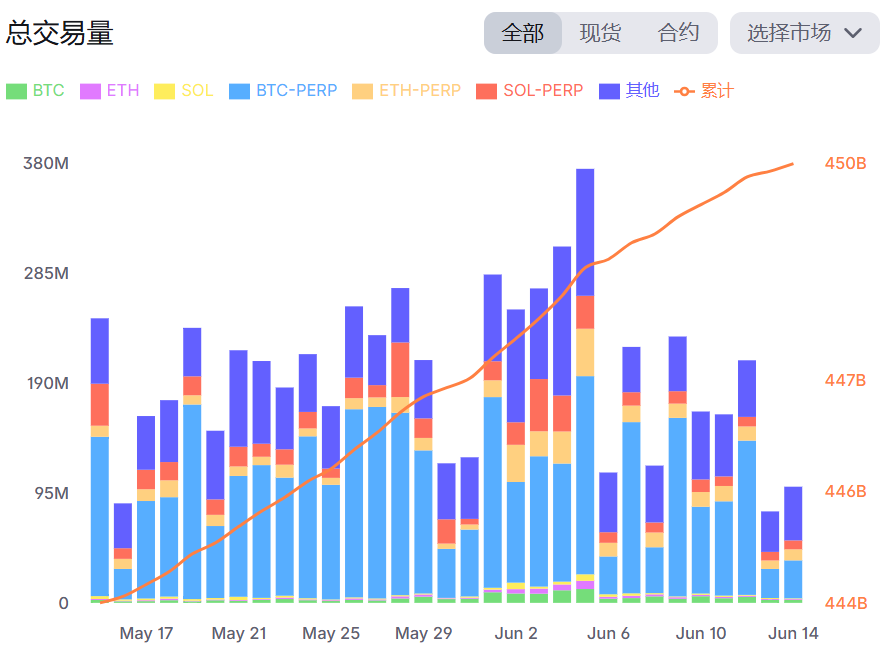


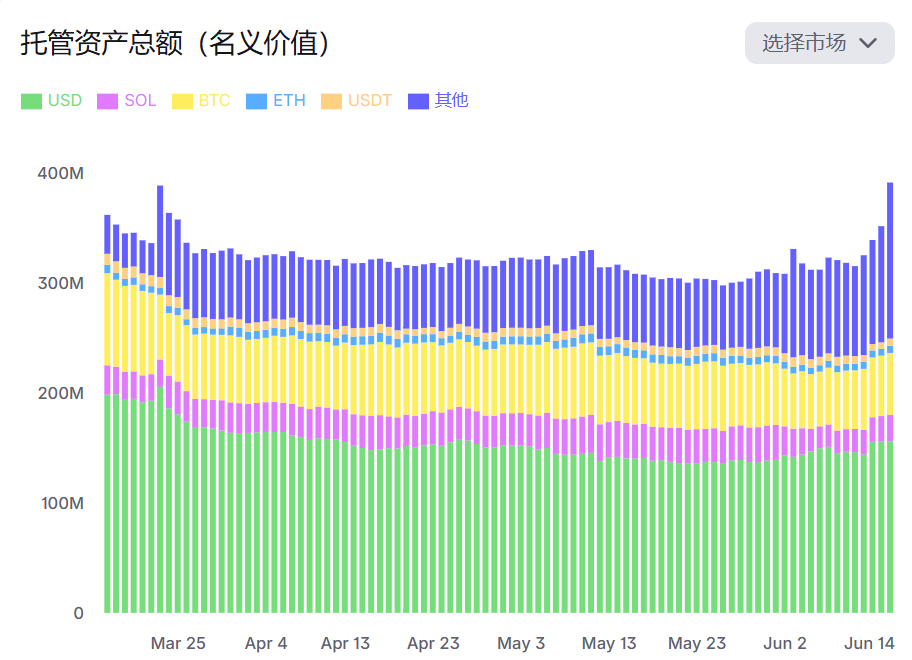
BP's rise this round stems more from the substantial expansion of the platform's business rather than short-term hype. Currently, its official website shows that Backpack's Total Custodied Assets (nominal value) has rebounded to $390 million.

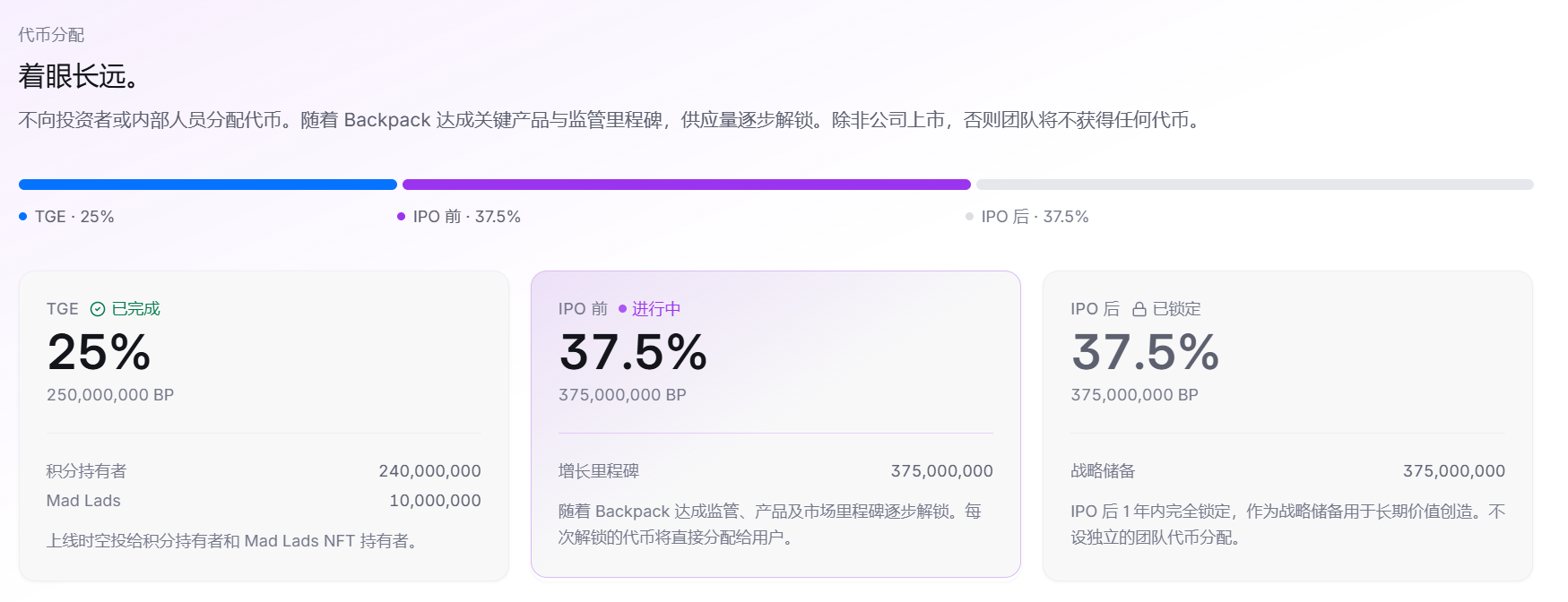
Team Receives Zero Tokens Unless the Company Goes Public


Supporting the development of the above business is the BP token and its unique economic structure launched by Backpack as early as March. The total supply of 1 billion tokens is divided into three phases: The TGE phase allocates 25% (250 million tokens) entirely to community users via airdrop, with approximately 240 million given to Points Program participants and 10 million to Mad Lads NFT holders. At launch, the team, founders, and investors received zero token allocation; The Pre-IPO phase allocates 37.5%, tied to growth triggers like regulatory milestones and product launches, and continues distribution to users upon unlocking; The Post-IPO phase allocates 37.5% to the company treasury, locked for at least one year post-IPO, with the team benefiting only through equity, not directly from tokens.


The most notable mechanism is the equity conversion design: Users staking BP for at least 1 year gain the right to convert their tokens into company equity upon an IPO or acquisition, with the base unlock bonus increasing with holding time up to the 4th year.


Additionally, staking grants benefits such as tiered trading fee discounts, extra yield on USD collateral, free wire transfers, and priority access to the Backpack Card. Currently, about 66% (approximately 165 million tokens) of the circulating supply is staked.


Although the airdrop process was technically smooth, it sparked community discussion. Supporters argued that the "no insider TGE allocation" model was quite radical, and the points system genuinely rewarded trading and ecosystem participation; criticism centered on the relatively strict Sybil filtering mechanism, which led to some long-term users having their points invalidated and receiving less than expected, as well as noticeable profit-taking during the post-listing price correction. CEO Armani Ferrante publicly denied allegations related to team OTC selling.


These controversies affected market sentiment in the short term, but as real products like Backpack Securities land, the focus is gradually shifting from distribution details to the platform's long-term growth and the token's actual utility. Against the backdrop of the platform's expansion into U.S. stock brokerage and tokenization services, the long-term alignment value of BP's staking and equity mechanisms is being re-examined.


Related Questions

QWhat is the primary driver behind the recent surge in Backpack Exchange's BP token price?

AThe primary driver behind the recent surge in BP token price is the platform's expansion into traditional U.S. stock brokerage and asset tokenization services, particularly the launch of Backpack Securities and the tokenization of SpaceX shares (SPCX).

QWhat key feature of the BP token's economic structure aims to align long-term user and platform interests?

AA key feature is the equity conversion design: users who stake BP for at least one year gain the right to convert their tokens into company equity during an IPO or acquisition, with the conversion bonus increasing up to the fourth year of staking.

QWhat was a significant immediate market reaction following the launch of the tokenized SpaceX (SPCX) product?

AA significant immediate market reaction was that BP's price rose approximately 27% within 24 hours after the SPCX tokenized product launched on Solana on June 12, coinciding with SpaceX's Nasdaq IPO.

QAccording to the article, what portion of the initially circulating BP token supply was allocated to the team, founders, and investors at TGE (Token Generation Event)?

AAccording to the article, 0% of the BP tokens were allocated to the team, founders, and investors at the TGE. The entire initial circulating supply of 250 million tokens (25% of total supply) was airdropped to the community.

QWhat is the total supply of BP tokens and what percentage is designated for the 'Post-IPO' stage to be held in the company treasury?

AThe total supply of BP tokens is 1 billion. 37.5% of the total supply is designated for the 'Post-IPO' stage and will enter the company treasury, locked for at least one year after an IPO.

Related Reads

pump.fun's New Feature Brings 'Black Mirror' Into Reality

The article begins by recounting a dark fictional story from *Black Mirror* (Season 7, Episode 1 "Common People"), where a man is forced to perform humiliating tasks online to pay for his wife's life-sustaining medical subscription. It then draws a parallel to a new real-world feature on the crypto platform pump.fun called "Pump.fun Go," which allows users to post and complete paid bounty tasks. This feature gained mainstream attention, often negatively, through extreme examples. A prominent case involved a bounty of 40 SOL (~$2,600) offered to permanently tattoo "$bountywork" on one's forehead. An Indian man completed the task, stating the money "changed his life," and later earned significantly more from a related meme coin. Another bounty paid 200 SOL (~$14,000) for a "bounty.fun" forehead tattoo, with the participant simply stating, "We need the money." The article highlights how this system can amplify darkness, citing the dev behind $Bountywork who spent thousands on bounties for attention-grabbing stunts like eating bugs or drinking hot sauce for small sums. It compares this to past tragic live-streaming incidents where people harmed themselves for money, noting regulation cannot stop those in desperate need. However, it also points to positive, altruistic bounties that have emerged, such as organizing anti-work rallies in New York, performing random acts of kindness for strangers, organizing community food drives, or even helping an elderly person cross the street. The piece concludes by acknowledging the platform reflects both the dark and light sides of human nature when actions are given a price, hoping for more of the latter.

marsbit4m ago

pump.fun's New Feature Brings 'Black Mirror' Into Reality

marsbit4m ago

As the US and Japan Hike Interest Rates, Which Asset Class is Most at Risk?

This week, global markets face two major events: the Bank of Japan's likely interest rate hike and the US Federal Reserve's FOMC meeting. For risk assets, it is a pivotal and volatile week. In the US, expectations for rate cuts have faded dramatically. May's higher-than-expected CPI and resilient jobs data have shifted the Fed's focus from potential cuts to the possibility of future hikes. New Fed Chair Wash is unlikely to raise rates at this meeting, but any hawkish shift in communication, the dot plot, or the policy statement could lead markets to price in tighter policy, pushing up short-term Treasury yields and strengthening the dollar. High-valuation growth stocks, AI-related assets, and small-cap stocks reliant on cheap funding are most vulnerable to rising rates. In Japan, a 25 basis point hike is almost fully priced in (98.3% probability), which would bring the policy rate to 1%, its highest since 1995. The concern is not the hike itself, but its potential to unwind the massive "carry trade," where investors borrowed low-yielding yen to invest globally. Historically, Japan's rate hikes have coincided with global market stress (2000, 2007, 2024). While this well-telegraphed hike may be digested smoothly, two key factors increase uncertainty: 1) Governor Ueda's absence due to illness, putting communication in the hands of less-familiar deputies, and 2) the Fed meeting occurring just days later, creating potential for a compounded market reaction if both central banks sound hawkish. Asset implications: * **Bonds:** US short-term yields sensitive to Fed signals. Japan's rate hike could pressure its massive US Treasury holdings. * **Currencies:** Dollar likely supported by Fed; Yen's reaction hinges on BoJ's forward guidance. * **Equities:** US growth stocks, small-caps most at risk. Japanese stocks face pressure from a stronger yen. * **Crypto:** Assets like Bitcoin face headwinds from higher rates and tighter liquidity; high-beta altcoins are even more vulnerable. The convergence of these two central bank meetings amplifies market volatility risks, with potential spillovers across asset classes globally.

marsbit9m ago

As the US and Japan Hike Interest Rates, Which Asset Class is Most at Risk?

marsbit9m ago

Data Decrypts the BTC Cycle: Three Major Bottom Signals Illuminate Simultaneously, Q4 Could Be a Crucial Turning Point Window?

"Decoding the Bitcoin Cycle: Three Bottom Signals Flash Simultaneously, Is Q4 the Key Turning Point?" The article analyzes Bitcoin's current market position, comparing it to historical cycles. BTC has corrected over 52% from its October 2025 peak of $126,198 to around $59,100 in June 2026. While significant, this drawdown is milder than the 77-86% declines seen in past bear markets. The analysis is framed within Bitcoin's four-year halving cycle. Past cycles show a pattern: prices peak 12-18 months post-halving, bottom 12-14 months after the peak, with lows typically occurring roughly 17 months before the next halving. Following the April 2024 halving and the October 2025 peak, this pattern suggests a potential bottoming window around Q4 2026, ahead of the expected 2028 halving. Three key on-chain metrics are signaling undervaluation: The MVRV Z-Score has dropped near 0.27, approaching historic bottom zones. The market price is only about 9% above the network's average realized price of ~$53,600, a rare low premium. Bitcoin's price recently touched its 200-week moving average (~$62,200), a level that aligned with bottoms in 2015, 2018, and 2020. While US spot Bitcoin ETFs saw record outflows in May/June 2026, indicating retail panic, whale addresses (holding 100+ BTC) reached a yearly high. Entities like MicroStrategy resumed buying, and long-term holders control a near-record 78% of the supply, suggesting accumulation. A major macro overhang was partially removed with a US-Iran ceasefire agreement in mid-June 2026, which eased oil prices and triggered a sharp BTC rally. However, persistent inflation means high-interest rates remain a constraint. The conclusion notes that genuine investment opportunities often arise when confidence is lowest, amidst narratives that "this time is different." While not guaranteeing an immediate bottom, the confluence of cycle timing, undervaluation signals, and shifting macro risks suggests late 2026 may be a critical period for reassessing risk/reward and patient accumulation for long-term believers.

marsbit9m ago

Data Decrypts the BTC Cycle: Three Major Bottom Signals Illuminate Simultaneously, Q4 Could Be a Crucial Turning Point Window?

marsbit9m ago

Trading

Spot
Futures
活动图片