BofA's Hartnett: Brace for the 'June Storm', US CPI to 'Burst the Bubble'

marsbitPublished on 2026-06-08Last updated on 2026-06-08

Abstract

Bank of America strategist Hartnett warns of a potential "June storm" for markets, with an unexpectedly high US CPI print set to be the key catalyst. Historical data shows that when CPI surpasses 4%, the S&P 500 has historically fallen by an average of 4% over the next 3 months and 7% over 6 months. A confluence of risks threatens to puncture the tech asset bubble. Global central banks, notably the Fed under Chair Warsh, are tilting hawkish to combat inflation, risking a sharp rise in long-term bond yields. Market sentiment is at an extreme, with BofA's internal indicators flashing a strong "sell signal." Further pressure comes from record liquidity drainage due to mega IPOs like SpaceX, alongside key non-economic events. Hartnett concludes that risk assets are in an extremely fragile position, facing a severe test from macro events, policy shifts, and tightening liquidity in June.

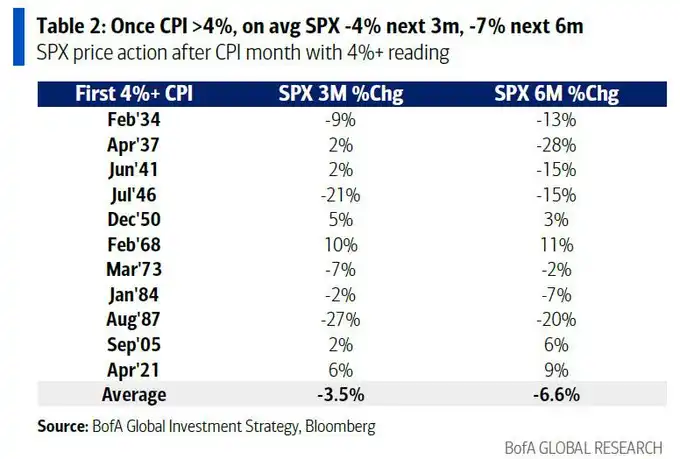
BofA strategist Hartnett issued a warning: if upcoming inflation data exceeds expectations, it will directly trigger a sell-off in risk assets. Historical data shows that over the past 100 years, once CPI breaks above 4%, the S&P 500 index has fallen by an average of 4% over the next 3 months and 7% over 6 months.

Furthermore, market "sell signals" are strengthening, with mega IPOs like SpaceX set to drain record liquidity, combined with risks of a hawkish pivot by global central banks, leaving the tech bubble in an extremely fragile moment.

U.S. stocks face a severe stress test in June. Bank of America strategist Michael Hartnett warns that a series of concentrated macro event risks and a sharp withdrawal of market liquidity could drive global bond yields significantly higher, thereby bursting the current technology asset bubble.

According to Flow Trading Desk, Hartnett stated in his latest research report that the upcoming U.S. CPI data is the core catalyst for this "June storm". If the latest inflation data exceeds expectations, it will directly trigger the mechanism for selling risk assets. Historical data shows that when inflation breaks through key warning levels, it often triggers a deep correction in U.S. benchmark stock indices in the following months.

Simultaneously, intensive resolutions and statements from global central banks are steering the market's direction. Particularly, the Federal Open Market Committee (FOMC) meeting led by the new Fed Chair Wash is a key event. Its policy stance, whether hawkish or dovish, will determine the fate of U.S. stocks and long-term bond yields. Any unexpectedly tight signal will hit investors hard.

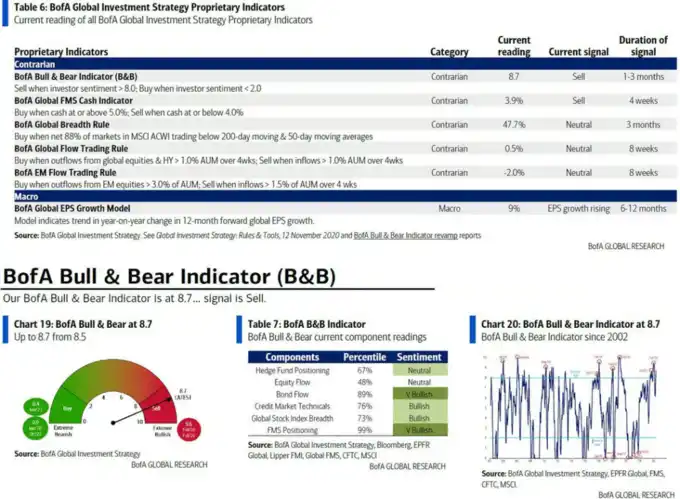
Against a backdrop of extremely euphoric bullish sentiment, Bank of America's internal sentiment indicators have issued a strong "sell signal." Coupled with the unprecedented liquidity drain from imminent mega tech IPOs, current risk assets are in an extremely vulnerable position.

Key Inflation Data Approaches, U.S. Stocks Face Historic Pullback Risk

The U.S. CPI data to be released on June 10th is the first major test for the market.

Over the past three months, this data has averaged a month-on-month increase of 0.6%; over the past six months, the average is 0.4%. If May's CPI month-on-month growth exceeds 0.4% (the current market expectation is 0.5%), it means the U.S. CPI year-on-year growth rate will break above 4% and could head towards 5% before the U.S. midterm elections. This trend would make risk assets extremely uneasy.

Historical data shows that over the past 100 years, once CPI breaks above 4%, the S&P 500 index has fallen by an average of 4% over the next 3 months and 7% over 6 months.

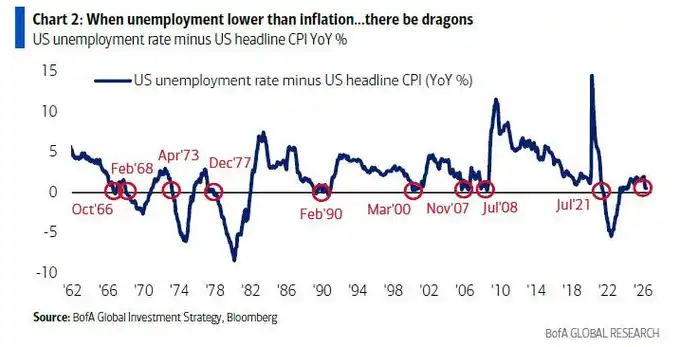
Another inflation indicator that cannot be ignored is the crossover between the unemployment rate and CPI.

In May, there is a "small probability but high-impact possibility" that the U.S. unemployment rate (consensus expectation 4.3%) could equal or fall below the inflation rate (consensus expectation 4.2%). This would be only the 7th occurrence since 1960. In years when inflation is close to or higher than unemployment (such as 1966, 1973, 2008, and 2021), the Federal Reserve typically resorts to interest rate hikes, and Wall Street's memories of these years are often painful.

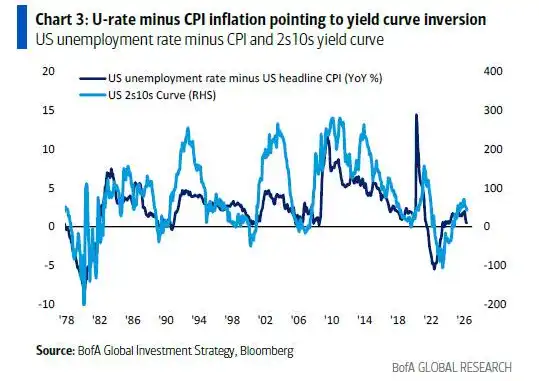
Furthermore, the spread between the unemployment rate and CPI is highly correlated with the U.S. yield curve and is currently pointing towards a near-term curve inversion, which is another signal with negative implications for risk assets.

Global Central Bank Meetings Dense, Bond Yields May End the Boom

"Booms and bubbles are ultimately ended by bonds," Michael Hartnett reiterated this logic in the report.

He warns that a series of events in June could push the UK 30-year bond yield above 6%, the U.S. above 5%, and Japan above 4%. With the market saturated with bullish positions and optimistic earnings expectations, a surge in yields would undoubtedly be negative for risk assets.

Global central banks are currently significantly lagging behind the inflation curve. Among 68 global central banks, 46 currently have inflation levels exceeding their target or the absolute median of their target range. Against this backdrop, the European Central Bank (ECB) has a 98% probability of raising rates by 25 basis points, while the probability of the Bank of Japan (BoJ) raising rates by 25 basis points also reaches 83%, with the latter urgently needing this to prevent the yen from breaking below the "Maginot Line" of 160 per dollar.

The June 17th FOMC meeting led by Wash is seen as one of the two most important events this month.

The market currently faces a policy dilemma: if Wash is too dovish, long-term yields will head towards 6%; if too hawkish, the S&P 500 risks a correction towards the 7000-point zone; while a "Goldilocks"-style moderate stance could propel the NYSE Composite Index (NYA) to break above the all-time high of 24000 points.

As Wash stated back in 2024, global central banks seem complacent with inflation nearing 3%, and the 2% inflation target is no longer taken seriously. This compromise is extremely dangerous.

Wealth Effect Fuels Inflation, Extreme Sentiment Triggers "Sell Signal"

From a macroeconomic perspective, the U.S. is experiencing a K-shaped recovery driven by a "wealth-stock market virtuous cycle."

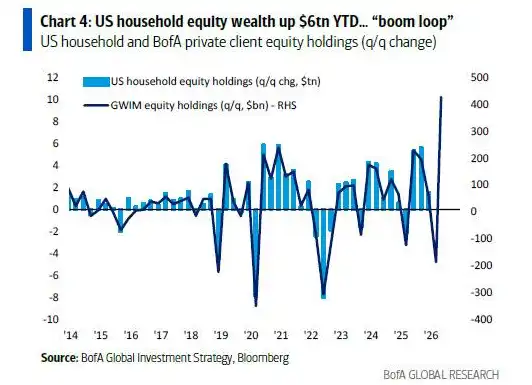
U.S. household stock wealth has increased by $6 trillion year-to-date. This "wealth-price spiral" directly exacerbates inflationary pressures. Despite economic prosperity, voters' perceptions are not uniform. Currently, Trump's approval rating on inflation is already lower than Biden's lowest levels.

In terms of fund flows, investors have recently shown an extreme tendency to chase the tech bubble. Last week's data showed a massive $122 billion flowing into cash, $39 billion into bonds (a record high), and $23.1 billion into equities. Meanwhile, cryptocurrencies saw outflows of $2 billion and gold outflows of $3.1 billion, indicating investors are selling other assets to chase technology and semiconductor sectors.

The extreme fund flows have caused Bank of America's Bull/Bear indicator to rise further from 8.5 to 8.7, making the "sell signal" triggered two weeks ago even stronger.

Historical data shows that among the 17 "sell signals" since 2002, global stocks have lost an average of 2% to 3% over the subsequent 2 to 3 months, with maximum drawdowns reaching 15% to 20%. Additionally, global breadth indicators show that 48% of global stocks are in overbought territory.

Mega IPOs Drain Liquidity, Non-Economic Events Intensify Market Turmoil

Beyond macroeconomic data, the biggest non-economic event risk in June comes from massive capital market supply.

SpaceX's initial public offering (IPO) is set to start trading next Friday. Along with Anthropic and OpenAI's offerings and the end of related lock-up periods, this will drain record liquidity from the market. The impact of this scale of liquidity tightening as a market catalyst may even surpass the decisions of central banks.

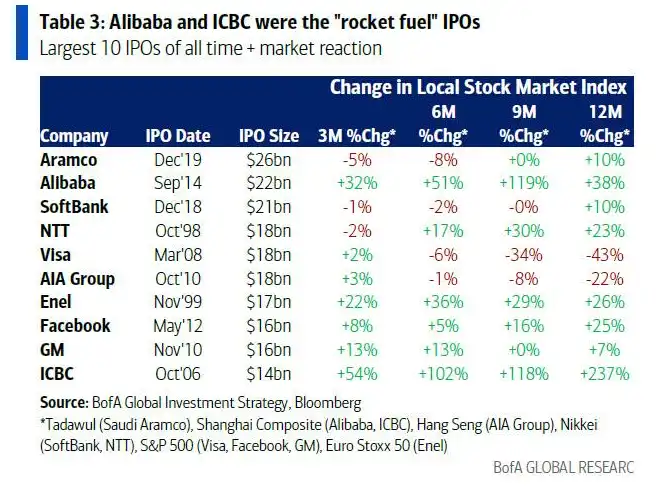
The impact of historical mega IPOs on the market is mixed.

While IPOs like Alibaba and ICBC once acted as market boosters, the listings of Visa and AIA marked market "tops," with the S&P 500 and the Hang Seng Index declining significantly within 9 to 12 months after these IPOs.

Hartnett believes that this political shift is the core reason why Latin American bond yields and spreads are at historic lows (falling to 217 basis points, the lowest since November 2007). A similar trend of political rightward shift is also evident in Europe.

For investors, this means a profound, substantive reassessment of global economic policy preferences is underway in the near term.

Trending Cryptos

Related Questions

QAccording to Michael Hartnett of Bank of America, what is the potential impact on the S&P 500 if the upcoming CPI data exceeds expectations?

AAccording to Michael Hartnett, if the upcoming CPI data exceeds expectations, it could directly trigger a sell-off in risk assets. Historical data shows that once CPI surpasses 4%, the S&P 500 index has historically fallen an average of 4% over the subsequent three months and 7% over six months.

QWhat is Hartnett's view on the relationship between bond yields and the end of market booms or bubbles?

AHartnett reiterates the logic that 'booms and bubbles are ultimately ended by bonds.' He warns that events in June could cause yields on UK 30-year gilts to break above 6%, US yields above 5%, and Japanese yields above 4%, which would be bearish for risk assets.

QWhat does the Bank of America's internal sentiment indicator currently signal, and what is its historical implication?

ABank of America's internal sentiment indicator, the Bull/Bear indicator, has triggered a strong 'sell signal,' rising further from 8.5 to 8.7. Historically, since 2002, following the 17 previous 'sell signals,' global equities have lost an average of 2% to 3% over the subsequent two to three months, with maximum drawdowns reaching 15% to 20%.

QAside from macro data, what significant non-economic event risk does Hartnett identify for June, and what is its potential market impact?

AHartnett identifies the massive capital market supply from mega IPOs, specifically mentioning SpaceX's upcoming IPO launch, as a significant non-economic event risk for June. He states it could drain record liquidity from the market, with its catalytic power potentially even exceeding central bank decisions.

QWhat specific policy dilemma does Hartnett outline for the June FOMC meeting chaired by the new Fed Chair, and what are the potential market outcomes for each scenario?

AHartnett outlines a policy dilemma for the FOMC meeting: if the new Chair is too dovish, long-term yields could head towards 6%; if too hawkish, the S&P 500 risks a correction towards the 7000-point area; a 'Goldilocks' or just-right stance could push the NYSE Composite Index to a new all-time high above 24,000 points.

Related Reads

The Verdict in Choi Tae-won's Divorce Case: Revealing the Inheritance Undercurrent Behind SK Hynix's Trillion-Won Empire

SK Group Chairman Chey Tae-won's high-profile divorce case, involving a record 1.38 trillion won settlement, has drawn attention to the succession plans for Korea's second-largest conglomerate, especially its crown jewel, SK hynix. Unlike traditional chaebol scripts centered on the eldest son, Chey's three children from his marriage to former President Roh Tae-woo's daughter, Roh Soh-yeong, are carving distinct, non-traditional paths. Eldest daughter Chey Yun-jung (b. 1989) is seen as the most evident successor. With a scientific and consulting background, she holds executive roles at SK bioscience and SK Inc.'s growth support department, focusing on future strategy and biopharma. Her marriage is to an AI infrastructure entrepreneur, not a traditional business alliance. Second daughter Chey Min-jung (b. 1991) took a unique route, voluntarily serving as a South Korean naval officer, including an anti-piracy deployment. She later worked on policy and strategy for SK hynix in Washington D.C. before co-founding an AI-driven healthcare startup. She married a former U.S. Marine Corps officer, connecting her to U.S. defense and policy circles—networks crucial for a global semiconductor giant. The only son, Chey In-geun (b. 1995), who studied physics like his father, worked briefly at SK E&S before joining McKinsey. Despite fitting the traditional "heir" profile as the eldest son, he remains silent and holds no public position or shares in SK, suggesting the old succession playbook is obsolete. As SK hynix's valuation soars, becoming a geopolitical asset in the AI era, the heirs' legitimacy is no longer automatic. They must prove themselves in fields like AI biotech, global policy, and strategic consulting. Their marriages also reflect new elite networks in tech and defense, not old political alliances. Their inheritance is the complex challenge of navigating a globalized, tech-driven world, not just a corporate throne.

marsbitYesterday 09:06

The Verdict in Choi Tae-won's Divorce Case: Revealing the Inheritance Undercurrent Behind SK Hynix's Trillion-Won Empire

marsbitYesterday 09:06

From OpenSea to OpenRouter: Is Alex Atallah Repeating His 'Exit at the Peak' Playbook?

From OpenSea to OpenRouter: Is Alex Atallah Repeating His "Exit at the Peak" Playbook? According to the Wall Street Journal, payments giant Stripe is in talks to acquire the AI model aggregation platform OpenRouter in a potential deal valuing the company near $100 billion. This would mark founder Alex Atallah's second creation of a company reaching a $100 billion valuation, following his co-founding of NFT marketplace OpenSea. OpenRouter, founded just over three years ago, has grown rapidly by acting as a unified gateway for developers to access over 400 AI models. It currently has about 10 million users and processes over 200 trillion tokens monthly. While the platform's annualized revenue is around $50 million, its valuation has skyrocketed from $1.3 billion in March 2026. The potential acquisition by Stripe, a company OpenRouter's founder once likened it to, represents a major expansion into AI infrastructure for the payments leader. This move echoes Atallah's previous timing with OpenSea, where he departed before the NFT market's significant downturn. For OpenRouter, selling now may be strategic. Despite its scale, its business model—charging a 5-5.5% fee on AI inference calls—faces pressure from competition, open-source models, and potential price wars among model providers, limiting its profitability narrative for an IPO. A key asset for potential acquirers like Stripe is OpenRouter's vast repository of real-world AI usage data, which offers unique insights into model performance and developer preferences that are difficult to replicate. Whether this potential deal signifies a new valuation benchmark for AI infrastructure or another market peak signal remains to be seen.

链捕手Yesterday 08:42

From OpenSea to OpenRouter: Is Alex Atallah Repeating His 'Exit at the Peak' Playbook?

链捕手Yesterday 08:42

Trading

Spot

Hot Articles

Discussions

Welcome to the HTX Community. Here, you can stay informed about the latest platform developments and gain access to professional market insights. Users' opinions on the price of S (S) are presented below.

活动图片