BlackRock Warns Bitcoin And Ethereum Investors About Quantum Computing

bitcoinistPublished on 2026-06-10Last updated on 2026-06-10

Abstract

BlackRock's report warns that future advancements in quantum computing could threaten the cryptographic security of Bitcoin, Ethereum, and other digital assets. While no cryptographically relevant quantum computer (CRQC) exists today, the firm stresses the need for proactive industry migration to post-quantum cryptography before "Q-Day." The primary risk lies in the elliptic curve cryptography (ECC) used for digital signatures, which a powerful quantum computer running Shor's algorithm could break. Bitcoin's SHA-256 hash function is considered quantum-resistant, but roughly 35% of circulating BTC may be vulnerable due to exposed public keys. The report notes that Bitcoin's technical upgrade path is relatively narrow, focusing on signature algorithms, but faces significant challenges in decentralized coordination. Ethereum has a more defined migration roadmap but greater complexity due to its proof-of-stake architecture, smart contracts, and layered cryptographic systems. BlackRock concludes that quantum computing presents a manageable but serious long-term risk. Successfully coordinating and implementing post-quantum upgrades across decentralized networks is seen as a multi-year challenge, but one that is less daunting than building a functional CRQC.

BlackRock has entered the quantum-computing debate with a new report warning that future breakthroughs could eventually threaten the cryptography securing Bitcoin, Ethereum and much of the broader digital-asset market. The firm’s central message is not that blockchains face an immediate crisis, but that the industry needs to begin post-quantum migration before “Q-Day” becomes a live security event.

The report, titled “Quantum Computing and Blockchains,” was authored by Will Su, Head of Digital Assets Research at BlackRock, Inish Crisson, Senior Software Engineer at Aladdin Digital Assets Lab, and Robert Mitchnick, BlackRock’s Head of Digital Assets. It frames quantum computing as both a cybersecurity risk and a potential test of blockchain governance, particularly for networks that rely on elliptic curve cryptography for transaction signatures.

“Quantum computing has been the subject of growing attention in recent years, particularly due to its implications for blockchains and many other elements of modern cyber infrastructure,” the authors wrote. “In our view, quantum computing is likely to be a manageable risk for blockchains, subject to the industry’s ability to upgrade swiftly and proactively to post-quantum cryptography in the coming years.”

Bitcoin And Ethereum’s Core Risk

BlackRock stresses that no functional Cryptographically Relevant Quantum Computer, or CRQC, exists today. But it says timelines have shifted. The report notes that Google has moved its post-quantum migration deadline to 2029, while IBM is targeting large-scale fault-tolerant quantum computing between 2029 and 2033.

The main issue is not Bitcoin’s proof-of-work engine. BlackRock says Bitcoin’s SHA-256 hash function is “largely considered quantum-resistant,” with Grover’s algorithm offering only a quadratic speedup that could be absorbed by Bitcoin’s difficulty adjustment. The more relevant attack surface is ownership: the digital signatures that prove control over coins.

Bitcoin and Ethereum currently rely on elliptic curve cryptography for key ownership and transaction authorization. Classical computers would need millions to billions of years to break 256-bit ECC, according to the report. A sufficiently powerful quantum computer using Shor’s Algorithm could change that equation by turning private-key recovery into a more tractable mathematical problem.

“The foundations of modern-day cryptography become challenged in the quantum world,” BlackRock wrote. “This is not because quantum computers run faster. Rather, QCs are particularly efficient at teasing out hidden patterns in large datasets by leveraging unique properties of quantum physics and employing quantum algorithms to solve classically infeasible problems like ECDLPs in as little as days to minutes.”

Bitcoin’s Migration Is Simpler, But Coordination Is Hard

For Bitcoin, BlackRock argues that the technical scope of a post-quantum upgrade is narrower than for many other systems because the core task is replacing a digital-signature algorithm. The harder problem is social coordination across a decentralized network that deliberately avoids rapid or centralized change.

The report says nearly 7 million BTC, or roughly 35% of circulating supply, may be vulnerable to long-range quantum attacks because public keys have already been exposed. That figure includes 1.9 million BTC in address types that expose unhashed public keys and another 5 million BTC in reused addresses that have revealed public keys in previous transactions while still holding UTXOs.

BlackRock also highlights the unresolved debate around inactive or lost coins. It cites Chainalysis estimates that 2.3 million to 3.7 million BTC, or 11% to 19% of circulating supply, may be permanently lost. That includes roughly 1.1 million BTC in P2PK addresses widely believed to belong to Satoshi Nakamoto.

“In our view, PQ migration for cryptocurrencies is eminently addressable from a technical standpoint, and the key challenge is one of timely coordination and implementation,” the report said. “The end-to-end process to build consensus around PQC protocols and timing, implement upgrades on the blockchain, and perform orderly migrations across the ecosystem will likely be a multi-year endeavor.”

Ethereum Has A Roadmap, But More Moving Parts

Ethereum’s situation is different. BlackRock says the network has a more clearly defined migration path, guided by the Ethereum Foundation, but faces greater technical complexity due to its proof-of-stake architecture, smart-contract environment, data layer and application-layer zero-knowledge systems.

The report cites four Ethereum vulnerability areas identified by Vitalik Buterin in early 2026: BLS signatures in the consensus layer, KZG proofs in the data layer, externally owned account signatures, and zero-knowledge proofs in the application layer. In simpler terms, validator voting, data verification, user transactions and app-level proofs all touch quantum-vulnerable cryptographic assumptions.

BlackRock points to Ethereum’s “L1 Strawmap,” a draft sequence of seven network updates and hard forks between 2026 and 2029, five of which directly address quantum vulnerabilities. These include native account abstraction, post-quantum signature precompiles, post-quantum validator keys, hash-based consensus signatures and a longer-term shift from KZG commitments toward STARK-based verification.

A Wall Of Worry For Crypto

BlackRock’s conclusion is measured. The report does not present quantum computing as an imminent existential threat to Bitcoin or Ethereum. It argues instead that quantum risk is one of the few remaining “walls of worry” for digital assets, and that successful post-quantum migrations could strengthen the sector over time.

“Global cybersecurity infrastructure stands at an important inflection point as quantum computing advances,” the authors wrote. “Digital assets including Bitcoin and Ethereum are technically positioned for migration; a harder problem is coordinating timelines and rolling out upgrades across decentralized networks in an orderly manner. That said, it is a much less daunting task to upgrade current cryptographic systems, including Bitcoin, Ethereum, and others, to a quantum-secure standard than it is to build a CRQC from where quantum computing progress stands today.”

At press time, BTC traded at $62,629.
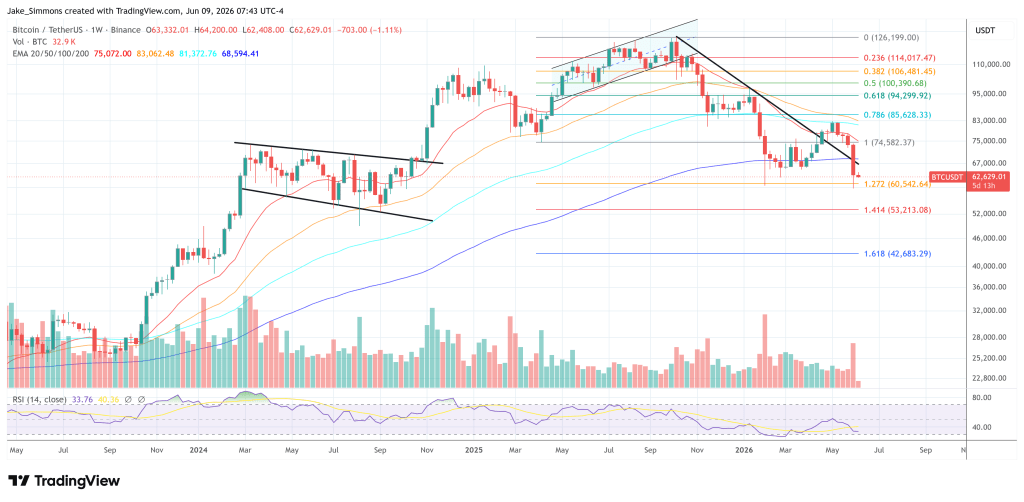
Bitcoin trades below the 200-week EMA, 1-week chart | Source: BTCUSDT on TradingView.com

Related Questions

QWhat is the main message of BlackRock's report on quantum computing and blockchains?

AThe main message is not that blockchains face an immediate crisis, but that the industry needs to proactively begin migrating to post-quantum cryptography before 'Q-Day' becomes a live security event.

QAccording to the report, what is the primary quantum vulnerability for Bitcoin and Ethereum?

AThe primary vulnerability is the elliptic curve cryptography used for key ownership and transaction authorization, which could be broken by a sufficiently powerful quantum computer using Shor's Algorithm to recover private keys.

QWhy does BlackRock consider Bitcoin's migration path to be technically simpler but still challenging?

AIt is technically simpler because the core task is primarily replacing a digital-signature algorithm. The greater challenge is the social coordination required across a decentralized network that avoids rapid or centralized change.

QWhat key difference does the report highlight between Bitcoin and Ethereum regarding quantum risk mitigation?

AEthereum has a more clearly defined migration roadmap (like the L1 Strawmap) guided by the Ethereum Foundation, but faces greater technical complexity due to its proof-of-stake architecture, smart contracts, data layer, and application-layer zero-knowledge systems.

QWhat is BlackRock's overall conclusion about the quantum computing threat to cryptocurrencies?

ABlackRock concludes that quantum computing is not an imminent existential threat but a manageable risk and a 'wall of worry.' Successfully upgrading to post-quantum cryptography is seen as a much less daunting task than building a Cryptographically Relevant Quantum Computer (CRQC).

Related Reads

CFTC Proposes New Rules for Prediction Markets, Redefining Which Events Can Be Listed and Who Can Participate

The U.S. Commodity Futures Trading Commission (CFTC) has proposed new rules to establish a clearer regulatory framework for prediction markets. The proposal aims to modify how "event contracts" are reviewed, creating a structured process to determine if contracts involving terrorism, assassination, war, or illegal activities violate the public interest. This moves away from a blanket ban toward a case-by-case assessment of whether a contract's subject matter is acceptable for financial trading. A key focus is distinguishing between predicting the impact of risks and predicting the occurrence of harm. The proposal suggests that many sports-based prediction markets—such as those on game outcomes, scores, or season standings—may be permissible as they can provide price discovery and meaningful information. However, markets on easily manipulated events like specific player injuries, referee calls, or outcomes of youth sports would face stricter scrutiny. The rules directly target insider trading and manipulation risks, highlighting cases where individuals with non-public information or the ability to influence an event's outcome could unfairly profit. This underscores a shift toward ensuring market fairness. The proposal does not end the regulatory debate, particularly with state gambling regulators who argue that sports prediction markets are essentially sports betting and should fall under state jurisdiction. Nonetheless, the CFTC's action signals a move toward formalizing prediction markets, pushing the industry from a phase of rapid, often unregulated expansion into a more institutionalized, rule-based environment that more closely resembles traditional financial markets.

marsbit11m ago

CFTC Proposes New Rules for Prediction Markets, Redefining Which Events Can Be Listed and Who Can Participate

marsbit11m ago

CFTC Proposes New Rules for Prediction Markets, Redefining Which Events and Who Can Participate

The U.S. Commodity Futures Trading Commission (CFTC) has proposed new rules to establish a regulatory framework for prediction markets, aiming to define which event contracts can be traded and who can participate. The 267-page proposal seeks to amend regulations to create a structured review process for "event contracts." The core goal is to determine whether contracts involving sensitive topics like terrorism, assassination, war, or illegal activities are contrary to the "public interest." The CFTC's approach is not an outright ban but a case-by-case assessment, focusing on whether a contract predicts harmful acts themselves or merely their commercial or risk-related impacts. The proposal suggests that most mainstream sports prediction markets—based on final scores, winners, or season outcomes—may be permissible as they provide price discovery and informational value. However, markets on easily manipulated granular events (e.g., player injuries, specific referee calls) or those encouraging harm/cheating would face stricter scrutiny. A primary regulatory target is insider trading and market manipulation, where individuals with non-public knowledge or influence over an event's outcome could unfairly profit. Recent alleged incidents involving military personnel, former politicians, and corporate insiders highlight this risk. The move clarifies federal oversight but does not end the debate. State regulators and gambling associations argue that many prediction markets, especially on sports, constitute gambling and should fall under state, not federal, jurisdiction. This sets up a potential conflict over regulatory authority. Overall, the CFTC's proposal signals a shift for prediction markets from rapid, less-regulated expansion toward a more institutionalized, rules-based model resembling traditional financial markets. Growth will increasingly depend on demonstrating market fairness, transparent settlement, and controlled risks.

Odaily星球日报20m ago

CFTC Proposes New Rules for Prediction Markets, Redefining Which Events and Who Can Participate

Odaily星球日报20m ago

Trading

Spot
Futures

Hot Articles

What is $BITCOIN

DIGITAL GOLD ($BITCOIN): A Comprehensive Analysis Introduction to DIGITAL GOLD ($BITCOIN) DIGITAL GOLD ($BITCOIN) is a blockchain-based project operating on the Solana network, which aims to combine the characteristics of traditional precious metals with the innovation of decentralized technologies. While it shares a name with Bitcoin, often referred to as “digital gold” due to its perception as a store of value, DIGITAL GOLD is a separate token designed to create a unique ecosystem within the Web3 landscape. Its goal is to position itself as a viable alternative digital asset, although specifics regarding its applications and functionalities are still developing. What is DIGITAL GOLD ($BITCOIN)? DIGITAL GOLD ($BITCOIN) is a cryptocurrency token explicitly designed for use on the Solana blockchain. In contrast to Bitcoin, which provides a widely recognized value storage role, this token appears to focus on broader applications and characteristics. Notable aspects include: Blockchain Infrastructure: The token is built on the Solana blockchain, known for its capacity to handle high-speed and low-cost transactions. Supply Dynamics: DIGITAL GOLD has a maximum supply capped at 100 quadrillion tokens (100P $BITCOIN), although details regarding its circulating supply are currently undisclosed. Utility: While precise functionalities are not explicitly outlined, there are indications that the token could be utilized for various applications, potentially involving decentralized applications (dApps) or asset tokenization strategies. Who is the Creator of DIGITAL GOLD ($BITCOIN)? At present, the identity of the creators and development team behind DIGITAL GOLD ($BITCOIN) remains unknown. This situation is typical among many innovative projects within the blockchain space, particularly those aligning with decentralized finance and meme coin phenomena. While such anonymity may foster a community-driven culture, it intensifies concerns about governance and accountability. Who are the Investors of DIGITAL GOLD ($BITCOIN)? The available information indicates that DIGITAL GOLD ($BITCOIN) does not have any known institutional backers or prominent venture capital investments. The project seems to operate on a peer-to-peer model focused on community support and adoption rather than traditional funding routes. Its activity and liquidity are primarily situated on decentralized exchanges (DEXs), such as PumpSwap, rather than established centralized trading platforms, further highlighting its grassroots approach. How DIGITAL GOLD ($BITCOIN) Works The operational mechanics of DIGITAL GOLD ($BITCOIN) can be elaborated on based on its blockchain design and network attributes: Consensus Mechanism: By leveraging Solana’s unique proof-of-history (PoH) combined with a proof-of-stake (PoS) model, the project ensures efficient transaction validation contributing to the network's high performance. Tokenomics: While specific deflationary mechanisms have not been extensively detailed, the vast maximum token supply implies that it may cater to microtransactions or niche use cases that are still to be defined. Interoperability: There exists the potential for integration with Solana’s broader ecosystem, including various decentralized finance (DeFi) platforms. However, the details regarding specific integrations remain unspecified. Timeline of Key Events Here is a timeline that highlights significant milestones concerning DIGITAL GOLD ($BITCOIN): 2023: The initial deployment of the token occurs on the Solana blockchain, marked by its contract address. 2024: DIGITAL GOLD gains visibility as it becomes available for trading on decentralized exchanges like PumpSwap, allowing users to trade it against SOL. 2025: The project witnesses sporadic trading activity and potential interest in community-led engagements, although no noteworthy partnerships or technical advancements have been documented as of yet. Critical Analysis Strengths Scalability: The underlying Solana infrastructure supports high transaction volumes, which could enhance the utility of $BITCOIN in various transaction scenarios. Accessibility: The potential low trading price per token could attract retail investors, facilitating wider participation due to fractional ownership opportunities. Risks Lack of Transparency: The absence of publicly known backers, developers, or an audit process may yield skepticism regarding the project's sustainability and trustworthiness. Market Volatility: The trading activity is heavily reliant on speculative behavior, which can result in significant price volatility and uncertainty for investors. Conclusion DIGITAL GOLD ($BITCOIN) emerges as an intriguing yet ambiguous project within the rapidly evolving Solana ecosystem. While it attempts to leverage the “digital gold” narrative, its departure from Bitcoin's established role as a store of value underscores the need for a clearer differentiation of its intended utility and governance structure. Future acceptance and adoption will likely depend on addressing the current opacity and defining its operational and economic strategies more explicitly. Note: This report encompasses synthesised information available as of October 2023, and developments may have transpired beyond the research period.

363 Total ViewsPublished 2025.05.13Updated 2025.05.13

What is $BITCOIN

Discussions

Welcome to the HTX Community. Here, you can stay informed about the latest platform developments and gain access to professional market insights. Users' opinions on the price of BTC (BTC) are presented below.

活动图片