Auteur original : 0xJeff
Compilation originale : AididiaoJP, Foresight News
Cet article vise à fournir une brève comparaison entre les sous-réseaux Bittensor et les agents Virtuals, afin de mieux comprendre leurs mécanismes de roue motrice, leurs différences et leurs similitudes.
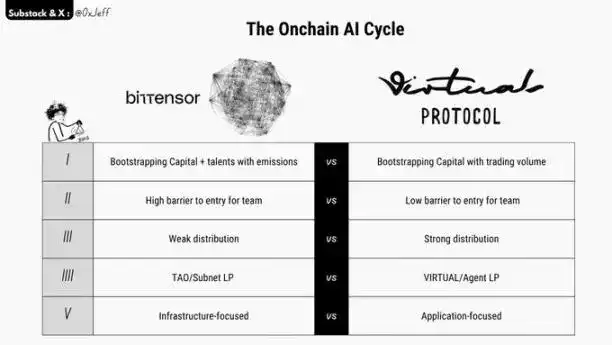
I. Orienter les capitaux et les talents via un mécanisme d'émission vs Orienter les capitaux via le volume des transactions
Bittensor oriente le développement de ses sous-réseaux via un mécanisme d'émission de TAO. Les sous-réseaux sont responsables d'introduire les projets les plus innovants (ou des activités génératrices de revenus) et se font concurrence pour obtenir une part des 3600 TAO émis quotidiennement.
Les sous-réseaux orientent également les contributeurs (y compris les mineurs qui exécutent les tâches et les validateurs qui vérifient le travail des mineurs) via leur propre mécanisme d'émission de jetons alpha. Le mécanisme d'émission et le mécanisme de coordination des incitations entre les différentes parties prenantes sont intégrés depuis le lancement du projet.
Virtuals adopte un modèle similaire à pump.fun, en orientant le développement via le volume des transactions. Une activité transactionnelle élevée se traduit par une accumulation de capital pour les projets d'agents. Les équipes d'agents peuvent utiliser leurs propres mécanismes d'émission pour inciter la participation des utilisateurs.
Dans les cycles de marché où la demande spéculative pour les jetons est forte, ce modèle présente un avantage significatif - les équipes peuvent accumuler rapidement du capital, obtenir de l'attention sur leur produit et de l'intérêt du marché, ce qui favorise le lancement et le développement du projet.
II. Barrière d'entrée élevée vs Barrière d'entrée faible (pour les équipes)
Lancer un sous-réseau sur Bittensor nécessite un investissement important. Actuellement, obtenir un siège de sous-réseau coûte 871 TAO (environ 300 000 dollars), le prix fluctuant selon la demande et le mécanisme d'enchères. Cela signifie que les équipes de sous-réseaux doivent généralement avoir une idée mature, une planification claire et des capacités d'exécution solides.
Pour exploiter un sous-réseau avec succès, le propriétaire doit s'assurer que la tâche ou l'objectif défini contribue au développement de son produit/solution d'IA, tout en se protégeant contre la triche des mineurs, en garantissant que les validateurs remplissent efficacement leurs fonctions de vérification, en réalisant des revenus via le développement commercial et la collaboration avec les clients, et en maintenant la confiance des investisseurs via des mécanismes de rachat.
Le prix du jeton du sous-réseau doit maintenir une tendance haussière pour attirer plus de TAO, augmenter la part des émissions du sous-réseau et ainsi attirer des contributeurs de plus haut niveau pour participer au minage.
En comparaison, le lancement d'un jeton d'agent d'IA sur Virtuals a une barrière d'entrée plus faible, ne nécessitant aucun coût initial pour démarrer, permettant de tester de nouvelles idées avec un capital moindre.
Virtuals propose également un « programme de 60 jours », permettant aux fondateurs de tester de nouvelles idées et d'émettre des jetons pendant cette période. Si un ajustement produit-marché n'est pas trouvé dans les 60 jours, les fonds concernés sont récupérés et les investisseurs peuvent récupérer une partie de leur capital investi.
III. Capacité de distribution plus faible vs Capacité de distribution plus forte
Bittensor fonctionne de manière indépendante sur une blockchain construite sur le framework Polkadot Substrate, ce qui rend le pontage inter-chaînes difficile. Il manque de composants de base de la finance décentralisée (DeFi) et n'est pas configuré avec des infrastructures courantes comme la Machine Virtuelle Ethereum (EVM) ou Solana.
Cela entraîne un seuil d'entrée plus élevé pour l'écosystème Bittensor. De plus, le matériel pédagogique disponible est souvent rempli de termes techniques complexes, ce qui augmente la difficulté d'apprentissage et de compréhension pour les nouveaux utilisateurs. Par conséquent, les membres de sa communauté sont principalement des professionnels techniques prêts à investir du temps dans une étude approfondie, avec une participation limitée des investisseurs particuliers (retail).
En revanche, le seuil de compréhension de Virtuals est plus faible. Son équipe excelle en marketing, communication de marque et distribution. Les utilisateurs particuliers peuvent comprendre de manière assez intuitive des concepts comme les agents IA, les paiements par agent et les robots (bots).
Comme Virtuals est déployé sur la chaîne Base, le processus d'achat des jetons d'agents IA est pratique. Le temps entre la découverte d'un projet, la formation d'une opinion positive et la décision d'achat est court, ce qui est une raison importante de sa popularisation rapide fin 2024 - début 2025 (chronologiquement avant Bittensor).
Actuellement, Bittensor, poussé par Jason, Chamath, Barry Silbert (DCG & Yuma) et la communauté, entre progressivement dans le champ de vision grand public et sa visibilité augmente. Cependant, le processus d'achat des jetons de ses sous-réseaux reste relativement complexe, le problème n'étant pas encore résolu fondamentalement.
IV. Pool de liquidités TAO/Sous-réseau vs Pool de liquidités VIRTUAL/Agent
Bittensor et Virtuals présentent une similarité clé dans le mécanisme de roue motrice des pools de liquidités.
Pour acheter un jeton alpha d'un sous-réseau, un investisseur doit détenir du TAO. Ainsi, une demande accrue pour les jetons alpha entraînera une hausse du prix du TAO.
De même, dans l'écosystème Virtuals, une demande accrue pour les jetons d'agents IA entraînera une hausse du prix de VIRTUAL.
Si le jeton central (TAO ou VIRTUAL) peut circuler à l'intérieur de l'écosystème sans fuir (par exemple, si les différents projets échangent des biens et des services entre eux, retenant ainsi la valeur), l'avantage de ce mécanisme sera encore plus marqué.
V. Orientation infrastructure vs Orientation application
Les sous-réseaux Bittensor se concentrent souvent sur l'infrastructure ou des activités nécessitant beaucoup de capital, comme le calcul décentralisé, l'inférence, l'entraînement, la recherche pharmaceutique et les expériences quantiques.
Étant donné que Bittensor peut fournir un soutien annuel de plus de 10 millions de dollars aux bons sous-réseaux et attirer des talents de haut niveau, son modèle est adapté pour faire avancer des idées ambitieuses, difficiles et à fort investissement.
Les équipes d'agents Virtuals, quant à elles, se concentrent davantage sur la couche application et les produits d'agents orientés consommateur. Comme le prix initial des jetons d'agents est bas, si une équipe peut lancer un excellent produit grand public, elle peut utiliser la popularité du jeton sur le marché pour attirer rapidement l'attention et faire avancer le projet.
Grâce à l'avantage de distribution de Virtuals, l'effet de roue motrice des jetons d'agents IA a affiché une vitesse et des gains plus élevés pendant les périodes de marché extrêmement actives (comme fin 2024 - début 2025).