The ability of Bitcoin to withstand advances in quantum computing is becoming an increasingly urgent topic of discussion: Bitmine Chairman Tom Lee warns that the network has not yet reached consensus on a path to protection.
In an interview, Lee called the moment when quantum machines can overcome widely used cryptographic systems "Q-day." He cited researchers from Google who suggest such a breakthrough could happen as early as 2028.
"Many crypto blockchains are developing quantum resistance," Lee said. "But in Bitcoin's case, there is no consensus yet on how to prevent Q-day."
Lee noted that networks like Ethereum, Solana, and Canton are in a more advantageous position because their developers are already working on quantum-resistant systems. His comments came during a broader discussion about the recent divergence of cryptocurrency momentum from that of the Nasdaq.
Jim Cramer to Sell His Bitcoins After IBM CEO's Warning on Quantum Threats
This concern echoes statements from IBM CEO Arvind Krishna, who told CNBC's Jim Cramer that investors should exercise greater caution over the next three to four years.
"I would become quite paranoid about it," Krishna said when asked about quantum computing and cryptocurrency security.
Cramer stated that this answer convinced him to sell his Bitcoin holdings. "Arvind Krishna is incredibly knowledgeable about quantum technology," he said. "I'm going to sell mine."
Lee expanded the scope of the warning beyond digital assets. He noted that banks, financial infrastructure, and government systems will also require more robust protection as artificial intelligence and quantum tools shorten the time needed to identify vulnerabilities.
"It will be difficult to stay ahead of the emergence of security vulnerabilities in the system," he said.
Bitcoin Developers Dispute This Terminology
These remarks immediately met with resistance from Bitcoin developers and security experts.
Blockstream co-founder Adam Back challenged the terminology, writing on Twitter that "Bitcoin does not use encryption for conducting transactions." Instead, Bitcoin relies on digital signatures, although sufficiently powerful quantum computers could still pose a threat to certain cryptographic keys.
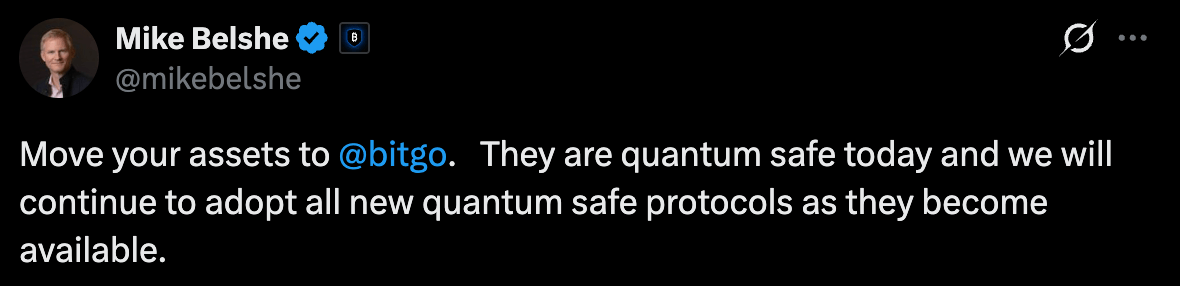
Bitgo CEO Mike Belshe used the discussion to promote asset custody services for institutional investors, stating that the company is "already quantum-resistant today" and will adopt new protocols as they emerge.
Within the Bitcoin community, attention is focused on possible upgrades like BIP-360, as well as the vulnerability of old wallets whose public keys are already visible on the blockchain. However, any significant change will require broad consensus among developers, miners, companies, and users.
The question of an immediate threat remains contentious. Nevertheless, the market reaction shows that preparing for quantum challenges is no longer a distant technical problem. For Bitcoin, the more complex challenge may not be developing new cryptography, but achieving consensus before investors decide time is running out.
end-content