Bitmine’s $6.6B ETH Drawdown: Tom Lee Calls the Bottom as LiquidChain Enters the Fray

bitcoinistPublished on 2026-02-04Last updated on 2026-02-04

Abstract

Tom Lee of Fundstrat argues that Bitmine's $6.6 billion unrealized loss on Ethereum is not a sign of capitulation but a technical and time-based bottom, suggesting the worst of the bear market is over. This highlights a key structural issue in crypto: liquidity fragmentation across chains like Bitcoin, Ethereum, and Solana, which traps capital and causes inefficiency. LiquidChain ($LIQUID) is introduced as a potential fix—a cross-chain liquidity layer enabling seamless asset movement and unified trading without multiple bridges or wrapped assets. It also offers a deploy-once architecture for developers to build across chains easily. Lee's stance may signal a market shift toward accumulation, with interoperability solutions like LiquidChain poised to lead the next cycle.

Fundstrat’s Tom Lee just stepped into the line of fire. His mission? Defending Bitmine’s staggering $6.6B unrealized loss on Ethereum. While that figure is startling, roughly the GDP of a small nation, Lee argues it’s not capitulation. It’s a ‘technical and time-based bottom.’

Basically, he sees this massive drawdown as a lagging indicator of the bear market we’re leaving behind, not a warning of what’s ahead.
Why does this matter? When veterans like Lee defend underwater positions, it usually signals a shift from ‘risk-off’ to aggressive accumulation.

The market seems to have absorbed the worst liquidation shocks. But let’s be honest, that $6.6B hole highlights a glaring structural weakness: liquidity fragmentation. Big players often get stuck in siloed environments, unable to move capital efficiently without getting hit by massive slippage. It’s a mess.

While legacy giants weather the valuation storm, new infrastructure is emerging to fix the rigidity trapping their capital. As the market recovers, eyes are turning to Layer 3 (L3) protocols designed to stitch these fractured ecosystems back together.

That’s where LiquidChain ($LIQUID) comes in, a project aiming to dissolve the walls between Bitcoin, Ethereum, and Solana.

Buy your $LIQUID here.

Unifying Liquidity in a Fragmented Market

The headache plaguing DeFi (and hurting portfolios like Bitmine’s) is simple: you can’t trade seamlessly across chains. Moving value from Bitcoin’s vault to Solana’s high-speed racetrack usually involves risky bridges, wrapped assets, and counterparty exposure.

LiquidChain isn’t just another bridge; it’s positioning itself as a ‘Cross-Chain Liquidity Layer’ to cut through that friction.
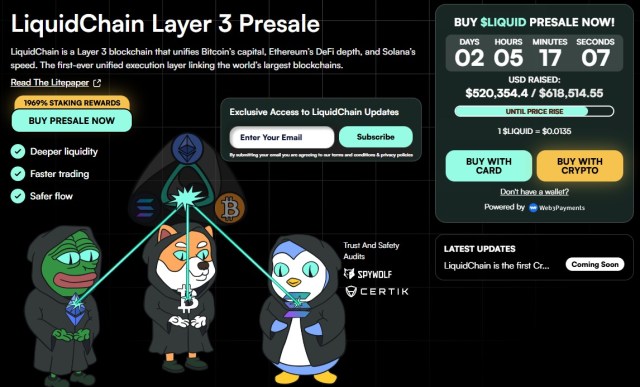
The project uses a ‘Single-Step Execution’ model. Instead of forcing you to lock assets on Chain A to mint synthetics on Chain B, the protocol fuses liquidity from BTC, ETH, and SOL into one environment. For traders, that means accessing deep liquidity without the nightmare of managing five different wallets or trusting centralized middlemen.

Under the hood, the architecture relies on ‘Verifiable Settlement.’ Execution happens instantly on the LiquidChain L3, but finality is anchored securely. By creating a unified venue for liquidity staking, LiquidChain tackles the capital inefficiency leaving billions dormant in isolated silos.

Explore the LiquidChain ecosystem.

The Developer Advantage: Write Once, Deploy Everywhere

But liquidity is only half the battle. Long-term survival depends on devs. Right now, cross-chain development is a grind, teams have to juggle Rust (Solana), Solidity (Ethereum), and Bitcoin Script.

That fragmentation kills innovation and creates massive security blind spots.

LiquidChain solves this with a ‘Deploy-Once Architecture’ powered by a Cross-Chain VM. Developers can build apps that interact with assets across all chains without rewriting smart contracts for every environment.

Imagine a DeFi protocol that taps into Bitcoin’s trillion-dollar capital base and Solana’s sub-second speeds simultaneously. That’s the goal.

This shifts the focus from bridging assets to bridging applications. If Tom Lee is right and we’re at a technical bottom, the next cycle will be defined by interoperability plays that actually reduce friction. LiquidChain wants to be the engine room for that era, backing developers ready to build on unified infrastructure.

$LIQUID is available here.

This article is for informational purposes only and does not constitute financial advice. Crypto assets are high-risk; always conduct independent due diligence before investing.


Related Questions

QWhat is Tom Lee's perspective on Bitmine's $6.6B unrealized loss on Ethereum?

ATom Lee argues that the $6.6B unrealized loss is not a sign of capitulation but rather a 'technical and time-based bottom.' He sees it as a lagging indicator of the previous bear market, not a warning of future trouble, and suggests it signals a shift towards aggressive accumulation.

QWhat core problem in DeFi does the article highlight as a cause of Bitmine's situation?

AThe article highlights liquidity fragmentation as a core problem. Big players get stuck in siloed environments, unable to move capital efficiently across different blockchains without facing massive slippage and the risks associated with bridges and wrapped assets.

QHow does LiquidChain ($LIQUID) propose to solve the problem of cross-chain trading?

ALiquidChain positions itself as a 'Cross-Chain Liquidity Layer' that uses a 'Single-Step Execution' model. It fuses liquidity from Bitcoin, Ethereum, and Solana into one unified environment, allowing traders to access deep liquidity without managing multiple wallets or trusting centralized intermediaries.

QWhat is the 'Developer Advantage' offered by LiquidChain's technology?

ALiquidChain offers a 'Deploy-Once Architecture' powered by a Cross-Chain VM. This allows developers to build applications that interact with assets across all supported chains without needing to rewrite smart contracts for each different blockchain environment, reducing fragmentation and security.

QAccording to the article, what does Tom Lee's defense of large underwater positions typically signal for the market?

AWhen veterans like Tom Lee defend large underwater positions, it usually signals a market shift from a 'risk-off' mentality to one of aggressive accumulation, indicating that the worst liquidation shocks may have been absorbed.

Related Reads

Bitcoin's 'Rally Ends,' Officially Entering the Later Stage of a Bear Market?

Bitcoin prices declined 13% this week, reversing the recent rebound and signaling a likely transition into the later stages of a bear market. Key on-chain metrics deteriorated, with the short-term holder cost basis falling below the Realized Price—a pattern last seen in early 2022, characteristic of bear market maturity. The rally to ~$82k proved to be a bear market bounce, as evidenced by the 90-day realized profit/loss ratio failing to sustain above the bullish threshold of 2. Daily realized losses surged to $1.35B, including significant selling from long-term holders who accumulated near cycle tops, indicating ongoing supply redistribution. Price was rejected almost precisely at the aggregate US spot ETF cost basis of ~$83k, turning that level into resistance and leaving the average ETF investor underwater again. Spot market selling pressure intensified, with the 7-day volume delta turning significantly negative to its weakest level since February. While a major long liquidation event cleared over $400M in leverage, spot demand has not yet stepped in to absorb the resulting supply. Options markets continue pricing in higher future volatility (elevated volatility risk premium) and maintain a skew toward put options, reflecting persistent demand for downside protection, though not yet panic. Overall, market structure remains fragile. Sustained recovery likely requires a reclaim of the ETF cost basis, a shift back to positive spot demand, and a slowdown in realized loss-taking. Until then, the market risks further downside or extended consolidation within the broader bear trend.

Foresight News28m ago

Bitcoin's 'Rally Ends,' Officially Entering the Later Stage of a Bear Market?

Foresight News28m ago

How Risky is the "Death Spiral" of MSTR and STRC?

Summary: This article explores the perceived "death spiral" risk between MicroStrategy (MSTR), its Bitcoin holdings, and its perpetual preferred stock (STRC), drawing comparisons to the LUNA-UST collapse. While both systems feature price anchors, high yields for holders, and potential feedback loops, their core mechanisms differ fundamentally. The MSTR-STRC structure relies on continuous financing to sustain its high dividend payouts, primarily through stock ATM offerings. A negative feedback cycle could occur: falling MSTR stock price makes raising equity capital harder, increasing pressure to sell Bitcoin, which undermines STRC confidence and further depresses MSTR. However, unlike LUNA-UST's automated, direct linkage, the MSTR-STRC loop is weaker and has brakes: STRC dividends can be deferred or rates lowered, and STRC holders have a $100/share liquidation preference in bankruptcy, providing a price floor. The company's sustainability hinges on its ability to continue financing. Its current ~$900 million USD reserves cover only about 6.3 months of its ~$1.71 billion annual interest/dividend burden. The next six months are critical, aligning with both the potential bottom in Bitcoin's four-year cycle and the depletion timeline of its reserves. While a LUNA-style catastrophic collapse is deemed highly unlikely due to structural differences, the key question is whether MicroStrategy can navigate this period through healthy deleveraging to restart its capital engine.

Foresight News46m ago

How Risky is the "Death Spiral" of MSTR and STRC?

Foresight News46m ago

How Much Debt Does Strategy Really Have? Is There a Risk of Implosion?

MicroStrategy's Debt Risk: A Turning Point in the "Never Sell" Strategy As of June 3, 2026, MicroStrategy holds 843,706 bitcoins (valued at ~$53.1B) but faces significant financial obligations. Its capital structure includes $6.75B in convertible notes and $15.48B in perpetual preferred stock (led by the $8.5B STRC series), creating an annual payout burden of ~$1.71B. With software revenue at only ~$500M, interest and dividend obligations far exceed operating income. A critical shift occurred in late May 2026 when the company sold 32 bitcoins for ~$2.5M to cover dividends, breaking CEO Michael Saylor's long-standing "never sell" pledge. This symbolic move triggered a sharp decline in both Bitcoin's price and MSTR stock, reflecting market fears about cash flow sustainability. The core of the strain is the STRC perpetual preferred stock, designed as a "permanent loan" with no maturity date but requiring high monthly dividends (currently 11.5%). Its business model relies on a three-part cycle: issuing new STRC shares, using proceeds to buy more Bitcoin and fund a USD reserve, and using that reserve to pay dividends. This cycle depends on continuous investor demand for STRC and Bitcoin's price appreciation. Analysis shows Bitcoin needs to appreciate at least 2.3% annually to cover the $1.71B in yearly obligations at current holdings. With Bitcoin price down ~22% from March 2026 highs, this pressure has intensified. The company's $900M USD reserve can only cover about 7 months of payments if STRC issuance stalls. Key risks are not immediate bankruptcy or forced Bitcoin liquidation (as BTC is not collateral), but rather: 1) The erosion of MSTR's premium to its Bitcoin holdings (mNAV), which would cripple its ability to raise cheap capital; 2) A vicious cycle where stagnant Bitcoin prices reduce STRC demand, draining the USD reserve and forcing BTC sales, further depressing prices. The period from February 2027 to September 2028 is a crucial test, with over $5.9B in convertible notes facing put options or maturity. In essence, MicroStrategy has evolved from a simple Bitcoin holder into a complex financial entity acting like a "private Bitcoin bank," leveraging its BTC holdings to create layered financial products. Its survival depends on maintaining Bitcoin's price trend, its stock premium, and market appetite for its preferred shares. The recent token sale marks not a betrayal of its Bitcoin thesis, but an admission that the leveraged strategy must eventually be paid for.

marsbit57m ago

How Much Debt Does Strategy Really Have? Is There a Risk of Implosion?

marsbit57m ago

Anthropic Cries Wolf: Is the AGI Threat Real, or Just an IPO Story?

Anthropic has published an article titled "When AI builds itself," discussing the emerging concept of "recursive self-improvement," where AI begins to actively participate in designing, training, testing, and optimizing its own subsequent versions. The company presents internal data showing that by May 2026, over 80% of code merged into its codebase was written by Claude, its AI model. Claude's capabilities have expanded to handling complex, open-ended engineering tasks, achieving a 76% success rate in such areas, and even contributing to research processes, such as optimizing code performance and conducting AI safety experiments. Anthropic outlines an evolution from human-driven development to AI-assisted workflows, culminating in the current stage where AI agents can autonomously write, run, and delegate code. The company cautions that the path toward a "closed loop," where AI continuously improves itself, is becoming visible. It calls for coordinated global mechanisms to potentially slow or pause frontier AI development to allow safety research and societal structures to catch up. However, the timing of this warning coincides with Anthropic's preparations for an IPO, framing the narrative not just as a safety concern but also as a demonstration of Claude's advanced capabilities and its integral role in accelerating Anthropic's own R&D—creating a potential "flywheel" effect for competitive advantage. This contrasts with OpenAI's recent, more policy-oriented discussion of the same risks, highlighting the competitive dynamics in the AI industry as companies position themselves in both the technological and regulatory landscape.

marsbit1h ago

Anthropic Cries Wolf: Is the AGI Threat Real, or Just an IPO Story?

marsbit1h ago

Trading

Spot
Futures

Hot Articles

Discussions

Welcome to the HTX Community. Here, you can stay informed about the latest platform developments and gain access to professional market insights. Users' opinions on the price of S (S) are presented below.

活动图片