BitMine Buys Over 40,000 ETH As Sell-Off Deepens, Shrugs Off Massive Paper Losses

bitcoinistPublished on 2026-02-11Last updated on 2026-02-11

Abstract

BitMine Immersion Technologies acquired 40,613 ETH (worth $83–84 million) during a market downturn, increasing its total holdings to approximately 4.32–4.33 million ETH. Despite facing an estimated $7.5–8 billion in unrealized paper losses due to Ether's price decline, Executive Chairman Tom Lee defended the strategy, viewing the dip as a buying opportunity and predicting a V-shaped recovery. The company’s stock (BMNR) fell roughly 5% following the announcement, reflecting investor concern over the immediate impact on net asset value. BitMine continues to stake part of its ETH to generate yield, betting on long-term price appreciation. The outcome hinges on Ether’s price trajectory and the firm’s ability to manage short-term losses through staking returns and strategic patience.

BitMine Immersion Technologies kept buying as prices fell, scooping up 40,613 ETH during last week’s sell-off. Reports say the purchase totaled roughly $83–$84 million, made when Ether traded near $2,020 per token.

BitMine’s Growing Stake And The Man At The Helm

According to recent coverage, the move pushed BitMine’s total Ethereum holdings to around 4.32–4.33 million ETH, a stash worth billions at current prices. Executive chairman Tom Lee has framed the dip as an attractive entry point and has voiced confidence in a bounce back.

Paper Losses Widen As Prices Slide

Reports note that the firm’s large cost basis for its accumulated ETH has left its treasury sitting on multibillion-dollar unrealized losses.

Estimates in the latest pieces place those paper losses between about $7.5 billion and $8 billion, depending on which price is used to mark the holdings. That gap widened as Ether fell from higher levels into the low-$2Ks.
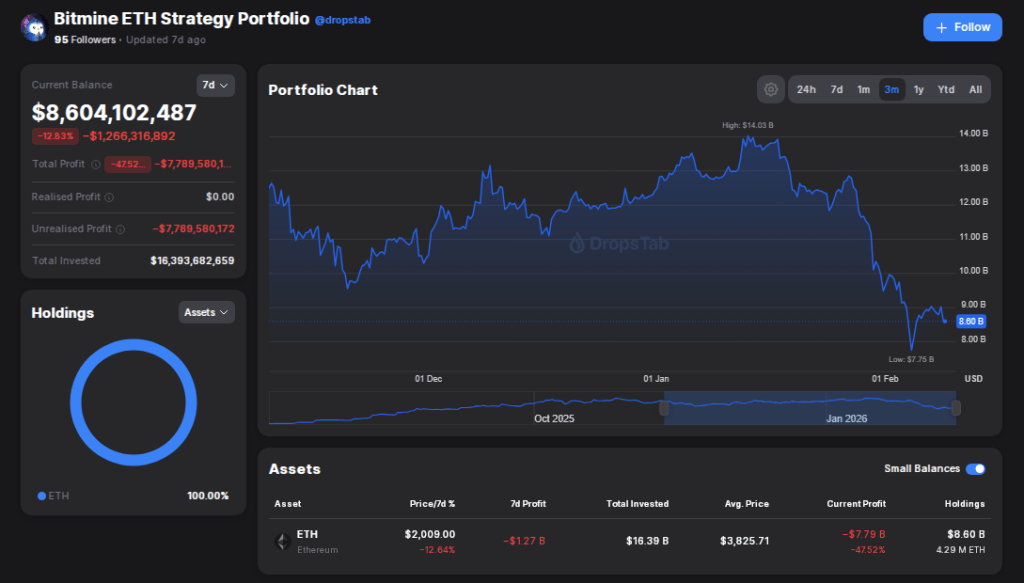
BitMine faces an estimated $7.7 billion paper loss on its ETH holdings. Source: DropsTab

Market And Shareholder Response

BitMine’s aggressive buying did not calm all investors. News outlets tracked a drop in the company’s stock (BMNR), which was reported down roughly 5% in pre-market trading around the same time the ETH buy was disclosed.

Traders appear to be weighing the long-term thesis against the immediate hit to the company’s net asset value.
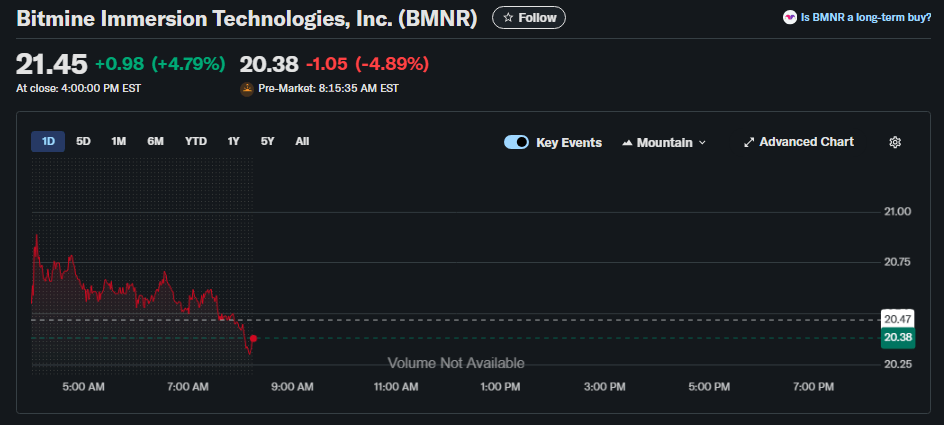
Six‐month performance of BitMine (BMNR) stock. Source: Yahoo Finance

Why The Company Is Still Adding

Reports say BitMine sees this as part of an intentional treasury play. Some of the firm’s ETH is staked, which generates yield and can help offset paper losses over time.

Tom Lee has forecast a strong rebound, calling for a V-shaped recovery in ether. That kind of outlook explains why purchases came even while the market was weak.

ETHUSD trading at $2,012 on the 24-hour chart: TradingView

What To Watch Next

Short term, price moves in ether and shifts in investor sentiment will be the clearest signals. If ETH stages a steady climb, the unrealized losses will shrink quickly.

If the token continues to trade lower, the company’s paper loss metrics will remain a headline for shareholders and analysts.

Reports say details such as financing, staking returns, and any further disclosed buys will shape how investors view the firm’s risk profile.

BitMine’s choice to keep buying at lower levels is a clear bet on future price recovery. Whether that bet pays off for shareholders depends on the market’s next moves, and on whether patience and staking income can outweigh a large short-term drawdown.

Featured image from Thomas Fuller/SOPA Images/LightRocket via Getty Images, chart from TradingView


Related Questions

QHow much ETH did BitMine purchase during the recent sell-off and at what approximate price?

ABitMine purchased 40,613 ETH during the sell-off at a price near $2,020 per token, totaling roughly $83–$84 million.

QWhat is the estimated value of the paper losses on BitMine's ETH holdings, and why did this gap widen?

AThe estimated paper losses on BitMine's ETH holdings are between $7.5 billion and $8 billion. This gap widened as the price of Ether fell from higher levels into the low-$2,000s.

QHow did the market and shareholders initially react to BitMine's aggressive ETH purchase?

AThe market reaction was negative, with BitMine's stock (BMNR) dropping roughly 5% in pre-market trading. Traders were weighing the long-term investment thesis against the immediate hit to the company's net asset value.

QWhat are the two main reasons provided for why BitMine continued to buy ETH despite the market weakness?

ABitMine views this as an intentional treasury play. First, some of the ETH is staked, generating yield to help offset paper losses over time. Second, Executive Chairman Tom Lee has forecast a strong V-shaped recovery for Ether.

QWhat future factors will shape how investors view the risk profile of BitMine's strategy?

AKey factors include short-term price moves in Ether, shifts in investor sentiment, details on how the purchases were financed, the returns from staking, and any further disclosed cryptocurrency buys.

Related Reads

Three Frameworks for Ordinary People to Achieve AI Capability Leap: Say Goodbye to the Dilemma of 'Repeating Inputs Every Day'

Summary: This article outlines three frameworks for maximizing AI efficiency, moving beyond basic prompt usage. 1. **Three-Layer Evolution**: Users progress from (1) **Prompt** (one-off instructions, reset each session), to (2) **Project** (context-aware within a specific project), to (3) **Skill** (permanent, auto-applied knowledge). Most users stagnate at the first layer, repeating the same instructions daily with no cumulative improvement. Skills transform the AI from a chat tool into a personalized work system. 2. **Transaction vs. Compound Interest Mindset**: Using prompts is a linear transaction—effort and output are 1:1, and stopping resets progress. Investing time in building Skills is compound interest; a small initial time investment pays continuous dividends, as each Skill permanently elevates the AI's baseline performance. 3. **Thin Harness, Fat Skills**: The system architecture should prioritize thick, well-defined Skills (90% of the value—containing processes, standards, and domain knowledge) and a thin "harness" (the minimal technical environment). Avoid over-engineering the toolchain while neglecting the AI's actual knowledge. Skills are permanent assets that automatically improve with model updates. The key takeaway: Identify tasks you repeat, encode them into Skills (using tools like Claude's Skill Creator), and shift focus from daily prompting to building a compounding, self-improving AI system.

marsbit37m ago

Three Frameworks for Ordinary People to Achieve AI Capability Leap: Say Goodbye to the Dilemma of 'Repeating Inputs Every Day'

marsbit37m ago

Trading

Spot
Futures

Hot Articles

Discussions

Welcome to the HTX Community. Here, you can stay informed about the latest platform developments and gain access to professional market insights. Users' opinions on the price of ETH (ETH) are presented below.

活动图片