Bitfarms Dumps Bitcoin, Rebrands As Keel Infrastructure In Full AI Shift

bitcoinistPublished on 2026-04-01Last updated on 2026-04-01

Abstract

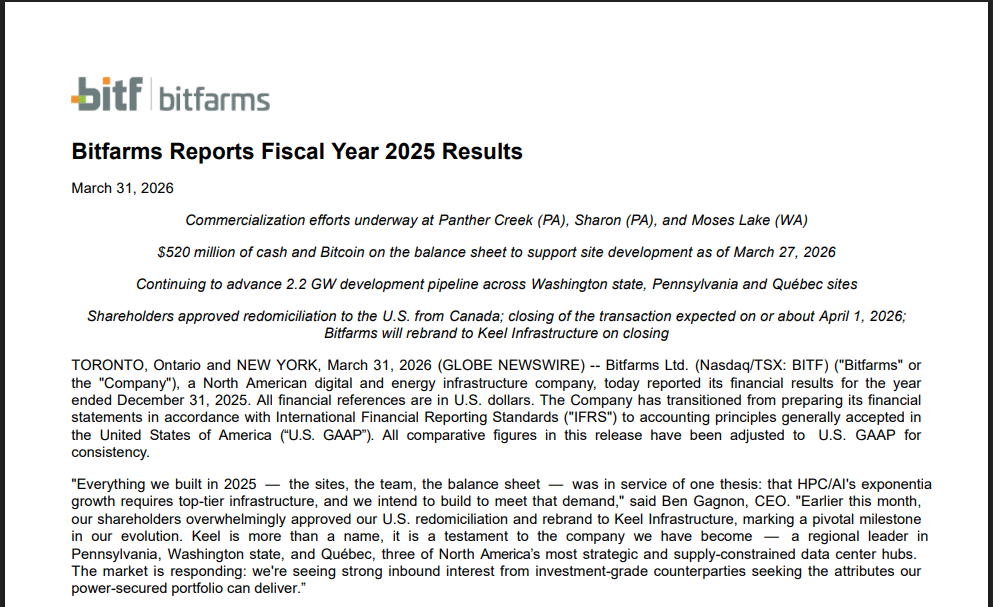
Bitfarms, a former Bitcoin mining company, is fully exiting the cryptocurrency business and rebranding as Keel Infrastructure. The company is relocating from Canada to the US and shifting its focus entirely to building data centers for high-performance computing and artificial intelligence. This strategic pivot follows a fiscal year 2025 net loss of $284.5 million, driven by falling Bitcoin prices and increased mining difficulty. Despite the loss, investors reacted positively, with shares rising 6.6%. The company still holds approximately $161 million in debt-free Bitcoin, providing financial flexibility during its transition. This move aligns with a broader industry trend of crypto miners seeking higher margins in AI and computing.

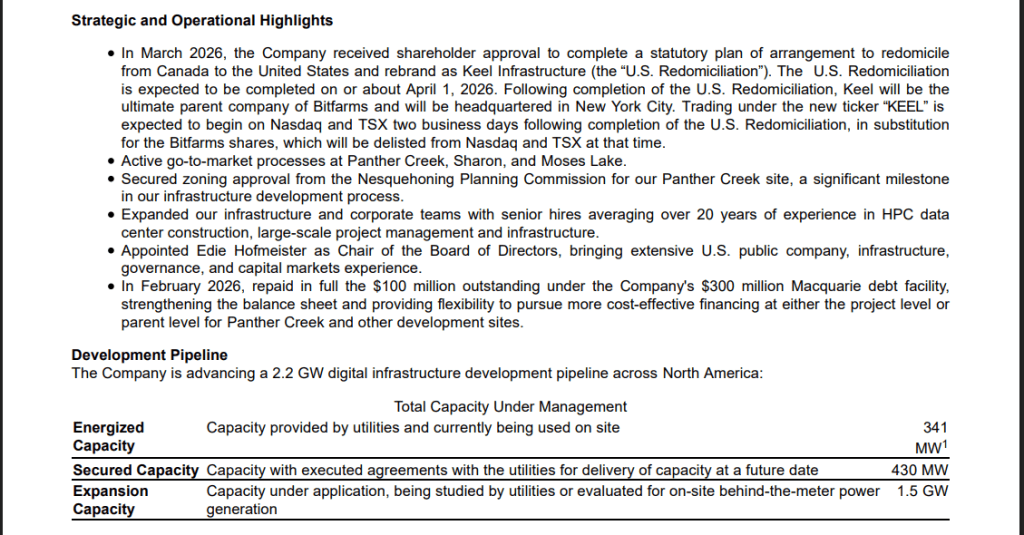
A company that built its name on cryptocurrency mining is walking away from the business entirely. Bitfarms announced plans Tuesday to rebrand as Keel Infrastructure and move its legal base from Canada to the US, capping a five-month exit from Bitcoin that management described as a deliberate break from the past.

No Half-Measures In The Company’s New Direction

CEO Ben Gagnon made the company’s position plain during an earnings call. “No half-measures, no compromises, and in time, no Bitcoin,” he said. “We built a new company.” Bitfarms is now focused on building and operating data centers that power high-performance computing and artificial intelligence platforms.

According to company filings, it is developing a 2.2-gigawatt infrastructure pipeline across North America, targeting what it calls hyperscalers and next-generation cloud providers.

The rebrand and the relocation have both received shareholder approval. The move to the US signals a deliberate repositioning — one aimed at tapping a market where AI infrastructure spending has been climbing steadily.
Bitfarms Fiscal Year 2025 Results. Source: Bitfarms

A Year Of Heavy Losses Tied To Falling Bitcoin Prices

The company’s 2025 financial results, also released Tuesday, showed a net loss of $284.5 million — wider than the year before. Revenue rose 70% year-on-year to close to $230 million, but the cost of generating that revenue came in at $248 million, producing a gross loss before other expenses were counted.

General and administrative costs also increased. A swing in the fair value of digital assets cost the company almost $51 million last year, compared to a $26 million gain in 2024. A $28 million gain from selling digital assets partially offset those figures.
Bitfarms Fiscal Year 2025 Results. Source: Bitfarms

Bitcoin mining has become a harder business to run. Data shows the leading cryptocurrency has dropped 45% from its October high. Mining difficulty — a measure of how hard it is to earn new coins — has risen 58% since the last halving in May 2024. Those conditions squeezed margins across the industry, not just at Bitfarms.

Despite the losses, investors responded positively. Shares closed Tuesday up 6.60%, trading at 2.73 Canadian dollars, or roughly $1.96 US.

BTCUSD trading at $68,780 on the 24-hour chart: TradingView

Bitcoin Holdings Still On The Books For Now

Reports indicate the company still holds about $161 million in Bitcoin that carries no debt against it. That reserve provides some financial flexibility as the transition continues.

Bitfarms is not alone in making this kind of shift. Iris Energy has been scaling AI cloud services using Nvidia graphics processors. Cipher Mining locked in a long-term hosting deal with AI cloud firm Fluidstack.

Riot Platforms and MARA Holdings have both expanded into AI and high-performance computing as well. The pattern reflects a broader move by mining companies seeking higher margins in a different corner of the tech sector.

For Bitfarms, the message from leadership is that the old business is done. What comes next is being built from the ground up — under a new name, in a new country, chasing a different market entirely.

Featured image from Akos Stiller/Bloomberg via Getty Images, chart from TradingView

Related Questions

QWhat is the new name and focus of Bitfarms after its rebranding?

AThe company has rebranded as Keel Infrastructure and is now focused on building and operating data centers that power high-performance computing and artificial intelligence platforms.

QWhat was the key financial result that contributed to Bitfarms' net loss in fiscal year 2025?

AThe company reported a net loss of $284.5 million, which was influenced by a $51 million loss from the change in fair value of its digital assets, despite a 70% increase in revenue.

QHow did the market conditions for Bitcoin mining affect Bitfarms' decision to shift its business?

ABitcoin's price dropped 45% from its October high, and mining difficulty increased by 58% since the last halving in May 2024, squeezing industry margins and prompting the shift to a more profitable sector.

QWhat strategic move did Bitfarms make alongside its rebrand to position itself in the AI infrastructure market?

AThe company received shareholder approval to relocate its legal base from Canada to the United States, aiming to tap into a market where AI infrastructure spending has been steadily climbing.

QWhich other cryptocurrency mining companies have similarly expanded into AI and high-performance computing?

AIris Energy, Cipher Mining, Riot Platforms, and MARA Holdings have all expanded into AI and high-performance computing, reflecting a broader industry trend towards higher-margin tech sectors.

Related Reads

iQiyi Is Too Impatient

The article "iQiyi Is Too Impatient" discusses the controversy surrounding the Chinese streaming platform IQiyi's recent announcement of an "AI Actor Library" during its 2026 World Conference. IQiyi claimed over 100 actors, including well-known names like Zhang Ruoyun and Yu Hewei, had joined the initiative. CEO Gong Yu suggested AI could enable actors to "star in 14 dramas a year instead of 4" and that "live-action filming might become a world cultural heritage." The announcement quickly sparked backlash. Multiple actors named in the list issued urgent statements denying they had signed any AI-related authorization agreements. This forced IQiyi to clarify that inclusion in the library only indicated a willingness to *consider* AI projects, with separate negotiations required for any specific role. The incident, which trended on social media with hashtags like "IQiyi is crazy," is presented as a sign of the company's growing desperation. Facing intense competition from short-video platforms like Douyin and Kuaishou, as well as Bilibili and Xiaohongshu, IQiyi's financial performance has weakened, with revenues declining for two consecutive years. The author argues that IQiyi is "too impatient" to tell a compelling AI story to reassure the market, especially as it pursues a listing on the Hong Kong stock exchange. The piece concludes by outlining three key "AI questions" IQiyi must answer: defining its role as a tool provider versus a content creator, balancing the "coldness" of AI with the human element audiences desire, and properly managing the interests of platforms, actors, and viewers. The core dilemma is that while AI can reduce costs and increase efficiency, it risks creating homogenized, formulaic content and devaluing human performers.

marsbit29m ago

iQiyi Is Too Impatient

marsbit29m ago

Trading

Spot
Futures

Hot Articles

Discussions

Welcome to the HTX Community. Here, you can stay informed about the latest platform developments and gain access to professional market insights. Users' opinions on the price of AI (AI) are presented below.

活动图片















