Bitcoin’s Network Distribution Factor Plunge Signals A Redistribution Event

bitcoinistPublished on 2026-02-22Last updated on 2026-02-22

Abstract

Bitcoin's Network Distribution Factor (NDF) is declining sharply, indicating a significant structural shift in BTC supply distribution. The NDF measures the proportion of total supply held by large entities controlling at least 0.01% of circulating BTC. A falling NDF suggests reduced concentration among major holders and a broader redistribution of Bitcoin to smaller participants and new entrants. This trend often occurs during market maturation phases following bull cycles, reflecting stronger economic decentralization and reduced structural risk from over-concentration. It signals Bitcoin’s evolution into a more widely distributed global financial network. Additionally, Bitcoin’s fixed supply of 21 million and predominantly individual-owned circulating supply (approx. 63%) reinforce its role as a structurally scarce, decentralized asset resistant to institutional or governmental control.

Bitcoin supply structure is undergoing a notable transformation as the Network Distribution Factor (NDF) declines rapidly. While price action often dominates headlines, shifts in distribution metrics can reveal structural changes. A falling NDF suggests that the balance of BTC holdings across different wallet cohorts is evolving, and potentially signaling a redistribution of market participants.

What The Network Distribution Factor Actually Measures

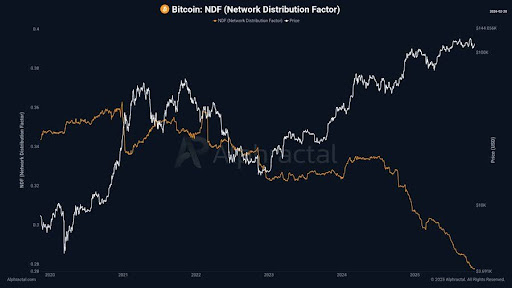
An advanced on-chain data analytics firm, Alphractal, noted on X that the NDF of Bitcoin is declining sharply, and revealing an important structural shift in how the asset supply is distributed across the market. The NDF measures the proportion of the total BTC supply held by larger holders controlling at least 0.01% of the entire circulating supply.

When the metric declines, it indicates that the BTC supply concentration among large holders is decreasing. In practical terms, this shift represents a reduced relative dominance of large holders over the total supply and broader redistribution of BTC among smaller participants and new market entrants.

A declining extreme concentration is often seen during early accumulation phases, and a natural redistribution process follows the periods of strong accumulation by large entities. Historically, extended declines in the NDF tend to occur during phases when the market is mature, and the asset becomes more widely distributed.

BTC market is undergoing a key shift | Source: Chart from Alphractal on X

This often occurs after major bull cycles, when large players accumulate supply and are gradually absorbed by the broader market. Rather than signaling weakness, this dynamic can strengthen BTC economic decentralization and reduce structural risk tied to excessive concentration.

At the same time, it reflects a transition phase where supply is being redistributed globally, reinforcing BTC’s evolution from a relatively concentrated asset into a widely distributed global financial network. However, this does not signal structural weakness, but rather signals maturation and the expansion of BTC’s ownership base.

Why Bitcoin Represents A True Financial Revolution

The clearest reasons Bitcoin remains the most compelling asset of our generation are its ownership structure and fixed supply. According to Crypto Patel, roughly 63% of the total circulating supply is held by everyday individual participants, not Wall Street, not the government, or even the institutions.

At the core of this thesis, there are only 21 million BTC in existence, and the number is fixed permanently; no central bank can inflate it, no politician can alter the code, and no corporation can dilute holders.

In a world characterized by aggressive money printing and currency debasement, BTC stands alone as mathematically enforced scarcity, and the majority of that asset belongs to ordinary individuals. Crypto Patel frames BTC’s decentralized ownership and fixed supply not just as a technology, but as a structural revolution.

BTC trading at $68,205 on the 1D chart | Source: BTCUSDT on Tradingview.com

Related Questions

QWhat does a declining Network Distribution Factor (NDF) indicate about Bitcoin's supply structure?

AA declining NDF indicates that the concentration of Bitcoin supply among large holders (those controlling at least 0.01% of the circulating supply) is decreasing, signaling a redistribution of BTC to smaller participants and new market entrants.

QAccording to the article, what phase of the market does a falling NDF typically occur in?

AA falling NDF typically occurs during phases when the market is mature, often after major bull cycles, when supply accumulated by large players is gradually absorbed by the broader market.

QHow does the declining NDF contribute to Bitcoin's economic structure?

AThe declining NDF strengthens Bitcoin's economic decentralization, reduces structural risk associated with excessive concentration, and reflects its evolution into a more widely distributed global financial network.

QWhat percentage of Bitcoin's circulating supply is held by everyday individual participants, according to Crypto Patel?

AAccording to Crypto Patel, roughly 63% of Bitcoin's total circulating supply is held by everyday individual participants.

QWhy is Bitcoin described as having 'mathematically enforced scarcity' in the article?

ABitcoin is described as having 'mathematically enforced scarcity' because its supply is permanently fixed at 21 million coins, which cannot be inflated by central banks, altered by politicians, or diluted by corporations.

Related Reads

What Are Some Good Paths for Chinese Web3 Entrepreneurship? (Part 5)

This article explores pathways for Chinese Web3 teams to pivot toward AI, building on a previous discussion. It focuses on two specific team profiles: **Security & Risk Control Teams:** These teams, skilled in smart contract auditing, wallet security, and on-chain monitoring, can transition to providing **Agent behavior auditing and AI security governance**. As AI Agents automate tasks, access data, and trigger payments, enterprises will need solutions to monitor permissions, audit logs, control data access, and prevent anomalies—creating a strong B2B demand. **Application & Community-Focused Teams:** Instead of completely rebranding as AI companies, these teams should use AI to **enhance their existing products**. For example, research platforms can use AI to summarize information and identify signals; community tools can automate user support and analysis; and educational products can create personalized learning paths. The key is integrating AI to solve existing user pain points, like information overload or high operational costs. The article also advises against certain AI directions for Chinese Web3 teams, such as building general-purpose large language models (too resource-intensive), creating overly broad Agent platforms (hard to monetize), developing AI traders/automated yield products (high regulatory and risk sensitivity), or simply adding superficial AI features without genuine value. The core conclusion: Successful migration depends not on chasing AI hype, but on **identifying how a team's existing Web3 capabilities—be it in data, payments, security, or user operations—can address real needs in new AI application scenarios.**

marsbit2h ago

What Are Some Good Paths for Chinese Web3 Entrepreneurship? (Part 5)

marsbit2h ago

Trading

Spot
Futures

Hot Articles

Discussions

Welcome to the HTX Community. Here, you can stay informed about the latest platform developments and gain access to professional market insights. Users' opinions on the price of S (S) are presented below.

活动图片