Bitcoin’s four-year cycle is intact, but driven by politics and liquidity: Analyst

cointelegraphPublished on 2025-12-14Last updated on 2025-12-14

Abstract

According to Markus Thielen of 10x Research, Bitcoin's four-year cycle remains intact but is now driven more by political events and liquidity conditions rather than its halving events. Thielen argues that past market peaks in 2013, 2017, and 2021 align more closely with U.S. presidential election cycles and broader political uncertainty than with Bitcoin’s programmed supply reductions. He also notes that recent Federal Reserve rate cuts have failed to boost Bitcoin significantly, as institutional investors remain cautious amid mixed policy signals and tightening liquidity. Thielen expecting consolidation rather than a major rally without increased capital inflows. In contrast, BitMEX co-founder Arthur Hayes contends the four-year cycle is dead, asserting that Bitcoin’s cycles have always been driven by global liquidity conditions, not arbitrary timelines or halving events.

Bitcoin’s long-debated four-year cycle is still playing out, but the forces behind it have shifted away from the halving toward politics and liquidity, according to Markus Thielen, head of research at 10x Research.

Speaking on The Wolf Of All Streets Podcast, Thielen argued that the idea of the four-year cycle being “broken” misses the point. In his view, the cycle remains intact, but it is no longer dictated by Bitcoin (BTC)’s programmed supply cuts. Instead, it is increasingly shaped by US election timelines, central bank policy and the flow of capital into risk assets.

Thielen pointed to historical market peaks in 2013, 2017 and 2021, all of which occurred in the fourth quarter. Those peaks, he said, align more closely with presidential election cycles and broader political uncertainty than with the timing of Bitcoin halvings, which have shifted throughout the calendar over the years.

“There's this uncertainty that the sitting president's party is going to lose a lot of seats. I think that's also the odds now that Trump would lose or Republicans would lose a lot of seats in the House, and therefore, maybe he's not going to push a lot of his agenda through anymore,” he said.
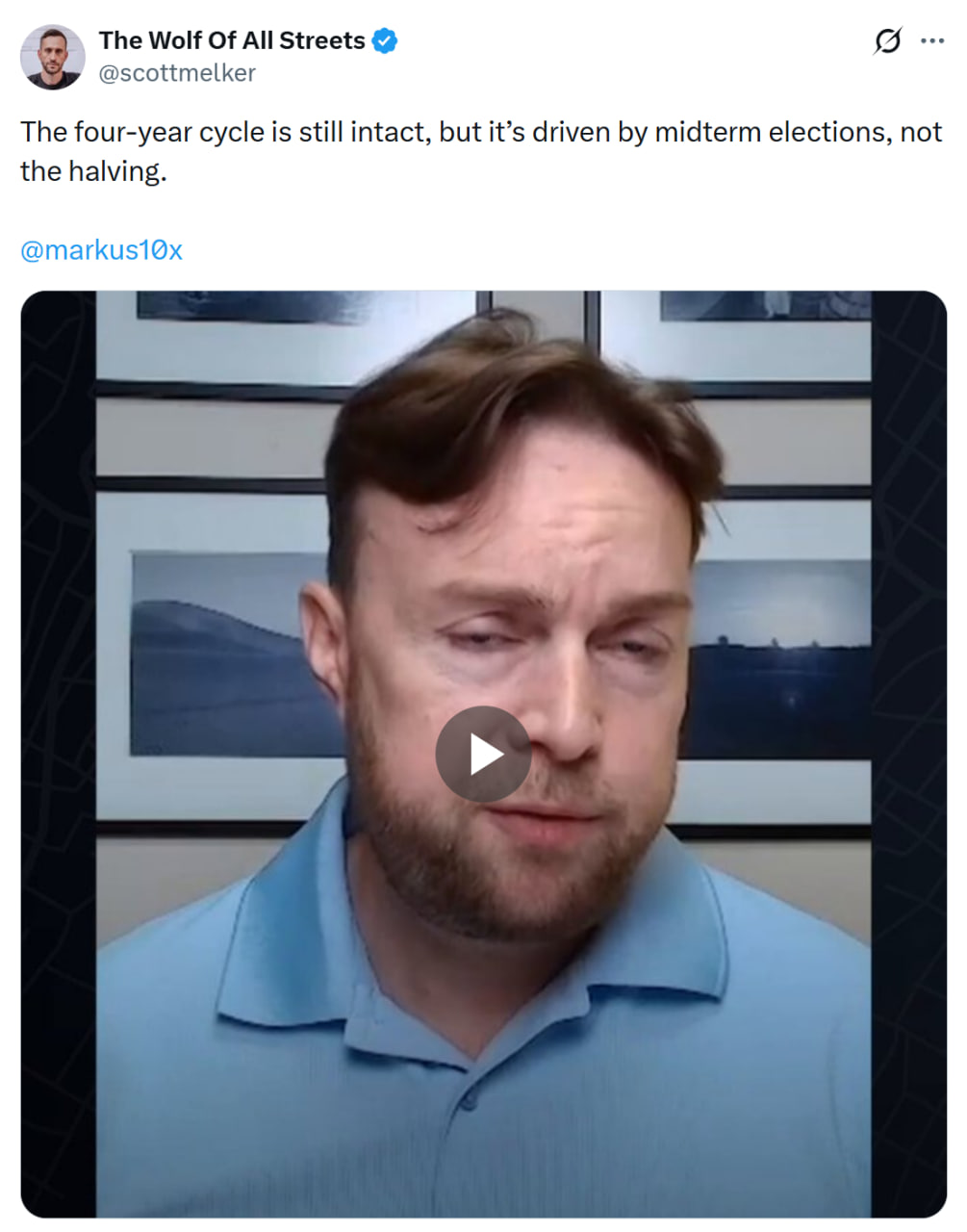
Markus Thielen says four-year cycle is not dead. Source: The Wolf Of All Streets

Related: Bitcoin 'up year' is 2026, and the four-year cycle is dead

Fed rate cut fails to boost Bitcoin

The comments come as Bitcoin struggles to regain momentum following the Federal Reserve’s latest rate cut. While rate cuts have historically supported risk assets, Thielen noted that the current environment is different. Institutional investors, now the dominant force in crypto markets, are more cautious, especially as policy signals from the Fed remain mixed and liquidity conditions tighten.

Furthermore, capital inflows into Bitcoin have slowed compared with last year, reducing the upside pressure needed to sustain a strong breakout. Without a clear pickup in liquidity, Thielen expects Bitcoin to remain in a consolidation phase rather than enter a new parabolic rally.

The shift also has implications for how investors think about timing. Rather than anchoring expectations to the halving, Thielen said market participants should watch political catalysts such as US elections, fiscal policy debates and shifts in monetary conditions.

Related: Bitcoin's 4-year cycle may not be dead after all: Glassnode

Arthur Hayes: Four-year crypto cycle is dead

In October, BitMEX co-founder Arthur Hayes argued that the four-year crypto cycle is over, but not because of fading institutional interest or changes to Bitcoin’s halving schedule. He said traders relying on historical timing models to call the end of the current bull market are likely to be wrong, as those patterns no longer reflect how markets move.

According to Hayes, Bitcoin cycles have always been driven by global liquidity, not by arbitrary four-year timelines. Past bull markets ended when monetary conditions tightened, particularly when US dollar and Chinese yuan liquidity slowed. The halving, he said, has been overstated as a causal factor rather than a coincidental one.

Magazine: 2026 is the year of pragmatic privacy in crypto — Canton, Zcash and more

Related Reads

Summary of Kevin Warsh's Past Remarks: How Will This Prospective 'New Head' Upend the Fed?

Kevin Warsh, nominated by President Trump to replace Fed Chair Powell, is poised to introduce sweeping reforms at the Federal Reserve. His agenda includes structural changes, advocating for lower policy rates, a fundamentally new approach to inflation, a significantly smaller balance sheet, safeguarding Fed independence, narrowing the Fed’s mandate, improving coordination with the Treasury, and reducing communication “noise” from policymakers. Warsh has criticized current monetary policy as “broken” and called for “fundamental regime change,” arguing that continuity is meaningless when the Fed has lost credibility. He believes interest rates should be lower and that a smaller balance sheet would help achieve that, describing the current one as “multiple trillions of dollars larger than necessary.” On inflation, he attributes its rise to cognitive errors at the Fed—including overreliance on flawed models, neglect of money supply, and blaming external factors rather than excessive government spending. He also suggests AI could lead to a structural decline in prices. He strongly defends Fed independence as its “most important asset” and warns against mission creep, which he says risks its core objectives and increases political vulnerability. He proposes closer coordination with the Treasury to align balance sheet and debt issuance plans, clarifying expectations for markets. Regarding communication, Warsh supports transparency but criticizes the current “cacophony of voices” and “forward guidance” that creates ambiguity. He has urged Fed officials to speak less frequently to avoid market confusion.

marsbit4m ago

Summary of Kevin Warsh's Past Remarks: How Will This Prospective 'New Head' Upend the Fed?

marsbit4m ago

Arbitrum Pretends to Be the Hacker, 'Steals' Back the Money Lost by KelpDAO

Title: Arbitrum Poses as Hacker to Recover Stolen Funds from KelpDAO Last week, KelpDAO suffered a hack resulting in nearly $300 million in losses, marking the largest DeFi security incident this year. Approximately 30,765 ETH (worth over $70 million) remained on an Arbitrum address controlled by the attacker. In an unprecedented move, Arbitrum’s Security Council utilized its emergency authority to upgrade the Inbox bridge contract, adding a function that allowed them to impersonate the hacker’s address and initiate a transfer without access to its private key. The council’s action, approved by 9 of its 12 members, moved the stolen ETH to a frozen address in a single transaction before reverting the contract to its original state. The operation was coordinated with law enforcement, which attributed the attack to North Korea’s Lazarus Group. Community reactions are divided: some praise the recovery of funds, while others question the centralization of power, as the council can upgrade core contracts without governance votes. However, such emergency mechanisms are common among major L2s. Despite the partial recovery, over $292 million was stolen in total, with more than $100 million in bad debt on Aave and remaining funds scattered across other chains. The incident highlights escalating security challenges in DeFi, with state-sponsored hackers employing advanced tactics and L2s responding with elevated countermeasures.

marsbit14m ago

Arbitrum Pretends to Be the Hacker, 'Steals' Back the Money Lost by KelpDAO

marsbit14m ago

iQiyi Is Too Impatient

The article "iQiyi Is Too Impatient" discusses the controversy surrounding the Chinese streaming platform IQiyi's recent announcement of an "AI Actor Library" during its 2026 World Conference. IQiyi claimed over 100 actors, including well-known names like Zhang Ruoyun and Yu Hewei, had joined the initiative. CEO Gong Yu suggested AI could enable actors to "star in 14 dramas a year instead of 4" and that "live-action filming might become a world cultural heritage." The announcement quickly sparked backlash. Multiple actors named in the list issued urgent statements denying they had signed any AI-related authorization agreements. This forced IQiyi to clarify that inclusion in the library only indicated a willingness to *consider* AI projects, with separate negotiations required for any specific role. The incident, which trended on social media with hashtags like "IQiyi is crazy," is presented as a sign of the company's growing desperation. Facing intense competition from short-video platforms like Douyin and Kuaishou, as well as Bilibili and Xiaohongshu, IQiyi's financial performance has weakened, with revenues declining for two consecutive years. The author argues that IQiyi is "too impatient" to tell a compelling AI story to reassure the market, especially as it pursues a listing on the Hong Kong stock exchange. The piece concludes by outlining three key "AI questions" IQiyi must answer: defining its role as a tool provider versus a content creator, balancing the "coldness" of AI with the human element audiences desire, and properly managing the interests of platforms, actors, and viewers. The core dilemma is that while AI can reduce costs and increase efficiency, it risks creating homogenized, formulaic content and devaluing human performers.

marsbit1h ago

iQiyi Is Too Impatient

marsbit1h ago

Trading

Spot
Futures

Hot Articles

Discussions

Welcome to the HTX Community. Here, you can stay informed about the latest platform developments and gain access to professional market insights. Users' opinions on the price of S (S) are presented below.

活动图片