Bitcoin under pressure as $30M from ‘lost’ drug dealer stash hits Coinbase – Details

ambcryptoPublished on 2026-07-03Last updated on 2026-07-03

Abstract

Irish drug dealer Clifton Collins is back in the news as authorities recovered 500 BTC (worth $30.85 million) from his wallet and deposited it into Coinbase. Collins originally acquired around 6,000 BTC between 2011-2012. Before his 2017 arrest, he hid his seed phrase in a fishing rod, but it was later dumped in a landfill. This recent seizure brings total assets recovered from his wallets to 1,500 BTC (~$103 million). Separately, investor Tim Draper deposited 1,000 BTC (~$61.82 million) into Coinbase. These large transfers coincided with Bitcoin's Exchange Supply Ratio rising to a three-week high, indicating increased selling pressure on exchanges. Technical indicators like the Stochastic Momentum Index and ADX suggest weak upside momentum for BTC. Analysts warn that continued sell-side activity could push Bitcoin back toward $60,000, though if the recent rebound holds, it could test resistance at $65,600.

The Irish drug dealer Clifton Collins is back in the news after Irish authorities recovered more of his seized Bitcoin. Collins acquired approximately 6,000 Bitcoin between 2011 and 2012.

In 2017, he was jailed after a drug-related arrest. Before the arrest, he printed his seed phrase and hid it inside a fishing rod.

However, the landlord later cleared the house and dumped his belongings in a landfill, including the private keys. In 2026, authorities continued recovering the lost Bitcoin and selling it as proceeds of crime.

How much Bitcoin did authorities recover?

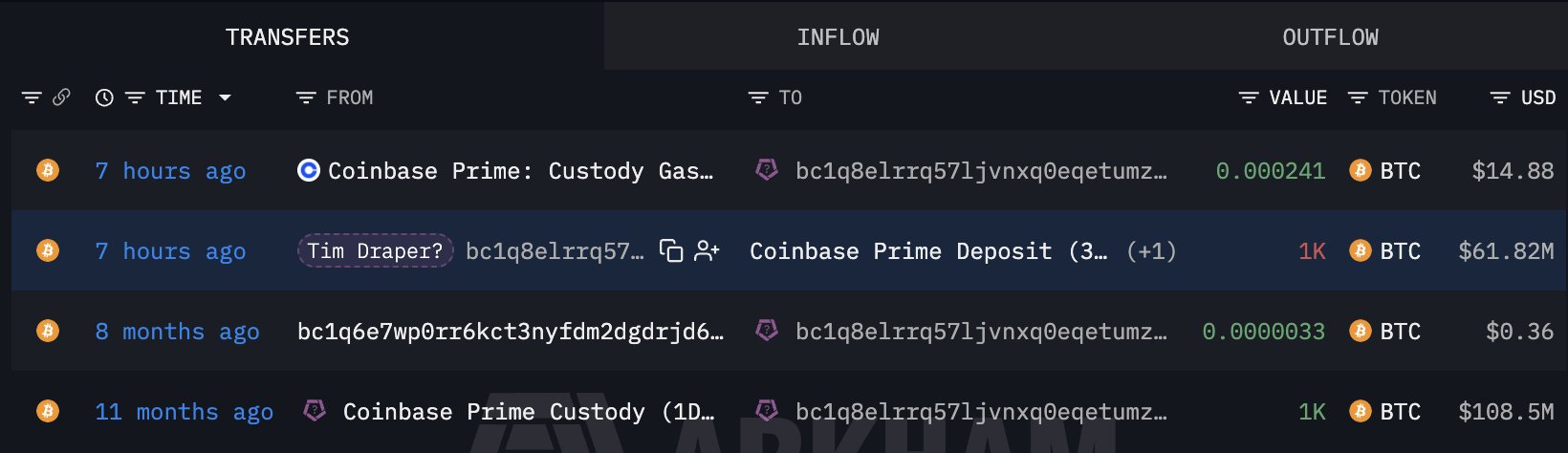
The Irish authorities successfully recovered 500 BTC, worth $30.85 million, from Clifton Collins’ wallet and deposited it into Coinbase.

The recent seizure brought the total assets recovered from his wallets to 1,500 BTC, worth approximately $103 million. At its peak, Collins’ 6,000 BTC were worth approximately $757 million.
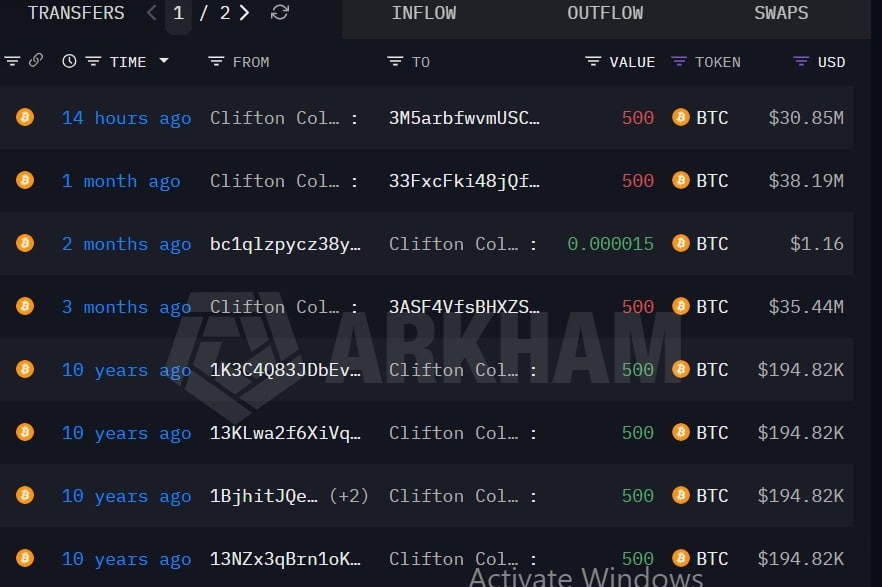
Source: Arkham

Despite the recovery effort, Clifton Collins’ addresses still held 4,500 BTC worth approximately $276 million. In fact, more than nine addresses remained untouched, and authorities have not confirmed whether the same decryption could apply to future operations.

Even so, the recovery suggested authorities could still access dormant wallets under certain circumstances.

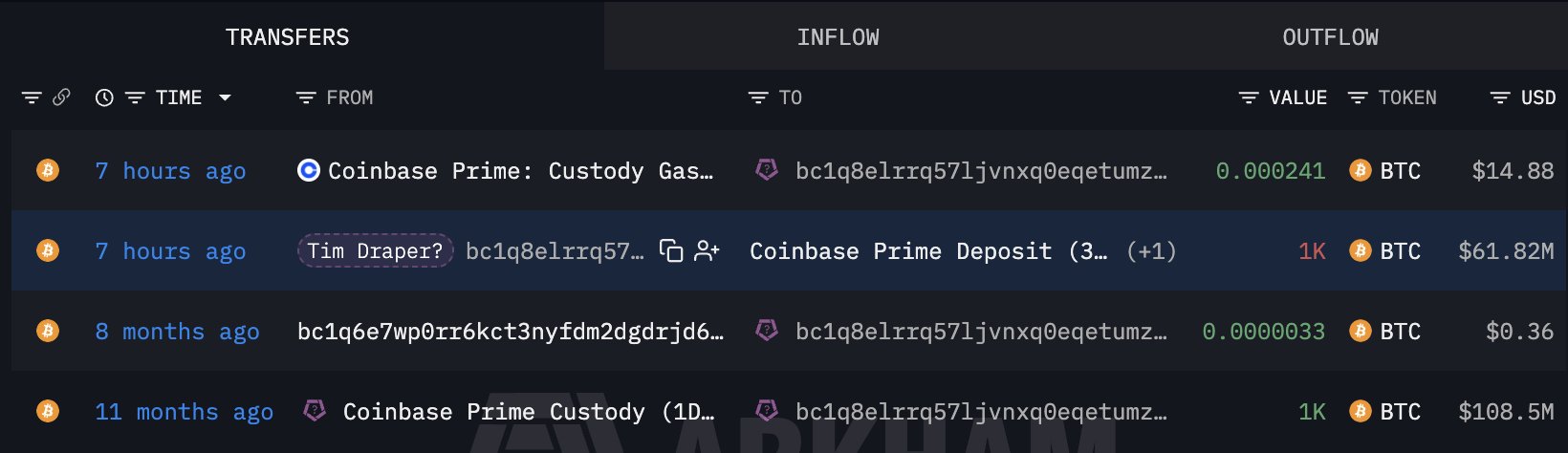
In addition to Collins, Bitcoin [BTC] also saw sell-side activity from another long-term investor. Lookonchain reported that a wallet linked to Tim Draper deposited 1,000 BTC worth $61.82 million into Coinbase.
Source: Arkham

Tim Draper purchased 29,656 BTC from the seized Silk Road assets during the U.S. Marshals Service auction in 2014.

He bought the holdings for roughly $18.7 million, paying about $632 per BTC. At its peak, those holdings were worth $3.74 billion, before declining to approximately $1.8 billion.

Could these transfers pressure Bitcoin?

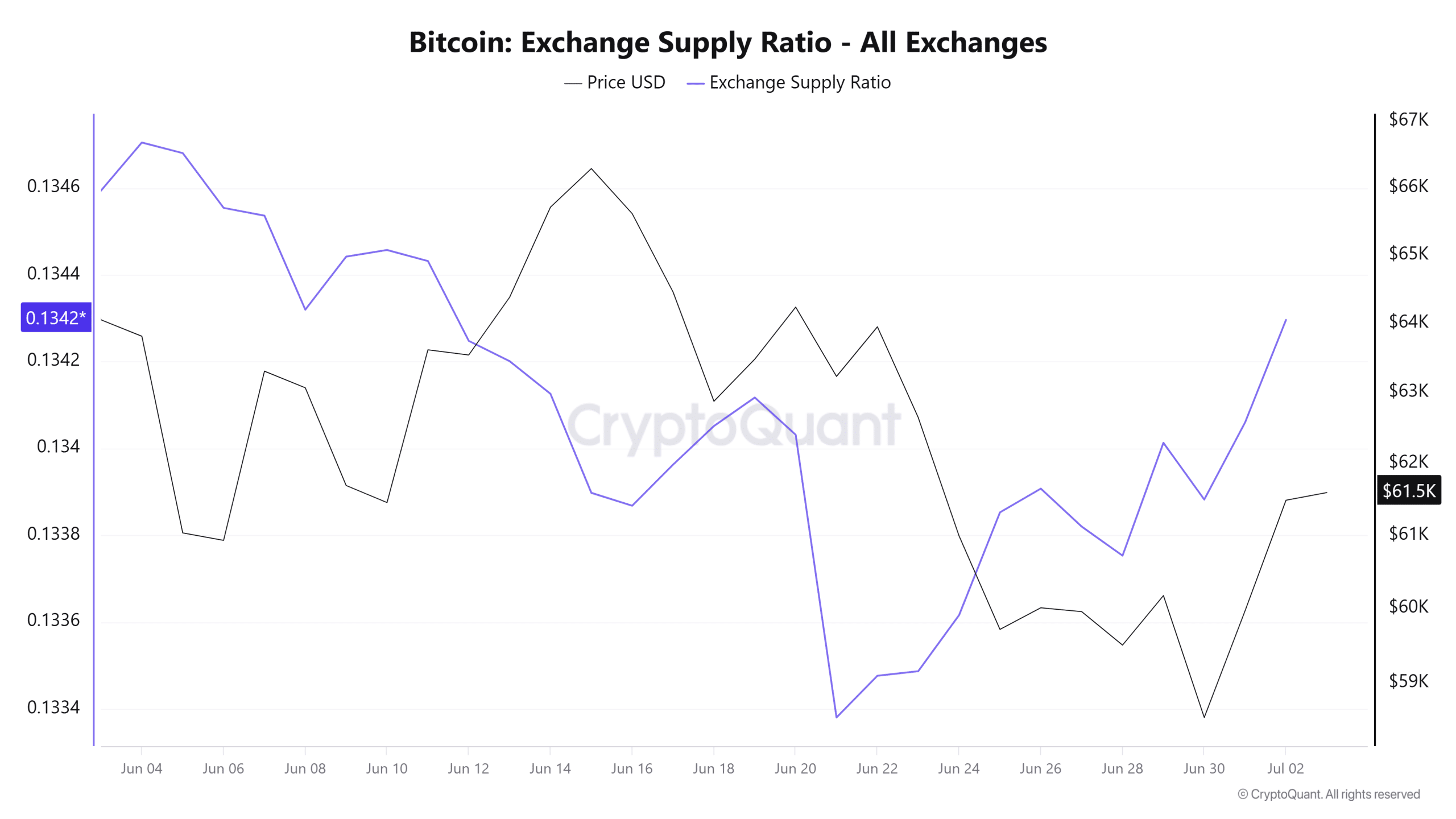
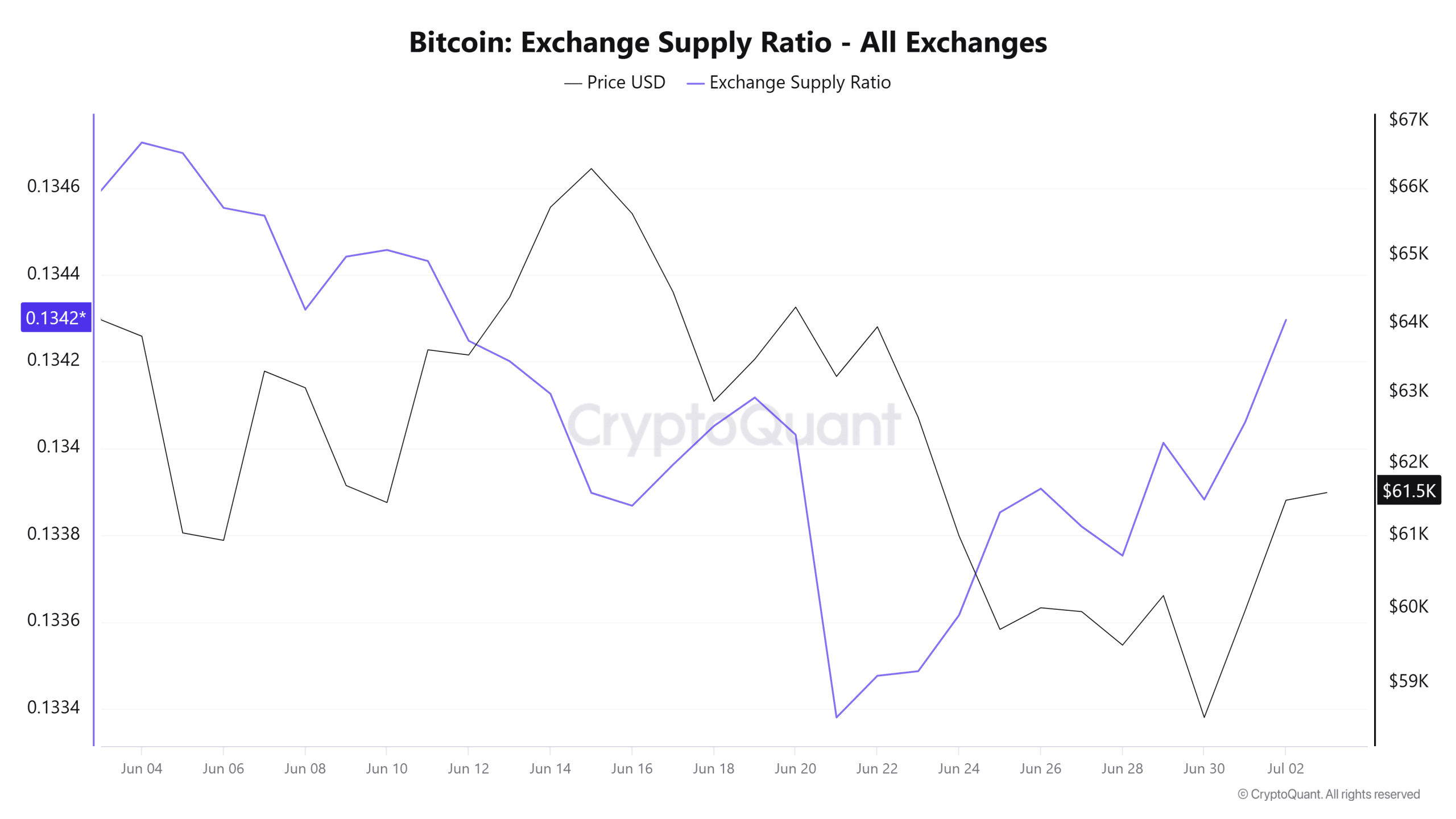
Meanwhile, transfers linked to Collins and Tim Draper coincided with a rise in Bitcoin’s Exchange Supply Ratio. In fact, the Exchange Supply Ratio climbed to a three-week high of 0.134.
Source: CryptoQuant

The rising Exchange Supply Ratio suggested that more market participants had moved BTC onto exchanges, potentially increasing selling pressure. That shift left traders focused on broader market sentiment.

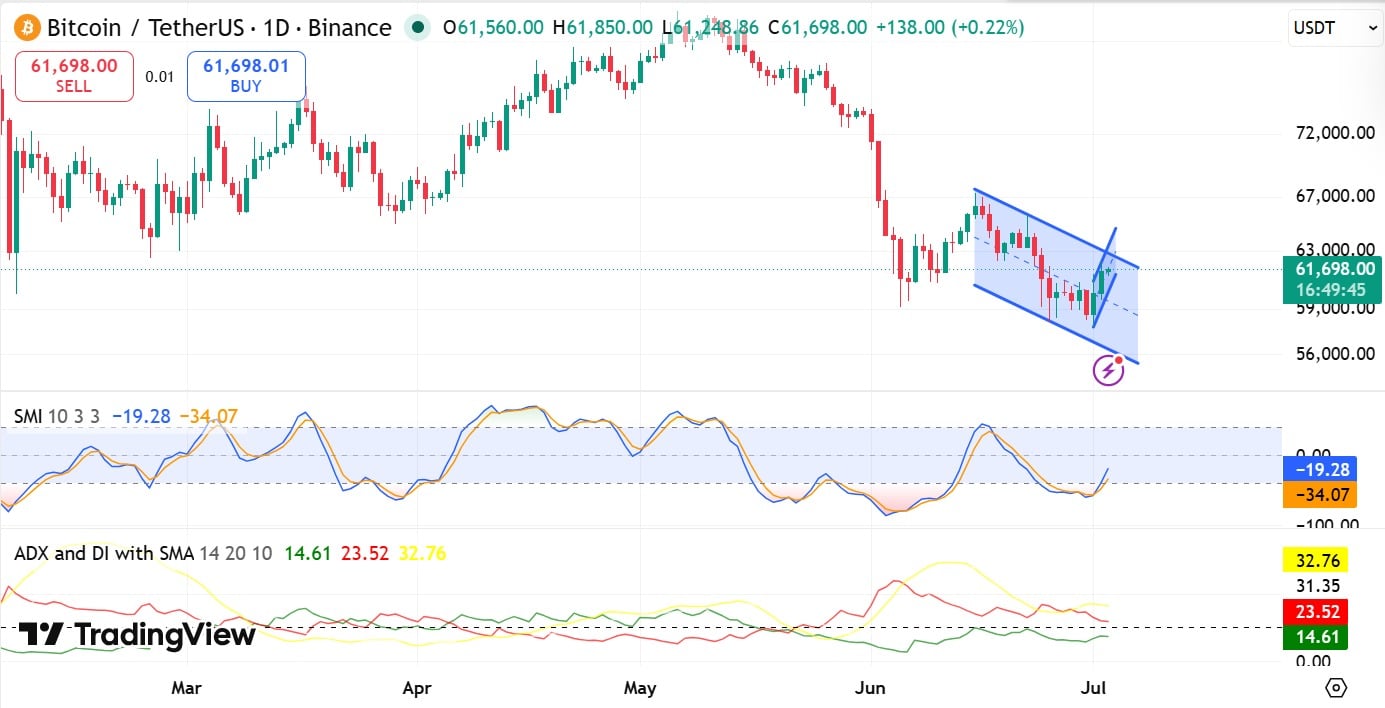
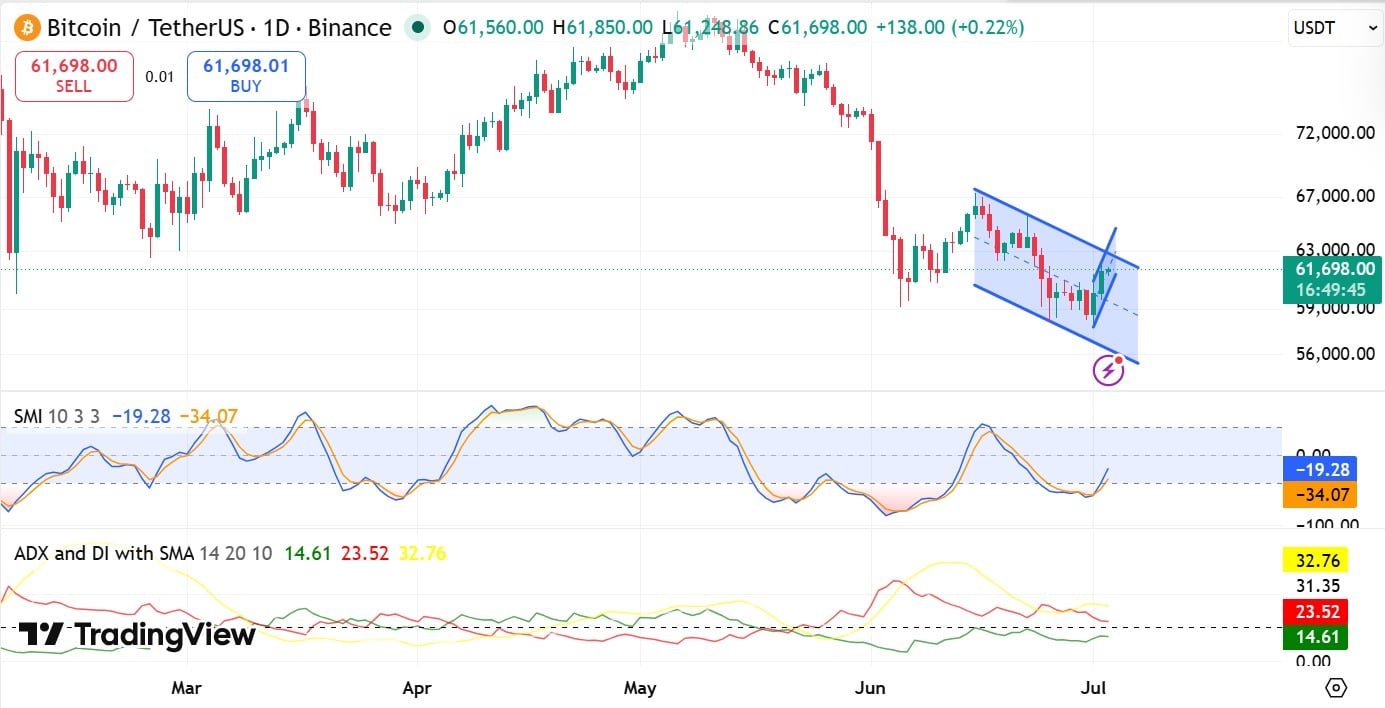
Higher Exchange Inflows also weighed on market sentiment. Meanwhile, the Stochastic Momentum Index remained in negative territory.

Although BTC rebounded to $62,000 and the Stochastic Momentum Index rose slightly, upside momentum remained weak. The ADX also supported this setup, as the negative index remained elevated at 23.
Source: TradingView

Taken together, these indicators suggested a weak structure that could lead to another decline. If sell-side activity continues, BTC could drop back to $60,000. However, if the recent rebound holds, Bitcoin could target the $65,600 resistance level.


Trending Cryptos

Related Questions

QWhat is the total amount of Bitcoin authorities have recovered from Clifton Collins's wallets so far, and what is its approximate value?

AThe Irish authorities have successfully recovered a total of 1,500 BTC from Clifton Collins's wallets, which is worth approximately $103 million.

QHow did Clifton Collins originally lose access to his Bitcoin private keys?

AHe printed his seed phrase and hid it inside a fishing rod. After his arrest, his landlord cleared the house and dumped his belongings, including the private keys, in a landfill.

QWho is Tim Draper, and what significant Bitcoin transaction is mentioned in the article regarding him?

ATim Draper is a long-term investor who purchased 29,656 BTC from the seized Silk Road assets at a U.S. Marshals Service auction in 2014. The article reports that a wallet linked to him deposited 1,000 BTC worth $61.82 million into Coinbase.

QWhat does the rising Bitcoin Exchange Supply Ratio suggest about potential market pressure?

AThe rising Exchange Supply Ratio, which climbed to a three-week high of 0.134, suggests that more market participants have moved BTC onto exchanges. This could potentially increase selling pressure on Bitcoin.

QBased on the technical indicators mentioned, what are the two potential price scenarios for Bitcoin discussed in the article?

AIf sell-side activity continues, Bitcoin (BTC) could drop back to the $60,000 level. However, if the recent rebound holds, Bitcoin could instead target the $65,600 resistance level.

Related Reads

How Far Are We from the End of the Crypto Bear Market?

How Much Longer Until the Crypto Bear Market Ends? A persistent negative Coinbase Bitcoin Premium Index, reaching a record 46 consecutive days of negative values, underscores the ongoing crypto bear market. The downturn accelerated in late May/early June when MicroStrategy (referred to as "Strategy" in the text), a major BTC holder, sold a small amount of Bitcoin (32 BTC), shattering market confidence and triggering sharp declines in BTC, ETH, and SOL. This was compounded by sustained net outflows from US spot Bitcoin ETFs. June saw Bitcoin briefly fall below $60,000, its worst weekly performance since 2022, breaking below the critical 200-week moving average—a signal some analysts consider confirmation of a bear market. While some institutional analyses in mid-June suggested the bottom might be near (e.g., around $53,600 based on realized price, or a potential end during the 2026 World Cup summer), further price drops quickly disproved these optimistic forecasts. Key bear market indicators include: the severe de-pegging of MicroStrategy's preferred shares (STRC) from their $100 NAV, which later recovered partly due to company stabilization plans; a record number of BTC (over 10.83 million) and a significant portion of long-term ETH holders now in unrealized loss; and Bitcoin's price trading below its 200-week moving average. Predictions for the bear market's end vary. Some, like investor Yilihua, suggest July-August 2026 could present a final buying opportunity. Others, like miner Jiang Zhu'o'er, predict a bottom between $42,000-$44,000 in October-December 2026, based on the historical lag between MicroStrategy's mNAV ratio bottom and Bitcoin's price bottom. Technical indicators like the BTC 4-year average price index dipped briefly below 1, and the Coinbase Premium Index remains negative, suggesting a need for a price rebound to around $77,000 for a return to positive territory. In the absence of major external catalysts, the consensus leans toward the bear market persisting for another 2-3 months, with late September to early October 2026 being a potential turning point window.

Odaily星球日报26m ago

How Far Are We from the End of the Crypto Bear Market?

Odaily星球日报26m ago

Solana Ecosystem Shows Signs of Recovery: On-Chain Governance Upgrade, Tokenized Stocks and Meme Coins Heat Up

Solana Ecosystem Shows Signs of Revival: Governance Upgrades, Tokenized Stocks, and Memecoins Heat Up While the broader crypto market faces a downturn, Solana has shown relative strength with its price rising nearly 15% recently. This resilience is attributed to warming ecosystem activity, particularly in tokenized stocks and memecoins, coupled with a major upgrade to its on-chain governance. In the Real World Assets (RWA) sector, Solana now leads all public chains in both the number of unique holder wallets and the quantity of RWA assets. Its tokenized stock weekly trading volume has surged to a record $1.42 billion, capturing about 96% of the market share, largely driven by the Backpack exchange. Simultaneously, the Solana memecoin sector has reignited, fueled by the rapid ascent of the ANSEM token following endorsements from a prominent crypto influencer. This has boosted activity across platforms like Pump.fun and increased fee revenue for several Solana-based exchanges. A key development is the launch of Solana Governance Proposals (SGP), a new on-chain mechanism. It allows validators with at least 100,000 SOL delegated to submit proposals for community vote, enhancing decentralized decision-making. SGP will operate alongside the existing technical proposal process (SIMD), focusing on broader ecosystem governance. Despite these positive signals in specific areas, overall on-chain activity and transaction volumes still lag behind previous bull market peaks, indicating the recovery remains partial rather than ecosystem-wide.

marsbit49m ago

Solana Ecosystem Shows Signs of Recovery: On-Chain Governance Upgrade, Tokenized Stocks and Meme Coins Heat Up

marsbit49m ago

While Semiconductor Stocks Plunge, Anthropic Plans to Develop a 2nm Chip

Anthropic, the AI company behind Claude, is exploring the development of its own custom AI chip, according to a report from The Information. The company is in early discussions with Samsung Electronics to manufacture the chip using Samsung's most advanced 2-nanometer process and packaging technology. While the project is still in preliminary stages, including defining chip specifications, and could be abandoned, it marks a strategic step for Anthropic. The move comes as the company seeks greater control over its computing costs and hardware optimization, particularly for inference tasks to run its models more efficiently and cheaply. Samsung's potential involvement follows its participation as a strategic investor in Anthropic's recent $65 billion funding round. For Samsung, partnering with a major AI lab represents a significant opportunity for its foundry business to compete with market leader TSMC in advanced semiconductor manufacturing. Anthropic's CEO, Dario Amodei, has previously highlighted the immense financial challenge of securing enough computing power for anticipated growth, making cost-effective inference a critical focus. The company would join other tech giants like Google, Amazon, Microsoft, Meta, and OpenAI in pursuing custom AI silicon. However, analysts note this trend creates deeper interdependencies rather than independence, as US AI labs become more tightly woven into Asian semiconductor supply chains. Despite this move, Anthropic remains heavily reliant on a multi-cloud, multi-vendor strategy for its immediate computing needs. It has secured massive, long-term commitments for capacity from Amazon Web Services (Trainium chips), Google (TPUs), and even leased a large GPU cluster from xAI. For now, Nvidia continues to dominate the AI chip market, with its share reportedly growing to 74%.

链捕手51m ago

While Semiconductor Stocks Plunge, Anthropic Plans to Develop a 2nm Chip

链捕手51m ago

Korean Companies Following Strategy in Accumulating Cryptocurrency: From Bull Market to Delisting?

Title: Korean DAT Companies Following "Strategy" Bitcoin Hoarding Model Face Delisting Amid Bear Market Summary: Several Korean KOSDAQ-listed companies, known as Digital Asset Trusts (DATs), are at risk of being delisted due to a combination of stricter regulatory thresholds and a downturn in crypto markets. These firms, inspired by models like Strategy and Japan's Metaplanet, raised capital to buy Bitcoin, relying on a cycle of rising crypto prices to boost their stock value. However, recent reforms in Korea have raised the minimum market capitalization required to stay listed from 150 billion won to 200 billion won (approx. $1.3M), with a further increase to 300 billion won set for next January. The new rules also close loopholes like reverse stock splits used to artificially inflate share prices. The situation is exacerbated by a significant drop in Bitcoin's price from its 2025 peak and a weak KOSDAQ market. While the main KOSPI index has surged nearly 95% year-to-date, KOSDAQ has fallen about 10%, draining liquidity from smaller companies. Many DATs now hover near or below the new market cap thresholds and must also book substantial valuation losses on their Bitcoin holdings. Analysts suggest that without a sustained recovery in both crypto prices and broader market interest in KOSDAQ stocks, these companies have limited options to avoid delisting, marking a precarious moment for Korea's crypto-linked public companies.

marsbit1h ago

Korean Companies Following Strategy in Accumulating Cryptocurrency: From Bull Market to Delisting?

marsbit1h ago

Trading

Spot

Hot Articles

What is $BITCOIN

DIGITAL GOLD ($BITCOIN): A Comprehensive Analysis Introduction to DIGITAL GOLD ($BITCOIN) DIGITAL GOLD ($BITCOIN) is a blockchain-based project operating on the Solana network, which aims to combine the characteristics of traditional precious metals with the innovation of decentralized technologies. While it shares a name with Bitcoin, often referred to as “digital gold” due to its perception as a store of value, DIGITAL GOLD is a separate token designed to create a unique ecosystem within the Web3 landscape. Its goal is to position itself as a viable alternative digital asset, although specifics regarding its applications and functionalities are still developing. What is DIGITAL GOLD ($BITCOIN)? DIGITAL GOLD ($BITCOIN) is a cryptocurrency token explicitly designed for use on the Solana blockchain. In contrast to Bitcoin, which provides a widely recognized value storage role, this token appears to focus on broader applications and characteristics. Notable aspects include: Blockchain Infrastructure: The token is built on the Solana blockchain, known for its capacity to handle high-speed and low-cost transactions. Supply Dynamics: DIGITAL GOLD has a maximum supply capped at 100 quadrillion tokens (100P $BITCOIN), although details regarding its circulating supply are currently undisclosed. Utility: While precise functionalities are not explicitly outlined, there are indications that the token could be utilized for various applications, potentially involving decentralized applications (dApps) or asset tokenization strategies. Who is the Creator of DIGITAL GOLD ($BITCOIN)? At present, the identity of the creators and development team behind DIGITAL GOLD ($BITCOIN) remains unknown. This situation is typical among many innovative projects within the blockchain space, particularly those aligning with decentralized finance and meme coin phenomena. While such anonymity may foster a community-driven culture, it intensifies concerns about governance and accountability. Who are the Investors of DIGITAL GOLD ($BITCOIN)? The available information indicates that DIGITAL GOLD ($BITCOIN) does not have any known institutional backers or prominent venture capital investments. The project seems to operate on a peer-to-peer model focused on community support and adoption rather than traditional funding routes. Its activity and liquidity are primarily situated on decentralized exchanges (DEXs), such as PumpSwap, rather than established centralized trading platforms, further highlighting its grassroots approach. How DIGITAL GOLD ($BITCOIN) Works The operational mechanics of DIGITAL GOLD ($BITCOIN) can be elaborated on based on its blockchain design and network attributes: Consensus Mechanism: By leveraging Solana’s unique proof-of-history (PoH) combined with a proof-of-stake (PoS) model, the project ensures efficient transaction validation contributing to the network's high performance. Tokenomics: While specific deflationary mechanisms have not been extensively detailed, the vast maximum token supply implies that it may cater to microtransactions or niche use cases that are still to be defined. Interoperability: There exists the potential for integration with Solana’s broader ecosystem, including various decentralized finance (DeFi) platforms. However, the details regarding specific integrations remain unspecified. Timeline of Key Events Here is a timeline that highlights significant milestones concerning DIGITAL GOLD ($BITCOIN): 2023: The initial deployment of the token occurs on the Solana blockchain, marked by its contract address. 2024: DIGITAL GOLD gains visibility as it becomes available for trading on decentralized exchanges like PumpSwap, allowing users to trade it against SOL. 2025: The project witnesses sporadic trading activity and potential interest in community-led engagements, although no noteworthy partnerships or technical advancements have been documented as of yet. Critical Analysis Strengths Scalability: The underlying Solana infrastructure supports high transaction volumes, which could enhance the utility of $BITCOIN in various transaction scenarios. Accessibility: The potential low trading price per token could attract retail investors, facilitating wider participation due to fractional ownership opportunities. Risks Lack of Transparency: The absence of publicly known backers, developers, or an audit process may yield skepticism regarding the project's sustainability and trustworthiness. Market Volatility: The trading activity is heavily reliant on speculative behavior, which can result in significant price volatility and uncertainty for investors. Conclusion DIGITAL GOLD ($BITCOIN) emerges as an intriguing yet ambiguous project within the rapidly evolving Solana ecosystem. While it attempts to leverage the “digital gold” narrative, its departure from Bitcoin's established role as a store of value underscores the need for a clearer differentiation of its intended utility and governance structure. Future acceptance and adoption will likely depend on addressing the current opacity and defining its operational and economic strategies more explicitly. Note: This report encompasses synthesised information available as of October 2023, and developments may have transpired beyond the research period.

569 Total ViewsPublished 2025.05.13Updated 2025.05.13

What is $BITCOIN

Discussions

Welcome to the HTX Community. Here, you can stay informed about the latest platform developments and gain access to professional market insights. Users' opinions on the price of BTC (BTC) are presented below.

活动图片