Bitcoin social chatter raises eyebrows – Will Saylor’s 105th buy cancel FUD?

ambcryptoPublished on 2026-04-06Last updated on 2026-04-06

Abstract

Bitcoin's strong start in January 2026 faded as prices dropped below $80,000 by February, influenced by U.S.-Iran geopolitical tensions. Despite outperforming gold, silver, and the S&P 500, bearish sentiment dominated social discussions, reaching peak fear levels since late February. The Crypto Fear and Greed Index remained in "Extreme Fear" territory. However, Michael Saylor continued his aggressive Bitcoin accumulation strategy, hinting at a 105th purchase. His company, MicroStrategy, now holds 762,099 BTC worth $52.59 billion. Despite a dip in MSTR stock, Saylor remains committed to long-term Bitcoin investment, dismissing short-term market noise. Upcoming events like the CLARITY Act and ongoing FUD may shift sentiment, potentially reversing the current negative trend.

Bitcoin was showing strong signals in the first month of 2026, but now that seems to be just New Year optimism that slipped away into a moment in time.

Since the 1st of February, BTC dropped below the $80K mark, and with the start of U.S.-Iran tensions, bears outpaced bulls. Even though Bitcoin was stronger than gold, silver, and the S&P 500, it still failed to cancel out the cautious market sentiment.

Bitcoin’s social chatter raises eyebrows

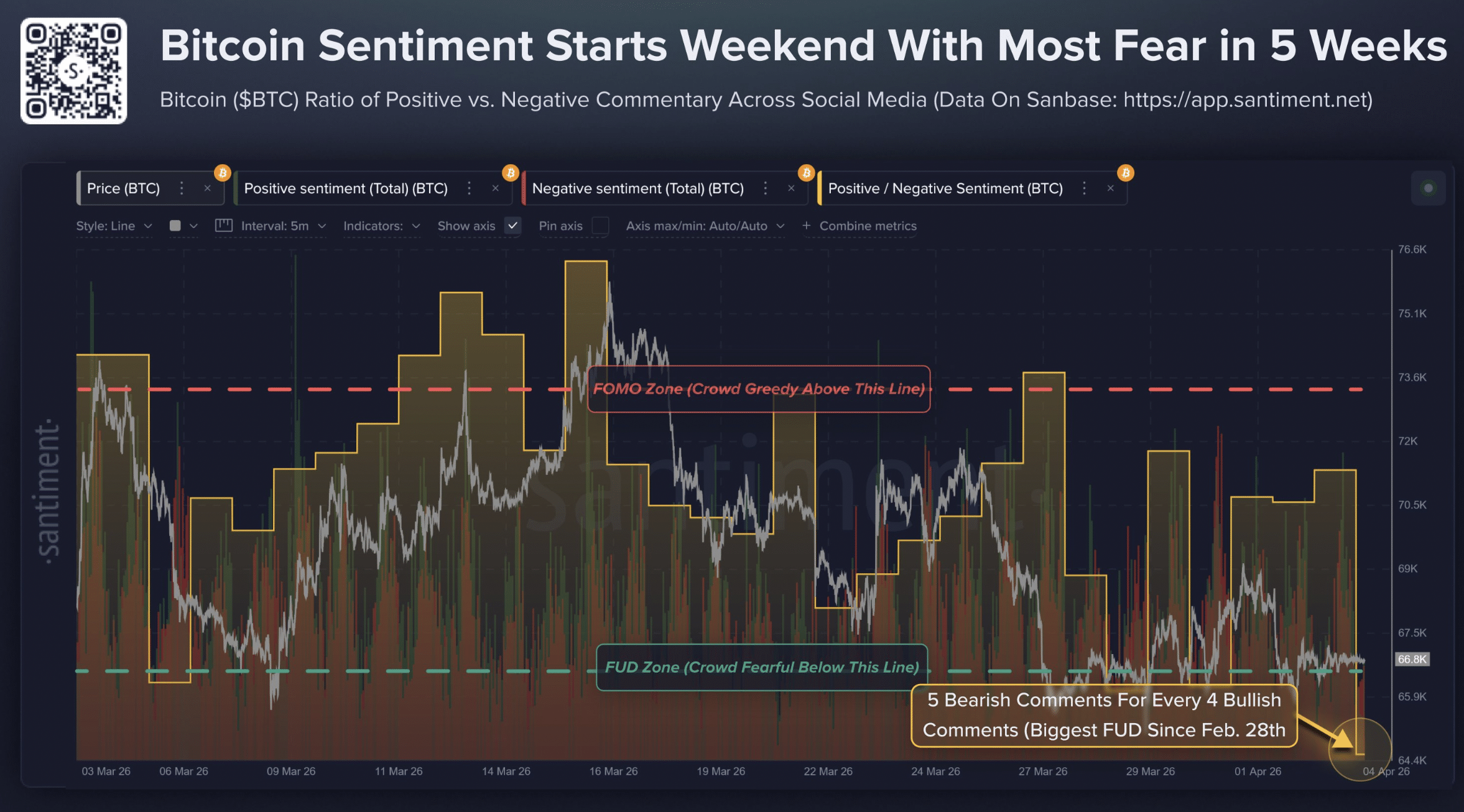
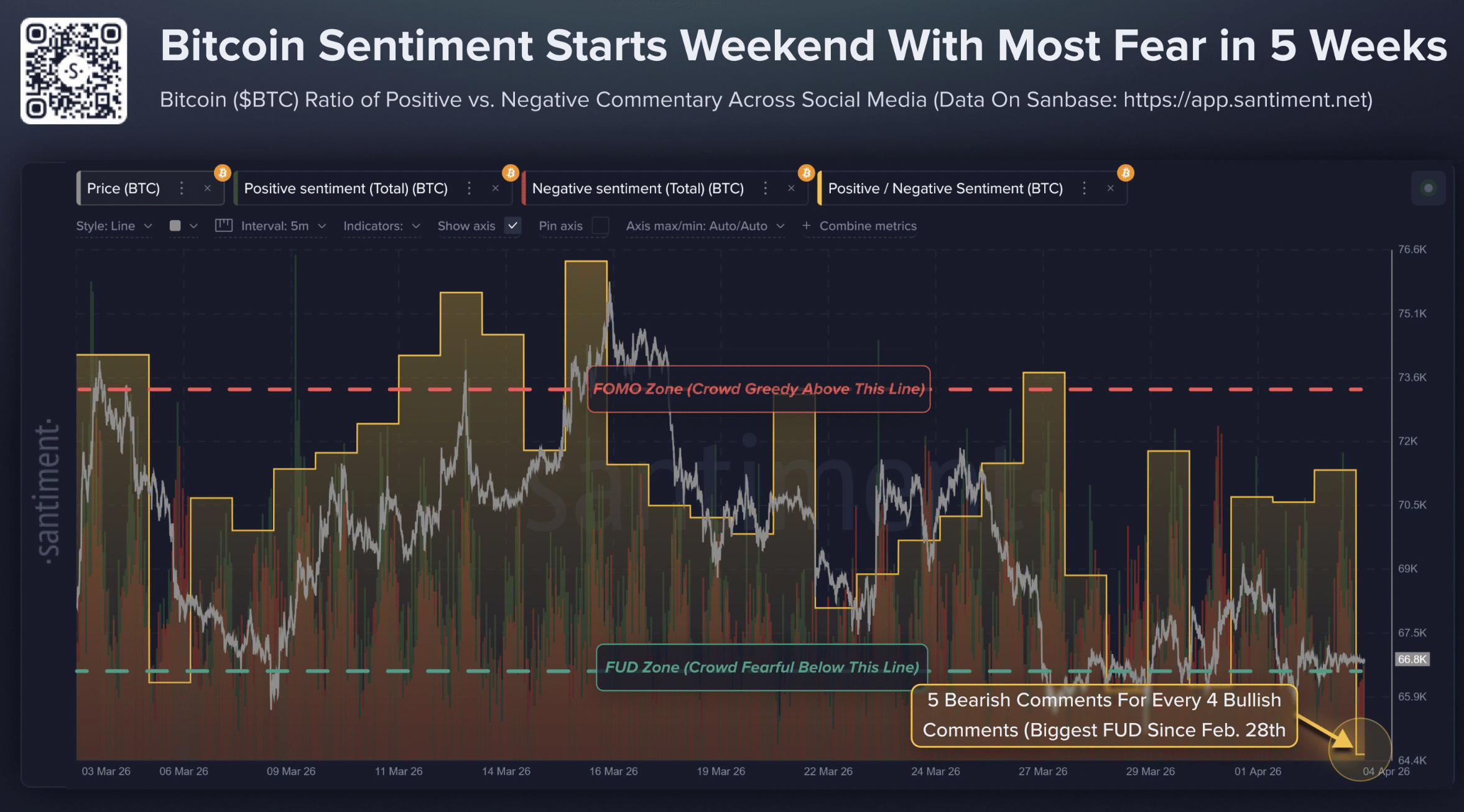
In fact, as per a recent analysis from Santiment, Bitcoin [BTC] saw its “highest ratio of bearish discussions (fear)” since the 28th of February across X, Reddit, Telegram, and other such platforms.

At press time, BTC traded near $69,090.
Source: Santiment

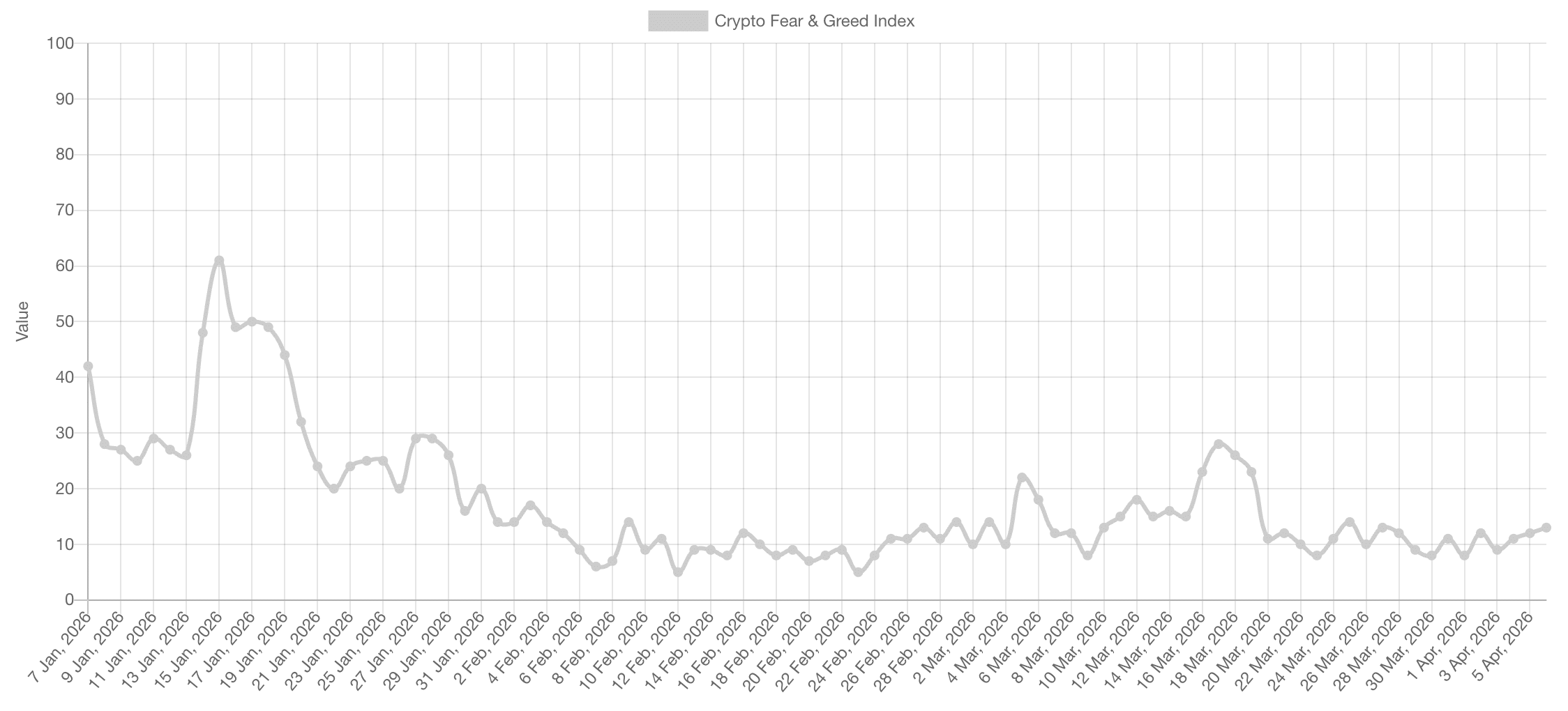
This sentiment was further confirmed by the Crypto Fear and Greed Index, which was in the “Extreme Fear” zone at the time of reporting. In fact, since mid-January, the index has been oscillating only between the “Fear” and “Extreme Fear” zones.
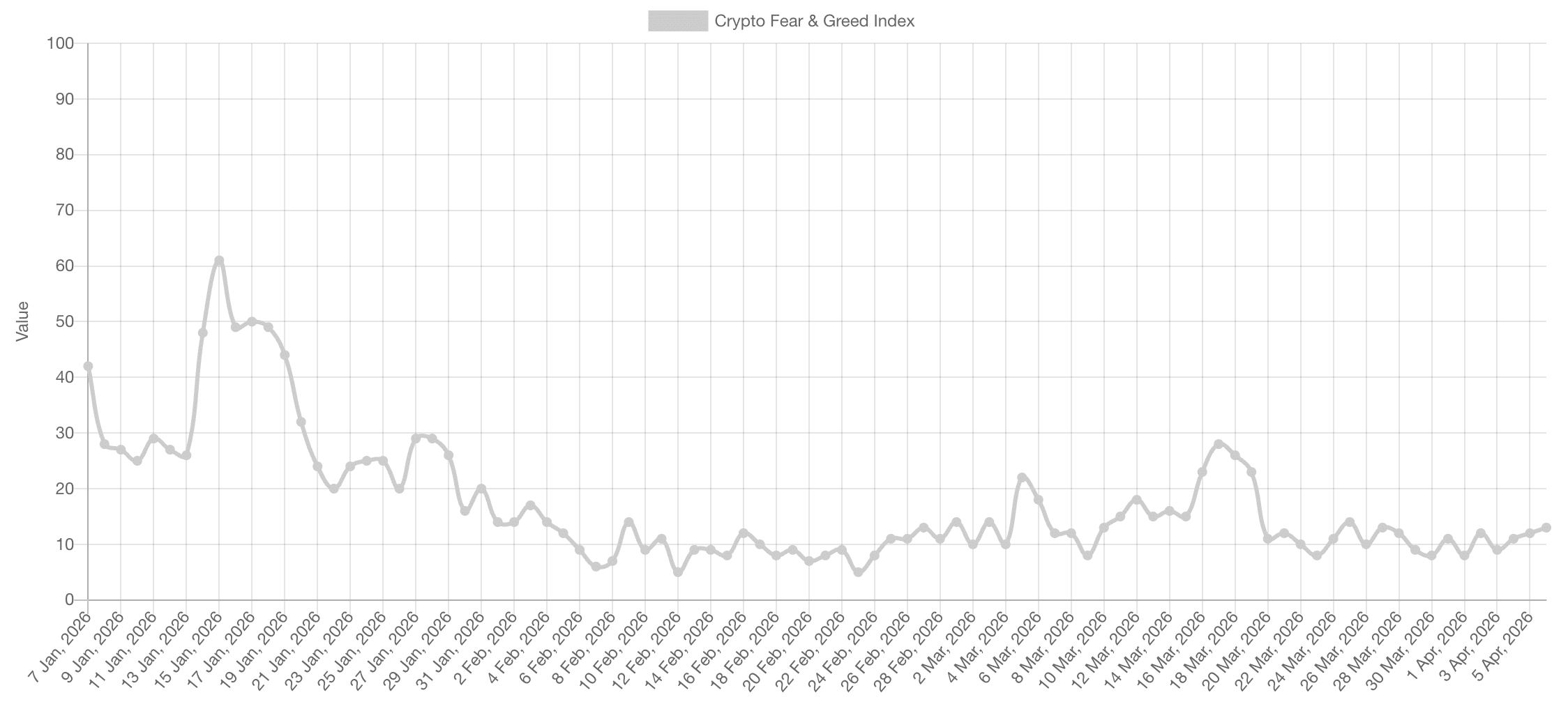
Source: Alternative

Michael Saylor’s buying spree continues

However, not everyone is buying this sentiment.

Michael Saylor, who has always followed a “buy-the-dip” strategy, is hinting at buying again. This has even dispelled the ongoing chatter from last weekend, when Saylor did not come up with his usual “Orange Dot” tease on X.

As per the fresh tease, Saylor is hinting that Strategy is “Back at Work” and with 104 purchases already done, the next buying spree will mark the 105th purchase of Strategy.
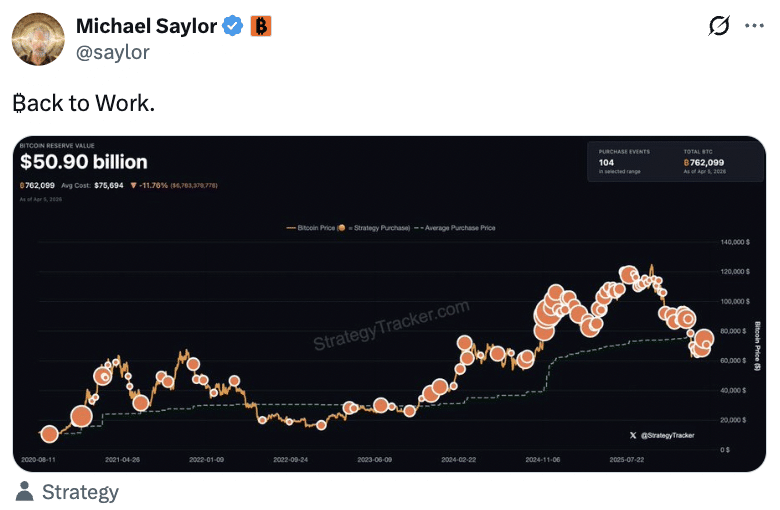
Source: Michael Saylor/X

With such aggressive Bitcoin buying moves, Strategy now holds 762,099 BTC worth worth $52,59 billion. In fact, since the 28th of February, Strategy has made 4 purchases totalling 44377 BTC.


Source: BitcoinTreasuries.Net

However, despite such moves, the stock price of MSTR was sitting at $119.83 at press time after seeing a drop of 2.4%, down by $2.95 per share.

How will upcoming events shape Bitcoin?

That being said, as sellers are clouding buyers around the largest cryptocurrency, various upcoming events might change things for good. In fact, Santiment also believes that markets usually move in “the opposite direction of the crowd’s expectations”.

So, with the ongoing debate around the CLARITY Act, increasing geopolitical turmoil, and “a high level of FUD,” there’s a good chance that “things can turn positive sooner rather than later”.

Needless to say, this prompts a question: Will this impact Saylor’s buying spree?

Interestingly, the answer is simple because Saylor never worried about the short-term noises.

So, if things turn good for the crypto market, it will be good for Strategy, but if it doesn’t, Saylor will continue to buy like always.

This comes as ABMCrypto recently reported Saylor’s latest bullish thesis, where he had put it best when he said,

Bitcoin has won.


Final Summary

  • Despite Bitcoin performing better than traditional assets, the sentiment around Bitcoin have turned bearish since the U.S. attacked Iran.
  • Michael Saylor’s confidence in Bitcoin reflects his long-term conviction in the leading cryptocurrency.


Related Questions

QWhat was the price of Bitcoin at the time of reporting, and what significant psychological threshold had it recently dropped below?

AAt the time of reporting, Bitcoin traded near $69,090. It had dropped below the $80K mark since the 1st of February.

QAccording to Santiment, what was notable about the social media discussions surrounding Bitcoin?

ASantiment's analysis found that Bitcoin saw its 'highest ratio of bearish discussions (fear)' since the 28th of February across platforms like X, Reddit, and Telegram.

QHow many Bitcoins does Michael Saylor's company, MicroStrategy, hold, and what is the total value of this holding?

AMicroStrategy holds 762,099 BTC, which is worth $52.59 billion.

QWhat is the current reading of the Crypto Fear and Greed Index, and how has it behaved since mid-January?

AThe Crypto Fear and Greed Index was in the 'Extreme Fear' zone at the time of reporting. Since mid-January, it has been oscillating only between the 'Fear' and 'Extreme Fear' zones.

QWhat is Michael Saylor's stated strategy regarding Bitcoin price fluctuations, and what is the significance of his 'Orange Dot' tease?

AMichael Saylor follows a 'buy-the-dip' strategy. His 'Orange Dot' tease on social media platform X is a signal that he is hinting at another Bitcoin purchase for MicroStrategy.

Related Reads

Codex Goal Mode Usage Guide: How to Make AI Continuously Pursue a Specific Objective

"Codex Goal Mode: How to Make AI Work Continuously Toward a Specific Goal" OpenAI's Codex "goal mode" (/goal) transforms the AI from a reactive code assistant into a proactive execution agent capable of working autonomously for hours or even days to achieve a defined objective. To maximize its effectiveness, follow these key principles: 1. **Define Clear, Verifiable Exit Criteria:** The goal prompt should be a concise, measurable success condition, not a lengthy specification. Use quantifiable metrics like "reduce build time by 30%" or "achieve 100% test parity." 2. **Provide Initial Guidance and Tools:** Direct Codex toward likely problem areas and specify available tools (e.g., browsers, testing environments) to prevent it from exploring unproductive paths. 3. **Enable Progress Measurement:** Equip Codex with ways to track advancement, such as creating comparison tools for visual tasks or evaluation sets, ensuring it can gauge its own progress. 4. **Use a Realistic Execution Environment:** For tasks like performance optimization, provide access to environments that closely mimic production (e.g., similar configs, databases) to yield valid results. 5. **Be Cautious with Visual Goals:** Avoid vague "pixel-perfect" instructions. Instead, supplement visual references with functional checklists or design system specifications to prevent Codex from obsessing over minor details. 6. **Implement Progress Tracking:** For long-running tasks, have Codex commit code to draft PRs, update progress documents, or send Slack updates to maintain visibility into its work. 7. **Review and Consolidate Results:** Once the goal is met, instruct Codex to review its work, clean up ineffective experimental code, and reflect on what strategies succeeded or failed. Ultimately, using goal mode shifts the developer's role from writing prompts to managing a persistent engineering agent—defining objectives, establishing metrics, configuring environments, and conducting final reviews.

marsbit1h ago

Codex Goal Mode Usage Guide: How to Make AI Continuously Pursue a Specific Objective

marsbit1h ago

From Ethereum to AI's 'CROPS': What Exactly Is This 'Slow Variable' That Vitalik Has Repeatedly Emphasized?

Recently, Vitalik Buterin has frequently emphasized the concept of "CROPS," first outlined in the Ethereum Foundation's March mandate as core principles guiding its focus: Censorship Resistance, Capture Resistance, Open Source, Privacy, and Security. CROPS represents Ethereum's commitment to providing foundational capabilities for user sovereignty—enabling asset ownership, identity expression, and coordination without reliance on centralized platforms or surrendering ultimate control. This framework is gaining new urgency with the rise of AI, particularly AI agents managing digital assets and automating transactions. While AI offers convenience, it risks centralizing user data, intent, and control if dependent on opaque, centralized services. Vitalik argues for "CROPS AI"—AI that is open, privacy-preserving, secure, and capable of local execution to maintain user agency. He highlights convergence between "CROPS Ethereum access layers" and "CROPS AI," such as using zero-knowledge proofs for private remote LLM calls and Ethereum RPC reads, ensuring users can access services without exposing sensitive information. Ultimately, CROPS is not just an abstract ideal but a practical guide for Ethereum's development and AI integration. It addresses the critical long-term question: as digital systems grow more powerful, how can users retain control over their privacy, assets, and autonomy? In an AI-driven era, these principles may define Ethereum's enduring value—prioritizing verifiable, secure, and user-centric design over short-term optimizations like speed and cost alone.

marsbit1h ago

From Ethereum to AI's 'CROPS': What Exactly Is This 'Slow Variable' That Vitalik Has Repeatedly Emphasized?

marsbit1h ago

Trading

Spot
Futures

Hot Articles

Discussions

Welcome to the HTX Community. Here, you can stay informed about the latest platform developments and gain access to professional market insights. Users' opinions on the price of S (S) are presented below.

活动图片