Bitcoin Sharpe Ratio Currently Falling Faster Than Price — What’s Happening?

bitcoinistPublished on 2026-01-31Last updated on 2026-01-31

Abstract

Bitcoin's price has dropped to around $81,000, reinforcing bearish sentiment amid factors like geopolitical tensions and liquidation cascades. According to Joao Wedson, founder of Alphractal, the Bitcoin Sharpe Ratio—a measure of risk-adjusted returns—is declining faster than the price itself, indicating the market is taking on more risk for diminishing returns. This ratio turned negative earlier in the year, yet BTC's price continued to rally briefly before the current downturn. Historically, such a rapid decline in the Sharpe Ratio often leads to extended periods of sideways or negative momentum. Wedson warns that if Bitcoin loses the $81,000 support, a deeper capitulation similar to 2022 could occur, potentially driving the price down to $65,500. As of now, BTC has slightly recovered to above $83,000 but remains down nearly 8% over the past week.

If there has been any doubt about the arrival of the bear market, the latest drop in the Bitcoin price to around $81,000 somewhat made it more believable. While different triggers, including geopolitical tensions, Microsoft’s earnings miss, and liquidation cascades, have been credited for this drop, the premier cryptocurrency seems to be struggling catch any break at the moment.

Interestingly, the latest decline not only shattered the remains of the Bitcoin price bullish structure but also tilted the on-chain framework towards an even more bearish outlook. With both technical and on-chain data looking less optimistic, the bears appear to be winning the battle for dominance in the BTC market.

This Metric Changes First, BTC Price Reacts Later: Crypto Founder

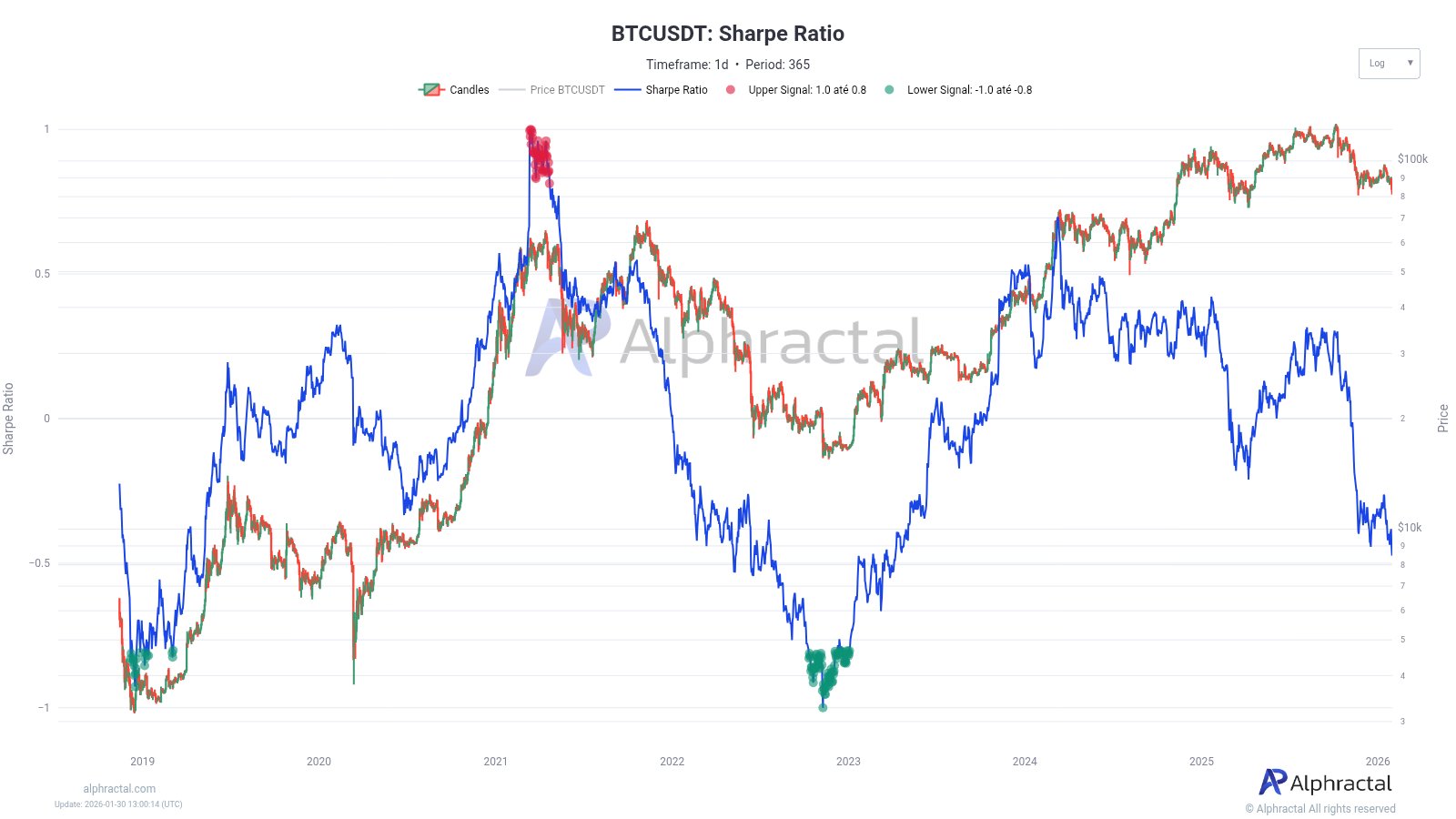
In a January 30 post on the X platform, Alphractal’s founder and CEO, Joao Wedson, revealed that the Bitcoin Sharpe Ratio is declining at a rate faster than the BTC price. The relevant indicator here is the Sharpe Ratio, which assesses the risk-adjusted returns of a particular cryptocurrency (Bitcoin, in this case).

This on-chain metric basically tracks the amount of profit an investment offers per unit of risk (considering risk is measured by volatility), with a high value signaling a higher risk-adjusted performance. Meanwhile, a negative Sharpe Ratio indicates that the returns being realized on an investment are not commensurate with the risk being taken.

Wedson wrote in his post on X:

Simply put: the market is taking more risk for less return.
Source: @joao_wedson on X

Indeed, the Bitcoin Sharpe Ratio slipped into the negative territory a few days into the new year. However, BTC’s price action still enjoyed an incredible run of form — running to as high as $97,000 — after this shift, placing less significance on the on-chain observation.

What’s more interesting is that the Sharpe Ratio is falling and weakening at a pace faster than the Bitcoin price. Historically, this rate of decline has often coincided with extended periods of momentum loss and sideways price movement. In fact, Wedson concluded that the risk-adjusted metrics need to change before price can react positively.

Bitcoin Price Could Fall To $65,500 If This Happens

In a case where the premier cryptocurrency continues its downward spiral, Wedson has projected a target for the BTC price. In an older post on X, the Alphractal founder had revealed that the Bitcoin price cannot lose the $81,000 level under any circumstances.

The on-chain expert stated that a capitulation phase similar to the one seen in 2022 could unfold if the market leader breaks below the $81,000 level. Based on the Fibonacci-Adjusted Market Mean Price, Wedson identified $65,500 as the next major support level.

The $81,000 came under focus as the Bitcoin price approached this level during its decline on Thursday, January 29. As of this writing, though, BTC has recovered above the $83,000 mark, with the price still down by nearly 8% on the weekly timeframe.

The price of BTC on the daily timeframe | Source: BTCUSDT chart on TradingView


Related Questions

QWhat is the Bitcoin Sharpe Ratio and what does its decline indicate?

AThe Bitcoin Sharpe Ratio is an on-chain metric that assesses the risk-adjusted returns of Bitcoin. It measures the amount of profit an investment offers per unit of risk, with risk measured by volatility. A decline, especially into negative territory, indicates that the market is taking more risk for less return, signaling a lower risk-adjusted performance.

QAccording to Joao Wedson, what is the relationship between the Sharpe Ratio's decline and the BTC price?

AJoao Wedson observed that the Bitcoin Sharpe Ratio is currently declining at a rate faster than the BTC price itself. Historically, this rapid rate of decline has often coincided with extended periods of momentum loss and sideways price movement. He concluded that the risk-adjusted metrics need to change before the price can react positively.

QWhat critical price level did Wedson identify for Bitcoin, and what is the consequence of losing it?

AWedson identified $81,000 as a critical level that Bitcoin cannot lose under any circumstances. He stated that if the price breaks below this level, a capitulation phase similar to the one seen in 2022 could unfold.

QIf Bitcoin breaks below $81,000, what is the next major support level projected by Wedson?

ABased on the Fibonacci-Adjusted Market Mean Price, Wedson projected that the next major support level for Bitcoin would be $65,500 if it breaks below the $81,000 level.

QWhat were some of the triggers mentioned for the latest drop in Bitcoin's price?

AThe article mentions several triggers for the latest Bitcoin price drop, including geopolitical tensions, Microsoft’s earnings miss, and liquidation cascades.

Related Reads

You Bet on the News, the Pros Read the Rules: The True Cognitive Gap in Losing Money on Polymarket

The article explains that the key to profiting on Polymarket, a prediction market platform, lies not just predicting real-world events correctly, but in meticulously understanding the specific rules that govern how each market will be resolved. It illustrates this with examples, such as a market on Venezuela's 2026 leader, where the official rules defining "officially holds" the office overruled the intuitive answer of who was in practical control. Other examples include debates over the definition of a "token" or what constitutes an "agreement." The core argument is that a "reality vs. rules" gap creates pricing discrepancies that savvy traders ("车头" or "whales") exploit. The platform has a formal dispute resolution process managed by UMA token holders to settle ambiguous outcomes. This process involves proposal submission, a challenge window, a discussion period, and a final vote. However, the article highlights a critical flaw in this system compared to a traditional court: the lack of separation between the arbiters (UMA voters) and the interested parties (traders with financial stakes in the outcome). This conflict of interest undermines the discussion phase, leads to herd mentality, and results in opaque final decisions without explanatory rulings. Consequently, the system lacks a body of precedent, making it difficult for users to learn from past disputes. The ultimate takeaway is that success on Polymarket requires a lawyer-like scrutiny of the rules to identify and capitalize on the cognitive gap between how events appear and how they are contractually defined for settlement.

marsbit1h ago

You Bet on the News, the Pros Read the Rules: The True Cognitive Gap in Losing Money on Polymarket

marsbit1h ago

Trading

Spot
Futures

Hot Articles

Discussions

Welcome to the HTX Community. Here, you can stay informed about the latest platform developments and gain access to professional market insights. Users' opinions on the price of S (S) are presented below.

活动图片