Bitcoin Realized Profit/Loss Reveals Underlying Structural Shift — What’s Happening?

bitcoinistPublished on 2026-01-24Last updated on 2026-01-24

Abstract

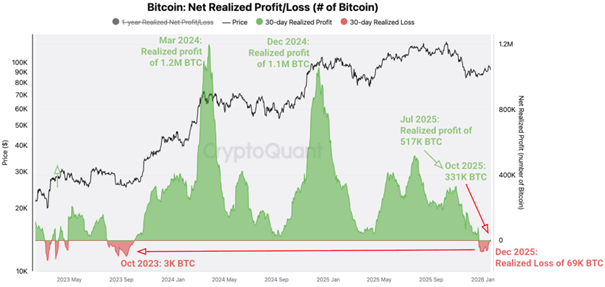
Bitcoin is experiencing a significant structural shift, as indicated by on-chain data showing a net realized loss on a 30-day basis for the first time since October 2023. Unlike the short-lived losses of 2023, the current decline is broader and more persistent, suggesting a change in market dynamics. Investors appear cautious, showing less interest in buying the dip or holding through price fluctuations, and are more willing to accept losses. Additionally,ized profits have sharply declined, dropping from 1.2 million BTC in March 2024 to 517,000 BTC by July 2025, with a further contraction to 331,000 BTC by October. This decline occurred despite rising prices, indicating a lack of strong upward momentum. These trends resemble patterns observed during the late-stage bull market of 2021-2022, which preceded a bearish turn. Bitcoin is currently transitioning from a mature bull phase to a more volatile environment, with its price at $89,462 at the time of writing.

Based on data from the weekly price chart, Bitcoin is witnessing a significant loss of over 6% following recent widespread market liquidations. Notably, the premier cryptocurrency has taken on a consolidatory stance in the past day, as if to lend credence to growing hopes of some price recovery. However, a recent on-chain analysis points out that Bitcoin’s outward show of resilience might merely be theatrical and that the flagship cryptocurrency could be facing a dark future ahead.

Bitcoin Enters 30-Day Cumulative Realized Loss Phase Since October 2023

In a recent Quicktake post on CryptoQuant, crypto education and research group XWIN Research Japan dissects the present on-chain situation of Bitcoin, with the center of attraction being the Bitcoin Net Realized Profit/Loss metric, which shows the leading cryptocurrency has recorded a net realized loss on a 30-day basis for the first time since October 2023.

Source: CryptoQuant

However, the losses seen in 2023 were short-lived and rapidly retraced, unlike the current decline, which is broader and more persistent, suggesting a possible structural shift in market dynamics. At this moment, it appears that investors are less-interested in “buying the dip,” nor are they looking to “HODL” through the Bitcoin price action, and are more willing to accept losses.

For this reason, the market can be more plausibly described as being in a state of caution. It is, however, worth mentioning that the present phase does not necessarily precede a market crash. If anything, it reflects that Bitcoin may be entering a more volatile phase, independent of speculative frenzies.

Realized Profits Signal Late-Stage Of Bull Cycle

XWIN Research further reinforces the hypotheses by referencing the trend in realized profits. According to the market experts, Realized Profits peaked in March 2024 at approximately 1.2 million BTC, and reduced slightly to 1.1 million in December 2024.

As of July, 2025, realized profits had sharply dropped to 517,000 BTC, reflecting an increasing exit of profit-taking activity within the market. But this pales in comparison to the lower 331,000 BTC recorded in October. The analytics group explained that this contraction occurred despite a rise in prices, thus suggesting an absence of deep upside momentum.

The group further highlights that this is a telltale sign of a late-stage bull market, one which was seen in 2021-2022. In this period, realized profits slowly dropped before the Bitcoin price flipped bearish. More shockingly, the annual timeframe tells a similar story, with annual net realized profits contracting from 4.4 million BTC to 2.5 million BTC, just within October 2025 and early 2026. This is also similar to the phase that preceded the bear market of 2022.

In essence, Bitcoin is in a transitioning phase, from a mature bull phase to a volatile environment. As of this writing, the Bitcoin price stands at $89,462.

BTC trading at $89,818 on the daily chart | Source: BTCUSDT chart on Tradingview.com

Featured image from Pexels, chart from Tradingview

Related Questions

QWhat does the Bitcoin Net Realized Profit/Loss metric indicate for the first time since October 2023?

AThe Bitcoin Net Realized Profit/Loss metric indicates that Bitcoin has recorded a net realized loss on a 30-day basis for the first time since October 2023.

QHow does the current market behavior differ from the short-lived losses seen in 2023?

AUnlike the short-lived and rapidly retraced losses in 2023, the current decline is broader and more persistent, suggesting a possible structural shift in market dynamics with investors showing less interest in buying the dip or HODLing.

QWhat trend in realized profits suggests Bitcoin might be in a late-stage bull cycle?

ARealized profits peaked at approximately 1.2 million BTC in March 2024, dropped to 1.1 million in December 2024, and sharply declined to 517,000 BTC by July 2025, with a further drop to 331,000 BTC in October, indicating a contraction despite price rises and signaling a late-stage bull market.

QWhat does the contraction in annual net realized profits from 4.4 million BTC to 2.5 million BTC indicate?

AThe contraction in annual net realized profits from 4.4 million BTC to 2.5 million BTC between October 2025 and early 2026 suggests an absence of deep upside momentum and is similar to the phase that preceded the bear market of 2022.

QWhat is the current state of Bitcoin's market phase according to the on-chain analysis?

ABitcoin is in a transitioning phase from a mature bull phase to a more volatile environment, reflecting caution among investors and a potential structural shift in market dynamics.

Related Reads

The Evolution of Listing Cycles: Yesterday's Wind Won't Fly Today's Kite

The article "The Evolution of Listing Cycle: Yesterday's Wind Can't Fly Today's Kite" uses a dental braces metaphor to describe the structural evolution of cryptocurrency exchange listing processes from 2017 to 2025. It outlines four distinct phases: 1. **Community-Priced Era (2017-2018)**: A chaotic "milk teeth" period where listings were driven by community votes and loud narratives, with exchanges acting as passive platforms seeking user growth. 2. **Exchange-Priced Era (2019-2022)**: The "teeth-growing" phase where exchanges (e.g., via IEOs/Launchpads) became gatekeepers, providing due diligence and using new listings to empower their own ecosystem tokens. 3. **VC-Priced Collapse (2023-2024)**: A "malocclusion" period where high FDV, low float VC deals dominated, causing token prices to peak at launch. Excountered, exchanges intervened with measures like HODLer airdrops to redistribute value to retail users and counter VC dominance. 4. **Market/Derivatives-Priced Era (2025)**: The "orthodontic" phase marked by industrialization. Price discovery shifts to derivatives, with pre-market perpetual合约 trading allowing price formation before spot listing. Mechanisms like Binance Alpha act as a sandbox, requiring projects to prove market resilience. Concurrently, the "listing fee" model evolved: from direct payments to exchanges, to sharing tokens with the exchange's ecosystem, and finally to a current model where projects must allocate a significant portion of their token supply (3-7%) for user airdrops and marketing, effectively making listing a major customer acquisition cost. The core thesis is a transfer of pricing power: from community -> exchange -> VC -> finally to the market itself via sophisticated derivatives. The article concludes that the era of easy gains from simple listings is over, demanding greater professionalism from both projects and traders.

marsbit9m ago

The Evolution of Listing Cycles: Yesterday's Wind Won't Fly Today's Kite

marsbit9m ago

Trading

Spot
Futures

Hot Articles

Discussions

Welcome to the HTX Community. Here, you can stay informed about the latest platform developments and gain access to professional market insights. Users' opinions on the price of S (S) are presented below.

活动图片