Bitcoin Price To Crash Another 50% As Analyst Marks $40,000 Bottom Target

bitcoinistPublished on 2026-01-06Last updated on 2026-01-06

Abstract

Bitcoin has declined over 32.5% from its all-time high above $126,000 and is currently trading above $90,000. However, analyst CryptoBullet predicts a further 50% crash in 2026, potentially driving the price down to around $40,000. This forecast is based on Bitcoin’s Realized Price—the average price at which all coins last moved—which has historically been breached during bear markets. Past cycles saw drawdowns of up to 66% below this level. Due to declining volatility, the analyst expects a less severe drop this cycle, estimating a 24–31% decline below the Realized Price, placing the bottom between $40,000 and $43,000. In an extreme scenario mirroring 2022’s 33% drop, Bitcoin could fall to $37,400 or even $35,000 by late 2026.

The Bitcoin price has already crashed by more than 32.5% from last year’s all-time high above $126,000, toward the $85,000 region. Although the cryptocurrency has recovered slightly and is now trading above $90,000, a crypto analyst has forecast another major price crash in 2026. According to the forecast, Bitcoin could decline by 50%, following trends observed in previous cycles, potentially hitting a bottom near $40,000.

Bitcoin Price Set For 50% Crash

Bitcoin could face another price correction as technical indicators continue to signal a strong bear market. Market expert CryptoBullet warns that Bitcoin’s bear market behavior is not over, with a deeper pullback aligning with long-term on-chain trends.

CryptoBullet bases his outlook on Bitcoin’s Realized Price, a metric that reflects the average price at which all circulating coins last moved. He explained that this level acts as a key reference during bear markets and has historically marked zones where price eventually breaks down before forming a bottom.

Looking at past cycles, he noted that Bitcoin has consistently fallen below its Realized Price during bear markets. The drawdowns reached 66% in 2011, 48% in 2015, 35% in 2018, and 33% in 2022, indicating a consistent tendency for prices to fall below this level. Due to this repeated decline, the analyst believes the next bear-market crash will follow the same pattern, triggering a 50% drop to $40,000 for Bitcoin this year.
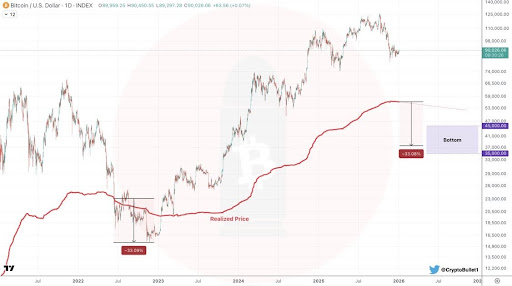
Source: Chart from CryptoBullet on X

Another major factor supporting CryptoBullet’s analysis is Bitcoin’s declining volatility over time. He noted that the gap between market price and Realized Price has steadily narrowed, shrinking from a 66% deviation in 2011 to roughly 33% in 2022.

Because of this trend, the analyst does not expect the bear market this year to be as severe as the downside observed in past cycles. Instead, he estimates Bitcoin could fall by 24% to 31% below Realized Price, placing its likely bottom in the $40,000 to $43,000 range.

Extreme Bear Market Scenario

With the Realized Price currently near $56,000, CryptoBullet has also cautioned that Bitcoin could decline even further to below $40,000 this year. The analyst noted that if the market repeats the 2022 bear market, a 33% drop below Realized Price would place Bitcoin near $37,400.

He added that by the third quarter or fourth quarter of 2026, Realized Price could fall deeper to $53,000 or $54,000, which could result in a similar 33% crash, pushing Bitcoin closer to $35,000. The analyst has stated that $35,000 represents the most extreme downside he can reasonably see this year based on historical behavior. The accompanying chart also reflects this view by highlighting previous bear-market crashes that occurred after the price slipped well below the Realized Price line.

BTC trading at $93,079 on the 1D chart | Source: BTCUSDT on Tradingview.com

Related Questions

QAccording to the analyst CryptoBullet, what is the main reason for predicting a 50% Bitcoin price crash to $40,000?

AThe prediction is based on Bitcoin's historical behavior of consistently falling below its Realized Price during bear markets, with the gap between market price and Realized Price having narrowed over time.

QWhat is the 'Realized Price' metric and why is it significant in this analysis?

AThe Realized Price is a metric that reflects the average price at which all circulating Bitcoin last moved. It acts as a key reference during bear markets and has historically marked zones where the price eventually breaks down before forming a bottom.

QWhat are the historical drawdown percentages below the Realized Price that the analyst cites for previous bear markets?

AThe historical drawdowns were 66% in 2011, 48% in 2015, 35% in 2018, and 33% in 2022.

QWhat is the most extreme downside price target for Bitcoin mentioned in the article, and under what scenario could it occur?

AThe most extreme downside target is $35,000. This could occur if the 2026 bear market repeats the 33% drop below the Realized Price seen in 2022, especially if the Realized Price itself falls to around $53,000-$54,000 by late 2026.

QHow does the analyst explain the decreasing severity of Bitcoin's bear market crashes over time?

AThe analyst notes that Bitcoin's declining volatility over time has caused the gap between its market price and Realized Price to steadily narrow, shrinking from a 66% deviation in 2011 to roughly 33% in 2022, making severe crashes less likely.

Related Reads

You Bet on the News, the Pros Read the Rules: The True Cognitive Gap in Losing Money on Polymarket

The article explains that the key to profiting on Polymarket, a prediction market platform, lies not just predicting real-world events correctly, but in meticulously understanding the specific rules that govern how each market will be resolved. It illustrates this with examples, such as a market on Venezuela's 2026 leader, where the official rules defining "officially holds" the office overruled the intuitive answer of who was in practical control. Other examples include debates over the definition of a "token" or what constitutes an "agreement." The core argument is that a "reality vs. rules" gap creates pricing discrepancies that savvy traders ("车头" or "whales") exploit. The platform has a formal dispute resolution process managed by UMA token holders to settle ambiguous outcomes. This process involves proposal submission, a challenge window, a discussion period, and a final vote. However, the article highlights a critical flaw in this system compared to a traditional court: the lack of separation between the arbiters (UMA voters) and the interested parties (traders with financial stakes in the outcome). This conflict of interest undermines the discussion phase, leads to herd mentality, and results in opaque final decisions without explanatory rulings. Consequently, the system lacks a body of precedent, making it difficult for users to learn from past disputes. The ultimate takeaway is that success on Polymarket requires a lawyer-like scrutiny of the rules to identify and capitalize on the cognitive gap between how events appear and how they are contractually defined for settlement.

marsbit1h ago

You Bet on the News, the Pros Read the Rules: The True Cognitive Gap in Losing Money on Polymarket

marsbit1h ago

Trading

Spot
Futures

Hot Articles

What is $BITCOIN

DIGITAL GOLD ($BITCOIN): A Comprehensive Analysis Introduction to DIGITAL GOLD ($BITCOIN) DIGITAL GOLD ($BITCOIN) is a blockchain-based project operating on the Solana network, which aims to combine the characteristics of traditional precious metals with the innovation of decentralized technologies. While it shares a name with Bitcoin, often referred to as “digital gold” due to its perception as a store of value, DIGITAL GOLD is a separate token designed to create a unique ecosystem within the Web3 landscape. Its goal is to position itself as a viable alternative digital asset, although specifics regarding its applications and functionalities are still developing. What is DIGITAL GOLD ($BITCOIN)? DIGITAL GOLD ($BITCOIN) is a cryptocurrency token explicitly designed for use on the Solana blockchain. In contrast to Bitcoin, which provides a widely recognized value storage role, this token appears to focus on broader applications and characteristics. Notable aspects include: Blockchain Infrastructure: The token is built on the Solana blockchain, known for its capacity to handle high-speed and low-cost transactions. Supply Dynamics: DIGITAL GOLD has a maximum supply capped at 100 quadrillion tokens (100P $BITCOIN), although details regarding its circulating supply are currently undisclosed. Utility: While precise functionalities are not explicitly outlined, there are indications that the token could be utilized for various applications, potentially involving decentralized applications (dApps) or asset tokenization strategies. Who is the Creator of DIGITAL GOLD ($BITCOIN)? At present, the identity of the creators and development team behind DIGITAL GOLD ($BITCOIN) remains unknown. This situation is typical among many innovative projects within the blockchain space, particularly those aligning with decentralized finance and meme coin phenomena. While such anonymity may foster a community-driven culture, it intensifies concerns about governance and accountability. Who are the Investors of DIGITAL GOLD ($BITCOIN)? The available information indicates that DIGITAL GOLD ($BITCOIN) does not have any known institutional backers or prominent venture capital investments. The project seems to operate on a peer-to-peer model focused on community support and adoption rather than traditional funding routes. Its activity and liquidity are primarily situated on decentralized exchanges (DEXs), such as PumpSwap, rather than established centralized trading platforms, further highlighting its grassroots approach. How DIGITAL GOLD ($BITCOIN) Works The operational mechanics of DIGITAL GOLD ($BITCOIN) can be elaborated on based on its blockchain design and network attributes: Consensus Mechanism: By leveraging Solana’s unique proof-of-history (PoH) combined with a proof-of-stake (PoS) model, the project ensures efficient transaction validation contributing to the network's high performance. Tokenomics: While specific deflationary mechanisms have not been extensively detailed, the vast maximum token supply implies that it may cater to microtransactions or niche use cases that are still to be defined. Interoperability: There exists the potential for integration with Solana’s broader ecosystem, including various decentralized finance (DeFi) platforms. However, the details regarding specific integrations remain unspecified. Timeline of Key Events Here is a timeline that highlights significant milestones concerning DIGITAL GOLD ($BITCOIN): 2023: The initial deployment of the token occurs on the Solana blockchain, marked by its contract address. 2024: DIGITAL GOLD gains visibility as it becomes available for trading on decentralized exchanges like PumpSwap, allowing users to trade it against SOL. 2025: The project witnesses sporadic trading activity and potential interest in community-led engagements, although no noteworthy partnerships or technical advancements have been documented as of yet. Critical Analysis Strengths Scalability: The underlying Solana infrastructure supports high transaction volumes, which could enhance the utility of $BITCOIN in various transaction scenarios. Accessibility: The potential low trading price per token could attract retail investors, facilitating wider participation due to fractional ownership opportunities. Risks Lack of Transparency: The absence of publicly known backers, developers, or an audit process may yield skepticism regarding the project's sustainability and trustworthiness. Market Volatility: The trading activity is heavily reliant on speculative behavior, which can result in significant price volatility and uncertainty for investors. Conclusion DIGITAL GOLD ($BITCOIN) emerges as an intriguing yet ambiguous project within the rapidly evolving Solana ecosystem. While it attempts to leverage the “digital gold” narrative, its departure from Bitcoin's established role as a store of value underscores the need for a clearer differentiation of its intended utility and governance structure. Future acceptance and adoption will likely depend on addressing the current opacity and defining its operational and economic strategies more explicitly. Note: This report encompasses synthesised information available as of October 2023, and developments may have transpired beyond the research period.

363 Total ViewsPublished 2025.05.13Updated 2025.05.13

What is $BITCOIN

Discussions

Welcome to the HTX Community. Here, you can stay informed about the latest platform developments and gain access to professional market insights. Users' opinions on the price of BTC (BTC) are presented below.

活动图片