Bitcoin Pattern From 2022 That Led To Crash To $20,000 Reappears

bitcoinistPublished on 2026-01-24Last updated on 2026-01-24

Abstract

A technical analysis by Crypto Bullet suggests Bitcoin is mirroring a pattern from its 2022 cycle that preceded a major crash to $20,000. The current setup shows BTC retesting and getting rejected at the 100-day Moving Average (MA100), then pulling back to a support zone within an ascending channel, similar to 2022. After a short-term recovery that could push the price to $102,000, the analyst predicts a dramatic 23.5% crash to around $68,450, as downside momentum accelerates if Bitcoin fails to reclaim the 200-day Moving Average (MA200) as support. Another analyst, Tyrex, notes consolidation above $89,000 and a potential rally to $92,000, but warns the broader market sentiment is fearful despite a forming ascending channel.

Bitcoin (BTC) is mirroring the same setup from its 2022 bull cycle, which led to a massive price crash to $20,000. According to market expert Crypto Bullet, this recurring structure could signal another major correction for BTC ahead. However, this time the leading cryptocurrency could give up almost a quarter of its current value.

2022 Bitcoin Chart Pattern Signals Over 20% Crash

In his technical analysis released on X, Crypto Bullet revealed that Bitcoin is currently repeating a 2022 structure that could lead to a more than 20% decline in its value. To support his bearish outlook, the analyst presented a parallel chart comparing Bitcoin’s price action from 2023-2022 and 2025-2026, highlighting similar technical patterns, price behavior, and Moving Averages (MA).

During the 2022 cycle, Bitcoin experienced a similar pattern, beginning with a test of the 100-day Moving Average (MA100), highlighted as the blue trendline on the chart. After facing rejection at that level, the price pulled back to a nearby support zone inside a rising channel. From there, BTC staged a sharp rally, surging to fresh highs around $48,500, where it aligned with the 200-day Moving Average (MA200), marked in orange.
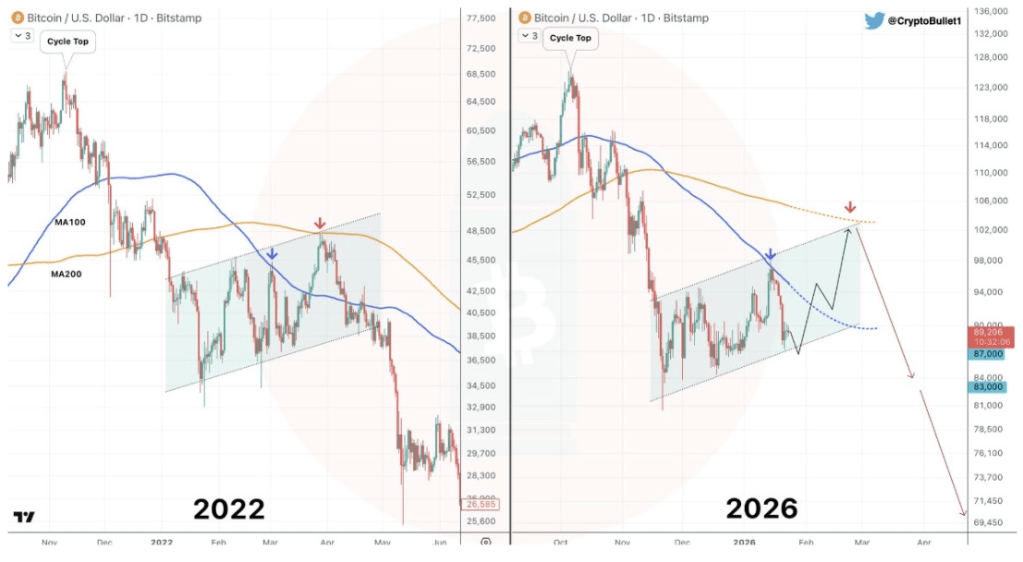
However, the recovery proved short-lived. Bitcoin soon reversed course and failed to reclaim the MA200 as support. Once the cryptocurrency’s price structure was lost, downside momentum accelerated, pushing the price into a much deeper correction toward the $20,000 level.

According to Crypto Bullet, Bitcoin is repeating this exact pattern in 2026. It has already retested the MA100, gotten rejected, and moved lower into a support zone within a similar ascending channel. The chart also showed that in both cycles, BTC reached a “market cycle top,” first around December 2023 and then again in November 2025, before breaking down and entering a consolidation phase.

BTCUSD currently trading at $89,361. Chart: TradingView

Given how closely Bitcoin is mirroring its 2022 setup, Crypto Bullet has forecast another dramatic price crash, predicting a more than 23.5% drop from its current price near $89,500 to $68,450. Before this decline happens, the analyst expects BTC to experience a short-term recovery, potentially climbing back above the $100,000 psychological level to reach $102,000.

Bitcoin Could Still Rally To $92,000

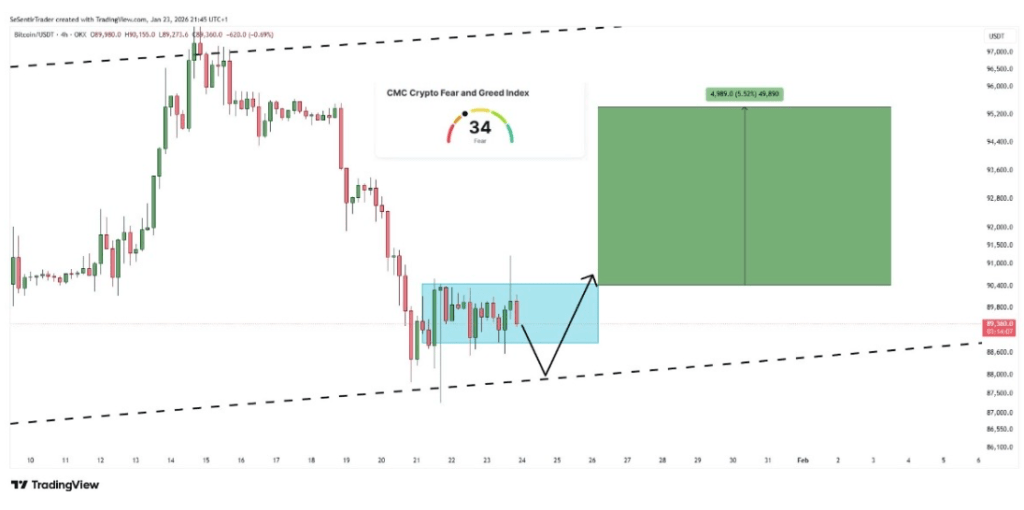
Crypto analyst Tyrex has stated that Bitcoin has been consolidating for the past 48 hours, with price holding above $89,000 for most of that period. Despite the muted price action, he believes that BTC could soon rally to $92,000. The analyst also noted that the broader market is in a state of fear, with many traders anticipating further declines in Bitcoin.

However, the analyst cautions that this expected drop may be a trap. He points out that an ascending channel is forming on Bitcoin’s chart, prompting him to adopt a more bullish outlook despite the prevailing bearish sentiment and sideways price movement.
Featured image from Unsplash, chart from TradingView


Related Questions

QWhat specific pattern from 2022 is Bitcoin currently mirroring according to Crypto Bullet?

ABitcoin is mirroring the same setup from its 2022 bull cycle, which involves a test and rejection at the 100-day Moving Average (MA100), a pullback to a support zone, a sharp rally to new highs near the 200-day Moving Average (MA200), followed by a reversal and a deep price crash.

QWhat is the potential downside target for Bitcoin's price if the 2022 pattern repeats, as forecast by Crypto Bullet?

ACrypto Bullet forecasts a more than 23.5% drop from the current price near $89,500, with a downside target of $68,450.

QWhat short-term price movement does Crypto Bullet expect to occur before the predicted major correction?

ABefore the predicted decline, Crypto Bullet expects Bitcoin to experience a short-term recovery, potentially climbing back above the $100,000 psychological level to reach $102,000.

QWhat is analyst Tyrex's short-term price target for Bitcoin, and what chart pattern does he cite for his outlook?

AAnalyst Tyrex believes Bitcoin could soon rally to $92,000, citing an ascending channel that is forming on Bitcoin's chart as the reason for his more bullish outlook.

QWhat key moving averages are central to the technical analysis presented in the article?

AThe 100-day Moving Average (MA100) and the 200-day Moving Average (MA200) are central to the analysis, with the pattern involving rejection at the MA100 and a rally to the MA200 before a reversal.

Related Reads

The Evolution of Listing Cycles: Yesterday's Wind Won't Fly Today's Kite

The article "The Evolution of Listing Cycle: Yesterday's Wind Can't Fly Today's Kite" uses a dental braces metaphor to describe the structural evolution of cryptocurrency exchange listing processes from 2017 to 2025. It outlines four distinct phases: 1. **Community-Priced Era (2017-2018)**: A chaotic "milk teeth" period where listings were driven by community votes and loud narratives, with exchanges acting as passive platforms seeking user growth. 2. **Exchange-Priced Era (2019-2022)**: The "teeth-growing" phase where exchanges (e.g., via IEOs/Launchpads) became gatekeepers, providing due diligence and using new listings to empower their own ecosystem tokens. 3. **VC-Priced Collapse (2023-2024)**: A "malocclusion" period where high FDV, low float VC deals dominated, causing token prices to peak at launch. Excountered, exchanges intervened with measures like HODLer airdrops to redistribute value to retail users and counter VC dominance. 4. **Market/Derivatives-Priced Era (2025)**: The "orthodontic" phase marked by industrialization. Price discovery shifts to derivatives, with pre-market perpetual合约 trading allowing price formation before spot listing. Mechanisms like Binance Alpha act as a sandbox, requiring projects to prove market resilience. Concurrently, the "listing fee" model evolved: from direct payments to exchanges, to sharing tokens with the exchange's ecosystem, and finally to a current model where projects must allocate a significant portion of their token supply (3-7%) for user airdrops and marketing, effectively making listing a major customer acquisition cost. The core thesis is a transfer of pricing power: from community -> exchange -> VC -> finally to the market itself via sophisticated derivatives. The article concludes that the era of easy gains from simple listings is over, demanding greater professionalism from both projects and traders.

marsbit5m ago

The Evolution of Listing Cycles: Yesterday's Wind Won't Fly Today's Kite

marsbit5m ago

Trading

Spot
Futures

Hot Articles

What is $BITCOIN

DIGITAL GOLD ($BITCOIN): A Comprehensive Analysis Introduction to DIGITAL GOLD ($BITCOIN) DIGITAL GOLD ($BITCOIN) is a blockchain-based project operating on the Solana network, which aims to combine the characteristics of traditional precious metals with the innovation of decentralized technologies. While it shares a name with Bitcoin, often referred to as “digital gold” due to its perception as a store of value, DIGITAL GOLD is a separate token designed to create a unique ecosystem within the Web3 landscape. Its goal is to position itself as a viable alternative digital asset, although specifics regarding its applications and functionalities are still developing. What is DIGITAL GOLD ($BITCOIN)? DIGITAL GOLD ($BITCOIN) is a cryptocurrency token explicitly designed for use on the Solana blockchain. In contrast to Bitcoin, which provides a widely recognized value storage role, this token appears to focus on broader applications and characteristics. Notable aspects include: Blockchain Infrastructure: The token is built on the Solana blockchain, known for its capacity to handle high-speed and low-cost transactions. Supply Dynamics: DIGITAL GOLD has a maximum supply capped at 100 quadrillion tokens (100P $BITCOIN), although details regarding its circulating supply are currently undisclosed. Utility: While precise functionalities are not explicitly outlined, there are indications that the token could be utilized for various applications, potentially involving decentralized applications (dApps) or asset tokenization strategies. Who is the Creator of DIGITAL GOLD ($BITCOIN)? At present, the identity of the creators and development team behind DIGITAL GOLD ($BITCOIN) remains unknown. This situation is typical among many innovative projects within the blockchain space, particularly those aligning with decentralized finance and meme coin phenomena. While such anonymity may foster a community-driven culture, it intensifies concerns about governance and accountability. Who are the Investors of DIGITAL GOLD ($BITCOIN)? The available information indicates that DIGITAL GOLD ($BITCOIN) does not have any known institutional backers or prominent venture capital investments. The project seems to operate on a peer-to-peer model focused on community support and adoption rather than traditional funding routes. Its activity and liquidity are primarily situated on decentralized exchanges (DEXs), such as PumpSwap, rather than established centralized trading platforms, further highlighting its grassroots approach. How DIGITAL GOLD ($BITCOIN) Works The operational mechanics of DIGITAL GOLD ($BITCOIN) can be elaborated on based on its blockchain design and network attributes: Consensus Mechanism: By leveraging Solana’s unique proof-of-history (PoH) combined with a proof-of-stake (PoS) model, the project ensures efficient transaction validation contributing to the network's high performance. Tokenomics: While specific deflationary mechanisms have not been extensively detailed, the vast maximum token supply implies that it may cater to microtransactions or niche use cases that are still to be defined. Interoperability: There exists the potential for integration with Solana’s broader ecosystem, including various decentralized finance (DeFi) platforms. However, the details regarding specific integrations remain unspecified. Timeline of Key Events Here is a timeline that highlights significant milestones concerning DIGITAL GOLD ($BITCOIN): 2023: The initial deployment of the token occurs on the Solana blockchain, marked by its contract address. 2024: DIGITAL GOLD gains visibility as it becomes available for trading on decentralized exchanges like PumpSwap, allowing users to trade it against SOL. 2025: The project witnesses sporadic trading activity and potential interest in community-led engagements, although no noteworthy partnerships or technical advancements have been documented as of yet. Critical Analysis Strengths Scalability: The underlying Solana infrastructure supports high transaction volumes, which could enhance the utility of $BITCOIN in various transaction scenarios. Accessibility: The potential low trading price per token could attract retail investors, facilitating wider participation due to fractional ownership opportunities. Risks Lack of Transparency: The absence of publicly known backers, developers, or an audit process may yield skepticism regarding the project's sustainability and trustworthiness. Market Volatility: The trading activity is heavily reliant on speculative behavior, which can result in significant price volatility and uncertainty for investors. Conclusion DIGITAL GOLD ($BITCOIN) emerges as an intriguing yet ambiguous project within the rapidly evolving Solana ecosystem. While it attempts to leverage the “digital gold” narrative, its departure from Bitcoin's established role as a store of value underscores the need for a clearer differentiation of its intended utility and governance structure. Future acceptance and adoption will likely depend on addressing the current opacity and defining its operational and economic strategies more explicitly. Note: This report encompasses synthesised information available as of October 2023, and developments may have transpired beyond the research period.

363 Total ViewsPublished 2025.05.13Updated 2025.05.13

Discussions

Welcome to the HTX Community. Here, you can stay informed about the latest platform developments and gain access to professional market insights. Users' opinions on the price of BTC (BTC) are presented below.

活动图片














