Bitcoin Miners Are Under Heavy Profit Pressure, CoinShares Finds

bitcoinistPublished on 2026-03-27Last updated on 2026-03-27

Abstract

CoinShares' Q1 2026 report reveals Bitcoin miners are under severe financial pressure due to falling BTC prices, low hashprice, and intense competition, pushing many toward breakeven or losses. The weighted average cash cost to produce one BTC rose to nearly $80,000 in Q4 2025. Hashprice dropped significantly to $29/PH/s/day in Q1, causing miner capitulation and three consecutive negative difficulty adjustments. Approximately 15-20% of the global mining fleet is now unprofitable. Public miners have sold over 15,000 BTC from their treasuries, with some liquidating holdings entirely. The sector is diverging: some remain focused on Bitcoin, while others pivot to AI and high-performance computing, with AI revenue potentially reaching 70% by end-2026. This shift introduces new risks as companies take on substantial debt to fund AI expansions.

Bitcoin miners are coming under acute financial strain as weaker bitcoin prices, compressed hashprice and elevated network competition push much of the sector toward breakeven or below, according to CoinShares’ Q1 2026 mining report. For public miners in particular, the pressure is no longer just cyclical. It is increasingly shaping business models, treasury policy and capital structure across the industry.

CoinShares said Q4 2025 was “the most challenging quarter for Bitcoin miners since the April 2024 halving,” with BTC sliding from an all-time high of about $124,500 in early October to roughly $86,000 by late December, a drawdown of around 31%. Against that backdrop, the weighted average cash cost to produce one bitcoin among publicly listed miners rose to about $79,995 in Q4 2025.

Bitcoin Miners Are Facing A Serious Profitability Crunch

The squeeze has intensified further in early 2026. CoinShares wrote that hashprice fell to about $36–38 per PH/s/day in Q4 and then dropped “significantly further” to $29 in Q1, implying “further pain” ahead for miners. The report also pointed to three consecutive negative difficulty adjustments, the first such streak since July 2022, as a sign of miner capitulation.

CoinShares framed the pressure in unusually direct terms. “The hash price environment has deteriorated beyond our prior expectations, briefly touching ~$28/PH/s/day in late February before recovering to ~$30-35 at the time of writing,” the report said. “At these levels, miners running mid-generation hardware need access to sub-5c/kWh power to remain cash-profitable, while latest-generation fleets (sub-15 J/TH) retain meaningful margin at typical industrial electricity rates.” “We expect further capitulation among higher-cost operators in H1 2026 unless BTC price recovers materially.”

That economics gap is now wide enough to knock a meaningful chunk of the global fleet out of profitability. CoinShares estimated that at a hashprice of $30/PH/s/day, any miner running hardware below an S19 XP with electricity costs at or above 6 cents per kWh is losing money. By its estimate, that covers roughly 15% to 20% of the global mining fleet.

The result is visible in balance sheets and treasury behavior. CoinShares said public miners have collectively reduced BTC treasuries by more than 15,000 BTC from peak levels. It highlighted Core Scientific selling around 1,900 BTC, or about $175 million, in January alone and planning to liquidate substantially all remaining holdings in Q1 2026, while Bitdeer cut its treasury to zero in February and Riot sold 1,818 BTC, roughly $162 million, in December 2025.

At the same time, the report argues that the sector is splitting into two increasingly distinct groups: miners that remain focused on bitcoin production and operators using mining infrastructure as a bridge into AI and HPC.

CoinShares said more than $70 billion in cumulative AI and HPC contracts have now been announced across the public mining sector, with WULF, CORZ, CIFR and HUT “effectively becoming data centre operators that happen to mine Bitcoin.” It added that listed miners could derive as much as 70% of revenue from AI by the end of 2026, up from roughly 30% today.

That pivot comes with its own risk profile. CoinShares said leverage has risen sharply as some miners finance AI buildouts with large debt loads, citing IREN’s $3.7 billion in convertible notes, WULF’s $5.7 billion in total debt and CIFR’s $1.7 billion in senior secured notes. In the report’s view, the sector’s aggregate leverage has “fundamentally changed its risk profile,” even as the market rewards AI-linked operators with richer valuation multiples than pure-play miners.

At press time, BTC traded at $67,850.
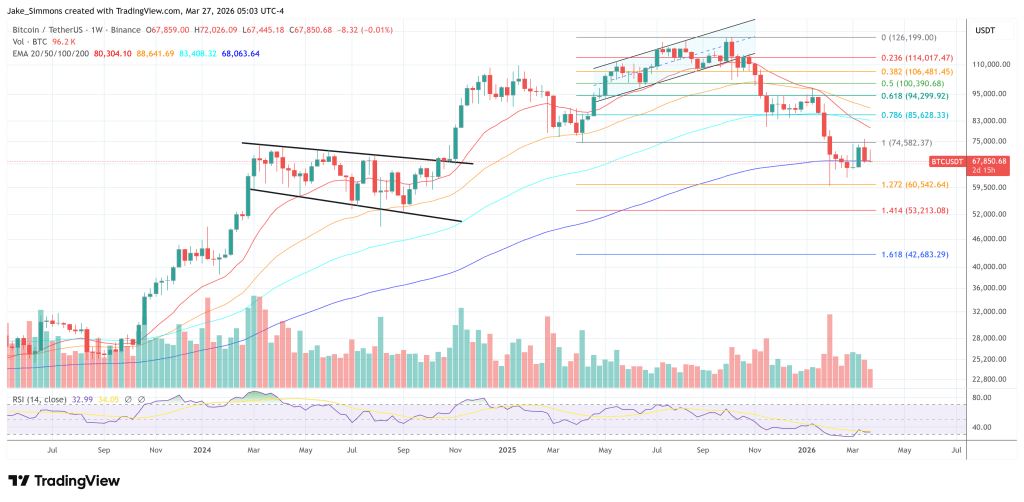
Bitcoin must break above $74,500 1-week chart | Source: BTCUSDT on TradingView.com

Related Questions

QWhat are the main factors putting Bitcoin miners under acute financial strain according to CoinShares' report?

AWeaker bitcoin prices, compressed hashprice, and elevated network competition are the main factors pushing much of the sector toward breakeven or below.

QWhat was the weighted average cash cost to produce one bitcoin among public miners in Q4 2025?

AThe weighted average cash cost to produce one bitcoin among publicly listed miners rose to about $79,995 in Q4 2025.

QWhat does CoinShares estimate is the percentage of the global mining fleet that is losing money at a hashprice of $30/PH/s/day?

ACoinShares estimates that roughly 15% to 20% of the global mining fleet is losing money at a hashprice of $30/PH/s/day.

QHow are some public miners pivoting their business models to address profitability challenges?

ASome public miners are pivoting by using their mining infrastructure as a bridge into AI and High-Performance Computing (HPC), with some companies effectively becoming data centre operators.

QWhat significant change in treasury behavior did CoinShares observe among public miners?

ACoinShares observed that public miners have collectively reduced their BTC treasuries by more than 15,000 BTC from peak levels, with some companies like Core Scientific, Bitdeer, and Riot selling large portions of their holdings.

Related Reads

How Many Tokens Away Is Yang Zhilin from the 'Moon Chasing the Light'?

The article explores the intense competition between two leading Chinese AI companies, DeepSeek and Kimi (Moon Dark Side), and the mounting pressure on Yang Zhilin, the founder of Kimi. While DeepSeek re-emerged after 15 months of silence with its powerful V4 model—boasting 1.6 trillion parameters and low-cost, long-context capabilities—Kimi has been focusing on long-context processing and multi-agent systems with its K2.6 model. Yang faces a threefold challenge: technological rivalry, commercialization pressure, and investor expectations. Despite Kimi’s high valuation (reaching $18 billion), its revenue heavily relies on a single product with low paid conversion rates, while DeepSeek’s strategic silence and open-source influence have strengthened its market position and valuation prospects, now targeting over $20 billion. Both companies reflect broader trends in China’s AI ecosystem: Kimi aims for global influence through open-source contributions and agent-based advancements, while DeepSeek prioritizes foundational innovation and hardware independence, notably shifting to Huawei’s chips. Their competition is seen as vital for China’s AI progress, with the gap between top Chinese and U.S. models narrowing to just 2.7% on the Elo rating scale. Ultimately, the article argues that this rivalry, though anxiety-inducing for leaders like Zhilin, is essential for driving innovation and solidifying China’s role in the global AI landscape.

marsbit20m ago

How Many Tokens Away Is Yang Zhilin from the 'Moon Chasing the Light'?

marsbit20m ago

TechFlow Intelligence Bureau: ChatGPT Helps Amateur Mathematician Crack 60-Year-Old Problem, CFTC Sues New York Regulator Over Coinbase and Gemini

An amateur mathematician, with the assistance of ChatGPT, has solved a combinatorial mathematics puzzle originally proposed by Hungarian mathematician Paul Erdős in the 1960s. This marks another milestone in AI-aided mathematical research, demonstrating the evolving capabilities of large language models in formal reasoning. In other AI developments, OpenAI introduced a new privacy filter tool for enterprise API usage, automatically screening sensitive data. Meanwhile, the Qwen3.6-27B model achieved 100 tokens per second on a single RTX 5090 GPU using quantization, significantly lowering the cost barrier for local AI deployment. In crypto and Web3, the U.S. CFTC sued New York’s financial regulator, challenging its oversight of Coinbase and Gemini—a first-of-its-kind federal-state regulatory clash. Following a vulnerability, KelpDAO and major DeFi protocols established a recovery fund. Tether froze $344 million in assets linked to Iran’s central bank upon U.S. Treasury request, highlighting the centralized control risks in stablecoins. Separately, Litecoin underwent a 3-hour chain reorganization to undo a privacy-layer exploit. In the U.S., former President Trump invoked the Defense Production Act to address power grid bottlenecks affecting AI data centers and dismissed the entire National Science Board, raising concerns over research independence. A retail trader gained 250% on a $600k Intel options bet amid AI-related speculation. Xiaomi announced its first performance electric vehicle, targeting rivals like Tesla. Meanwhile, iPhone users reported devices automatically reinstalling a hidden app daily, suspected to be MDM-related. A Chinese securities report noted that A-share institutional crowding has reached its second-longest streak since 2007, signaling high valuations and potential style rotation. The day’s developments reflect a dual narrative: AI is enabling unprecedented individual breakthroughs, while centralized power structures—whether governmental or corporate—are becoming more assertive, underscoring that decentralization is as much a political-economic challenge as a technical one.

marsbit43m ago

TechFlow Intelligence Bureau: ChatGPT Helps Amateur Mathematician Crack 60-Year-Old Problem, CFTC Sues New York Regulator Over Coinbase and Gemini

marsbit43m ago

Trading

Spot
Futures

Hot Articles

What is $BITCOIN

DIGITAL GOLD ($BITCOIN): A Comprehensive Analysis Introduction to DIGITAL GOLD ($BITCOIN) DIGITAL GOLD ($BITCOIN) is a blockchain-based project operating on the Solana network, which aims to combine the characteristics of traditional precious metals with the innovation of decentralized technologies. While it shares a name with Bitcoin, often referred to as “digital gold” due to its perception as a store of value, DIGITAL GOLD is a separate token designed to create a unique ecosystem within the Web3 landscape. Its goal is to position itself as a viable alternative digital asset, although specifics regarding its applications and functionalities are still developing. What is DIGITAL GOLD ($BITCOIN)? DIGITAL GOLD ($BITCOIN) is a cryptocurrency token explicitly designed for use on the Solana blockchain. In contrast to Bitcoin, which provides a widely recognized value storage role, this token appears to focus on broader applications and characteristics. Notable aspects include: Blockchain Infrastructure: The token is built on the Solana blockchain, known for its capacity to handle high-speed and low-cost transactions. Supply Dynamics: DIGITAL GOLD has a maximum supply capped at 100 quadrillion tokens (100P $BITCOIN), although details regarding its circulating supply are currently undisclosed. Utility: While precise functionalities are not explicitly outlined, there are indications that the token could be utilized for various applications, potentially involving decentralized applications (dApps) or asset tokenization strategies. Who is the Creator of DIGITAL GOLD ($BITCOIN)? At present, the identity of the creators and development team behind DIGITAL GOLD ($BITCOIN) remains unknown. This situation is typical among many innovative projects within the blockchain space, particularly those aligning with decentralized finance and meme coin phenomena. While such anonymity may foster a community-driven culture, it intensifies concerns about governance and accountability. Who are the Investors of DIGITAL GOLD ($BITCOIN)? The available information indicates that DIGITAL GOLD ($BITCOIN) does not have any known institutional backers or prominent venture capital investments. The project seems to operate on a peer-to-peer model focused on community support and adoption rather than traditional funding routes. Its activity and liquidity are primarily situated on decentralized exchanges (DEXs), such as PumpSwap, rather than established centralized trading platforms, further highlighting its grassroots approach. How DIGITAL GOLD ($BITCOIN) Works The operational mechanics of DIGITAL GOLD ($BITCOIN) can be elaborated on based on its blockchain design and network attributes: Consensus Mechanism: By leveraging Solana’s unique proof-of-history (PoH) combined with a proof-of-stake (PoS) model, the project ensures efficient transaction validation contributing to the network's high performance. Tokenomics: While specific deflationary mechanisms have not been extensively detailed, the vast maximum token supply implies that it may cater to microtransactions or niche use cases that are still to be defined. Interoperability: There exists the potential for integration with Solana’s broader ecosystem, including various decentralized finance (DeFi) platforms. However, the details regarding specific integrations remain unspecified. Timeline of Key Events Here is a timeline that highlights significant milestones concerning DIGITAL GOLD ($BITCOIN): 2023: The initial deployment of the token occurs on the Solana blockchain, marked by its contract address. 2024: DIGITAL GOLD gains visibility as it becomes available for trading on decentralized exchanges like PumpSwap, allowing users to trade it against SOL. 2025: The project witnesses sporadic trading activity and potential interest in community-led engagements, although no noteworthy partnerships or technical advancements have been documented as of yet. Critical Analysis Strengths Scalability: The underlying Solana infrastructure supports high transaction volumes, which could enhance the utility of $BITCOIN in various transaction scenarios. Accessibility: The potential low trading price per token could attract retail investors, facilitating wider participation due to fractional ownership opportunities. Risks Lack of Transparency: The absence of publicly known backers, developers, or an audit process may yield skepticism regarding the project's sustainability and trustworthiness. Market Volatility: The trading activity is heavily reliant on speculative behavior, which can result in significant price volatility and uncertainty for investors. Conclusion DIGITAL GOLD ($BITCOIN) emerges as an intriguing yet ambiguous project within the rapidly evolving Solana ecosystem. While it attempts to leverage the “digital gold” narrative, its departure from Bitcoin's established role as a store of value underscores the need for a clearer differentiation of its intended utility and governance structure. Future acceptance and adoption will likely depend on addressing the current opacity and defining its operational and economic strategies more explicitly. Note: This report encompasses synthesised information available as of October 2023, and developments may have transpired beyond the research period.

363 Total ViewsPublished 2025.05.13Updated 2025.05.13

What is $BITCOIN

Discussions

Welcome to the HTX Community. Here, you can stay informed about the latest platform developments and gain access to professional market insights. Users' opinions on the price of BTC (BTC) are presented below.

活动图片