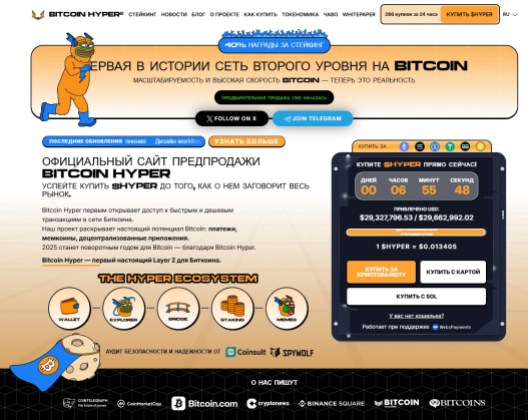
Bitcoin Hyper Raises $29.5M — Market Believes Bitcoin's Development Will Extend Beyond the Main Network

bitcoinistPublished on 2025-12-16Last updated on 2025-12-16

Abstract

Bitcoin faces a core paradox: its growing value as a "trust base" increases the desire to use it for payments, DeFi, and on-chain products, but its base layer is slow, limited, and expensive. This has reignited the 2025 narrative around Bitcoin Layer 2 (L2) solutions, driven by user experience demands and economic concerns over low transaction fees threatening miner revenue post-halving. Against this backdrop, projects like Bitcoin Hyper are gaining significant attention and investment. It recently raised $29.5 million in a presale by betting on a specific technical approach: integrating the Solana Virtual Machine (SVM) to create a high-speed Bitcoin L2. Its promise is extremely low-latency smart contract execution, potentially "faster than Solana," targeting DeFi, gaming, and high-frequency use cases. Architecturally, it follows a modular design where Bitcoin L1 provides base-layer security while computations are off-chain in L2. A key compromise is its use of a single trusted sequencer, introducing centralization risks, but the market currently seems to prioritize speed and ecosystem growth over perfect decentralization. The substantial investment signals strong demand for the narrative of combining Bitcoin's security with fast, scalable smart contracts, with success ultimately hinging on bridge quality, real-world performance, and developer adoption.

Bitcoin once again faces its own paradox: the more valuable it becomes as a "trust base," the stronger the desire to use it not just as a store of value, but also for payments, DeFi, and on-chain products. And here the problems begin. The base layer of Bitcoin is by design slow, limited in throughput, and expensive during periods of high congestion. You can't get very far on it. Yes, there are windows of a "cheap" mempool—but the market has already realized that a stable UX model isn't built on luck.

In 2025, this topic is even louder due to the debate around the network's "fee future." When fees fall, users are happy, miners are not, and this raises unpleasant questions about the long-term sustainability of the security model after the halving. Cointelegraph, citing Galaxy Digital, reported that Bitcoin's daily fees have plummeted by over 80% compared to April 2024, with some blocks being virtually "almost free."

Against this backdrop, the attention on Bitcoin Layer 2 and the infrastructure around $BTC looks not like a trend, but like pragmatism. If liquidity and trust are in Bitcoin, then where will the "fast" financial layer be executed? This is precisely why stories like Bitcoin Hyper are generating demand even before the product's release: the market is buying not just a token, but a bet on an architectural shift—execution off L1, final security via L1.

BUY BITCOIN HYPER

Why the Bitcoin Layer 2 Narrative is Returning in 2025

The rally in interest in Bitcoin L2 is fueled by two forces simultaneously: UX and economics. UX—because users and builders are accustomed to near-instant confirmations and penny fees in other ecosystems. Economics—because an "empty mempool" sounds good until you ask the question: what will sustain the fee market in the long run? Hence the growth in discussions about the thesis of moving activity, which generates fees and retains users, into "add-ons" around Bitcoin.

In the competitive field, an interesting stratification is also occurring. Some teams are moving towards the BitVM/zk-narratives and bridges, trying to minimize trust in bridges and increase the security of exiting to $BTC. For example, Citrea in 2025 rolled out major testnet upgrades and worked on a BitVM-based bridge architecture, while simultaneously reducing system-level fees.

Other ecosystems are betting on "Bitcoin-oriented" smart contracts and accelerating transaction execution on top of Bitcoin settlement (Stacks has historically moved in this direction through major upgrades). In this landscape, Bitcoin Hyper is another betting option, but with a different technical intonation: speed and a developer stack as the main hook. And, to be honest, this is what currently "sells" best to developers: less waiting, more results.

Why SVM on Bitcoin Could Become a Real Demand Magnet

Bitcoin Hyper's bet is extremely clear (and slightly audacious): bring the Solana Virtual Machine (SVM) to Bitcoin Layer 2 and achieve smart contract execution with extremely low latency—the project directly promises performance "faster than Solana." This is important because for DeFi, games, and high-frequency scenarios, latency is not a cosmetic issue but the economics of the product: arbitrage, liquidations, MEV dynamics, payment UX. The faster the execution "kitchen," the higher the ceiling for scenarios.

Architecturally, the message also hits a market nerve: a modular scheme where Bitcoin L1 acts as the base layer, and real calculations are moved to L2. Yes, the model has a compromise—a stated single trusted sequencer with periodic state anchoring in L1. The risk here is obvious: centralization of transaction sequencing and potential points of failure/censorship at the sequencer level (no matter how beautiful the bridge and SDK are). But here's what many miss: in the early stage, the market often buys not "perfect decentralization," but the speed of ecosystem launch and time to product-market fit. More precisely—a balance: a little less ideal today to not lose pace tomorrow.

Demand for the story is also supported by numbers: the presale has already raised $29.5 million at a token price of $0.013435. In addition, data on large addresses shows two notable purchases of approximately $396k; the largest transaction was about $53k (November 19, 2025). This is not a guarantee of growth, but a signal: some capital clearly wants exposure to the "Bitcoin L2 + fast smart contracts" narrative. And yes—for many, this looks more logical than just holding another "L1 for L1's sake."

What will decide the future is not the slogan, but three metrics: the quality of the bridge for BTC inflows, the actually achievable latency/execution cost, and the ability to attract builders (the Rust-oriented SDK plays a plus here). For understanding, it's useful to compare what the market is actually "buying" now: technology, brand, or liquidity—see the list of top coins for 2025.

Related Reads

First Batch of Keynote Speakers and Partners Announced! Web2+3 Summit: Defining the Next Generation of Digital Economy

Web2+3 Summit: Defining the Next Generation of Digital Economy The 6th BEYOND International Technology Innovation Expo (BEYOND Expo 2026), Asia's largest tech and ecosystem exhibition, is launching a dedicated Web2+3 stage for the first time. Co-hosted by BEYOND Expo and ChainNeXT Group, the Web3 Summit will take place from May 28–30, 2026. Against the backdrop of accelerating global tech integration, the boundaries between Web2 and Web3 are rapidly blurring. With clearer global regulations for blockchain-driven internet (Web3) and the special issuance of a Hong Kong dollar stable币 license by the Hong Kong SAR government on April 10, 2026, Web3's decentralized principles are quickly merging with traditional industries (Web2) such as e-commerce, finance, and artificial intelligence. Focused on blockchain-driven digital economy elements, the summit will center on three core principles—implementability, commercial viability, and compliance. It will bring together top Web3 experts to discuss key integration areas like stablecoin payment finance (PayFi), real-world asset tokenization (RWA), and decentralized AI (DeAI), unveiling new opportunities for industrial innovation. The first wave of confirmed speakers includes Jack Kong (Director of Hong Kong Cyberport, Chairman of Nano Labs), Yat Siu (Chairman of Animoca Brands), Michael Wu (Co-founder & CEO of Amber Group), Michael Heinrich (Co-founder & CEO of 0G), and Art Abal (Co-founder of Vana). More Web3 ecosystem pioneers, AI, and fintech experts will be announced soon. Core forum topics include: - Web2+DeAI: New AI Paradigms Driven by Decentralized Infrastructure - Web2+RWA: Real-World Asset Tokenization and Global Liquidity - Web2+PayFi: Cross-Border Payments and Financial Innovation Powered by Crypto Infrastructure - Web2+3 AI: Autonomous Agents and the Crypto Economy - Web2+3 Wealth: On-Chain and Off-Chain Integrated Investment Ecosystems - Web2+3 Commerce: A New Landscape for Global Trade Driven by Stablecoins Additional agenda details will be released in the near future.

marsbit3h ago

First Batch of Keynote Speakers and Partners Announced! Web2+3 Summit: Defining the Next Generation of Digital Economy

marsbit3h ago

Trading

Spot
Futures

Hot Articles

Discussions

Welcome to the HTX Community. Here, you can stay informed about the latest platform developments and gain access to professional market insights. Users' opinions on the price of S (S) are presented below.

活动图片