Bitcoin Continues to Plunge, Focus on Whether MSTR Is Forced to Sell

比推Published on 2026-02-02Last updated on 2026-02-02

Abstract

Bitcoin is undergoing a severe stress test as its price falls below key psychological levels, approaching the cost basis of major institutional holders like MicroStrategy. The cryptocurrency dropped below $80,000 over the weekend, hitting its lowest point since April 7, 2025, and has declined over 30% recently amid thin liquidity. Despite the sell-off, MicroStrategy’s Executive Chairman Michael Saylor signaled intentions to continue accumulating Bitcoin, even as the company raised the dividend on its perpetual preferred shares to 11.25% to attract capital. However, analysts warn that high dividend costs could strain cash flow if Bitcoin’s price remains stagnant or falls below its cost basis. The market is highly institutionalized, with MicroStrategy and 11 spot Bitcoin ETFs holding approximately 10% of Bitcoin’s circulating supply. These institutions face combined unrealized losses of around $7 billion, with an average acquisition cost of $85,360 per Bitcoin. Spot Bitcoin ETFs have seen net outflows for 10 consecutive days, exacerbating downward pressure. MicroStrategy holds 712,647 Bitcoin at an average cost of $76,037. With Bitcoin hovering near $78,000, its unrealized gains have narrowed to less than 3%. The company’s aggressive financing strategies, including high-yield debt, highlight both its commitment and the risks of its Bitcoin-centric strategy. Macro strategist Jim Bianco notes that Bitcoin faces a "narrative exhaustion," as the "institutional adoption" story h...

Written by: Ye Zhen

Source: Wall Street News

Original Title: Bitcoin Continues to Plunge, Focus on Whether MSTR Is Forced to Sell


Bitcoin is undergoing a severe stress test on institutional holdings. As the price falls below key psychological levels, approaching the cost basis of major institutional holders like MicroStrategy, market concerns about the liquidity of highly leveraged holders are rapidly intensifying.

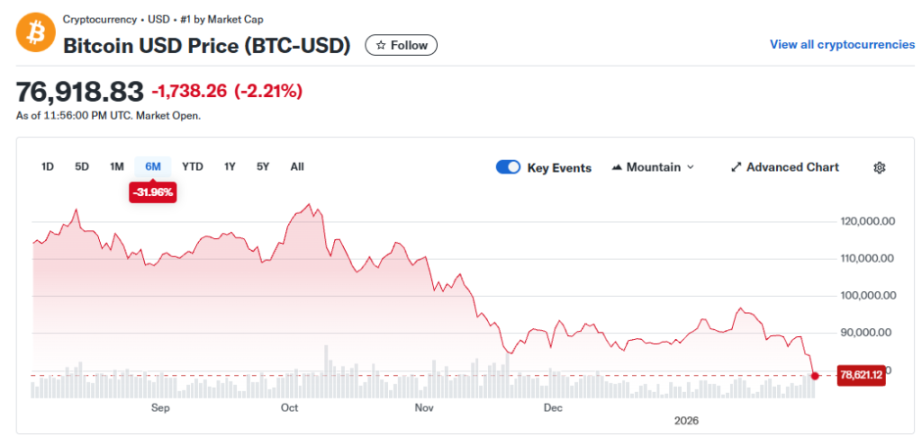
Over the weekend, Bitcoin broke below the $80,000 mark, hitting its lowest level since April 7, 2025. This round of selling occurred against a backdrop of significantly thin market liquidity, further exacerbating Bitcoin's recent cumulative decline of over 30%.
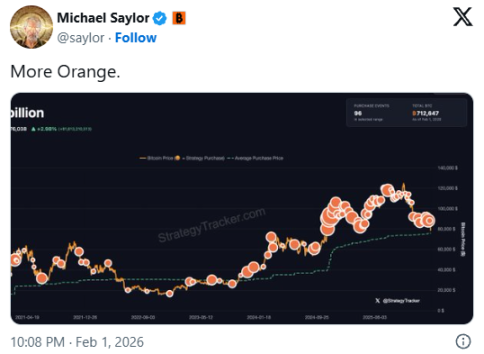
Despite the gloomy market sentiment, MicroStrategy Executive Chairman Michael Saylor still posted a picture with the words "More Orange" on the social media platform X on Sunday, hinting at continued accumulation. The company announced a 25 basis point increase in the dividend for its Series A Perpetual Extension Preferred Shares (STRC) to 11.25%, intending to attract capital with high financing costs to maintain its Bitcoin purchasing strategy. However, analysis points out that if the coin price remains stagnant or falls below its cost basis, the high dividend payments could trigger a severe cash flow squeeze.
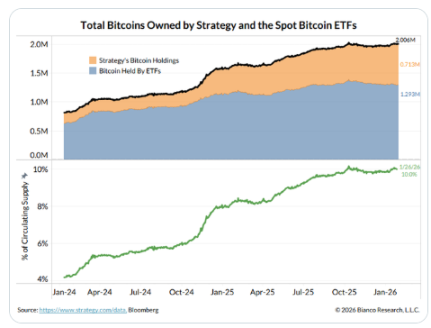
Jim Bianco, Macro Strategist at Bianco Research, analyzed that the Bitcoin market is facing a crisis of narrative exhaustion. The current market structure is highly institutionalized, with ETF investors and MicroStrategy collectively controlling about 10% of the circulating supply, and are currently in an overall floating loss position. This suggests that the once market-supporting narrative of "institutional entry" could reverse into a major source of selling pressure after being trapped at high levels.
Institutional Holdings See Worsening Floating Losses, ETFs Experience Net Outflow Wave

Jim Bianco's analysis shows that Bitcoin is becoming highly "institutionalized on the books," meaning the market can, for the first time, clearly observe the cost basis and profit/loss status of large capital holdings. Currently, MicroStrategy and the 11 spot Bitcoin ETFs collectively hold about 10% of the circulating Bitcoin supply, with a combined average purchase cost of approximately $85,360. At the current price, these institutional holdings are facing an overall floating loss of about $8,000 per coin, with total unrealized losses reaching approximately $7 billion.
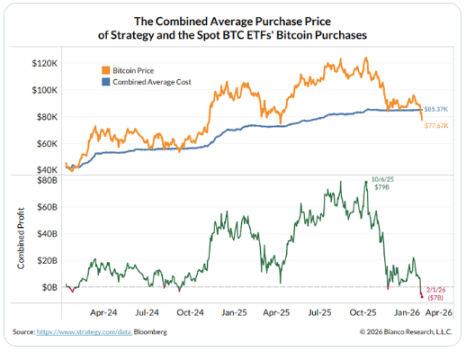
Among these, spot ETFs have become the core force affecting the supply and demand structure. Data shows that the 11 largest spot Bitcoin ETFs hold 1.29 million Bitcoins, accounting for 6.5% of the total circulating supply, with a market value of about $115 billion. However, the average purchase cost for these ETF investors is as high as $90,200, and the current coin price is about $13,000 lower than their cost basis.
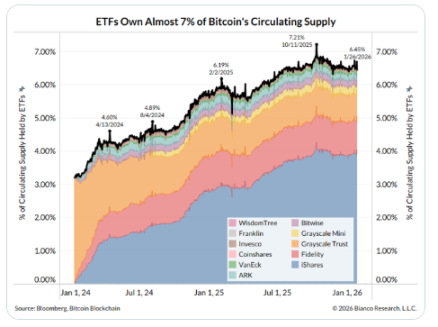
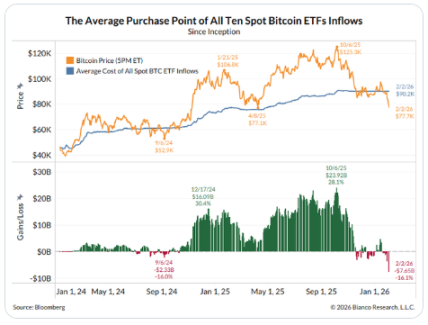
This high-level acquisition structure has led to a typical pro-cyclical effect. Bianco points out that these ETFs have seen net outflows for 10 consecutive trading days. Investors are choosing to redeem after buying high and experiencing a pullback. This fund structure is amplifying the market's downward volatility.

MicroStrategy's Safety Margin Narrows, Aggressive Financing Raises Concerns

As a benchmark for corporate Bitcoin holdings, MicroStrategy's balance sheet is facing its most severe test in months. The company currently holds 712,647 Bitcoins, with an average cost of approximately $76,037. As Bitcoin trades around $78,000, the company's unrealized gains have narrowed significantly to less than 3%.
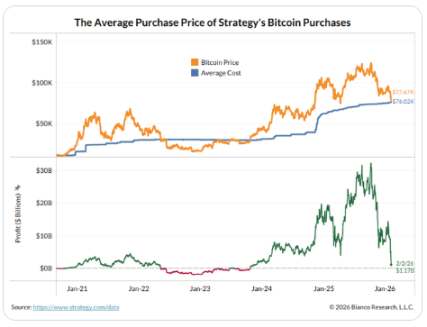
Despite the thinning safety margin, MicroStrategy shows no signs of retreating. To fund the next phase of purchases, the company adjusted the yield on its STRC product to 11.25%. This return rate represents a huge premium compared to typical corporate bonds, reflecting the company's extreme thirst for capital and the inherent volatility risk of its Bitcoin-centric model. Data shows that since the STRC product debuted in November, sales of this product alone have funded the acquisition of over 27,000 Bitcoins.

Analysis suggests that MicroStrategy is still profitable, but its margin for error has significantly narrowed. If the price falls further, the company will face an overall floating loss. Maintaining such high-cost dividend payments could cause cash flow strain, especially if the Bitcoin price falls below its cost "waterline" of $76,000, a risk that would become particularly acute.

Old Narrative Fails, Market Urgently Needs New Drivers

From a macro perspective, this plunge has intensified the market's disappointment over recent weeks. Jim Bianco believes the real problem Bitcoin faces is a lack of new narratives. The previously high-hoped "Boomer Adoption" story has been fully priced in and is even being disproven.

The current market structure shows that ETFs and MicroStrategy not only bought a lot, bought concentratedly, but are also currently trapped overall. Bianco points out that as long as there is no new, sustainable buying narrative, the trend of capital outflows is likely to continue. In this case, the high level of institutional holdings, once seen as a positive, may instead turn into the market's biggest source of pressure. Bitcoin's current problem is not whether people bought in the past, but where the next batch of buyers will come from at the current price level.


Twitter:https://twitter.com/BitpushNewsCN

Bitpush TG Discussion Group:https://t.me/BitPushCommunity

Bitpush TG Subscription: https://t.me/bitpush

Original Link:https://www.bitpush.news/articles/7607882

Related Questions

QWhat is the main concern regarding MicroStrategy as Bitcoin's value continues to decline?

AThe main concern is whether MicroStrategy will be forced to sell its Bitcoin holdings as the price approaches its average cost basis, potentially triggering a liquidity crisis due to its high leverage and expensive financing costs.

QAccording to Jim Bianco, what percentage of Bitcoin's circulating supply is controlled by MicroStrategy and ETF investors combined?

AMicroStrategy and the 11 spot Bitcoin ETFs collectively control approximately 10% of Bitcoin's circulating supply.

QWhat is the average purchase cost of Bitcoin for MicroStrategy's holdings mentioned in the article?

AMicroStrategy's average purchase cost for its Bitcoin holdings is approximately $76,037 per Bitcoin.

QWhy are the spot Bitcoin ETFs experiencing a continuous outflow of funds for 10 consecutive trading days?

AThe ETFs are experiencing continuous outflows because investors who bought at high prices are choosing to redeem their shares as the price of Bitcoin falls, amplifying the downward market volatility.

QWhat new financing measure did MicroStrategy take to fund further Bitcoin purchases, and what is the associated risk?

AMicroStrategy increased the dividend on its Series A Perpetual Preferred Shares (STRC) by 25 basis points to 11.25% to attract capital. The risk is that maintaining such high-cost dividend payments could lead to severe cash flow strain, especially if Bitcoin's price falls below its cost basis.

Related Reads

Not Speculation but a Necessity: The 4 Unique Values of Prediction Markets

Polymarket's recent $4 billion funding round and soaring valuation of $15 billion highlight the explosive growth of prediction markets, with trading volume reaching $25.7 billion in March 2026—a 10.6% monthly increase. This analysis argues that prediction markets serve critical non-speculative functions, positioning them as essential tools rather than mere gambling platforms. Prediction markets offer four unique values: entertainment consumption, insurance-like protection, risk hedging, and truth discovery. Firstly, they stimulate economic activity by engaging users in event-based betting, similar to the broader sports industry. Secondly, they act as a form of decentralized insurance, allowing users to hedge against specific, well-defined risks (e.g., weather events) transparently and without traditional overhead costs. Thirdly, institutions and individuals use these markets to hedge against geopolitical and commodity price risks, as demonstrated during the U.S.-Iran conflict and the launch of 24/7 commodity markets on platforms like Kalshi. Finally, prediction markets counter media bias by aggregating crowd-sourced information, often achieving 30% higher accuracy than surveys due to users' vested interests. Experts like Bitwise’s Jeff Park and SIG’s Jeff Yass emphasize the markets' role in risk transfer and financial innovation. As these platforms evolve, they are poised to become trillion-dollar markets, offering more reliable, decentralized mechanisms for information pricing and risk management.

marsbit2h ago

Not Speculation but a Necessity: The 4 Unique Values of Prediction Markets

marsbit2h ago

Trading

Spot
Futures

Hot Articles

What is $BITCOIN

DIGITAL GOLD ($BITCOIN): A Comprehensive Analysis Introduction to DIGITAL GOLD ($BITCOIN) DIGITAL GOLD ($BITCOIN) is a blockchain-based project operating on the Solana network, which aims to combine the characteristics of traditional precious metals with the innovation of decentralized technologies. While it shares a name with Bitcoin, often referred to as “digital gold” due to its perception as a store of value, DIGITAL GOLD is a separate token designed to create a unique ecosystem within the Web3 landscape. Its goal is to position itself as a viable alternative digital asset, although specifics regarding its applications and functionalities are still developing. What is DIGITAL GOLD ($BITCOIN)? DIGITAL GOLD ($BITCOIN) is a cryptocurrency token explicitly designed for use on the Solana blockchain. In contrast to Bitcoin, which provides a widely recognized value storage role, this token appears to focus on broader applications and characteristics. Notable aspects include: Blockchain Infrastructure: The token is built on the Solana blockchain, known for its capacity to handle high-speed and low-cost transactions. Supply Dynamics: DIGITAL GOLD has a maximum supply capped at 100 quadrillion tokens (100P $BITCOIN), although details regarding its circulating supply are currently undisclosed. Utility: While precise functionalities are not explicitly outlined, there are indications that the token could be utilized for various applications, potentially involving decentralized applications (dApps) or asset tokenization strategies. Who is the Creator of DIGITAL GOLD ($BITCOIN)? At present, the identity of the creators and development team behind DIGITAL GOLD ($BITCOIN) remains unknown. This situation is typical among many innovative projects within the blockchain space, particularly those aligning with decentralized finance and meme coin phenomena. While such anonymity may foster a community-driven culture, it intensifies concerns about governance and accountability. Who are the Investors of DIGITAL GOLD ($BITCOIN)? The available information indicates that DIGITAL GOLD ($BITCOIN) does not have any known institutional backers or prominent venture capital investments. The project seems to operate on a peer-to-peer model focused on community support and adoption rather than traditional funding routes. Its activity and liquidity are primarily situated on decentralized exchanges (DEXs), such as PumpSwap, rather than established centralized trading platforms, further highlighting its grassroots approach. How DIGITAL GOLD ($BITCOIN) Works The operational mechanics of DIGITAL GOLD ($BITCOIN) can be elaborated on based on its blockchain design and network attributes: Consensus Mechanism: By leveraging Solana’s unique proof-of-history (PoH) combined with a proof-of-stake (PoS) model, the project ensures efficient transaction validation contributing to the network's high performance. Tokenomics: While specific deflationary mechanisms have not been extensively detailed, the vast maximum token supply implies that it may cater to microtransactions or niche use cases that are still to be defined. Interoperability: There exists the potential for integration with Solana’s broader ecosystem, including various decentralized finance (DeFi) platforms. However, the details regarding specific integrations remain unspecified. Timeline of Key Events Here is a timeline that highlights significant milestones concerning DIGITAL GOLD ($BITCOIN): 2023: The initial deployment of the token occurs on the Solana blockchain, marked by its contract address. 2024: DIGITAL GOLD gains visibility as it becomes available for trading on decentralized exchanges like PumpSwap, allowing users to trade it against SOL. 2025: The project witnesses sporadic trading activity and potential interest in community-led engagements, although no noteworthy partnerships or technical advancements have been documented as of yet. Critical Analysis Strengths Scalability: The underlying Solana infrastructure supports high transaction volumes, which could enhance the utility of $BITCOIN in various transaction scenarios. Accessibility: The potential low trading price per token could attract retail investors, facilitating wider participation due to fractional ownership opportunities. Risks Lack of Transparency: The absence of publicly known backers, developers, or an audit process may yield skepticism regarding the project's sustainability and trustworthiness. Market Volatility: The trading activity is heavily reliant on speculative behavior, which can result in significant price volatility and uncertainty for investors. Conclusion DIGITAL GOLD ($BITCOIN) emerges as an intriguing yet ambiguous project within the rapidly evolving Solana ecosystem. While it attempts to leverage the “digital gold” narrative, its departure from Bitcoin's established role as a store of value underscores the need for a clearer differentiation of its intended utility and governance structure. Future acceptance and adoption will likely depend on addressing the current opacity and defining its operational and economic strategies more explicitly. Note: This report encompasses synthesised information available as of October 2023, and developments may have transpired beyond the research period.

363 Total ViewsPublished 2025.05.13Updated 2025.05.13

What is $BITCOIN

Discussions

Welcome to the HTX Community. Here, you can stay informed about the latest platform developments and gain access to professional market insights. Users' opinions on the price of BTC (BTC) are presented below.

活动图片