Original Author: SoSoValue
Trump's urging of Congress to advance the "CLARITY Act" during a White House crypto meeting swiftly improved market expectations for the US crypto regulatory outlook. Simultaneously, the US Treasury expanded long-term bond buybacks, pushing long-end yields down and somewhat alleviating pressure from the dollar and real rates on risk assets. A convergence of narrowed policy discount, improved liquidity expectations, and short covering led Bitcoin to briefly break above $75,000.
This rally was initially ignited by policy signals, and the subsequent breach of a key price level triggered massive short position liquidations. Forced covering by short sellers further amplified gains, allowing Bitcoin to rapidly move out of its previous consolidation range. However, buying pressure from forced liquidations is phased; as high-leverage short positions are gradually cleared, follow-up price action will require active capital to take over.
The core factors determining whether Bitcoin can transition from a rapid rebound to a sustained uptrend now rest on two institutional capital channels: US spot Bitcoin ETFs and Strategy's financing-buyback cycle.
ETF Capital Begins to Replace Short Covering
Short covering can quickly push up prices and improve market sentiment but rarely independently supports a sustained trend. The force capable of absorbing short-term profit-taking and elevating the price floor still comes from the spot market, particularly US spot Bitcoin ETFs.
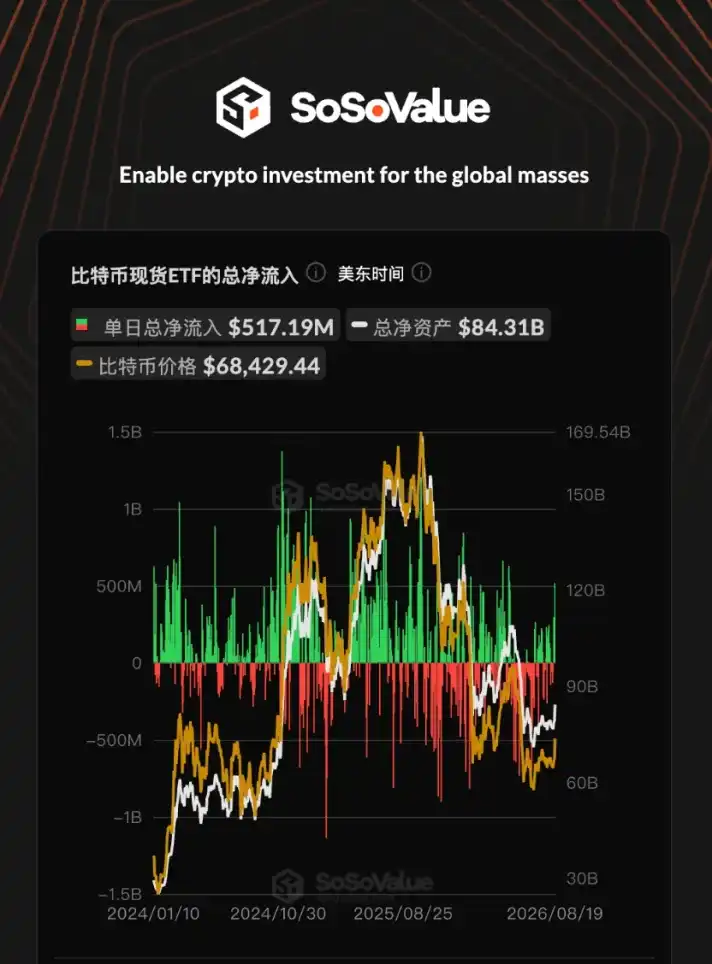
SoSoValue data shows that on August 19th, US spot Bitcoin ETFs recorded a net inflow of approximately $517 million, marking the third consecutive day of net inflows and the largest single-day inflow in three and a half months. This indicates institutional capital is beginning to replace short covering, shifting the buying structure of the rally from derivatives-driven to a resonance between spot and derivatives.
This change improves the quality of the current rebound. While Bitcoin's initial sharp rise was spurred by policy news, the market might still have interpreted it as event-driven trading; three consecutive days of ETF net inflows demonstrate that some institutional capital is re-establishing spot exposure, capitalizing on improved policy expectations.
The key going forward is whether ETF net inflows can maintain a scale of hundreds of millions of dollars and spread from a few top-tier products to more funds. Sustained, large net inflows can absorb short-term profit-taking and provide support for Bitcoin's post-breakout price floor; if capital flows retreat quickly, the market could still revert to high-level consolidation once the marginal buying from short covering diminishes.
Therefore, the continuity of ETF capital flows in the coming days will directly determine the quality of this rally. The price breakout shows the market has been activated, but sustained institutional spot capital will determine whether the trend can continue.
STRC Recovery, Strategy Approaches Financing Window Again
The second potential buying source to watch comes from Strategy.
Strategy's latest disclosure shows holdings of 840,447 Bitcoins, with an average acquisition cost of approximately $75,385. As Bitcoin rose above $75,500 intraday, its holdings briefly returned above the breakeven line. With reduced pressure on the asset side, credit expectations for both Strategy's common and preferred shares improved simultaneously, with STRC recovering above $95.
STRC is a crucial financing tool for Strategy to expand its Bitcoin balance sheet. Its price target is near the $100 par value. The closer it gets to par, the lower the market's concerns about dividend coverage and credit risk, making conditions for Strategy to reissue STRC for financing more favorable. As of August 16th, the company retained about $17.51 billion in STRC issuance quota, leaving ample potential financing space.
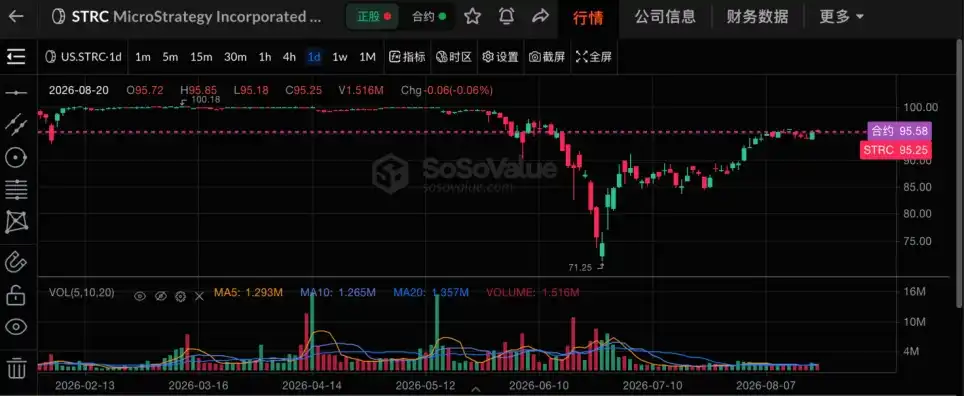
However, STRC rising above $95 currently indicates the financing window is being repaired, not that new Bitcoin-buying capital has been deployed. Strategy did not issue STRC or purchase additional Bitcoin in the past week, still focusing on repairing its financing structure by selling MSTR, supplementing US dollar reserves, and repurchasing discounted STRC.
The truly meaningful signal for the next phase would be STRC further approaching and stabilizing around $100, followed by Strategy resuming STRC issuance and Bitcoin accumulation. Once this cycle restarts, STRC financing could translate into direct spot Bitcoin buying, resonating with ETF inflows.
Strategy's holdings nearing the breakeven line also holds significant sentiment value. When Bitcoin's price was below its average cost, the market focused more on balance sheet pressure, financing costs, and potential selling risks. Once the price returns above cost, investor focus shifts back to its financing and expansion capabilities. Therefore, whether STRC can continue to recover serves as a leading indicator for observing when Strategy might become a major Bitcoin buyer again.
Two Institutional Buying Channels to Determine Sustainability of Uptrend
This Bitcoin rally has completed the first stage: policy tailwinds improved sentiment, macro liquidity expectations drove valuation repair, and short covering accelerated the price breakout. The second stage requires continuous incremental capital from ETFs and Strategy.
The strength of the trend can be gauged by watching two data points:
• Whether US spot Bitcoin ETFs can sustain net inflows at the hundreds of millions of dollars level, continuing to absorb selling pressure after short covering subsides;
• Whether STRC can stably recover towards its $100 par value, prompting Strategy to resume preferred share financing and Bitcoin accumulation.
If both capital channels strengthen simultaneously, Bitcoin has the potential to upgrade from a short-covering rally to an institutionally-driven trend rebound. ETFs would provide continuous spot demand, while Strategy would convert capital market funds into Bitcoin buying through financing. Their resonance could further lift the market's price floor.
If ETF inflows cool rapidly and Strategy's financing cycle fails to restart, profit-taking accumulated during the sharp rally could push the market towards high-level consolidation. The pace of regulatory bill progress, Treasury yields, and the dollar's movement will also continue to impact institutional risk appetite.
From Single Bets to Portfolio-Based Accumulation
For users looking to participate in the market recovery while reducing single-token risk, SoSoValue's MAG7.SSI and DEFI.ssi offer more efficient portfolio-based options.
MAG7.SSI covers the most representative core assets in the crypto market, capable of capturing the overall recovery in risk appetite comprehensively. DEFI.ssi focuses on high-value assets within the DeFi space, benefiting more directly from improvements in on-chain transactions, liquidity, and capital activity.
Compared to betting on a single token, users can use SoSoValue to trade MAG7.SSI and DEFI.ssi with one click, employing a portfolio approach to accumulate positions in the industry's most representative high-value assets in batches, reducing coin selection costs and risks from individual project volatility.
While the market is showing signs of improved capital structure, the trend still requires confirmation from both ETF and Strategy institutional buying channels. By positioning in batches through MAG7.SSI and DEFI.ssi, one can more comprehensively cover this round of crypto market recovery while controlling single-asset risk.