On Saturday at block 961,632, BIP-110 proceeded to mandatory signaling: miners had supported it in only 51 of the previous 2,016 blocks—2.53%. This is significantly below the 55% required for early activation, according to the BIP-110 monitor.
From block 961,632, nodes with BIP-110 started rejecting blocks without version bit 4, while regular Bitcoin nodes continued to accept both signaling and non-signaling blocks. A minority BIP-110 chain later emerged but quickly fell behind the main chain.
The low level of signaling makes a sustainable competing chain unlikely without significantly greater miner support. With weak miner participation, the BIP-110 chain may grow slowly or even stop producing blocks altogether.
This phase will show whether proponents can carry out a controversial consensus change without broad miner support. It could separate BIP- nodes from the main chain and intensify the debate over Bitcoin's block space usage.
BIP-110 to Temporarily Restrict Data in Bitcoin
A developer using the pseudonym Dathon Ohm prepared BIP-110—a proposal for additional consensus restrictions lasting approximately one year.
It will limit the size of most new output scripts to 34 bytes, the maximum size of OP_RETURN outputs to 83 bytes, and individual data carries and witness elements to 256 bytes. Several Taproot features will also be temporarily restricted. Unspent transaction outputs created before activation will be exempt from these rules.
Supporters believe the restrictions will curb inscriptions and other non-monetary data that increase the storage and bandwidth costs for node operators.
Critics of the proposal, including Strategy executive chairman Michael Saylor and Blockstream CEO Adam Back, argue that BIP- could split Bitcoin and lead to nodes rejecting transactions permitted by the network's current rules.
Related: Number of Bitcoin Nodes with BIP-110 Exceeds 2% Amid Escalating Spam Wars
Miners signal support via version bit 4. The period from block 961,632 to 963,647 is the mandatory signaling window: nodes with BIP-110 reject blocks without this signal.
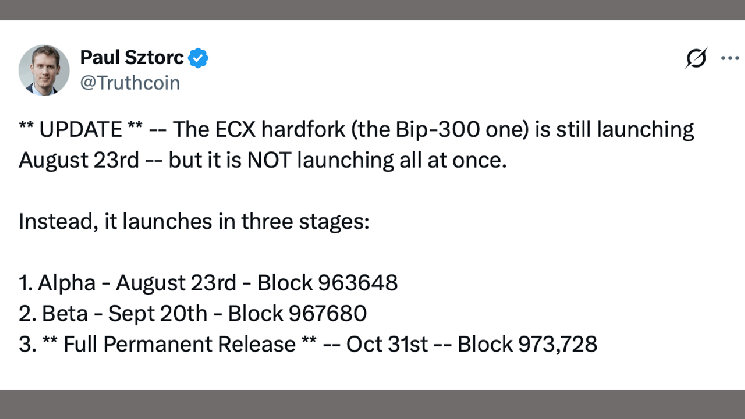
The specification provides for the start of the locked-in phase at block 963,648, with transaction restrictions taking effect at block 965,664.
BIP-110 proponents are also discussing a more extensive contingency plan. On August 1, Bitcoin developer Chris Guida rebased preliminary proof-of-work change code originally written by Bitcoin Knots maintainer Luke Dashjr.
Guida described this code as a contingency plan in case miners oppose BIP- and clarified that no activation date is set. Journal: 110
The Strangest Things Ever Tokenized... Including Fart.10 dek
end-content