Binance hints at stock perps push to join global tokenized equities race

cointelegraphPublished on 2025-12-12Last updated on 2025-12-12

Abstract

Crypto exchange Binance is preparing to introduce stock trading capabilities, as indicated by recent API updates that include endpoints for signing “TradFi-Perps” agreements and checking trading session schedules. This suggests Binance may soon offer perpetual futures for stocks, operating in traditional market hours rather than 24/7. The move follows Binance’s short-lived 2021 attempt at tokenized stocks, which was halted due to regulatory scrutiny. This development aligns with a broader industry trend toward tokenized equities, with players like Coinbase also entering the space. However, the growth of tokenized stock trading—both on centralized and DeFi platforms—has drawn mixed reactions. Some traditional finance entities, like Citadel Securities and the World Federation of Exchanges, have called for stricter regulation, while others, including Nasdaq and the SEC, appear more supportive, viewing tokenization as a positive innovation for markets.

Crypto exchange Binance has added new features to its application programming interface (API), indicating that the platform is preparing to introduce stock trading capabilities.

Binance’s changelog notes that on Dec. 11, the exchange introduced three new API endpoints, one of which — with a URL including stock/contract — allows users to “sign [a] TradFi-Perps agreement contract.” The two other endpoints introduced on the same day allow users to query “trading session schedules for a one-week period” or “current trading session information.”

Together, this information suggests that Binance is introducing perpetual futures trading on its platform. The existing trading schedule endpoints also suggest trading will likely occur in sessions, as in traditional finance, rather than following crypto’s 24/7 nature.

This follows Binance’s launch of tokenized stocks in 2021, in a relatively short-lived initiative. Following their announcement in late April, Binance halted tokenized stock sales just months later in mid-July 2021 after immediately attracting the attention of regulators.

Binance acknowledged Cointelegraph’s request for comment, but had not responded by publication.
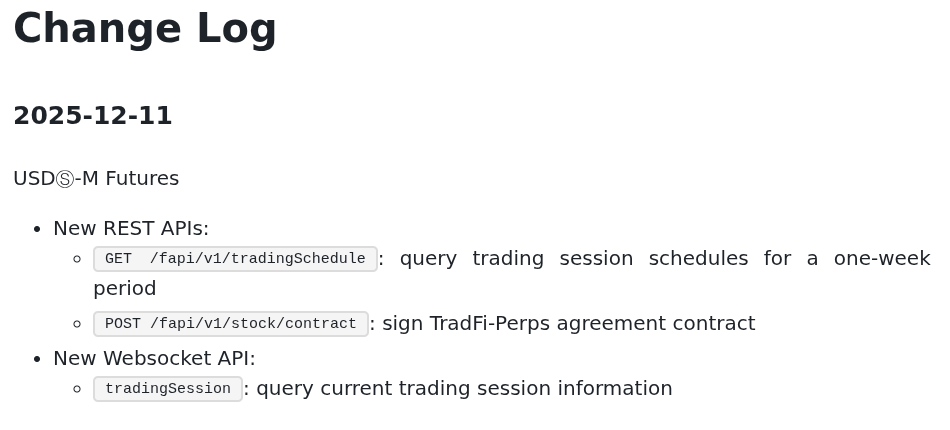
Binance API change log. Source: Binance

Related: Ondo wins Liechtenstein approval to offer tokenized stocks in Europe

Tokenized stocks are all the rage

Binance’s initiative follows a series of similar efforts by players in both traditional and crypto finance, taking stock tokenization out of the fringes of finance. Friday reports indicate that top US-based crypto exchange Coinbase is days away from unveiling its push into tokenized stocks and prediction markets.

However, not everyone is enthusiastic about how stock tokenization is being rolled out. Market maker Citadel Securities caused uproar earlier this month when it recommended that the US Securities and Exchange Commission tighten regulations on tokenized stock trading on decentralized finance (DeFi) platforms.

According to the market maker, DeFi developers, smart-contract coders, and self-custody wallet providers should not be given “broad exemptive relief” for offering trading of tokenized US equities. Citadel argued that DeFi platforms likely fall under the definitions of an “exchange” or “broker-dealer” and should be regulated under securities law.

It also claimed that allowing those platforms to operate free from regulations “would create two separate regulatory regimes for the trading of the same security.” The World Federation of Exchanges (WFE) also argued in late November that the SEC shouldn’t grant broad regulatory relief to companies launching tokenized stock offerings.

The WFE said tokenization “is likely a natural evolution in capital markets” and that it was “pro-innovation.”Still, the organization argued that it “must be done in a responsible way that does not put investors or market integrity at risk.”

The comments follow tokenized stocks making their way not only to centralized crypto exchanges, but also to the DeFi ecosystem. At the end of June, more than 60 tokenized stocks launched on Solana-based DeFi platforms as well as crypto exchanges Kraken and Bybit.

Related: Robinhood tokenizes nearly 500 US stocks, ETFs on Arbitrum for EU users

Not all of traditional finance sees an issue

Other traditional finance players appeared to follow the “if you can’t beat them, join them” approach to the issue.

Last month, Nasdaq’s head of digital assets strategy, Matt Savarese, said the stock exchange is making SEC approval of its proposal to offer tokenized versions of stocks listed on the exchange a top priority.

The race intensified after the SEC was reported to be developing a plan to allow blockchain-registered versions of stocks to trade on cryptocurrency exchanges by the end of September.

SEC Chair Paul Atkins recently described tokenization as an “innovation” the agency should seek to advance, not restrict. The SEC issued a “no-action” letter Thursday to a subsidiary of the Depository Trust and Clearing Corporation that specializes in tokenizing securities, indicating that the regulator intends to allow the company to offer a new securities market tokenization service.


Related Reads

How to Do Research Well: Deliberately Practice the Real Skills That Matter

No one truly teaches you how to do research. You're often given a desk, a pre-selected problem, and vague instructions to "create something new." Consequently, many people reverse-engineer the job based on visible outputs—papers, posts, announcements—learning only how to *appear* like a researcher rather than how to *become* one. True research capability is built from stacking small, trainable skills, nearly all of which can be developed through deliberate practice. **Pick Your Own Problem:** Most researchers absorb problems from advisors or trends, lacking the underlying reasoning. Choosing a problem you genuinely care about, as John Schulman advises, leads to original work. Develop "taste" like a muscle: predict experiment outcomes, guess paper results from methods, and track which findings remain important over time. **Upgrade Your Inputs:** Relying on shared reading lists (arXiv hot lists, filtered group chats) leads to unoriginal conclusions. Undervalued old literature often holds crucial insights (e.g., MoE, LSTM, backpropagation). Richard Sutton's "The Bitter Lesson" or Claude Shannon's 1952 talk on creative thinking are more predictive than lengthy modern surveys. Breadth matters as much as depth: draw from neuroscience, mechanism design, hardware knowledge, and honest statistics. Read papers directly, especially appendices and limitations sections. **Write Everything Down:** As Paul Graham noted, writing exposes flaws in seemingly mature ideas. Writing is the cheapest defense against self-deception. Following Feynman's principle, Darwin programmatically wrote down facts contradicting his theory to combat memory bias. Maintain a detailed log of hypotheses, setups, predictions, results, and updated understandings. Reviewing past logs fosters essential humility.

marsbit16m ago

How to Do Research Well: Deliberately Practice the Real Skills That Matter

marsbit16m ago

Following US Ban on Fable 5, Zhipu AI's Stock Soars 47%

On June 15th, shares of Zhipu AI surged dramatically on the Hong Kong stock market, peaking at a 47.6% gain before closing 32.82% higher. This sharp increase was directly triggered by two recent industry events. On June 12th, Anthropic announced it was suspending global access to its latest flagship models, Claude Fable 5 and Claude Mythos 5, to comply with a U.S. government export control order. The next day, Zhipu AI announced it would open access to its latest open-source flagship model, GLM-5.2, under the permissive MIT license. The Anthropic incident highlighted a critical issue beyond raw model capability: the risk of sudden, unpredictable loss of access to advanced AI models, especially for developers and enterprises deeply integrated with them. This has shifted industry and market focus toward factors like stability, sustainable access, and controllability. Zhipu's move, promoting "frontier intelligence for all," positions its openly available model as a reliable and accessible alternative. The GLM-5.2 model emphasizes "Long Horizon Task" capabilities with a 1M context window, targeting complex, multi-step coding and engineering workflows where maintaining context is crucial. Analysts note this event exposes the risk of dependency on closed-source models subject to single jurisdictional controls, potentially accelerating a shift toward domestic base models and localized deployments. The market's reaction signals a new valuation dimension in AI: providers who can offer stable, long-term, and sustainably accessible AI capabilities are gaining strategic importance.

marsbit40m ago

Following US Ban on Fable 5, Zhipu AI's Stock Soars 47%

marsbit40m ago

Fully Entering the AI Era: Alipay Bets on Conversation, WeChat Holds Fast to Social

In May 2026, Alipay announced over 300 million AI payment transactions. Shortly after, WeChat opened its mini-programs for AI integration, sparking controversy by requiring developer source code access. This highlights their diverging approaches to AI integration. Alipay is testing "Project Treasure," an optional AI-native interface replacing traditional app grids with a conversational window. Users can command complex tasks (e.g., "book a ride and order coffee") handled end-to-end by AI. This shift follows an abandoned standalone AI app, focusing instead on enhancing its existing user base. For unmodified mini-programs, Alipay's AI uses "screen-reading" to simulate user interactions, bypassing the need for developer overhaul. It also introduced "Token Pay" for micro-transactions and "AI Wallets" for autonomous agent spending. WeChat, prioritizing its core social function, is taking an embedded approach. Its AI agent will operate within existing contexts like group chats and official accounts, assisting without a separate interface. To enable this, WeChat offers developers two paths: granting source code access for direct AI control ("Automatic Mode") or manually encapsulating services into standardized "Skills." Both place significant burden on developers. Key differences emerge in handling legacy services: WeChat demands developer cooperation (code or labor), while Alipay's screen-reading offers immediate, if potentially less stable, compatibility. Alipay's 3 billion AI transactions demonstrate user acceptance of AI-driven commercial actions. The divergent strategies may reshape mini-program ecosystems—Alipay passively "AI-fying" services, WeChat potentially favoring resource-rich developers—and set competing technical standards. Ultimately, the competition centers on where users entrust the command to "help me get things done."

marsbit40m ago

Fully Entering the AI Era: Alipay Bets on Conversation, WeChat Holds Fast to Social

marsbit40m ago

Trading

Spot
Futures

Hot Articles

How to Buy PUSH

Welcome to HTX.com! We've made purchasing Push Protocol (PUSH) simple and convenient. Follow our step-by-step guide to embark on your crypto journey.Step 1: Create Your HTX AccountUse your email or phone number to sign up for a free account on HTX. Experience a hassle-free registration journey and unlock all features.Get My AccountStep 2: Go to Buy Crypto and Choose Your Payment MethodCredit/Debit Card: Use your Visa or Mastercard to buy Push Protocol (PUSH) instantly.Balance: Use funds from your HTX account balance to trade seamlessly.Third Parties: We've added popular payment methods such as Google Pay and Apple Pay to enhance convenience.P2P: Trade directly with other users on HTX.Over-the-Counter (OTC): We offer tailor-made services and competitive exchange rates for traders.Step 3: Store Your Push Protocol (PUSH)After purchasing your Push Protocol (PUSH), store it in your HTX account. Alternatively, you can send it elsewhere via blockchain transfer or use it to trade other cryptocurrencies.Step 4: Trade Push Protocol (PUSH)Easily trade Push Protocol (PUSH) on HTX's spot market. Simply access your account, select your trading pair, execute your trades, and monitor in real-time. We offer a user-friendly experience for both beginners and seasoned traders.

3.7k Total ViewsPublished 2024.03.29Updated 2026.06.02

How to Buy PUSH

Discussions

Welcome to the HTX Community. Here, you can stay informed about the latest platform developments and gain access to professional market insights. Users' opinions on the price of PUSH (PUSH) are presented below.

活动图片