Original|Odaily Planet Daily(@OdailyChina)
Author|Wenser(@wenser 2010)

Recently, after the release of its Q4 2025 financial report, the stock price of "the first stablecoin stock" Circle (CRCL) experienced a long-awaited strong rebound, surging over 45% in two days and once hitting $90 today, reaching a new high since last November. In the continuously declining market of crypto concept stocks, Circle (CRCL) momentarily stole the spotlight, with major institutions and analysts beginning to cheer it on, and many traders even boldly claiming that "Circle's stock still has tenfold growth potential."
Behind the fervent sentiment, what the market is more concerned about might be the underlying drivers of this price rebound, as this directly determines whether Circle's (CRCL) stock price can continue to rise. Odaily Planet Daily will provide a brief analysis of this issue from the perspectives of Circle's business performance, institutional views, the AI "ticket," and prediction markets, attempting to clarify the key question of where Circle's next wave of growth will come from.
Transformation of Circle's Business Fundamentals: From Stablecoins to Internet Financial Infrastructure
When it comes to Circle, many might still perceive it through the stereotypical image of "the perpetual runner-up in the stablecoin race." However, in terms of performance and data growth in 2025, Circle's stablecoin USDC is rapidly catching up with Tether's stablecoin USDT.
Circle's Recent Report Card: USDC Transaction Volume Reached $18.3 Trillion in 2025, Ranking First in the Industry
According to data from the Artemis website, global stablecoin transaction volume surged 72% year-over-year in 2025, reaching a record $33 trillion; among them, the transaction volume of USDC, issued by Circle, reached $18.3 trillion, ranking first; in contrast, Tether's USDT transaction volume was only $13.3 trillion.
As we entered 2026, the scale of USDC transaction counts remained exceptionally rapid: in early February, Circle CEO Jeremy Allaire stated in a post that, according to Artemis data, the on-chain transaction count for USDC in January exceeded 8.4 trillion, while the total on-chain transaction count for the stablecoin market was 10 trillion. In terms of on-chain transaction count, USDC accounted for 84% of the total market share. In other words, unnoticed by many, USDC's trading activity has been quietly climbing. Moreover, the growth rate of USDC's circulation is also accelerating rapidly. As of February 12 local time, the issuance of USDC increased by approximately 2.6 billion tokens within a week.
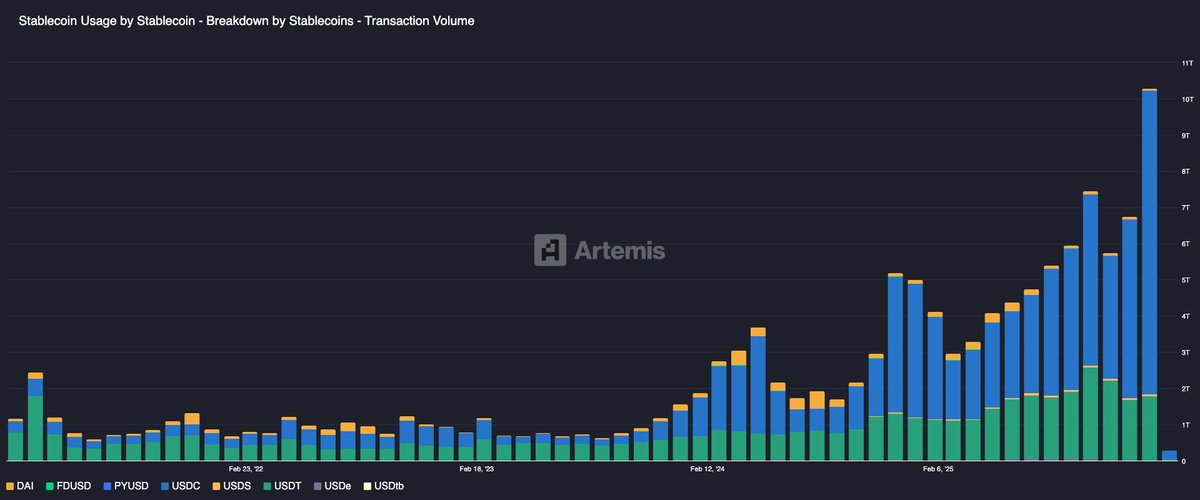
In comparison, the market capitalization of the "stablecoin leader" USDT fell 0.8% in February to $1.8361 trillion, continuing the decline of about 1% in January, marking the first consecutive monthly contraction since the Terra incident in 2022.
Finally, looking closely at its 2025 fiscal year financial report, Circle's USDC circulation at the end of 2025 was $753 billion, a 72% year-over-year increase; USDC on-chain transaction volume in Q4 2025 was $11.9 trillion, a 247% year-over-year increase; Q4 total revenue reached approximately $770 million, a sharp 77% increase compared to the same period last year; total revenue and reserve income for the 2025 fiscal year were $2.7 billion, a 64% year-over-year increase. Although its net loss from continuing operations reached $70 million, this was mainly affected by high IPO-related equity incentive expenses of $424 million. However, Circle expects USDC circulation to maintain an annual growth rate of about 40% in the future and forecasts that other business revenue (excluding reserve income) will reach approximately $170 million in 2026, higher than the approximately $110 million in 2025.
Personally, I speculate that the growth in USDC's circulation and transaction count might be driven by a combination of factors, including AI Agent crypto payment demand, the rising transaction volume in prediction markets, and institutional business demand following the passage of the GENIUS Act regulatory bill. We will elaborate on this point later.
Institutional Views Overview: Some Are Buying the Dip, Others Still Believe Circle Will "Outperform the Market"
Currently, market opinions on Circle's future stock performance are clearly divided: some investment institutions continue to buy the dip and accumulate shares; others are optimistic about its business model upgrade, transitioning from a stablecoin issuer to a fintech infrastructure provider; yet other research institutions believe this stock rebound is primarily driven by a short squeeze and lacks sustainability.
Bernstein: Circle Stock Aims for $190, Maintains "Outperform" Rating
Bernstein pointed out that Circle is no longer viewed merely as a "proxy investment target" for crypto assets but has transformed into a fintech infrastructure service provider, indicating a profound shift in its business positioning. The firm's analyst team believes that Circle will play a key role in this "fundamental transformation of the global economic system" and reaffirmed its "Outperform" rating and $190 target price in its latest research report, suggesting significant upside potential for the stock.
Furthermore, Bernstein analysts Gautam Chhugani and others noted in the report that Circle's Q4 performance clearly diverged from the overall crypto market trend, emphasizing that the company is moving towards becoming a core internet infrastructure provider, rather than just being in the stablecoin or crypto token business.
Ark Invest: Putting Money Where Their Mouth Is, Circle (CRCL) Stock Holdings Total Nearly $350 Million
Unlike research institutions, the investment firm Ark Invest, led by renowned Silicon Valley investor "Cathie Wood," has consistently been a "major buyer" of Circle.
In early February, trading documents showed that Ark Invest purchased approximately $9.4 million worth of Circle stock through two of its ETFs;
On February 12, Ark Invest increased its holdings again by 75,559 shares of Circle (CRCL), worth about $4.4 million.
Based on public information compiled, as of the time of writing, Ark Invest holds a total of approximately 4,015,642 shares of Circle (CRCL) through its three funds: ARKK (ARK Innovation ETF), ARKF (ARK Fintech Innovation ETF), and ARKW (ARK Next Generation Internet ETF), with a total market value of about $349 million (calculated at $87 per share).
Vanguard Group: Holds Over 5.65 Million Circle (CRCL) Shares, Once Faced Floating Losses Exceeding $400 Million
On February 14, according to the latest 13F filing submitted to the U.S. SEC by the world's second-largest fund management company, Vanguard Group, it currently holds a cumulative total of 5,653,110 shares of Circle stock CRCL (current value $339.4 million), with an entry cost of $739.6 million, resulting in floating losses of over $400 million at the time.
With Circle (CRCL)'s stock price rebounding to around $87 (at the time of writing), this nearly $740 million investment now shows a floating profit of over $152 million.
10x Research: Circle Surges Due to Short Squeeze
Yesterday, crypto research firm 10x Research stated in a post that the core driver of the recent rise in Circle's stock price was not the financial report data itself, but the market's positioning structure, which was more likely to trigger a high-probability short covering rally rather than a pure fundamental revaluation. It is reported that a hedge fund established a large short position before the earnings release. However, as Circle's stock price soared in a single day, it triggered a violent short squeeze, causing the hedge fund to lose approximately $500 million in a single day. 10x Research added that this round of sharp volatility not only affected Circle (CRCL) but also spilled over to Coinbase (COIN) and Bitcoin. Although Circle is a clear bullish target, the overall magnitude of the move was primarily driven by an imbalance in the overall crypto market positioning structure. New market catalysts might soon emerge, potentially reshaping the market narrative, after which trading logic may return to fundamentals. In other words, 10x Research is not optimistic about Circle (CRCL)'s future performance.
In summary, Circle is in a critical period of transitioning from its past concept as the "first stablecoin stock" to a narrative of "fintech infrastructure." The business performance of its stablecoin USDC is promising, and its other new revenue streams (non-interest income) have also proven their profitability to the market with a high gross profit of $37 million in Q4.
Whether Circle (CRCL) can continue its current strong upward trend may be closely related to three key keywords—"AI payments," "prediction markets," and "institutional adoption."
USDC's "Growth Boosters": AI Payments, Prediction Market Trading, Large-Scale Institutional Adoption
From Circle's financial reports and the external statements of CEO Jeremy Allaire, we can clearly see that Circle's revenue channels are rapidly expanding, unlike in the past when it heavily relied on the USDC stablecoin issuance business.
Previously, Circle announced that the Circle Payments Network (CPN) has 55 financial institutions registered, with another 74 financial institutions undergoing qualification review; the L1 blockchain network Arc testnet has gone live, attracting over 100 participants; USDC's inherent adoption rate and integration advantages also赋予 Circle with "automated payment" capabilities for AI Agents. This may become its ticket to the next era of interconnected finance.
Circle's "AI Ticket": x402 Protocol, AI Agent Economy, and A2A Transactions
Circle's first ticket comes from AI payments. The x402 standard, led by Coinbase, became a market focus upon its launch in 2025. This protocol allows AI Agents to directly pay for services, such as API data access, computational resources, or content subscriptions, using USDC through the HTTP 402 status code, effectively "bridging the last mile of payment" for AI Agents. USDC can thus be seamlessly integrated into the AI Agent economy. As for the A2A (Agent to Agent) and M2M (Machine to Machine) transactions proposed by many AI model companies, they will also circulate using USDC.
Previously, analysts predicted that the scale of the AI Agent economy ecosystem could exceed $30 trillion by 2030, with Agentic AI dominating 15% of daily financial decisions. In this regard, USDC possesses a super-early mover advantage.
Circle's "Prediction Market Ticket": Prediction Market Trading Volume Continues to Hit New Highs, Weekly Transaction Count Exceeds 38 Million
Another major driver for the growth of USDC and Circle's business data might be attributed to the prediction market sector, where business data is continuously rising.
According to Dune data, on February 23, the weekly transaction count (Feb 16-22) in prediction markets reached a new historical high of 38.01 million, with Polymarket's transaction count at 22.58 million, ranking first; Kalshi's transaction count was 14.86 million, ranking second.
At the same time, Circle is also making continuous efforts in platform-level cooperation with prediction market giants—in early February, Circle announced a partnership with Polymarket to promote the optimization of stablecoin infrastructure for prediction markets. Circle will introduce transparent, fully-reserved stablecoin infrastructure to prediction markets, improving settlement reliability and reducing friction to support the next phase of development in on-chain financial markets.
Based on the background of a "big year for predictions" featuring events like the Winter Olympics and the World Cup, USDC transaction volume and custody income are expected to see further growth.
Circle's "Institutional Adoption Ticket": Legislation, Trust Bank, and Partnership Ecosystem
For institutional users, Circle and USDC might currently be the only "relatively optimal solution." The main reasons are:
First, the GENIUS Act framework will drive a massive inflow of digital dollar reserves into the U.S. Treasury market, further boosting USDC issuance and circulation;
Second, Circle was approved to establish a national trust bank (First National Digital Currency Bank) in December 2025, accelerating its integration into the traditional financial system;
Third, Circle's partners cover various fields, including traditional payment institutions (e.g., Visa), financial software companies (e.g., Intuit), leading prediction market platforms (e.g., Polymarket), blockchain payment settlement networks (e.g., Morph Network), and cryptocurrency exchanges (e.g., Kraken, OKX, Bybit, Hyperliquid), gradually building its own "ecosystem moat."
Conclusion: Concerns for Circle's Stock Lie in Coinbase Profit Sharing and U.S. Banking Sector Strangulation
In summary, Circle (CRCL)'s stock market performance may usher in a wave of strong rebound. However, limited by the overall crypto market conditions and unresolved factors such as the CLARITY Act, its future performance still holds some uncertainty.
Specifically, first, there is Coinbase, which shares nearly $1 billion in annual stablecoin "promotion profits." According to assessments by BI analysts Paul Gulberg and Samuel Radowitz, if payment adoption accelerates under the GENIUS Act framework signed by President Trump in July 2025, Coinbase's stablecoin revenue could grow two to seven times. For a cryptocurrency exchange whose stock price is also under pressure, this is undoubtedly an indispensable big cake.
Second, as the "first compliant stablecoin stock," Circle is destined to face collective suppression from the U.S. banking sector. Although its trust bank application was approved, as Standard Chartered analysts stated in a report, stablecoins pose a real risk to global and U.S. bank deposits. U.S. bank deposits will decrease as the market value of stablecoins grows, with the reduction accounting for a weight roughly equivalent to the stablecoin market value. U.S. regional banks are the most affected, while investment banks are the least affected. The report shows that only 14.5% of Circle's reserve assets are bank deposits, with a very low redeposit ratio. Similarly, traditional banks, driven by profit, are unlikely to sit idly by.
As for whether Circle (CRCL)'s stock price can achieve the "10x miracle" mentioned at the beginning of the article again, beyond the timing of last year's "stablecoin boom," it might require more "regional convenience policies" provided by the U.S. government and regulatory authorities to give it a helping hand.





















