Banks Advance Plans to Create Stablecoins as Bank for International Settlements Questions Their Role

cryptonews.ruPublished on 2026-08-29Last updated on 2026-08-29

Abstract

While the Bank for International Settlements (BIS) argues that stablecoins lack key properties to function as money at scale, major global banks are actively developing their own stablecoin plans on public blockchains. BIS head Pablo Hernández de Cos advocates for tokenized bank deposits as a superior foundation for modern digital payments, citing issues with stablecoins regarding uniformity, interoperability, and financial integrity. These problems include exchange rate fluctuations between different stablecoins, settlement complexities across fragmented blockchains, and anonymity concerns. Despite these warnings, a consortium of over a dozen major banks, including Bank of America and Citi, is preparing to launch a bank-issued stablecoin. This shift is driven by competitive pressure and regulatory changes like the GENIUS Act, with banks fearing potential deposit outflows to crypto-native issuers. Data shows stablecoin transaction volumes are massive, but a small fraction represents real-economy payments. While central banks prefer tokenized deposits for core payments, commercial banks increasingly see a strategic need for stablecoins to retain relevance, even as some, like JPMorgan, currently deny having imminent launch plans.

Despite the Bank for International Settlements (BIS) chief's view that stablecoins cannot be considered money on a large scale, the world's largest banks are moving financial settlements and regular transactions onto public blockchains.

Speaking at the Economic Symposium in Jackson Hole on August 28, BIS General Manager Pablo Hernández de Cos stated that a system based on tokenized deposits "looks more promising" than stablecoins. BIS representatives emphasized that tokenized deposits should form the foundation of modern digital payment systems as banks transition their operations to blockchain.

For banks, the dilemma is straightforward: should they adopt blockchain now, or wait for regulators to approve a more technologically advanced version of this innovative solution?

Where Stablecoins Fall Apart, According to de Cos

De Cos's argument centers on three properties he says money must possess: uniformity, interoperability, and financial integrity.

Regarding uniformity, he gave a simple example. If one person holds Tether's $USDT tokens and wants to transfer money to a recipient who only accepts Circle's $USDC tokens, that person would first have to sell $USDT and buy $USDC. However, since the coins' prices can fluctuate on the market, the final transfer amount might not equal one US dollar. The system does not guarantee that two stablecoins will exchange one-for-one.

The interoperability issue creates another problem. Most fiat-backed stablecoins operate on fragmented, permissionless public blockchains and scaling layers. Even a request to transfer the same stablecoin issued on different blockchains from one chain to another requires performing complex—and sometimes costly—procedures.

In contrast, the settlement process for tokenized deposits involves using central bank accounts, as de Cos noted, preserving the nominal redeemability and finality of such deposits.

The Integrity Issue BIS Keeps Returning To

The third issue is financial integrity. According to de Cos, information shows that most stablecoins are currently held in self-custodied wallets and that an increasing number of transfers between blockchain wallets are conducted without any platform performing "Know Your Customer" (KYC) checks. This is vastly different from traditional finance, where bank deposits, the least anonymous form of money, predominate.

In its Annual Economic Report on June 23, the Bank for International Settlements (BIS) presented a similar viewpoint. In the section on stablecoins, it went so far as to state that existing stablecoin designs "do not meet the fundamental properties of money and threaten financial integrity."

Furthermore, the research expressed concern about the concept of "stablecoin dollarization" in developing countries, where the demand for foreign stablecoins could impact capital flows and reduce their monetary sovereignty.

What Payment Data Actually Shows

The discussion on scale is backed by significant figures.

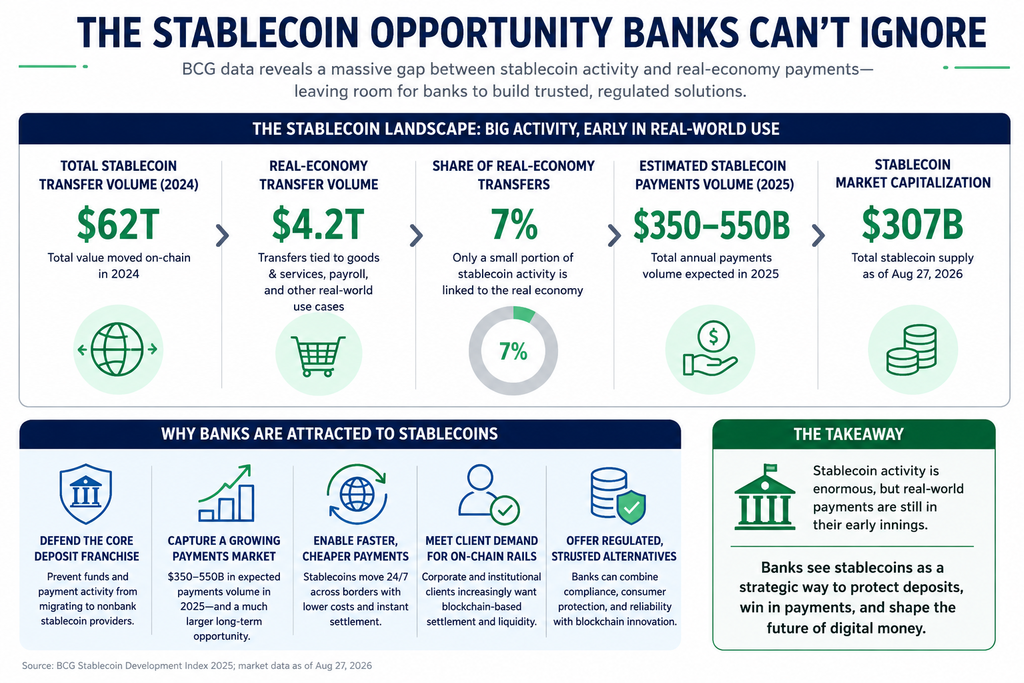
According to an analytical report published in January 2026 by Boston Consulting Group (BCG) and blockchain data analytics firm Allium, over $62 trillion worth of stablecoin transactions occurred on public blockchains in a year. However, of this amount, only about $4.2 trillion (approximately 7% of the total) represented payments made in the real economy.

BCG estimated the observed volume of bilateral payments for goods and services in 2025 to be between $350 and $550 billion, which they termed a minimal figure. Additionally, the article noted that the stablecoin market capitalization grew to $307 billion by December 2025.

Why Are Banks Shifting Policy at All?

These warnings have not stopped banks from moving towards blockchain adoption.

On August 28, Forkast reported that a consortium of over 12 global banks, including Bank of America, Wells Fargo, Santander, Citi, Goldman Sachs, and UBS, is preparing to issue its own stablecoin on public blockchains, rather than leaving the market to Tether and Circle.

The GENIUS Act, which took effect on July 18, 2025, was a legislative measure allowing banks to access the federal level through subsidiaries approved by the Office of the Comptroller of the Currency (OCC), although it prohibited issuers from paying any interest to holders.

Bank of America CEO Brian Moynihan warned that up to $6 trillion in deposits could be withdrawn from banks if stablecoin issuers were allowed to offer yields.

"If it is legalized, we will engage in this business."

Smaller lending institutions are also adopting new technologies. Cryptopolitan reported that 39 state bankers' associations have formed the BankChain Alliance, set to launch in 2027. This initiative aims to provide local banks with shared access to tokenized deposits and stablecoins without relying on crypto platforms.

Are Banks Moving from Research to Creating a Joint Stablecoin?

Today's article in the Seoul Economic Daily states that a major banking group is considering initially issuing a dollar-pegged token, with subsequent expansion to G7 currencies. It also highlights the strategic reason: banks fear stablecoins could divert deposits away from traditional banks.

Feature Stablecoins Tokenized Deposits
What is it? Digital tokens designed to maintain a stable value relative to a reference asset, typically the US dollar. Digital representation of ordinary commercial bank deposits on a programmable ledger.
Issuer Typically a private stablecoin issuer. Commercial bank.
Holder's Claim Claim on the stablecoin issuer's/reserve structure. Direct claim on the issuing bank.
Backing Typically reserves like cash, central bank reserves, Treasury bonds, or other permitted assets. Ultimately, the bank's deposit obligations are part of the banking system.
Redeemability Intended for redemption at $1, but secondary market prices may deviate from par. Exchanges at par as a bank deposit/claim.
Settlement Transfers between token holders on blockchain networks. Payment results in debiting one bank account and crediting another, with interbank settlement ultimately using central bank money.
Blockchain Often public/permissionless networks. Typically permissioned/controlled bank platforms, though hybrid models are possible.
Interoperability Can be fragmented across issuers and blockchains. Higher fungibility achieved when using tokenized central bank reserves.
AML/KYC May involve anonymous wallets and self-custody. Account ownership and activities within regulated bank infrastructure.
Bank Deposits Could potentially divert funds away from banks. Secures deposits within the banking system.
Main Advantage Global reach, programmability, and 24/7 transfer capability. Programmability while preserving the existing bank/central bank monetary structure.
BIS's Preferred Role Specialized uses, not the basis for everyday payments. Handling large daily payments and wholesale settlements.
Current Examples $USDT, $USDC, and other fiat-backed tokens. JPMorgan's deposit token model and other bank tokenization projects.
The differences between stablecoins and tokenized deposits are structural, not merely numerical. | BIS

Central banks want to see tokenized deposits and central bank money at the heart of the blockchain economy, while commercial banks are increasingly concluding that they also need stablecoins. Notably, JPMorgan's position remains that the company has no current plans to issue a stablecoin.

end-content

Trending Cryptos

Related Questions

QAccording to the head of the BIS, what are the three properties that money should have, and how do stablecoins fail to meet them?

AAccording to the head of the BIS, Pablo Hernández de Cos, the three properties money should have are unity (uniqueness), compatibility (interoperability), and financial integrity. He argues stablecoins fail because: 1) Different stablecoins like USDT and USDC are not guaranteed to exchange at a 1:1 rate (unity). 2) They operate on fragmented, permissionless blockchains, making cross-chain transfers complex (compatibility). 3) Many are held in self-custody wallets with limited KYC checks, raising concerns about financial integrity versus traceable bank deposits.

QWhat is the Bank for International Settlements' (BIS) preferred model for the foundation of modern digital payment systems, and why?

AThe BIS prefers a system based on tokenized bank deposits as the foundation for modern digital payment systems. They argue this model is more promising than one based on stablecoins because tokenized deposits utilize central bank accounts for settlement, preserving nominal redemption and finality. This approach maintains the existing monetary structure, ensures financial integrity through bank-level AML/KYC, and prevents potential disintermediation of commercial bank deposits.

QDespite the BIS's warnings, why are major global banks reportedly planning to issue their own stablecoin on public blockchains?

AMajor global banks are reportedly planning to issue their own stablecoin on public blockchains to prevent deposits from being drained away by private stablecoin issuers like Tether and Circle. They fear that if these private issuers are allowed to offer yield, trillions in deposits could leave the traditional banking system. The passing of the GENIUS law, which allows banks to access the public blockchain space via OCC-approved subsidiaries (though without paying interest), is a key factor enabling this strategic move.

QWhat does the data from Boston Consulting Group (BCG) and Allium reveal about the volume of stablecoin transactions versus payments in the real economy?

AData from BCG and Allium reveals a significant gap between total stablecoin transaction volume and real-economy payments. They estimated that over $62 trillion worth of stablecoin transactions occurred on public blockchains in a year. However, only about $4.2 trillion (approximately 7% of the total) constituted payments made within the real economy. The observed volume of bilateral payments for goods and services in 2025 was estimated to be between $350 billion and $550 billion, which they termed a minimal figure.

QAccording to the article's comparison table, what is a key structural difference between the holder's claim in a stablecoin versus a tokenized deposit?

AA key structural difference is the nature of the holder's claim. For a stablecoin, the holder has a claim on the stablecoin issuer's reserve structure. For a tokenized deposit, the holder has a direct claim on the issuing commercial bank itself, just like a traditional bank deposit. This makes tokenized deposits an integral part of the existing banking system, whereas stablecoins represent a claim on an external, often private, entity.

Related Reads

Ripple (XRP) Company Announces Plans for Major Future Update

Ripple (XRP) has announced a four-phase plan to prepare the XRP Ledger (XRPL) for future security threats posed by quantum computers. The company's senior director of engineering stated the goal is to build necessary infrastructure before quantum computers become a direct threat, aiming to minimize impact on existing systems, user assets, and network operations. The plan begins with identifying potential quantum vulnerabilities within XRPL, followed by testing quantum-resistant cryptographic methods. The next phase involves parallel testing of existing security mechanisms and new quantum-resistant solutions to ensure reliability and prevent disruption for users and applications. The final phase would involve transitioning the XRPL to more comprehensive, quantum-resistant security standards if the technology matures. Ripple is also developing contingency plans for a faster-than-expected advancement of quantum computing, which could accelerate the transition timeline. A current XRPL feature allowing users to change the keys controlling their accounts without altering the accounts themselves is seen as a potential advantage in any future migration. However, Ripple cannot unilaterally change transaction validation rules or network-wide cryptographic standards; such updates require coordination and approval from independent validators via XRPL's governance process. While quantum computers are not yet capable of breaking the cryptography used by major blockchains like Bitcoin or XRPL, developers across the industry are already evaluating transition scenarios to quantum-resistant algorithms due to the long-term risks they pose to public-key cryptography.

cryptonews.ru40m ago

Ripple (XRP) Company Announces Plans for Major Future Update

cryptonews.ru40m ago

Trading

Spot

Hot Articles

What is $BANK

Bank AI: A Revolutionary Step in the Future of Banking Introduction In an era marked by rapid advancements in technology, Bank AI stands at the intersection of artificial intelligence (AI) and banking services. This innovative project seeks to redefine the financial landscape, enhancing operational efficiency, security measures, and customer experiences through the power of AI. As we embark on this exploration of Bank AI, we will delve into what the project entails, its operational dynamics, its historical context, and significant milestones. What is Bank AI? At its core, Bank AI represents a transformative initiative aimed at integrating artificial intelligence into various banking operations. This project harnesses the capabilities of AI to automate processes, improve risk management protocols, and enhance customer interaction through personalized services. The primary objectives of Bank AI include: Automation of Banking Functions: By leveraging AI technologies, Bank AI aims to automate routine tasks, reducing the burden on human resources and enhancing efficiency. Enhanced Risk Management: The project utilises AI algorithms to predict and identify risks, thereby fortifying security measures against fraud and other threats. Personalization of Banking Services: Bank AI focuses on offering tailored financial products and services by analysing customer data and behaviours. Improving Customer Experience: The implementation of AI-driven solutions, such as chatbots and virtual assistants, aims to provide users with more human-like interactions, revolutionising the way customers engage with banks. With these goals, Bank AI positions itself as a crucial player in rendering banking more efficient, secure, and user-centric. Who is the Creator of Bank AI? Details regarding the creator of Bank AI remain unknown. As such, no specific individual or organisation has been identified in the available information. The anonymity surrounding the project's inception raises questions but does not detract from its ambitious vision and objectives. Who are the Investors of Bank AI? Similar to the project's creator, specific information regarding the investors or supporting organisations of Bank AI has not been disclosed. Without this information, it is challenging to outline the financial backing and institutional support that might be propelling the project forward. Nevertheless, the importance of having a robust investment foundation is pivotal for sustaining development in such an innovative field. How Does Bank AI Work? Bank AI operates on several innovative fronts, focusing on unique factors that differentiate it from traditional banking frameworks. Below are key operational features: Automation: By applying machine learning algorithms, Bank AI automates various manual processes within banks. This results in reduced operational costs and allows human workers to redirect their efforts towards more strategic activities. Advanced Risk Management: The integration of AI into risk management practices equips banks with tools to accurately predict potential threats such as fraud, ensuring that customer information and assets remain secure. Tailored Financial Recommendations: Through continuous learning from customer interactions, the AI systems develop a nuanced understanding of user needs, enabling them to offer tailored advice on financial decisions. Enhanced Customer Interactions: Utilizing chatbots and virtual assistants powered by AI, Bank AI enables a more engaging customer experience, allowing users to have their queries resolved quickly, thus reducing wait times and improving satisfaction levels. Together, these operational features position Bank AI as a pioneer in the banking sector, establishing new benchmarks for service delivery and operational excellence. Timeline of Bank AI Understanding the trajectory of Bank AI requires a look at its historical context. Below is a timeline highlighting important milestones and developments: Early 2010s: The conceptualization of AI integration into banking services began to gain attention as banking institutions recognised the potential benefits. 2018: A marked increase in the implementation of AI technologies occurred when banks started using AI tools like chatbots for basic customer service and risk management systems for improved security handling. 2023: The sophistication of AI continued to advance, with generative AI being introduced for more complex tasks such as document processing and real-time investment analysis. This year marked a significant leap in the capabilities afforded to banks by AI technology. 2024-Current Status: As of this year, Bank AI is on an upward trajectory, with ongoing research and developments poised to further enhance capabilities in banking operations. Continued exploration of AI applications hints at exciting developments yet to come. Key Points About Bank AI Integration of AI in Banking: Bank AI focuses on adopting artificial intelligence to streamline banking processes and improve user experiences. Automation and Risk Management Focus: The project strongly emphasizes these areas, aiming to shift the burden of routine tasks while enhancing security frameworks through predictive analytics. Personalized Banking Solutions: By harnessing customer data, Bank AI enables tailored banking services that cater to individual user needs. Commitment to Development: Bank AI remains committed to ongoing research and development efforts, ensuring its adaptability and ongoing relevance as technology continues to evolve. Conclusion In summary, Bank AI exemplifies a crucial step forward in the banking industry, leveraging artificial intelligence to reshape operational paradigms, enhance security, and promote customer satisfaction. Despite gaps in information surrounding the creator and investors, the clear objectives and functional mechanisms of Bank AI provide a strong foundation for its ongoing evolution. As AI technology continues to advance and merge with the banking sector, Bank AI is well-positioned to significantly impact the future of financial services, enhancing the way we understand and interact with banking.

1.9k Total ViewsPublished 2024.04.05Updated 2024.12.03

What is $BANK

How to Buy BANK

Welcome to HTX.com! We've made purchasing Lorenzo Protocol (BANK) simple and convenient. Follow our step-by-step guide to embark on your crypto journey.Step 1: Create Your HTX AccountUse your email or phone number to sign up for a free account on HTX. Experience a hassle-free registration journey and unlock all features.Get My AccountStep 2: Go to Buy Crypto and Choose Your Payment MethodCredit/Debit Card: Use your Visa or Mastercard to buy Lorenzo Protocol (BANK) instantly.Balance: Use funds from your HTX account balance to trade seamlessly.Third Parties: We've added popular payment methods such as Google Pay and Apple Pay to enhance convenience.P2P: Trade directly with other users on HTX.Over-the-Counter (OTC): We offer tailor-made services and competitive exchange rates for traders.Step 3: Store Your Lorenzo Protocol (BANK)After purchasing your Lorenzo Protocol (BANK), store it in your HTX account. Alternatively, you can send it elsewhere via blockchain transfer or use it to trade other cryptocurrencies.Step 4: Trade Lorenzo Protocol (BANK)Easily trade Lorenzo Protocol (BANK) on HTX's spot market. Simply access your account, select your trading pair, execute your trades, and monitor in real-time. We offer a user-friendly experience for both beginners and seasoned traders.

7.1k Total ViewsPublished 2025.05.09Updated 2026.06.02

How to Buy BANK

Discussions

Welcome to the HTX Community. Here, you can stay informed about the latest platform developments and gain access to professional market insights. Users' opinions on the price of BANK (BANK) are presented below.

活动图片