Bank Of England Open To Review Stablecoin Ownership Cap Proposal Following Backlash

bitcoinistPublished on 2026-03-13Last updated on 2026-03-13

Abstract

The Bank of England (BoE) has indicated it is open to revising its proposed regulations for systemic pound-pegged stablecoins following significant backlash from lawmakers and industry leaders. Deputy Governor Sarah Breeden stated the central bank is considering alternatives to its controversial proposals, which include temporary ownership caps of £10,000-£20,000 for individuals and £10 million for businesses, and a requirement for issuers to hold at least 40% of reserves as deposits at the BoE. Industry figures argued the caps are too restrictive and administratively burdensome, potentially damaging the UK's ambition to be a digital asset hub. The BoE plans to release draft rules for consultation in June and finalize them by year-end.

The Bank of England (BoE) has signaled openness to softening its regulatory approach to systemic pound-pegged stablecoins after facing backlash from lawmakers and industry leaders over certain proposed policies.

BoE To Revise Stablecoin Regulation Proposal

On Wednesday, Bank of England Deputy Governor Sarah Breeden affirmed that the financial authority was “genuinely open” to revising its stablecoin proposals, including an ownership cap and a 60:40 split of asset backing, published for public consultation in late 2025.

For context, the financial regulator has proposed to temporarily cap stablecoin ownership to “mitigate financial stability risks stemming from large and rapid outflows of deposits from the banking sector.”

According to the November consultation paper, the restriction would set limits of £10,000 to £20,000 for individuals and £10 million for businesses, mirroring its proposed approach to the digital pound.

In addition, the BoE suggested that systemic stablecoin issuers are required to hold at least 40% of reserves backing a stablecoin as unremunerated deposits at the central bank, aiming to ensure “robust redemption and public confidence, even under stress.”

During a meeting with the House of Lords Financial Services Regulation Committee, Breeden said the BoE remained receptive to alternative approaches that could achieve its financial stability objective without relying on its controversial proposals.

According to recent reports, the central bank “proposed holding limits as a way of managing that risk.” Breeden told the House of Lords Committee that they “are open to feedback on other ways of achieving it.”

She also revealed that the BoE would review whether the 60:40 asset allocation supporting stablecoins is “excessively conservative.” However, she argued that the structure aligns broadly with measures proposed in the United States and has already been adopted in the European Union (EU).

Industry Pressure Is ‘Very Real’

Breeden reportedly recognized the technical difficulties with imposing the stablecoin caps but defended the central bank’s proposed rules, arguing that the caps “are there to support an orderly transition as the shape of the system changes.”

Benoit Marzouk, CEO of Tokenised GBP, the issuer of one of the few pound-pegged stablecoins currently available, told Bloomberg that there’s a “really small” window to get policy right. “It could be really damaging for the UK if we had this limit for both retail and companies,” he affirmed, adding, “As a business, you can’t do anything with £10 million.”

Meanwhile, Tom Rhodes, CLO at Agant, a company planning to issue a pound-denominated stablecoin, stated that tracking who’s holding the tokens would be “a massive administrative burden” for issuers.

The Deputy Governor also acknowledged the industry’s backlash, affirming that the pressure is “very real.” Although she asserted that the central bank has not received yet “the constructive engagement on a different way to solve the problem that I might have hoped for.”

As reported by Bitcoinist, a coalition of UK lawmakers opposed the BoE’s stablecoin policies, which could undermine the government’s efforts to position the UK as a leading nation in the digital assets industry.

In a letter to Chancellor Rachel Reeves, members of the House of Lords, the House of Commons, and peers argued that the financial regulator’s proposal to cap stablecoin ownership could prevent the UK from fully capitalizing on opportunities, drive innovation offshore, and lead investors to USD-pegged alternatives, while potentially positioning the UK “as a global outlier.”

Similarly, local crypto industry groups affirmed that the stablecoin cap proposal was a “step in the wrong direction” and urged the Bank of England to scrap it last year.

Breeden announced that the central bank would release draft rules for public consultation in June. The bank aims to finalize the regulations by the end of the year to align with global regulatory standards.
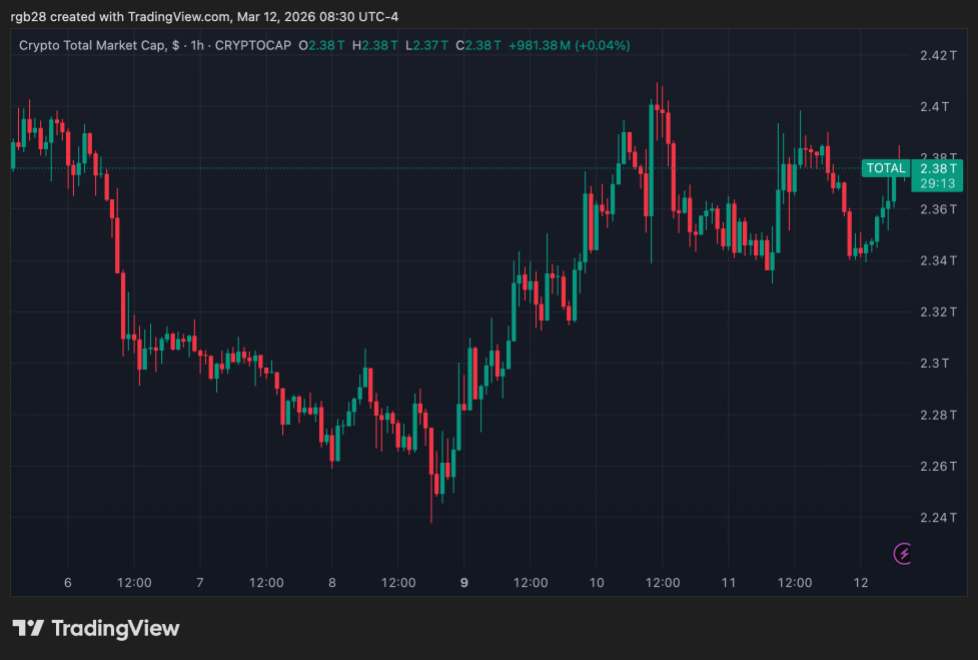
The total crypto market capitalization sits at $2.38 trillion on the one-week chart. Source: TOTAL on TradingView


Related Questions

QWhat specific policy proposals from the Bank of England regarding stablecoins are facing backlash?

AThe Bank of England's proposals facing backlash include a temporary ownership cap of £10,000 to £20,000 for individuals and £10 million for businesses, and a requirement for systemic stablecoin issuers to hold at least 40% of reserves as unremunerated deposits at the central bank.

QWhy did the Bank of England propose an ownership cap for stablecoins?

AThe Bank of England proposed the ownership cap to mitigate financial stability risks stemming from large and rapid outflows of deposits from the banking sector.

QWhat did Deputy Governor Sarah Breeden say about the 60:40 asset allocation proposal?

ASarah Breeden stated that the Bank of England would review whether the 60:40 asset allocation is 'excessively conservative,' but argued that it aligns broadly with measures proposed in the United States and has been adopted in the European Union.

QWhat were two main criticisms from industry leaders regarding the proposed stablecoin cap?

AIndustry leaders criticized the cap, stating that £10 million is too low for businesses to operate effectively and that tracking token ownership would impose a 'massive administrative burden' on issuers.

QWhat was the concern raised by UK lawmakers in their letter to Chancellor Rachel Reeves?

ALawmakers argued that the ownership cap could prevent the UK from capitalizing on digital asset opportunities, drive innovation offshore, lead investors to USD-pegged alternatives, and position the UK 'as a global outlier.'

Related Reads

Popular Interaction Collection | Interstate Launches Points Event; Flip Early Waitlist Application (June 12)

**Interstate Launches Points Event, Flip Opens Early Waitlist Applications** *Originally published by Odaily Planet Daily, author Asher.* **Interstate**, an infrastructure platform integrating on-chain transactions for assets like Meme tokens, prediction markets, and xStocks, has launched a points event. Each trade on the platform now rewards users with points. The project has completed a $1.5 million seed round from investors including MH Ventures, Alchemy Ventures, and Marshland Capital. Users can visit the official website to connect their wallets and start earning points through trading tasks (note: the site may experience high traffic). **Flip**, an AI-powered financial assistant, has opened applications for its early waitlist. The platform allows users to manage finances via chat, helping with spending tracking, bill management, investment portfolio monitoring (including stocks and crypto), and more. Flip recently raised $1.4 million in a pre-seed round led by The House Fund and participated in a16z's Speedrun accelerator. Interested users can join the waitlist via the official website. **ArcNova**, an AI-native infrastructure platform for short-form video and entertainment, continues to offer tasks for earning points. Users can sign in daily, complete social and app tasks, and refer friends to accumulate points. The project announced a $15 million funding round in May, backed by Adaverse Ventures, Animoca Brands, and others. The task portal is accessible through the ArcNova website. These updates highlight ongoing opportunities for user engagement and potential rewards across emerging crypto and AI projects.

Odaily星球日报32m ago

Popular Interaction Collection | Interstate Launches Points Event; Flip Early Waitlist Application (June 12)

Odaily星球日报32m ago

MoneyGram: Why Did We Launch Our Own Stablecoin?

MoneyGram, a global leader in cross-border remittances for over 80 years, has launched its own stablecoin, MGUSD. The initiative aims to evolve from single-transaction services to becoming a more integral part of users' financial lives. By allowing customers to hold a stable US dollar balance within the MoneyGram app, MGUSD enables not only remittances but also everyday spending, currency exchange, cash access, and future financial services. Targeting the billions globally who face challenges like currency volatility or lack of bank accounts, MGUSD leverages Stellar blockchain technology with a self-custody wallet architecture. This gives users control over their assets while providing a secure, compliant experience through a trusted brand. The approach focuses on solving existing customer pain points within MoneyGram's established network, rather than competing for broad crypto market liquidity. A key advantage is MoneyGram's hybrid model, combining digital services with the world's largest physical network for crypto-to-cash conversions. The stablecoin also modernizes the company's internal infrastructure, streamlining treasury management and partner settlements, with annual forex volume via stablecoins already reaching $2 billion. The project was delivered in about a year, driven by a reorganization into agile, cross-functional teams that operate with startup-like speed while leveraging decades of institutional expertise. Partners include Stablecoin (issuance), Crossmint (wallet APIs), Fireblocks (enterprise treasury), m0 (smart contracts), and the Stellar network. MoneyGram emphasizes that enhancing direct consumer offerings strengthens its partner ecosystem. The future direction is clear: to provide users worldwide with stable value storage, better financial tools, and greater control over their funds through a trusted, existing network.

Foresight News1h ago

MoneyGram: Why Did We Launch Our Own Stablecoin?

Foresight News1h ago

Trading

Spot
Futures

Hot Articles

What is $BANK

Bank AI: A Revolutionary Step in the Future of Banking Introduction In an era marked by rapid advancements in technology, Bank AI stands at the intersection of artificial intelligence (AI) and banking services. This innovative project seeks to redefine the financial landscape, enhancing operational efficiency, security measures, and customer experiences through the power of AI. As we embark on this exploration of Bank AI, we will delve into what the project entails, its operational dynamics, its historical context, and significant milestones. What is Bank AI? At its core, Bank AI represents a transformative initiative aimed at integrating artificial intelligence into various banking operations. This project harnesses the capabilities of AI to automate processes, improve risk management protocols, and enhance customer interaction through personalized services. The primary objectives of Bank AI include: Automation of Banking Functions: By leveraging AI technologies, Bank AI aims to automate routine tasks, reducing the burden on human resources and enhancing efficiency. Enhanced Risk Management: The project utilises AI algorithms to predict and identify risks, thereby fortifying security measures against fraud and other threats. Personalization of Banking Services: Bank AI focuses on offering tailored financial products and services by analysing customer data and behaviours. Improving Customer Experience: The implementation of AI-driven solutions, such as chatbots and virtual assistants, aims to provide users with more human-like interactions, revolutionising the way customers engage with banks. With these goals, Bank AI positions itself as a crucial player in rendering banking more efficient, secure, and user-centric. Who is the Creator of Bank AI? Details regarding the creator of Bank AI remain unknown. As such, no specific individual or organisation has been identified in the available information. The anonymity surrounding the project's inception raises questions but does not detract from its ambitious vision and objectives. Who are the Investors of Bank AI? Similar to the project's creator, specific information regarding the investors or supporting organisations of Bank AI has not been disclosed. Without this information, it is challenging to outline the financial backing and institutional support that might be propelling the project forward. Nevertheless, the importance of having a robust investment foundation is pivotal for sustaining development in such an innovative field. How Does Bank AI Work? Bank AI operates on several innovative fronts, focusing on unique factors that differentiate it from traditional banking frameworks. Below are key operational features: Automation: By applying machine learning algorithms, Bank AI automates various manual processes within banks. This results in reduced operational costs and allows human workers to redirect their efforts towards more strategic activities. Advanced Risk Management: The integration of AI into risk management practices equips banks with tools to accurately predict potential threats such as fraud, ensuring that customer information and assets remain secure. Tailored Financial Recommendations: Through continuous learning from customer interactions, the AI systems develop a nuanced understanding of user needs, enabling them to offer tailored advice on financial decisions. Enhanced Customer Interactions: Utilizing chatbots and virtual assistants powered by AI, Bank AI enables a more engaging customer experience, allowing users to have their queries resolved quickly, thus reducing wait times and improving satisfaction levels. Together, these operational features position Bank AI as a pioneer in the banking sector, establishing new benchmarks for service delivery and operational excellence. Timeline of Bank AI Understanding the trajectory of Bank AI requires a look at its historical context. Below is a timeline highlighting important milestones and developments: Early 2010s: The conceptualization of AI integration into banking services began to gain attention as banking institutions recognised the potential benefits. 2018: A marked increase in the implementation of AI technologies occurred when banks started using AI tools like chatbots for basic customer service and risk management systems for improved security handling. 2023: The sophistication of AI continued to advance, with generative AI being introduced for more complex tasks such as document processing and real-time investment analysis. This year marked a significant leap in the capabilities afforded to banks by AI technology. 2024-Current Status: As of this year, Bank AI is on an upward trajectory, with ongoing research and developments poised to further enhance capabilities in banking operations. Continued exploration of AI applications hints at exciting developments yet to come. Key Points About Bank AI Integration of AI in Banking: Bank AI focuses on adopting artificial intelligence to streamline banking processes and improve user experiences. Automation and Risk Management Focus: The project strongly emphasizes these areas, aiming to shift the burden of routine tasks while enhancing security frameworks through predictive analytics. Personalized Banking Solutions: By harnessing customer data, Bank AI enables tailored banking services that cater to individual user needs. Commitment to Development: Bank AI remains committed to ongoing research and development efforts, ensuring its adaptability and ongoing relevance as technology continues to evolve. Conclusion In summary, Bank AI exemplifies a crucial step forward in the banking industry, leveraging artificial intelligence to reshape operational paradigms, enhance security, and promote customer satisfaction. Despite gaps in information surrounding the creator and investors, the clear objectives and functional mechanisms of Bank AI provide a strong foundation for its ongoing evolution. As AI technology continues to advance and merge with the banking sector, Bank AI is well-positioned to significantly impact the future of financial services, enhancing the way we understand and interact with banking.

953 Total ViewsPublished 2024.04.05Updated 2024.12.03

What is $BANK

How to Buy BANK

Welcome to HTX.com! We've made purchasing Lorenzo Protocol (BANK) simple and convenient. Follow our step-by-step guide to embark on your crypto journey.Step 1: Create Your HTX AccountUse your email or phone number to sign up for a free account on HTX. Experience a hassle-free registration journey and unlock all features.Get My AccountStep 2: Go to Buy Crypto and Choose Your Payment MethodCredit/Debit Card: Use your Visa or Mastercard to buy Lorenzo Protocol (BANK) instantly.Balance: Use funds from your HTX account balance to trade seamlessly.Third Parties: We've added popular payment methods such as Google Pay and Apple Pay to enhance convenience.P2P: Trade directly with other users on HTX.Over-the-Counter (OTC): We offer tailor-made services and competitive exchange rates for traders.Step 3: Store Your Lorenzo Protocol (BANK)After purchasing your Lorenzo Protocol (BANK), store it in your HTX account. Alternatively, you can send it elsewhere via blockchain transfer or use it to trade other cryptocurrencies.Step 4: Trade Lorenzo Protocol (BANK)Easily trade Lorenzo Protocol (BANK) on HTX's spot market. Simply access your account, select your trading pair, execute your trades, and monitor in real-time. We offer a user-friendly experience for both beginners and seasoned traders.

4.7k Total ViewsPublished 2025.05.09Updated 2026.06.02

How to Buy BANK

Discussions

Welcome to the HTX Community. Here, you can stay informed about the latest platform developments and gain access to professional market insights. Users' opinions on the price of BANK (BANK) are presented below.

活动图片













