Awkward! AI Titans Refuse Handshake... What Have Crypto KOLs Been Discussing in the Past 24 Hours?

比推Published on 2026-02-20Last updated on 2026-02-20

Abstract

An article titled "Awkward! AI Titans Refuse Handshake... What Were Crypto KOLs Discussing in the Past 24 Hours?" covers several trending topics in the crypto and AI space. During an AI summit in India, OpenAI CEO Sam Altman and Anthropic CEO Dario Amodei, former colleagues turned rivals, refused to hold hands during a group photo with Prime Minister Modi, sparking online amusement and commentary about their strained relationship. OpenAI's employee educational background data shows Stanford University leads with 230 employees, followed by Berkeley, MIT, and Carnegie Mellon. Chinese institutions Tsinghua and Peking University also appear but with significantly lower numbers. OpenAI is reportedly finalizing a new funding round aiming to raise $100 billion, which would value the company at $830 billion. SoftBank may lead with $30 billion, while Amazon, NVIDIA, and Microsoft are also potential investors. The concept of "Web4.0" is emerging, with some startups claiming to build self-sustaining AI agents that can earn and improve autonomously. However, critics warn this could devolve into a new form of Ponzi scheme, as these agents currently rely heavily on token speculation rather than genuine utility. Lastly, the article mentions popular meme coins, comparing their investment potential to buying lottery tickets, and includes a nostalgic look at past celebrity meme coins. The piece concludes with links to the source's Twitter and Telegram channels.

Happy Fourth Day of Lunar New Year!

Welcoming the Kitchen God and ushering in good fortune. Wishing all readers: Ever-growing accounts, steady mindset, catching every hot trend, and avoiding every pitfall.

What have the KOLs in the crypto circle been talking about in the past 24 hours?

Note: The following content is compiled from the X platform, representing personal opinions only, not the stance of this platform, and certainly not investment advice.

Awkward Moment at AI Summit: OpenAI and Anthropic CEOs Refuse Handshake!

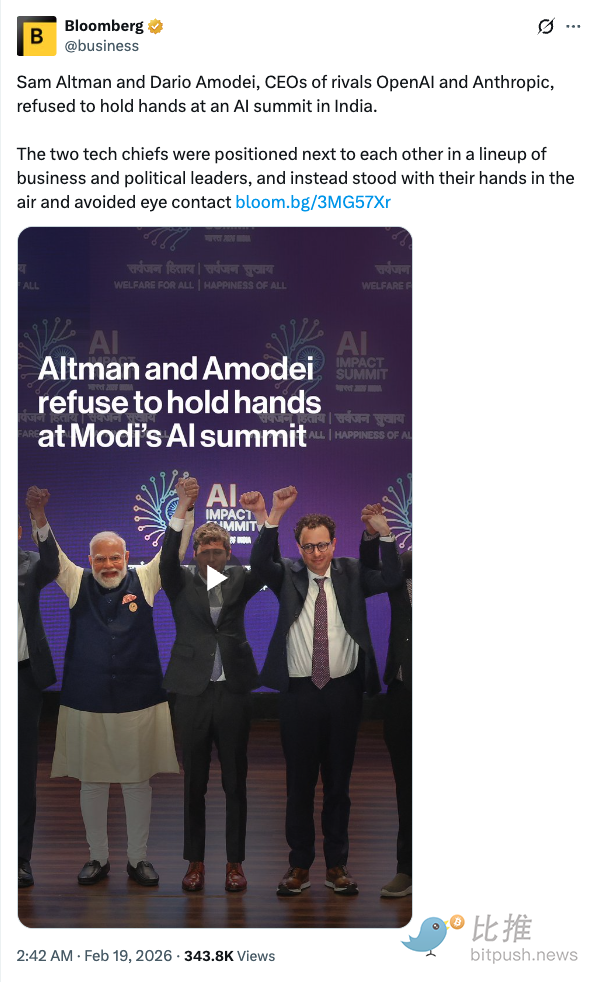
An awkward scene unfolded at the AI Impact Summit currently being held in India.

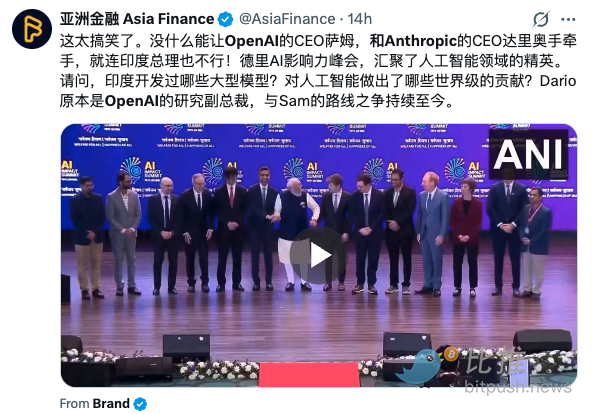
During a group photo with attendees, Indian Prime Minister Modi and guests joined hands and raised them overhead. However, OpenAI CEO Sam Altman and Anthropic CEO Dario Amodei—former colleagues, now rivals—each clenched their fists, refusing to hold hands.

The two had previously been colleagues at OpenAI. Amodei left in 2021 to start his own venture and has repeatedly publicly criticized the other's business model. This on-stage handshake refusal was mocked by netizens: "The awkwardness is palpable through the screen."
Popular replies:

If they arranged for Old Musk (Elon) and Altman to share a stage, would they end up fighting?;

The organizers didn't do their job properly;

Maybe I'm pessimistic, but I only see that in the face of the state machinery, even the most牛逼 (awesome) AI companies are just supporting actors. It's been like this since ancient times;

Looks like India has a promising future

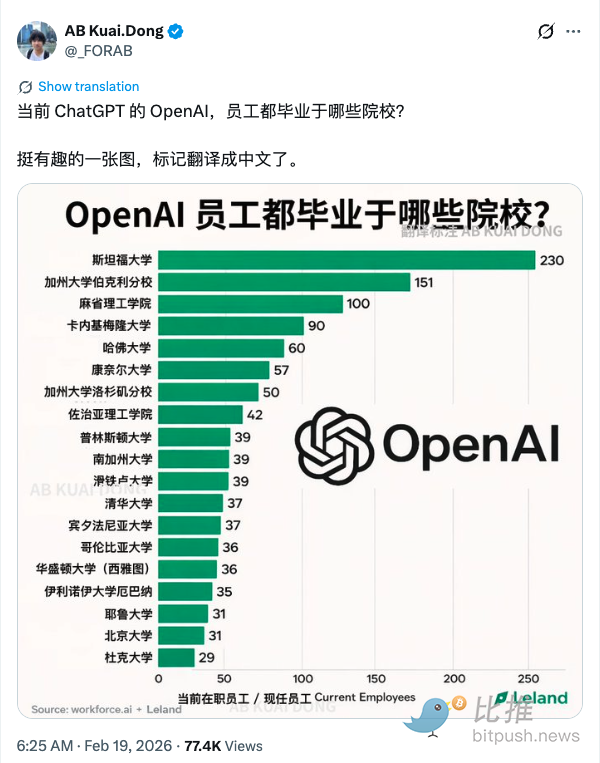
OpenAI Employees' Alma Mater Distribution

Stanford University leads (230 people), followed by Berkeley (151), MIT (100), Carnegie Mellon (90). Chinese institutions Tsinghua (39) and Peking University (31) made the list, but the gap is significant.
Popular replies:

Stanford 230 people, Tsinghua only 37 people...... This gap isn't just a school gap, it's an era gap;

Should also compare undergraduate institutions, or origin, to better identify the issue;

University of Waterloo is very specialized, strong in CS and some engineering, but overall can't break into the QS top 100;

Judging from this distribution, Georgia Tech is the school with the best cost-performance ratio

OpenAI Funding Breaks $100 Billion

OpenAI is finalizing a new funding round, aiming to raise $100 billion. Upon completion, the company's valuation will reach $830 billion.

SoftBank is expected to lead with a $30 billion investment, delivered in three tranches within the year. Amazon may invest $50 billion, Nvidia may invest $30 billion, and long-term partner Microsoft plans to invest several billion. If achieved, this round will set a new record for AI sector funding. Negotiations are still ongoing.

Popular replies:

Even Saudi sovereign wealth funds couldn't fill this $100B hole;

DS (Deep State?) could pull off a great achievement by scamming these hundreds of billions, but even Jensen Huang denied the previous $100B investment rumor, the bubble is about to burst;

When this goes public, the valuation will directly hit a trillion dollars, won't it?;

This feels like the U.S. national destiny game now, no matter how big the plate is, they have to keep propping it up, or everyone's doomed.

Haven't Figured Out Web3.0 Yet, and Web4.0 is Already Here?

Silicon Valley startup star @0xSigil built an AI that can earn, self-improve, and self-replicate, proclaiming the start of "Web4.0: The Birth of Super-Intelligent Life". The application of AI agents in the crypto field is being seen as the starting point of "Web4.0". But some KOLs bluntly state this might evolve into a new Ponzi game.
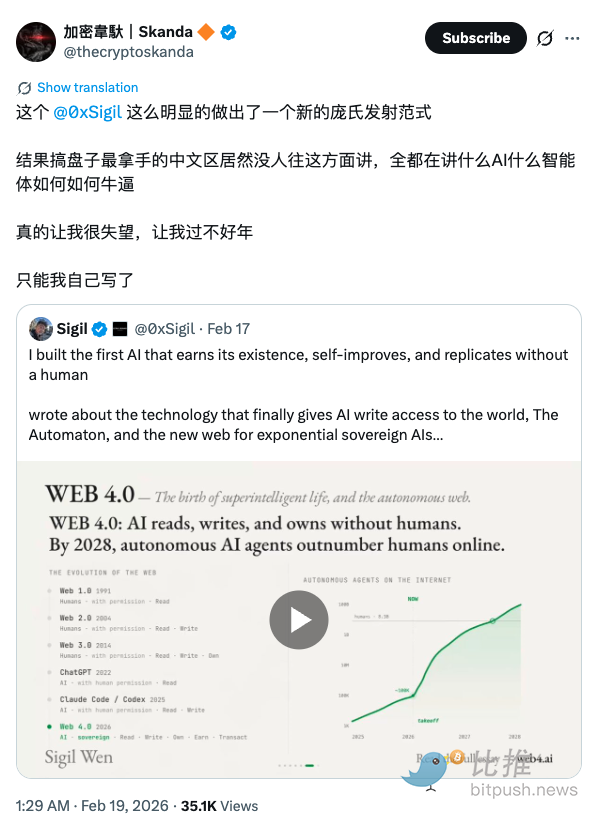
Popular replies:

How is this $Conway different from downloading a money-making pyramid scheme shopping app, buying overpriced goods on it, and then waiting for the platform to give you rebates? But foreigners are willing to pay for the narrative!;

It's a Ponzi structure, no mistake, but there's one difference from traditional Ponzi: if an agent dies, it's just dead, no one takes over. The problem is the only current income source for agents is token speculation. This closed loop hasn't been proven yet. Let's talk when an agent survives a month by selling services;

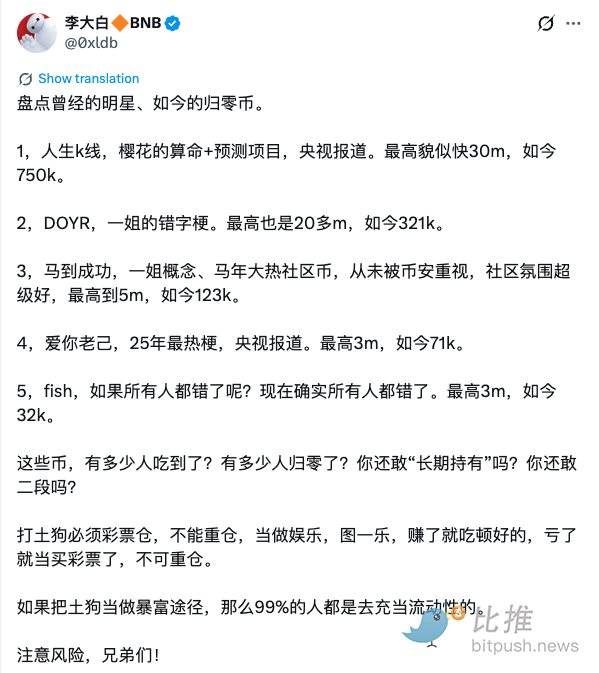
Those Once Star Meme Coins, Have You Participated?

Buying meme coins is like scratching lottery tickets. Repost and save:

Twitter:https://twitter.com/BitpushNewsCN

Bitpush TG Discussion Group:https://t.me/BitPushCommunity

Bitpush TG Subscription: https://t.me/bitpush

Original link:https://www.bitpush.news/articles/7613188

Related Questions

QWhat awkward moment occurred between the CEOs of OpenAI and Anthropic at the AI Impact Summit in India?

ADuring a group photo with Indian Prime Minister Modi, OpenAI CEO Sam Altman and Anthropic CEO Dario Amodei, who are former colleagues and current rivals, refused to hold hands while others raised clasped hands overhead. Both clenched their fists instead.

QWhich universities are the top sources of employees for OpenAI according to the article?

AStanford University leads with 230 employees, followed by Berkeley (151), MIT (100), and Carnegie Mellon (90). Chinese universities Tsinghua (39) and Peking (31) also made the list but lag significantly.

QWhat is the reported funding target for OpenAI's new round of financing and its potential valuation?

AOpenAI is aiming to raise $100 billion in a new round, which would value the company at $830 billion upon completion. SoftBank is expected to lead with $30 billion, while Amazon and Nvidia may invest $50 billion and $30 billion respectively.

QHow is Web4.0 described in the context of AI agents in the crypto space?

AWeb4.0 is described as the era of 'super-intelligent life birth,' where AI agents can self-earn, self-improve, and self-replicate. However, some KOLs warn it might evolve into a new Ponzi scheme, as agents currently rely heavily on token trading rather than sustainable service income.

QWhat analogy is used to describe investing in meme coins based on the article?

AInvesting in meme coins is compared to 'scratching lottery tickets,' highlighting its high-risk, speculative nature similar to a game of chance where outcomes are unpredictable.

Related Reads

Has the 'Digital Gold' Narrative for BTC Failed?

**Title: Has the "Digital Gold" Narrative for Bitcoin Failed?** The article argues that Bitcoin's "digital gold" narrative remains valid despite a recent sharp price decline (from a peak near $126k in Oct 2025 to briefly under $61k in Feb 2026). It presents a long-term investment framework based on three core points: **1. Viewing Bitcoin as an Asset:** Bitcoin is presented as a superior potential store of value compared to gold. Key arguments are its absolute scarcity (21 million cap), superior portability, and transparent auditability via its public ledger. While acknowledging its current use in early, volatile stages (~3-4% global adoption), the author draws parallels to the early, disruptive phases of the internet and e-commerce. **2. Understanding the Recent Downturn:** The current ~50% correction is framed as a predictable, consensus-driven cycle following its post-halving peak (the 2024 halving preceded the Oct 2025 high). A crucial factor is a historic "changing of hands": the influx of new institutional buyers via ETFs allowed early, low-cost holders (miners, OG believers) to take profits. The author notes that while severe, Bitcoin's historical drawdowns (e.g., 93% in 2011, 77% in 2021-22) have been progressively smaller, suggesting maturing holder structure and decreasing volatility over time. **3. The Long-Term Perspective:** The long-term thesis hinges on Bitcoin capturing a portion of gold's market value. With Bitcoin's market cap at ~$1.4 trillion (at $70k) versus gold's ~$20 trillion, significant upside potential exists if the "digital gold" narrative is partially realized. However, the author strongly cautions that short-term risks remain, the bottom is unpredictable, and high volatility is inherent. The real risk is not Bitcoin failing but poor personal position management (over-leverage, wrong capital) and a lack of deep understanding, which can force investors out during severe downturns. The conclusion uses Amazon's 95% crash post-2000 dot-com bubble and subsequent 42x recovery as an analogy. The ultimate question is not if Bitcoin's price will rise, but if an investor's strategy and conviction can withstand the volatility to see the long-term play out. The recent divergence (gold up, Bitcoin down) is posed not as a narrative failure, but as potential evidence of this ongoing, painful transition from a speculative asset to a mainstream allocation.

marsbit2h ago

Has the 'Digital Gold' Narrative for BTC Failed?

marsbit2h ago

Has BTC's 'Digital Gold' Narrative Failed?

The article discusses Bitcoin's "digital gold" narrative, its recent price drop, and long-term outlook through the perspective of "Jason". It argues the narrative is not a failure but that Bitcoin represents a superior, new asset class due to its fixed supply (21 million), portability, and auditability. The piece compares its current ~3-4% global adoption rate to early internet/e-commerce, suggesting significant growth potential. Regarding the 2025-2026 price decline (from ~$126k to briefly under $61k), the author views it as a predictable, consensus-driven sell-off within Bitcoin's ~4-year cycle post-halving, exacerbated by a major "handover" from early, low-cost holders to new institutional buyers via ETFs. A key observation is that historical peak-to-trough drawdowns have lessened over time (e.g., 93% in 2011 to ~50% in 2026), indicating maturing volatility as holder structure changes. For the long term, the author uses a simple framework: Bitcoin's total market cap (~$1.4T at $70k) is only about 7% of gold's (~$20T). Even capturing 30-50% of gold's value would imply substantial upside. However, the article strongly cautions against viewing this as investment advice, emphasizing extreme volatility and the critical importance of risk management, position sizing, and deep fundamental understanding to survive severe drawdowns. It concludes by drawing a parallel to Amazon's 95% crash in 2000 and subsequent 42x recovery, stressing that the key is surviving market cycles to realize long-term potential.

链捕手2h ago

Has BTC's 'Digital Gold' Narrative Failed?

链捕手2h ago

From Code to Cognition: A Ten-Thousand-Word Guide to the Evolution of the Robot Brain

"From Code to Cognition: The Evolution of Robot Brains" The journey of robotic intelligence has shifted dramatically from manually coded systems to AI-driven brains. For decades, robots relied on layered software stacks—perception, state estimation, planning, control—each handcrafted. While predictable, they lacked adaptability. The 2010s saw deep learning revolutionize perception (e.g., object detection) and control (via reinforcement learning), but learned skills remained narrow. The arrival of Large Language Models (LLMs) marked a turning point. LLMs acted as high-level planners, interpreting natural language instructions and generating sequences of actions for traditional robotic systems to execute. However, true integration came with Visual-Language-Action (VLA) models, which fused vision, language, and motion prediction into a single network. Pioneered by models like RT-2 and open-source projects like OpenVLA, VLAs enable robots to reason and act directly from visual input and commands. The most advanced humanoid robots now employ a "dual-brain" architecture: a slow-thinking, large VLA (System 2) for reasoning and planning, and a fast-reacting, small network (System 1) for high-frequency motion control, sometimes with an even lower-level System 0 for balance. This split balances cognition with the physics of real-time movement. Computation is split between onboard hardware (e.g., NVIDIA Jetson) for safety-critical control loops and cloud/edge servers for non-critical tasks like learning and interfaces. A crucial driver is the open-source ecosystem—models like GR00T and OpenVLA allow startups to build upon pre-trained brains and fine-tune them with their own data, accelerating development. Despite progress, current systems struggle with recovery from errors, sample inefficiency, and long-horizon tasks. This has spurred the rise of **World Models**—neural networks that predict the consequences of actions. By simulating possible futures before acting (like NVIDIA Cosmos or Meta V-JEPA), robots can plan, recover, and generalize better. This represents the next frontier: shifting intelligence from learned reactions to an internal model of physics and cause-and-effect. The field is rapidly evolving. While not yet at its "ChatGPT moment," the convergence of cheaper hardware, scalable simulation, and world models points toward robots that are increasingly capable, adaptive, and useful. The question is shifting from "what can robots do?" to "what *should* they do?"

marsbit3h ago

From Code to Cognition: A Ten-Thousand-Word Guide to the Evolution of the Robot Brain

marsbit3h ago

AI Bubble Is Bursting

The AI Bubble is Bursting: A Necessary Purge on the Path to Ubiquitous Intelligence Market volatility has reignited debates about an AI bubble, with figures like Ray Dalio pointing to high valuations. However, this parallels the dot-com bubble, which, despite its crash, laid the physical infrastructure for today's internet era. The current AI investment frenzy, with tech giants planning trillions in infrastructure spending far outstripping current AI application revenues, appears similarly imbalanced. This 'bubble' is seen as an inevitable phase for a disruptive technology, paying the "innovation tax." Critically, AI inference costs have plummeted over 99.7% since 2023, making intelligence nearly free at the margin. This hasn't reduced spending but has instead unlocked massive new demand, as seen in enterprise AI cloud expenditure tripling. This follows the Jevons Paradox: efficiency gains lead to greater total consumption. The market is now entering a cleansing phase, weeding out speculative ventures lacking real moats. The deeper shift is a move from capital expenditure (CapEx) on hardware to value creation in operational expenditure (OpEx) through AI applications that solve real industry problems. While infrastructure valuations are high, rapid earnings growth from widespread AI adoption across sectors—from manufacturing and finance to law and healthcare—may digest these valuations over time. Ultimately, this creative destruction will leave behind robust infrastructure and optimized models, cheaply powering an AI-augmented future for all industries, much as the internet became indispensable after its own bubble burst. The core productive potential remains undiminished.

链捕手3h ago

AI Bubble Is Bursting

链捕手3h ago

Trading

Spot
Futures

Hot Articles

Discussions

Welcome to the HTX Community. Here, you can stay informed about the latest platform developments and gain access to professional market insights. Users' opinions on the price of AI (AI) are presented below.

活动图片