
Original: Arthur Hayes
Compilation: Yuliya, PANews
Imagine a video call between U.S. President Trump and Venezuelan President Pepe Maduro, while Maduro was on a flight from Caracas to New York.
Trump: "Pepe Maduro, you are such a bad guy. Your country's oil is mine now, USA!"
Pepe Maduro: "Trump, you madman!"
*Note: Arthur Hayes refers to the Venezuelan president as "Pepe Maduro" in the article instead of his real name Nicolás Maduro. "Pepe" is a common nickname for "José" in Spanish, although Maduro's name is Nicolás.
One can apply various positive or negative labels to this historic, disruptive, authoritarian, militaristic event of the U.S. "kidnapping" or "legally arresting" the leader of a sovereign nation. Countless AI-assisted writers will likely churn out endless articles interpreting these events and predicting the future. They will judge these actions from a moral perspective and advise how other countries should respond. But this article is not about that. The core question is only one: Will the U.S. "colonization" of Venezuela push the price of Bitcoin/cryptocurrency up or down?
The Only Rule of Politics: Re-election
To answer this question, we must understand a simple, brutal political reality: All elected politicians, at all times, focus on only one thing—winning re-election. Grand narratives like God, country, etc., all come after winning votes. Because if you don't have power, you can't bring about change, so in a way, this obsession with re-election is rational.
For Trump, two elections are crucial: the 2026 midterms and the 2028 presidential election. Although he himself does not need to run in 2026 and cannot run for a third presidential term in 2028, the loyalty and obedience of his political supporters depend on their respective re-election prospects. Those who defected from the "Make America Great Again" (MAGA) camp did so precisely because they believed their future election prospects would dim if they continued to follow Trump's orders.
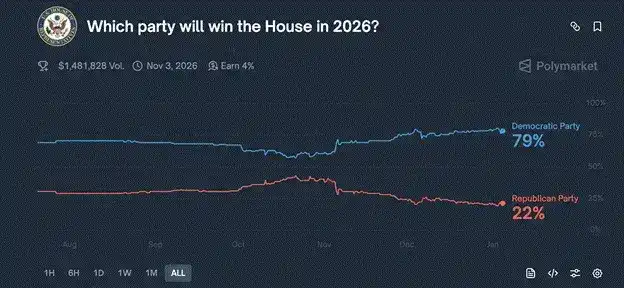
So, how can Trump ensure that the undecided swing voters, those not yet committed to the Democratic (Blue) or Republican (Red) camps, cast the "right" vote in November 2026 and 2028?
Currently, it seems likely that the Blue Democrats will retake the House of Representatives. For Trump to be a winner, he must act immediately. There is not much time left for policy adjustments to change voters' minds.
What Do Voters Care About? The Economy, Especially Oil Prices
So, how to please swing voters? All the flashy culture wars are worthless compared to the voter's wallet. Voters only care about the economy, about whether they feel richer or poorer when they vote.
For Trump, the easiest way to stimulate the economy is to turn on the money printing press and boost nominal GDP. This drives up financial asset prices, pleasing the wealthy class who will "reward" him with campaign donations. However, in the U.S., it's one person, one vote. If money printing leads to serious inflation and the cost of living soars for the general public, they will vote the ruling party out.
Trump and Treasury Secretary Besant have indicated they will let the economy run hot. The question is, how will they suppress inflation? The kind of inflation that kills re-election chances is inflation in food and energy.
For the average American, the most sensitive inflation indicator is gasoline prices. Because the U.S. public transportation system is poor, almost everyone drives, and oil prices directly affect everyone's cost of living.
Therefore, Trump and his deputies "colonized" Venezuela for its oil.
When talking about Venezuelan oil, many will quickly point out that the country has the world's largest proven reserves. But how much oil is in the ground doesn't matter. The question is, can it be extracted profitably? Trump clearly believes that by developing Venezuela's oil resources, oil can be shipped to Gulf Coast refineries, and cheap gasoline will appease the populace by suppressing energy inflation.
Whether this strategy is correct will be answered by the West Texas Intermediate (WTI) and Brent crude oil markets. As nominal GDP and dollar credit supply increase, will oil prices rise or fall? If GDP and oil prices rise together, the Blue Democrats win; if GDP rises while oil prices remain flat or fall, the Red Republicans win.
The best part of this framework is that oil prices will reflect all reactions from other oil-producing and military powers (most importantly Saudi Arabia, Russia, and China) to the U.S. "colonization" of Venezuela. Another advantage is that the market is reflexive. We know Trump adjusts policy based on stock prices, U.S. Treasuries, and oil prices. As long as stock prices keep rising and oil prices stay low, he will continue printing money and pursuing "colonization" policies to obtain oil. As investors, we can react on the same timeframe as Trump, which is the best scenario we can hope for. This reduces the need to predict the outcome of a complex geopolitical system. Traders just need to read the charts and adapt.
Here are some charts and statistical analysis that clearly show why Trump must boost nominal GDP while suppressing oil prices to win the election:
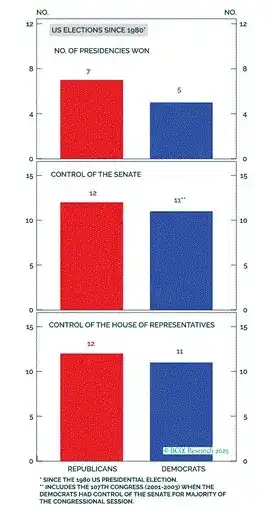
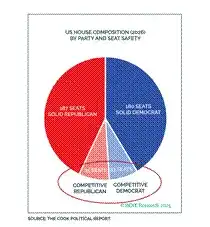
- Political Landscape: The Red and Blue camps are evenly matched, with only a small portion of Americans deciding which camp controls the government.
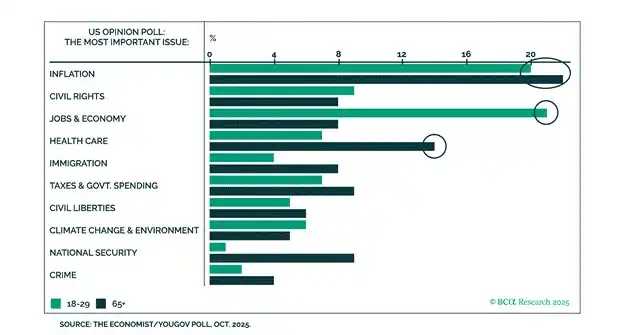
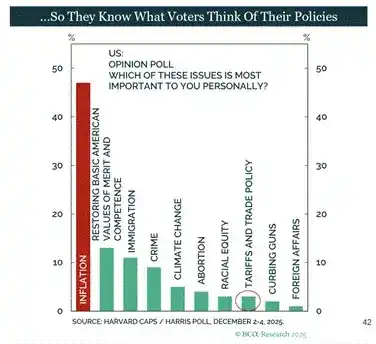
- Voter Focus: The economy and inflation are the top two concerns for voters; everything else is irrelevant.
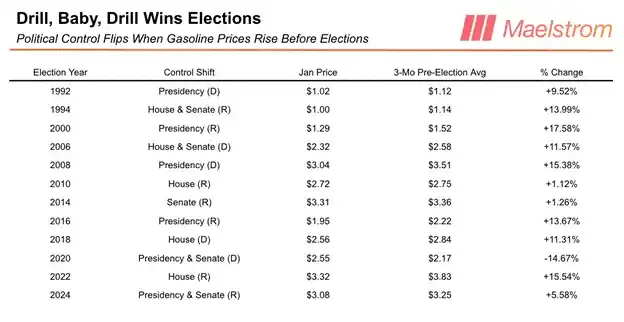
- "The 10% Rule": When the national average gasoline price in the three months before the election rises by 10% or more compared to the January average of the same year, control of one or more branches of government changes hands.
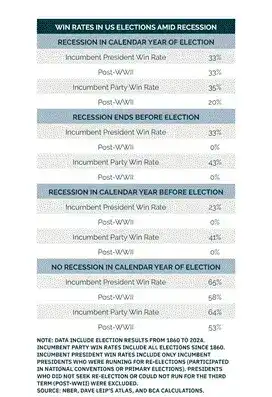
- Election Prospects: If a recession is avoided, the Red camp has the best chance of winning the 2028 presidential election.
These charts clearly show that Trump must make the economy run hot without causing gasoline prices to rise.
Bitcoin's Trajectory Under Two Scenarios
We face two scenarios: one where nominal GDP/credit and oil prices both rise; and another where nominal GDP/credit rises while oil prices fall. How will Bitcoin react?
To understand this, one must first clarify a core point: Oil prices are crucial not because they affect mining costs, but because they have the power to force politicians to stop printing money.
Bitcoin consumes energy through Proof-of-Work (PoW) mining, making it a pure monetary abstraction. Therefore, the energy price itself is irrelevant to the Bitcoin price, as all miners' costs change synchronously, which does not alter Bitcoin's intrinsic value logic.
The real power of oil prices lies in them being a "trigger" for political and financial disaster.
The Chain Reaction of Runaway Oil Prices
If economic expansion causes oil prices to rise too fast and too high, it will trigger the following series of devastating chain reactions:
Runaway oil prices mean a surge in the cost of living for the people, which will directly ignite voter anger and put those in power at great risk of being ousted. To retain power, they must suppress oil prices at all costs (e.g., by stealing oil from other countries or slowing credit creation). The 10-year U.S. Treasury yield and the MOVE index, which measures volatility in the U.S. bond market, will tell us when oil prices are too high.
Investors face a difficult choice: invest in financial assets or physical assets. When energy costs are low and stable, investing in financial assets like government bonds is reasonable. But when energy costs are high and volatile, investing in energy commodities is wiser. Therefore, when oil prices reach a certain level, investors will demand higher yields from government bonds, especially the 10-year U.S. Treasury.
When the 10-year Treasury yield approaches 5%, market volatility may increase significantly, and the MOVE index could spike. Current U.S. politics make it difficult to curb deficit spending; "free benefits" often win in elections. However, as oil prices rise and yields approach critical levels, the market may come under pressure. Because the current fiat financial system is embedded with massive leverage, when volatility rises, investors must sell assets, or they will be wiped out.
For example, last year's April 2nd "Liberation Day" and the subsequent April 9th Trump "TACO" (Tariff Action) is an example. Trump threatened extremely high tariffs, which would have reduced global trade and financial flow imbalances, creating a strong deflationary effect. The market plummeted, and the MOVE index briefly surged to 172 intraday. The next day, Trump "paused" the tariffs, and the market bottomed and rebounded violently.
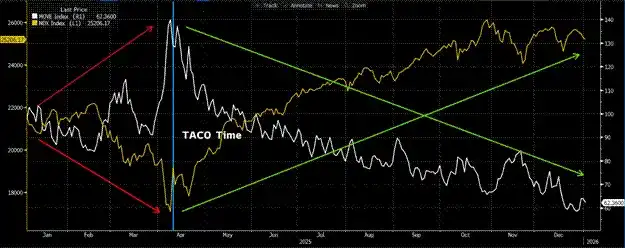
MOVE Index (White) vs. Nasdaq 100 Index (Yellow)
On such issues, trying to use historical data to precisely determine at what level oil prices and the 10-year yield will force Trump to tighten money printing is not meaningful. We will know it when we see it happen. If oil prices and yields rise sharply, then one should reduce bullishness on risk assets.
The current base case scenario is: Oil prices will remain stable or even fall, while Trump and Besant will print money like crazy, as in 2020. The reason is that the market will initially believe that U.S. control of Venezuelan oil will significantly increase daily crude production. Whether engineers can actually achieve millions of barrels per day in Venezuela is not important.
What really matters is: Trump will print money faster than Israeli Prime Minister Benjamin Netanyahu changes his reasons for attacking Iran. If this logic is still not enough to convince someone that it's time to go long on all risk assets, just remember one thing: Trump is the most socialist U.S. president since Roosevelt. He printed trillions of dollars in 2020 and, unlike previous presidents, sent money directly to everyone. You can be sure he will not lose an election by under-printing.
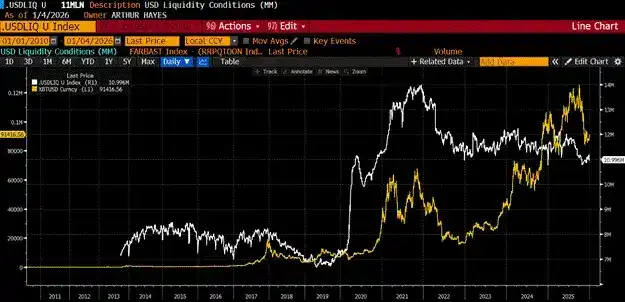
Based on statements from Trump and his core team, we know credit will expand. Red Republican lawmakers will engage in deficit spending, Besant's Treasury will issue debt to finance it, and the Federal Reserve (whether Powell or his successor) will print money to buy these bonds. As Lyn Alden says, "Nothing can stop this train." As the quantity of dollars expands, the prices of Bitcoin and certain cryptocurrencies will soar.
Trading Strategy
Arthur Hayes' biggest loss last year came from trading the token PUMP after its launch. Also, remember to stay away from Meme coins; the only Meme coin trade he made money on last year was TRUMP. On the bright side, most profits came from trading HYPE, BTC, PENDLE, and ETHFI. Although only 33% of trades were profitable, position sizing was managed well, and the average profit of winning trades was 8.5 times the average loss of losing trades.
Arthur Hayes plans to improve this year by: Focusing on what he is good at, which is making large, medium-term position deployments based on clear macro liquidity theses combined with a credible "altcoin" narrative. When trading "shitcoins" or Meme coins for entertainment purposes, he will reduce position size.
Looking ahead, this year's dominant narrative will revolve around "privacy." ZEC will be the bellwether in the privacy field. Maelstrom was already heavily long on this token in Q3 2025. The plan is to find at least one "altcoin" in the privacy space that can lead the trend and bring excess returns to the portfolio in the coming years. To achieve returns that outperform BTC and ETH, he plans to sell some Bitcoin and Ethereum in exchange for more explosive "altcoins" in the privacy and DeFi fields.
Once oil prices rise and cause a slowdown in credit expansion, he will take profits opportunistically, accumulate more Bitcoin, and buy some mETH.



















