Analyst Shares Full Technical Bitcoin Price Breakdown – Here’s The Target

bitcoinistPublished on 2025-12-16Last updated on 2025-12-16

Abstract

Crypto analyst 'Mr. Wall Street' presents a bearish technical and macroeconomic outlook for Bitcoin, predicting a significant price decline. Key indicators like the weekly EMA50, MACD, and RSI suggest a shift to a bear market. He forecasts a potential retest of the $100,000 area, followed by a drop to the $74,000–$68,000 range. Further decline is projected by Q4 2026, with Bitcoin potentially falling to $54,000–$60,000. The analyst cites broader market stress, including the Bank of Japan's planned rate hike and post-flash crash liquidations, as contributing factors. He dismisses near-term bullish arguments like Quantitative Easing resumption, warning traders to consider short-term risks. A long-term rebound to $160,000 is envisioned, but only after this extended bear cycle.

A crypto analyst has shared his latest forecast for the Bitcoin price, highlighting a potential downturn. His analysis breaks down technical indicators and macroeconomic data to predict key movements in the coming months and years. The report has outlined several bearish targets for Bitcoin, cautioning traders to forego excessive bullish expectations, especially as the market shows signs of entering a bearish phase.

Bitcoin Price Set To Decline Below $55,000

A crypto analyst who calls himself ‘Mr. Wall Street’ on X has released a full technical breakdown of Bitcoin, providing both market and psychological insights while predicting a devastating decline to new lows. He highlighted that the BTC bullish momentum seen earlier this year has collapsed, signaling a shift toward a bear market.

Key technical indicators used to understand Bitcoin’s market position and direction are signaling the start of a bear phase. The expert highlighted that the weekly 50-period Exponential Moving Average (EMA50), Moving Average Convergence Divergence (MACD) monthly cross, and Relative Strength Index (RSI) bearish divergence are now all pointing downward.

Given this weakness, Mr. Wall Street has predicted that Bitcoin could first retest the weekly EMA50 target near $100,000 before its next decline. The analyst stated that traders are likely planning short positions in the $104,000 to $98,000 range, targeting a potential drop to $74,000 to $68,000. Looking ahead, he projects that the Bitcoin price could crash further by Q4 2026, potentially declining to levels between $54,000 and $60,000.
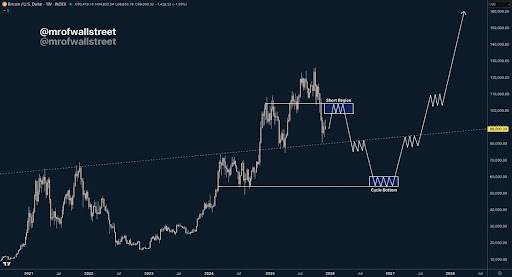
Source: Chart from Mr. Wall Street on X

Supporting his bearish forecast, the analyst has cited the decline and pressure in financial markets outside of crypto as factors contributing to the broader market downtrend. He also mentioned that the Bank of Japan’s (BOJ) planned interest rate hike adds to the current stress, along with market makers who went bankrupt during the October 10 flash crash and are waiting to liquidate billions of dollars in spot assets.

Mr. Wall Street has dismissed common bullish arguments such as the potential restart of Quantitative Easing, explaining that minor Federal Reserve (FED) balance sheet operations do not signal a complete QE cycle. He stressed that macro bullishness does not justify ignoring short and mid-term risks. Moreover, he warned that those who ignore the reality of a bear case would wish they had shorted the retested $100,000-$125,000 range a year from now.

Looking beyond the projected bear cycle, Mr. Wall Street believes that Bitcoin could eventually rebound to around $89,000 in 2027. Following this, he expects the cryptocurrency to accelerate toward $110,000 and ultimately $160,000.

Macroeconomic Factors Contribute To Market Decline

Mr. Wall Street also links his bearish Bitcoin forecast to the present weakness in broader macroeconomic conditions. He highlighted that BTC’s struggles are deeply connected to the decisions made by central banks, particularly the FED.

According to the analyst, the US economy began showing signs of deterioration at the start of 2025. He claimed that key indicators, such as worsening job data and misleading inflation figures, were allegedly ignored. Furthermore, he highlighted that the FED’s inaction and delayed rate cuts prevented necessary economic easing, leaving markets and cryptocurrencies like Bitcoin vulnerable to correction.

BTC trading at $86,217 on the 1D chart | Source: BTCUSDT on Tradingview.com

Trending Cryptos

Related Reads

Telegram Introduces WEB-Proxy Technology: Masks Traffic as Regular Website Visits

Telegram has introduced a new experimental WEB-Proxy technology designed to circumvent blocking by disguising messenger traffic as regular, secure website visits. Announced on August 21, 2026, the technology routes MTProxy data through an in-app WebView using HTTPS or WebSocket transport, making the data stream indistinguishable from legitimate web surfing. The core innovation is a multiplexed stream sent through a single WebView session. It uses special frame formats to pack multiple logical Telegram connections into one encrypted channel that externally resembles loading a web page. A server-side relay receives this stream, separates it into individual connections for the standard MTProxy, without decrypting content or knowing final destinations, thus preserving privacy. The WEB-Proxy operates on a standard HTTPS domain that also hosts a public website. The proxy bridge page is only activated by a specific URL parameter derived via HMAC-SHA256 from the proxy configuration; all other requests receive the normal site homepage. This provides reliable cover against automated detection systems. Currently a proof-of-concept, the system includes a desktop implementation, an experimental Android client, and plans for iOS support. The technology represents a shift towards more sophisticated integration with legitimate web infrastructure, complicating filtering systems that must choose between blocking HTTPS traffic entirely or allowing service access. Its long-term value will depend on resilience to adaptive traffic analysis and scalability without performance loss.

cryptonews.ru6m ago

Telegram Introduces WEB-Proxy Technology: Masks Traffic as Regular Website Visits

cryptonews.ru6m ago

MiCA is coming for DeFi vaults, but regulation will be difficult

The European Commission is exploring whether to extend the Markets in Crypto-Assets (MiCA) regulation to cover decentralized finance (DeFi) lending and borrowing, including lending vaults. These vaults, which channel billions into on-chain credit markets, present significant regulatory challenges because their decentralized structure doesn't map neatly onto existing financial frameworks. Their legal status is currently based on non-binding interpretations that they fall outside MiCA and EU fund rules. The article uses Morpho's decentralized lending protocol as an example, illustrating how responsibilities are divided among various participants (owner, curator, allocator, sentinel), making it difficult to identify a single "provider" to regulate. Experts warn that broadly categorizing "DeFi lending" could inadvertently capture vastly different structures. They argue that any regulatory approach should focus on the specific structure and control mechanisms of a vault, rather than using decentralization as a simple dividing line, and that DeFi lending may require a dedicated, carefully crafted framework distinct from traditional finance. The Commission's consultation closes on September 30, 2026. The core challenge for regulators is not just whether to regulate DeFi lending, but how to design rules that distinguish between different forms of on-chain lending and the entities that control them.

cointelegraph1h ago

MiCA is coming for DeFi vaults, but regulation will be difficult

cointelegraph1h ago

Grayscale Report: Financial Privacy in the AI Era, Why Zcash Should Not Be Overlooked?

Title: Grayscale Report: Financial Privacy in the AI Era – Why Zcash Should Not Be Overlooked The article argues that privacy is a fundamental, not niche, attribute of functional money. It highlights that technological shifts, like the rise of AI and stablecoins, are driving a new wave of public focus on financial privacy. Zcash, a decentralized digital currency similar to Bitcoin but with built-in privacy via zero-knowledge proofs, is positioned to address this need. Unlike transparent blockchains, Zcash offers users the option to conduct "shielded" transactions that hide sender, receiver, and amount while remaining verifiable. The report details Zcash's evolution, noting key upgrades that improved usability and security. It points to rising on-chain usage of privacy features as evidence of real demand. Currently, ZEC holds a minimal share (~0.4%) of the total crypto market cap. Grayscale suggests this reflects a market assumption that privacy is a marginal concern. The investment thesis hinges on a potential market re-evaluation: if privacy is recognized as a core monetary feature in an era of enhanced surveillance, Zcash's current valuation represents significant upside potential. Key risks discussed include regulatory challenges, historical trusted setup concerns for older pools (mitigated by newer protocols), quantum computing threats, and execution risks associated with future technical upgrades. The conclusion is that while the future scale of private digital currency is uncertain, the market currently prices in little chance of its value increasing substantially, presenting a potential opportunity for investors.

marsbit4h ago

Grayscale Report: Financial Privacy in the AI Era, Why Zcash Should Not Be Overlooked?

marsbit4h ago

Trading

Spot

Hot Articles

Discussions

Welcome to the HTX Community. Here, you can stay informed about the latest platform developments and gain access to professional market insights. Users' opinions on the price of S (S) are presented below.

活动图片