Alarm Bells Ringing: BOJ's Imminent 25bp Rate Hike, a Repeat of the 2024-Style Flash Crash for US Stocks and Crypto?

Odaily星球日报Published on 2026-06-11Last updated on 2026-06-11

Abstract

The Bank of Japan (BoJ) is highly expected to raise its short-term policy rate by 25 basis points to 1.0% at its June 15-16 meeting, marking the highest level since 1995. This imminent hike, driven by energy-induced inflation and a persistently weak yen, risks triggering a global market correction by forcing the unwinding of an estimated $500 billion in yen carry trades. As investors borrow cheap yen to fund investments in higher-yielding assets like U.S. stocks and cryptocurrencies, a BoJ rate hike would increase funding costs and potentially strengthen the yen. This could force a rapid deleveraging cycle: investors would sell overseas assets, buy back yen to repay loans, and amplify selling pressure. A similar scenario in August 2024 caused a global flash crash, with Bitcoin plunging nearly $20,000 in a single day. High-valuation assets are particularly vulnerable. AI-driven tech stocks, sensitive to liquidity and financing costs, face pressure from rising energy expenses and potential regulatory shifts. For cryptocurrencies, already competing with AI for market liquidity, the tightening of global leverage poses a significant near-term risk. Analysts warn this liquidity shock could lead to sharp corrections in both equities and crypto, urging investors to exercise caution regarding leverage amid heightened volatility.

Original | Odaily Planet Daily (@OdailyChina)

Author | Qin Xiaofeng (@QinXiaofeng 888 )

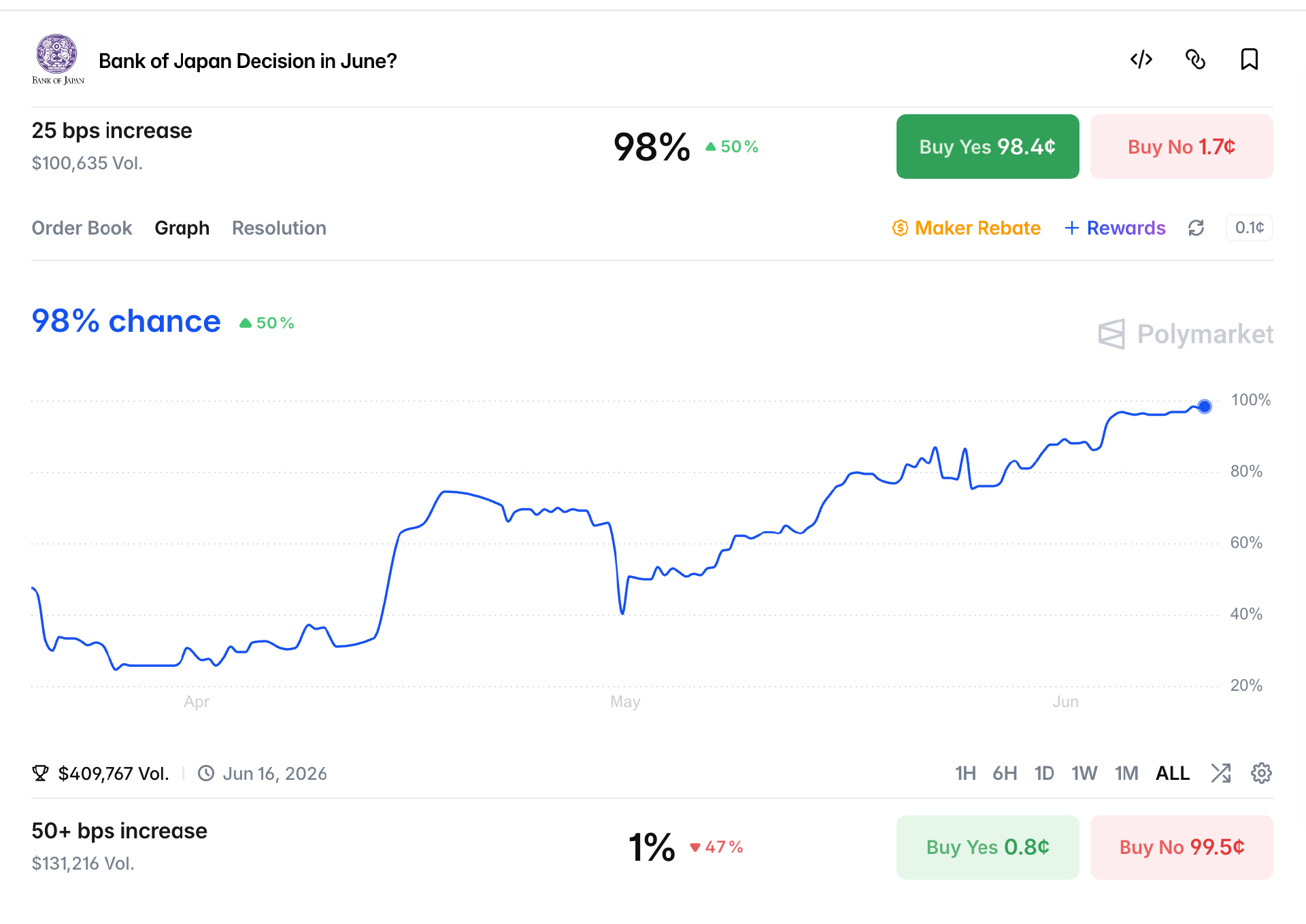
According to Nikkei News, the Bank of Japan (BoJ) is expected to raise the short-term policy rate from 0.75% to 1.0% at its monetary policy meeting on June 15-16, which would be the highest policy rate level since 1995. Currently, market pricing implies an extremely high probability of a rate hike, with the probability of "a 25bp (basis point) hike" on PolyMarket soaring from 25% in early April to 98%.
With the BOJ's rate hike imminent, a large number of investors engaging in yen carry trades may be forced to sell overseas assets, exchange funds back into yen, and repay loans, triggering a chain reaction that amplifies volatility in global risk assets—the flash crash in August 2024 is a classic case. Back then, a sharp yen appreciation led to a short-term plunge in global stock markets, with Bitcoin plummeting nearly $20,000 in a single day, a maximum drop of 15%.

Odaily Planet Daily will analyze the macro background and transmission mechanism of the BOJ's rate hike, and focus on assessing its risk impact on AI tech stocks and cryptocurrencies, for readers' reference.

1. Inflation Risks Driving BOJ Rate Hike

Over the past two years, hawkish voices within the BOJ have grown stronger, culminating in March 2024 with the end of its 17-year negative interest rate policy, raising the policy rate from -0.1% to a range of 0% ~ 0.1%, marking the first hike in this cycle. In July 2024, the BOJ hiked rates again by 15bp to 0.25% and announced gradual balance sheet reduction; in January and December 2025, it raised rates by 25bp each, bringing the rate to 0.75%; it remained unchanged in the first three meetings of 2026. The following are the details of the BOJ's rate hikes from several meetings:
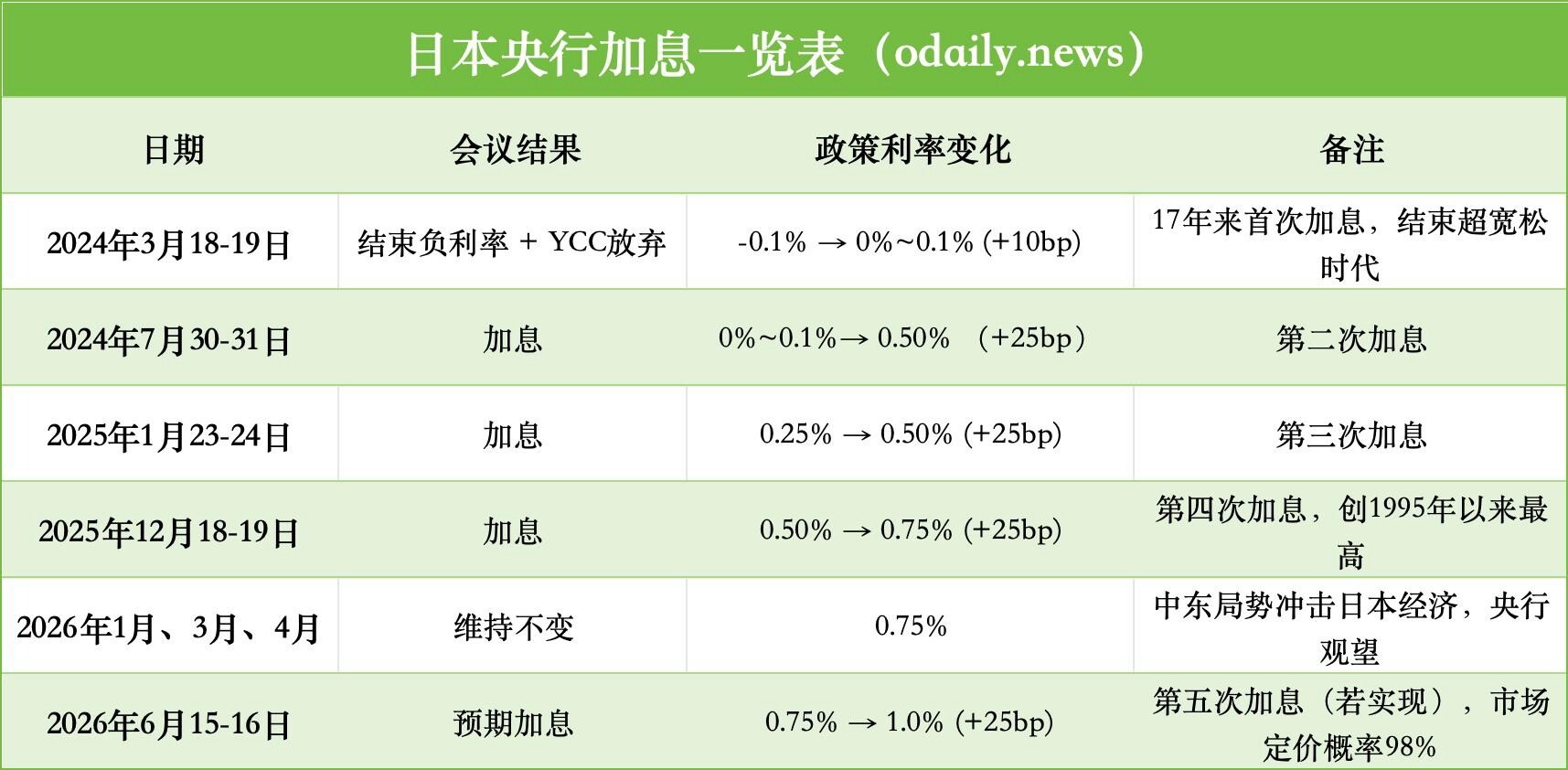
After keeping rates unchanged for half a year, why is the BOJ迫不及待 starting a new round of rate hikes? This hike is primarily driven by two factors.

First, energy shocks and imported inflation pressure. Fluctuating oil prices due to conflicts in the Middle East in the first half of the year have significantly increased import costs for Japan, a country highly dependent on imported energy. The Corporate Goods Price Index (CGPI) rose 6.3% year-on-year in May, the fastest pace since 2023, with petroleum products up 9.6% and utilities up 8.5%. The BOJ expects core CPI for fiscal year 2026 to rise to 2.5-3.0%, well above the 2% target.

Second, a weak yen exacerbates imported inflation. The current USD/JPY exchange rate continues to hover near the high range of 158-160, approaching historically extreme weakness levels. The significant depreciation of the yen directly undermines the import purchasing power of Japanese companies, leading to a substantial increase in import costs for energy, raw materials, and other commodities, further pushing up domestic price levels. Although Japan's Ministry of Finance has intervened in the foreign exchange market multiple times, the effects have been limited and difficult to sustain. This situation is forcing the BOJ to tighten monetary policy (i.e., raise rates) at its June meeting to avoid inflation expectations spiraling out of control.

In a speech on June 3, BOJ Governor Kazuo Ueda explicitly shifted towards an anti-inflation narrative, emphasizing that if upside risks to prices outweigh downside risks to the economy, the pros and cons of a rate hike must be discussed.

Reuters, citing three informed sources, reported that unless the Middle East conflict escalates sharply, the BOJ will hike rates in June and may slow the pace of bond tapering to maintain market stability. Bloomberg and institutions like ING hold similar judgments, expecting the BOJ to hike a total of 50bp in 2026.

This series of shifts marks Japan's transition from the "global lender of last resort" to a normalizing central bank, posing a direct challenge to global assets reliant on cheap yen financing.

2. Yen Carry Trade Unwinding, Liquidity Continues to Tighten

The Bank of Japan's long-term maintenance of ultra-loose monetary policy has made the yen carry trade a crucial component of global liquidity over the past decade. Investors borrow yen at near-zero interest rates to invest in high-yield assets like US stocks, tech stocks, emerging markets, and cryptocurrencies, earning interest differentials and capital gains.

The BOJ's upcoming rate hike will directly increase yen financing costs and could trigger yen appreciation (USD/JPY decline), forcing leveraged investors to unwind positions, creating a positive feedback loop: yen appreciation leads to expanding forex losses → rising financing costs → forced investor deleveraging → large-scale selling of risk assets → further decline in asset prices → triggering more stop-loss orders → increased unwinding pressure.

Historically, every BOJ policy tightening signal has triggered severe market volatility.

On July 31, 2024, the BOJ hiked rates by 15bp to 0.25% and announced gradual balance sheet reduction, coupled with weak US employment data, triggering severe global market turmoil. At that time, South Korea's two major stock indices (KOSPI and KOSDAQ) both plummeted, triggering circuit breakers; Japanese stocks crashed, with the Nikkei 225 plunging 12.4% in a single day and falling over 20% cumulatively in a week, its worst performance since 1987; global stock markets fell in tandem, with US stocks and tech stocks adjusting simultaneously, and the VIX fear index soaring. Crypto was also hit hard, with Bitcoin and ETH plummeting over 30% within a week, and leveraged liquidations surging.

According to Morgan Stanley estimates, although a significant amount of positions have been gradually unwound since 2024, there are still approximately $500 billion in outstanding yen-financed positions in the market. Although the market has partially priced in some risks ahead of time, these positions still pose a significant隐患. Morgan Stanley warns that if the yen appreciates rapidly, it could trigger chain unwinding during periods of thin liquidity, particularly severely impacting highly leveraged assets.

J.P. Morgan Global Market Strategist Dubravko Lakos-Bujas and Forex Strategist Meera Chandan both noted that the policy divergence between the BOJ and the Fed will exacerbate the instability of carry trade unwinding, potentially leading to a revaluation of global risk assets.

3. Global Risk Assets to Suffer, US Stocks and Crypto Not Spared

The AI-driven tech boom was the main theme of US stocks in the first half of 2026, with chip stocks like Nvidia and Broadcom and hyperscale cloud service providers leading the Nasdaq to repeatedly hit new highs.

However, entering June, significant market rotation and pullbacks emerged, especially on June 5th, when US stocks experienced their most severe single-day pullback of 2026 so far. The Nasdaq plunged 4.18%, marking its largest single-day drop since April 2025; the S&P 500 fell 2.64%, ending a nine-week winning streak; the Dow fell 1.35%, the Philadelphia Semiconductor Index plummeted over 10%, with AI core stocks like Nvidia, Broadcom, Micron, and Marvell leading the decline. (Recommended reading: "Nasdaq's 4.2% Single-Day Drop, Did 'Black Friday' Burst the US Stock Bubble?")

The US stock pullback is due to macro factors like geopolitical tensions and Fed policy uncertainty, but the potential impact from the BOJ's rate hike cannot be ignored.

First, tightening liquidity will directly hit high-valuation growth stocks. AI companies have massive capital expenditure scales and are highly dependent on cheap financing. Unwinding yen carry trades will reduce the inflow of global risk-preference funds, with high-beta tech stocks being the first to be hit. Semiconductor leaders like Nvidia and Broadcom, as well as hyperscalers like Meta and Microsoft, have极高的 valuation sensitivity and are极易 susceptible to selling. Investing.com analysis points out that high-valuation growth sectors are most sensitive to changes in global liquidity; once carry trade unwinding begins, rapid deleveraging often occurs.

Second, rising energy costs will significantly compress AI profit margins. Middle East conflicts pushing up oil prices lead to大幅攀升 in data center power and cooling costs, combining with the BOJ rate hike to create a "stagflationary" macro environment, severely testing the sustainability of the AI business model.

BitMEX founder Arthur Hayes explicitly warned in his latest article "Reality Test": "The energy reality is testing the current market's 'dreaming' state." High oil prices not only raise operational costs but may also slow the growth in corporate token usage, further打击 AI-related revenue expectations.

Finally, there's the supply shock from mega IPOs and political/regulatory risks. Giants like SpaceX, Anthropic, and OpenAI plan密集 IPOs in the second half of 2026, with valuations often in the hundreds of times sales; lock-up period expirations will bring massive supply pressure. Simultaneously, Trump may shift to being anti-AI for the midterm elections, increasing regulatory uncertainty.

Cryptocurrencies, as the highest-beta global risk assets, face an even bleaker outlook. On one side, the BOJ's rate hike increases global financing costs, directly raising the cost of leveraged crypto trades and forcing large-scale unwinding of crypto leveraged positions. On the other side, in competing with AI for liquidity, AI capital expenditure has already absorbed大量 market funds, and crypto is already lagging; BOJ action will further tighten marginal liquidity.

Yahoo Finance analyst Lockridge Okoth stated that a 98% probability of a rate hike could trigger the next liquidity shock for Bitcoin. Investing.com analysis指出 that yen appreciation and BTC weakness are often高度同步, a typical signal of rising global risk aversion.

Arthur Hayes has also emphasized in multiple analyses that the dynamics of yen carry trades remain a key variable affecting Bitcoin's liquidity,提醒 investors to watch for short-term liquidity shocks triggered by policy signals. In recent articles, Arthur Hayes emphasized the need to警惕 the叠加 impact of short-term energy costs and monetary policy risks; BTC/ETH may adjust in the short term along with risk assets, with the long term depending on liquidity restarting.

Conclusion:

Renewed concerns about a BOJ rate hike are not an isolated event but a signal of边际收紧 in global liquidity. Especially with multiple factors叠加—current Middle East geopolitical conflicts pushing up oil prices, AI capital expenditure consuming liquidity, and Federal Reserve policy uncertainty—the缓冲空间 is further compressed.

For investors, in the short term, global risk assets, particularly highly leveraged and high-valuation sectors (AI tech stocks and cryptocurrencies), may face significant pullback pressure, with volatility明显抬升. It is necessary to maintain high vigilance and be mindful of leverage risks.

Related Questions

QWhat is the Bank of Japan (BoJ) expected to do at its June 15-16 policy meeting, and what is the historical significance of this move?

AThe Bank of Japan is expected to raise its short-term policy interest rate by 25 basis points (bp) from 0.75% to 1.0% at its June 15-16 monetary policy meeting. If executed, this would mark the highest policy rate level in Japan since 1995.

QWhat are the two main reasons driving the Bank of Japan's decision to potentially raise interest rates again in June 2026?

AThe primary reasons are: 1) Energy shocks and imported inflation pressure, with rising oil prices increasing import costs and pushing up corporate goods prices; and 2) A weak Japanese Yen (JPY), which exacerbates imported inflation by making energy and raw material imports more expensive, forcing the BoJ to consider tightening monetary policy to prevent inflation expectations from becoming unanchored.

QHow did the market react to the Bank of Japan's policy changes in July 2024, as cited in the article?

AIn July 2024, the BoJ raised rates by 15bp and announced a gradual reduction of its bond holdings. This move, combined with weak US employment data, triggered severe market turbulence. Key Asian stock indices, including Japan's Nikkei 225, crashed, with the Nikkei falling 12.4% in a single day. Global stock markets declined in tandem, and the cryptocurrency market also suffered heavy losses, with Bitcoin and Ethereum plummeting over 30% within a week.

QAccording to the article, what is the estimated size of the remaining yen carry trade positions that could pose a risk, and what is the potential trigger for unwinding these positions?

AAccording to Morgan Stanley estimates cited in the article, there are still approximately $500 billion in outstanding yen-funded carry trade positions in the market. The potential trigger for a rapid unwinding of these positions would be a sharp appreciation of the Japanese Yen (USD/JPY falling), which could force leveraged investors to liquidate their holdings in risk assets to cover losses and repay loans.

QWhy are high-valuation AI technology stocks considered particularly vulnerable in the context of a potential Bank of Japan rate hike, according to the analysis?

AHigh-valuation AI technology stocks are considered vulnerable for several reasons: 1) They are heavily dependent on cheap financing for massive capital expenditures, and a global liquidity tightening from yen carry trade unwinding would reduce risk appetite, making them prime targets for sell-offs. 2) Rising energy costs (from Middle East conflicts) significantly increase data center power and cooling expenses, squeezing profit margins. 3) The combination of these factors creates a 'stagflationary' macro environment that challenges the sustainability of AI business models.

Related Reads

Xpeng and NIO Compete on Computing Power, Li Auto Shifts Architecture

On June 15, 2026, Li Auto unveiled details of its self-developed chip, Mahe M100, for its new L9 Livis model. CTO Xie Yan stated the goal was not just a faster chip, but a fundamentally different one, targeting the chip architecture itself. While competitors like NIO, Xpeng, and Huawei highlight TOPS (computing power) figures for their self-developed chips, Li Auto’s Mahe M100 focuses on redesigning the underlying architecture. It employs a "dynamic data flow architecture" to address memory bandwidth bottlenecks in large model inference, claiming up to 3x the effective computing power of Nvidia's Thor U for its specific workloads and a 40% reduction in latency. The chip's design was peer-reviewed and accepted at ISCA 2026. However, this performance is highly optimized for Li Auto's own VLA2.1 algorithm, meaning it may not generalize as well to other tasks. Li Auto aims to achieve full-stack in-house development with Mahe M100, covering chip, compiler, OS, AI algorithms, and domain controller—a level of vertical integration few competitors match. Beyond the chip, CEO Li Xiang introduced a new strategic narrative: the "embodied intelligent vehicle," defined as an integration of an EV, a professional driver, an AI computer, and a life assistant. This shifts competition from features like large screens to systemic AI capabilities. A key commitment was that Li Auto's Mahe VLA autonomous driving model will match Tesla's FSD V14 by Q4 2026, with specific OTA milestones set for July, September, and December. Financially, Li Auto faces pressure with declining revenue and vehicle gross margins since Q4 2025, while maintaining high R&D investment (approx. ¥12B in 2026, 50% AI-related). Its 2026 sales target is 550,000 vehicles, up from 406,000 in 2025. The new L9 Livis garnered over 10,000 pre-orders in two weeks. The effectiveness of these strategic moves—new products, OTAs, and the novel chip architecture—will begin to show in Q3 2026 financial results, with the year-end FSD V14 benchmark being the ultimate test.

marsbit36m ago

Xpeng and NIO Compete on Computing Power, Li Auto Shifts Architecture

marsbit36m ago

The Year of AI Applications: Saying 'Yes' While Ignoring Risks? A Comprehensive Open Source Log of Software Development's Journey

The Year of AI Applications: Blindly Saying "Yes" While Ignoring Risks? A Software Development Log Goes Fully Open Source. AI-generated code harbors risks hidden within seemingly correct programs, potentially leading to data leaks or asset loss. The open-source project "Narwhal AI Code Risks," from Peking University's Narwhal-Lab, compiles real-world cases, early warning signs, and typical risk pathways. Its goal is to help developers identify potential hazards early and avoid repeating past mistakes. In 2026, code is generated faster than ever but deployed with less scrutiny. The danger often lies not in glaring errors, but in code that appears normal—syntactically correct, passing all checks—yet introduces subtle but critical flaws like non-existent dependencies, excessive permissions, or exposed databases. A stark example is the Moonwell cbETH oracle incident. A configuration file error, where a cryptocurrency price was set to ~$1.12 instead of ~$2,200, slipped through 28 checks and a pull request signed by both AI (Claude, Copilot) and human developers. This "semantic deviation" resulted in a loss of $1.78 million. The risk is that AI can produce functionally valid code that is semantically wrong for the business context. As AI moves beyond simple code completion to modifying configurations, installing dependencies, and operating via autonomous agents, it traverses longer, less traceable paths within software engineering, blurring traditional boundaries and oversight points. The Narwhal AI Code Risks project structures information into three layers: `/cases` for documented real-world incidents, `/inferred` for early warning signals, and `/scenarios` for clear, generalized risk patterns not yet tied to specific events. This aims to create a lasting, public record to prevent collective amnesia about past AI-coding pitfalls. Risks are categorized into seven areas: Software Supply Chain (e.g., recommending fake packages), Code-Level Vulnerabilities (e.g., reintroducing path traversal bugs), Cloud & Infrastructure Misconfiguration (e.g., overly permissive settings), Agent Risks (from autonomous tool execution), Vertical Domain Risks (e.g., in finance, healthcare), Intellectual Property & Compliance issues, and Human Factors (like over-reliance on AI output). The project's core value is transforming isolated incidents into reusable knowledge—a foundational resource for developers to spot similar issues, for security researchers to build upon, for toolmakers to create detection rules, and for the community to contribute new findings. As AI integration accelerates, this open-source "logbook" serves as a crucial navigational aid, charting past errors to help future projects steer clear of the same traps.

marsbit37m ago

The Year of AI Applications: Saying 'Yes' While Ignoring Risks? A Comprehensive Open Source Log of Software Development's Journey

marsbit37m ago

The Foundation of SpaceX's Trillion-Dollar Valuation: Who is Dividing Up Musk's Annual Tens of Billions in Capital Expenditure?

SpaceX's trillion-dollar valuation is built on its three core businesses: Starlink (profitable, 60% of revenue), rockets (driving down launch costs), and AI (a major investment area). This creates a financial cycle: Starlink funds rocket development, which enables low-cost launches for AI hardware, generating future revenue. This cycle fuels annual capital expenditures of tens of billions, flowing to a vast supply chain. Suppliers are categorized by their replaceability. The first group includes irreplaceable players like NVIDIA (GPU/CUDA ecosystem), Eutelsat (critical radio spectrum), Filtronic (specialized amplifiers), Materion (strategic beryllium), and STMicroelectronics (antenna chips). The second group consists of hard-to-replace suppliers due to high switching costs, such as Honeywell (flight control), Carpenter Technology (specialty alloys), Hexcel (carbon fiber), Broadcom (data exchange), and Linde (industrial gases). The third group comprises high-volume, cost-critical suppliers for mass-produced items like Starlink terminals. Key names include Wistron NeWeb (primary manufacturer) and several A-share companies like Shenzhen Sunway (connectors), Pies New Materials (forgings), Western Superconducting (alloys), and Yingliu (castings). Other niche players include Trimble (timing), Astronics (power distribution), and CTS (thermal management). The article argues that investing in these suppliers, rather than SpaceX stock directly, offers an alternative opportunity. The rationale is threefold: procurement is just beginning to scale, SpaceX's IPO brings new transparency to its supply chain, and the situation mirrors early stages of past "super terminal" ecosystems like Apple or Tesla. While risks exist (commodity cycles, geopolitical factors, technology shifts), the core thesis is that SpaceX's massive, ongoing procurement will translate into reliable revenue for its key suppliers, regardless of its own stock price volatility.

marsbit1h ago

The Foundation of SpaceX's Trillion-Dollar Valuation: Who is Dividing Up Musk's Annual Tens of Billions in Capital Expenditure?

marsbit1h ago

SpaceX's Trillion-Dollar Valuation Base: Who's Sharing in Musk's Annual Tens of Billions in Capital Expenditure?

**Title: The Foundation of SpaceX's Trillion-Dollar Valuation: Who Benefits from Musk's Annual $100 Billion Capital Expenditure?** This article argues that investors seeking to benefit from SpaceX's growth might find greater opportunities in its supply chain rather than directly investing in the company itself, drawing parallels to historical successes with Apple, Tesla, and NVIDIA suppliers. **SpaceX's Business Model & Cash Flow:** SpaceX generates revenue from three main areas: 1. **Starlink:** Its profitable core, earning $11.3B in 2023 (60% of revenue), funding other ventures. 2. **Rockets (Falcon/Starship):** Requires $3B+ in annual R&D but achieves the world's lowest launch costs. 3. **AI:** Currently unprofitable (-$6B+ in 2023), investing heavily in ground-based supercomputers (220,000 GPUs) and future orbital data centers. The cycle is: Starlink profits → fund cheaper rockets → low-cost launches deploy AI hardware → AI compute rentals generate future revenue. This cycle drives annual procurement spending of tens of billions of dollars. **The Supply Chain Beneficiaries:** Suppliers are categorized by their replaceability: **1. Nearly Irreplaceable (High Barriers to Entry):** * **NVIDIA:** Powers the Colossus supercomputer; its CUDA ecosystem creates immense switching costs. * **Eutelsat (SATS):** Controls critical radio spectrum for satellite communications; holds a ~3% stake in SpaceX. * **Filtronic (FTC):** Supplies millimeter-wave signal amplifiers for Starlink satellites; SpaceX constitutes 83% of its revenue. * **Materion (MTRN):** Global leader in beryllium production, a strategic material used in Starship structures. * **STMicroelectronics (STM):** Supplies phased-array antenna chips for Starlink satellites. **2. Replaceable, but Switching Cost is Prohibitively High:** * **Honeywell (HON):** Provides flight control and inertial navigation systems with decades of certification. * **Carpenter Technology (CRS):** Manufactures ultra-pure specialty steel alloys for Raptor engines. * **Hexcel (HXL):** Supplies custom carbon fiber composites developed over a decade with SpaceX. * **Broadcom (AVGO):** Manages high-speed data switching. * **Linde Group:** Supplies industrial gases (liquid oxygen/nitrogen) from facilities built near SpaceX launch sites. **3. High-Volume, Cost-Critical Manufacturing:** Focuses on mass-producing components like Starlink user terminals (target: 30 million units). * **Key Players:** Wistron NeWeb (6285, primary terminal manufacturer), several Chinese A-share companies (e.g., Sunway Communication, PAX New Materials, Western Metal Materials, Yingliu Co.), and smaller US firms like Trimble (TRMB, timing systems). **Why Now?** Three factors make the supply chain opportunity timely: 1. **Volume Ramp-Up:** SpaceX plans 100 launches in 2026, aims for 30 million Starlink terminals, and will deploy AI data centers, meaning procurement will accelerate. 2. **Increased Transparency:** The IPO provides public financial data, allowing investors to track supplier order growth. 3. **Historical Precedent:** The current phase is likened to Tesla's early mass-production stage (circa 2018), suggesting a long growth runway for suppliers. **Conclusion:** The article posits that while investing in SpaceX stock is betting on Elon Musk's ambitious vision at a high valuation, investing in its established suppliers is a bet on the tangible, recurring revenue from its massive procurement budget, which is largely decoupled from day-to-day stock price volatility.

链捕手1h ago

SpaceX's Trillion-Dollar Valuation Base: Who's Sharing in Musk's Annual Tens of Billions in Capital Expenditure?

链捕手1h ago

Trading

Spot
Futures
活动图片