Alameda moves $3.56M in Ethereum – Should markets brace for another sell-off?

ambcryptoPublished on 2026-04-01Last updated on 2026-04-01

Abstract

Alameda Research, the defunct trading firm linked to FTX, has unstaked 1,695 ETH worth $3.56 million, signaling a potential sell-off in Ethereum and Solana. This follows a previous sale of $17 million in SOL tokens. The firm still holds significant assets, including $300 million in SOL, suggesting further selling pressure. Additional bearish signals include a trader from Fasanara Capital shorting $45 million in ETH and declining large transaction volumes. Ethereum is testing a key resistance level, while Solana is trading sideways with reduced network activity. A break above $2,100 for ETH or holding support at $76 for SOL could invalidate the expected decline.

The altcoin market could be in for yet another decline in price action.

Alameda Research, the now-defunct trading firm linked to the collapse of FTX, is making moves for the second time in less than a month. The firm recently hinted at a possible sell-off in Ethereum [ETH] and Solana [SOL]. Historically, its distribution events have resulted in massive sell-offs in associated assets, but will that happen again this time?

Examining Alameda Research’s selling pattern

According to Arkham data, Alameda unstaked more than 1,695 ETH, worth more than $3.56 million. This move seems to be following a familiar pattern. That is, three weeks ago, they sold more than $17 million of SOL tokens.

The firm still holds about $300 million worth of SOL, $35 million worth of Bitcoin, and $20 million worth of USDT. Therefore, there may be impending selling pressure on ETH and SOL as a result of the firm’s liquidation events.
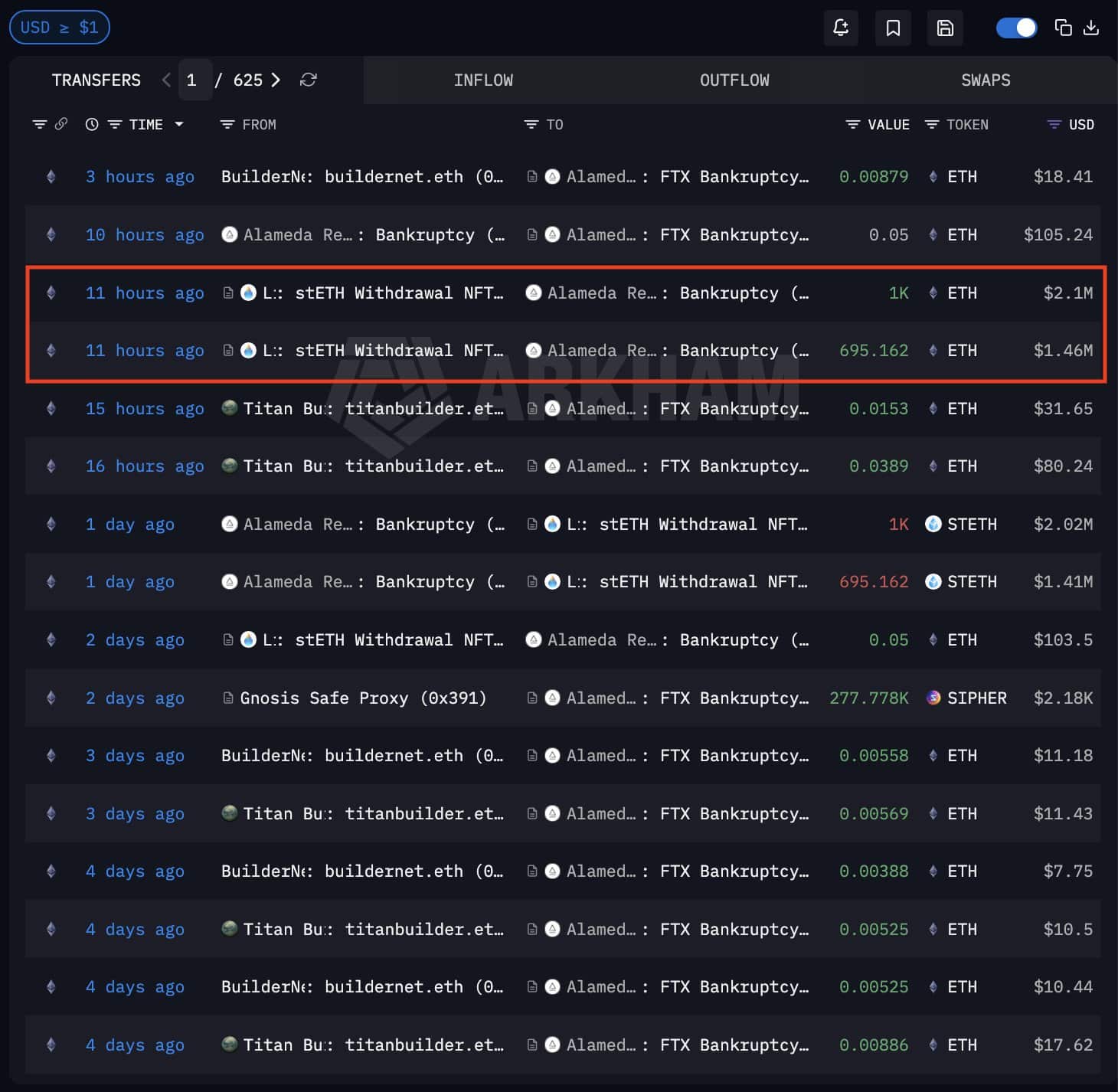
Source: Arkham

In addition to Alameda Research’s selling, other institutions are also shorting the largest altcoin. For instance, a trader linked to Fasanara Capital sold $45 million worth of ETH. Moreover, selling pressure rises amid long liquidations, particularly on big-cap altcoins.

How are ETH and SOL prices positioning?

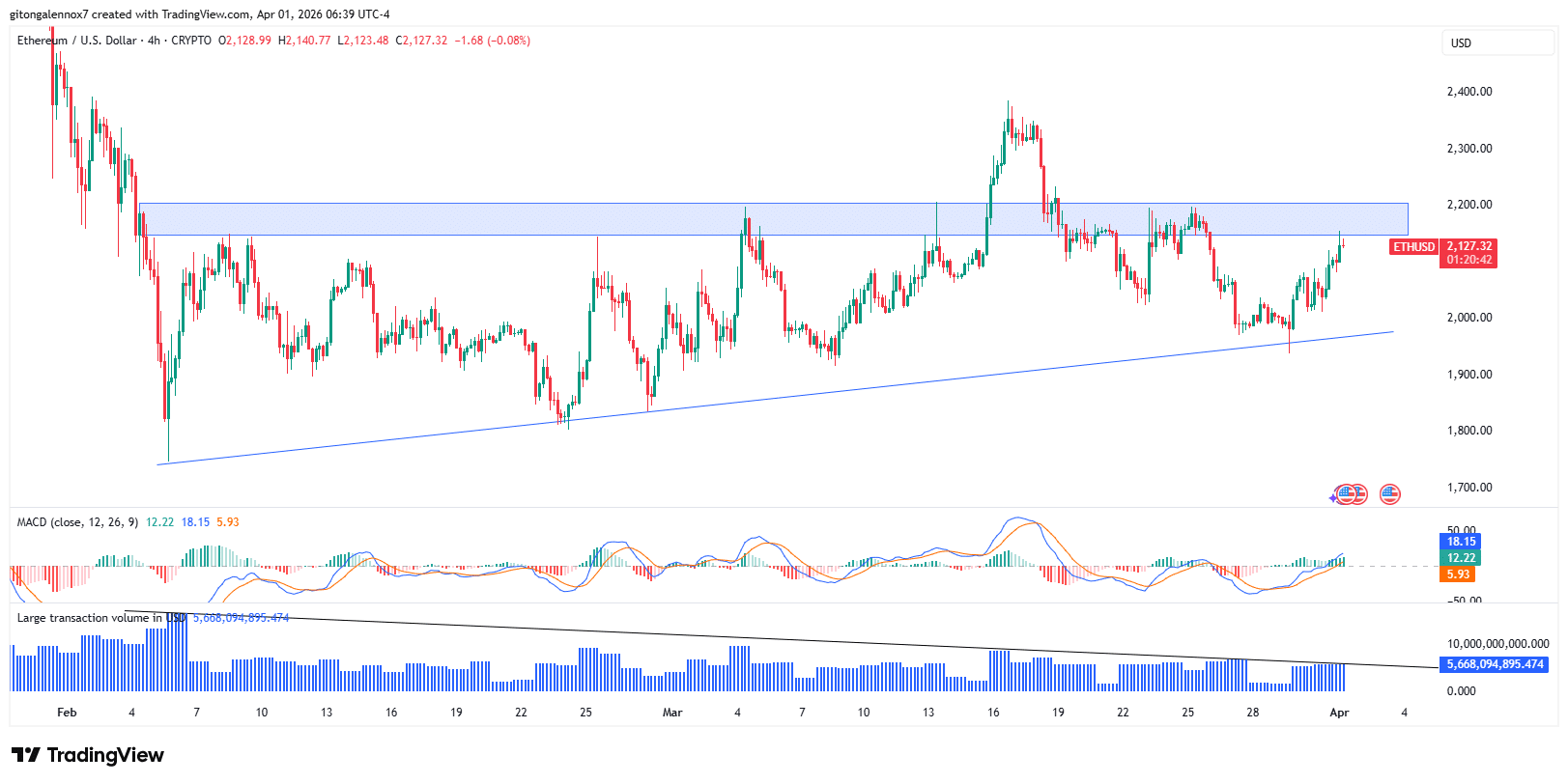
Ethereum price was showing strength at the moment. On the 4-hour chart, the altcoin was trading around a resistance zone that had held price since February.

While the MACD was bullish at press time, the amount of large transaction volume was declining. The Large Transaction Volume declined by 3x, from $17.5 billion to $5.67 billion.

This showed buying was weak at a price zone that has led to bearish reversals previously.
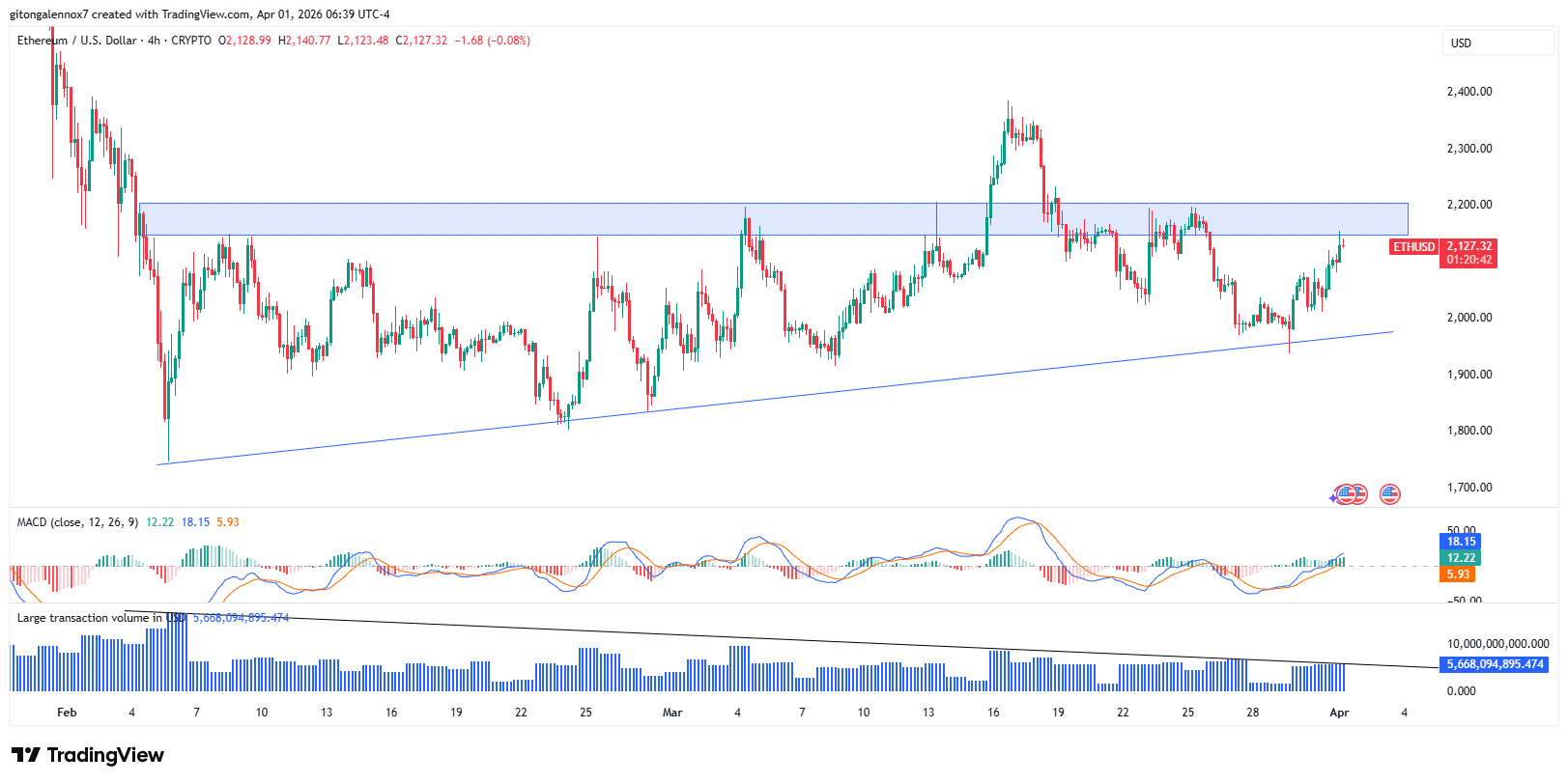
Source: ETH/USDT on TradingView

However, a break above would invalidate the signals sent by Alameda Research’s move, at least for now.

Meanwhile, Solana price action was trading in a sideways market, having lost much of its correlation with ETH. The correlation coefficient has dropped from 1 to 0.59.

The altcoin may drop to the support at $76 after trading near the range’s lows. This is due to a decrease in network activity as well; in just two months, the number of active addresses dropped from 7 million to 4.69 million.
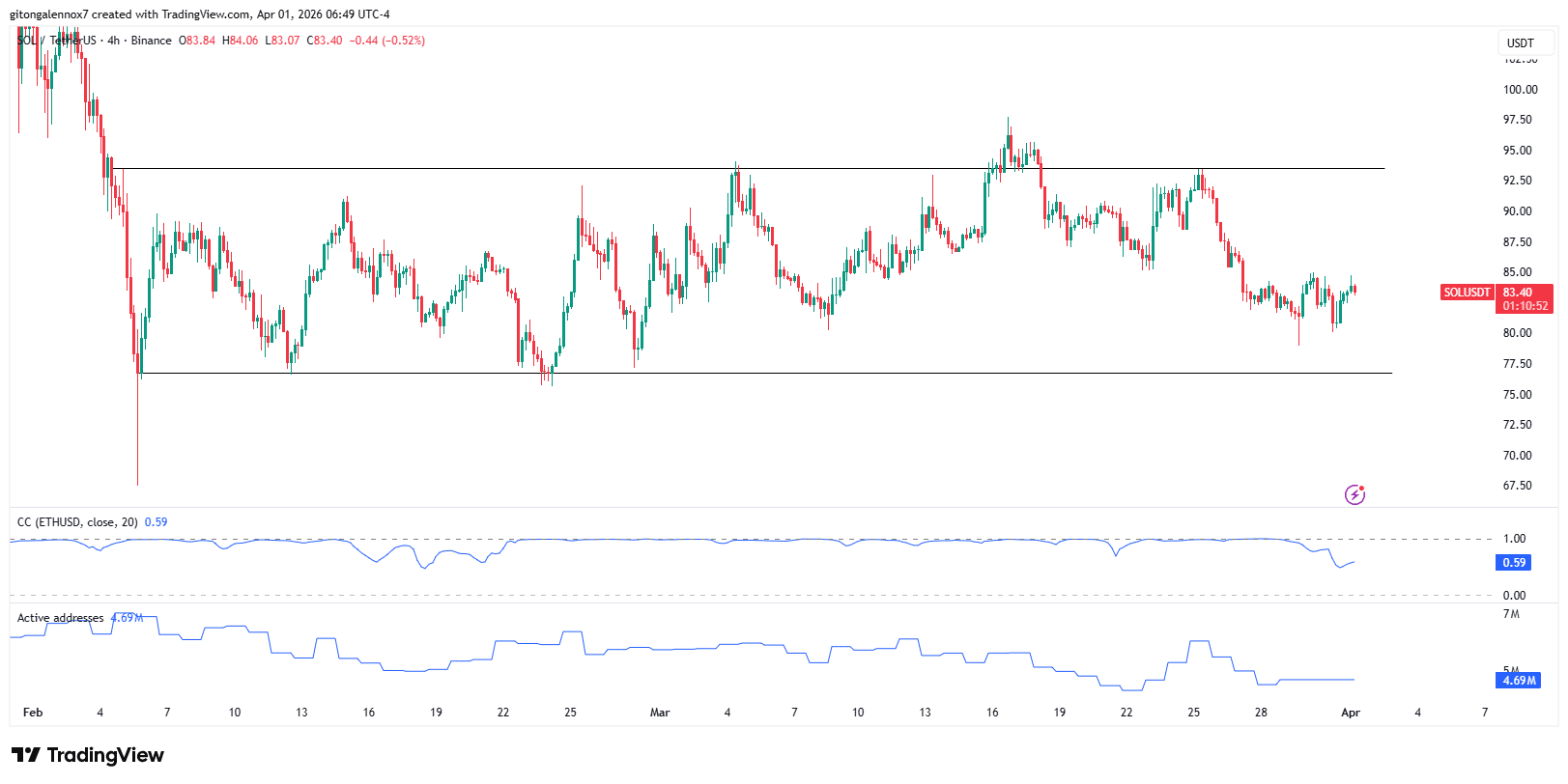
Source: SOL/USDT on TradingView

The signals above suggested that, should history repeat itself, Ethereum and Solana might experience a short-term decline. However, if SOL maintains its support and ETH surpasses $2,100, it could invalidate the anticipated price decline.


Final Summary

  • Alameda Research and Fasanara Capital are betting on Ethereum and Solana prices dropping in the short term.
  • Ethereum showed strength but traded below a resistance, while Solana was struggling at the lower band of a price range.


Trending Cryptos

Related Questions

QWhat was the value of Ethereum unstaked by Alameda Research according to the article?

AAlameda Research unstaked more than 1,695 ETH, worth over $3.56 million.

QWhich two cryptocurrencies are specifically mentioned as potentially facing selling pressure due to Alameda's liquidation events?

AEthereum (ETH) and Solana (SOL) are the cryptocurrencies mentioned as potentially facing selling pressure.

QWhat key price level for Ethereum would invalidate the bearish signals from Alameda's move, according to the analysis?

AA break above the $2,100 price level for Ethereum would invalidate the anticipated price decline.

QBesides Alameda move, what other evidence suggests rising selling pressure on Ethereum?

AA trader linked to Fasanara Capital sold $45 million worth of ETH, and there is rising selling pressure amid long liquidations on big-cap altcoins.

QWhat change in Solana's network activity is cited as a reason it might drop to its $76 support level?

AThe number of active addresses on the Solana network dropped from 7 million to 4.69 million in just two months.

Related Reads

U.S. Stock Market Trend (August 26th): NVIDIA Ends 7-Day Losing Streak, Storage and Optical Communications Rebound Across the Board

U.S. Stock Market Trends (August 26th): Nvidia Ends Seven-Day Losing Streak; Memory and Optical Communication Stocks Rebound Across the Board. On Tuesday, the three major U.S. stock indices closed higher. The tech-heavy Nasdaq gained 0.66% as declining long-term Treasury yields (the 10-year yield fell to 4.625%) provided a valuation relief window for growth stocks. The Philadelphia Semiconductor Index rose 1.44%. Nvidia shares gained 2.19%, ending a seven-session decline ahead of its closely-watched earnings report after Wednesday's close. Memory and optical communication stocks saw a broad rebound, with AMD, Marvell, and Micron among the notable gainers. The 'Magnificent Seven' were mixed, with Tesla being the sole decliner. Oil prices fell for a second consecutive day, with WTI crude dropping 2.4% to $85.01 per barrel. This followed a joint statement from Iran and Oman proposing a secure maritime channel in the Strait of Hormuz, signaling a potential de-escalation of regional tensions. Bitcoin briefly touched $80,000, while gold prices hit a three-month high. The simultaneous strength in both assets was driven by expectations of improved liquidity amid lower yields and persistent concerns about dollar credit. Market focus now shifts to Nvidia's earnings, with investors keenly awaiting guidance on Blackwell chip shipments, data center revenue, and signals on AI capital expenditure.

marsbit25m ago

U.S. Stock Market Trend (August 26th): NVIDIA Ends 7-Day Losing Streak, Storage and Optical Communications Rebound Across the Board

marsbit25m ago

From Near Zero to New Highs: Zcash Charges Towards a NYSE ETF

From Near-Zero to New Highs: Zcash Eyes NYSE ETF Zcash (ZEC), the privacy-focused cryptocurrency launched in 2016, recently surged past $800, reaching a market cap of over $13 billion. This rally coincides with Grayscale Investments' fifth amended filing to convert its Zcash Trust into a spot ETF on NYSE Arca, backed by major Wall Street firms like Coinbase Custody and Jane Street Capital. The path to this point was dramatic. In May, a critical, four-year-old vulnerability was discovered that could have allowed infinite counterfeit ZEC creation, causing ZEC's price to halve. The development team responded swiftly, deploying a patch and executing the "Ironwood" upgrade in July. This upgrade froze the old, potentially compromised shielded pool (holding ~3.66 million ZEC) and created a new, mathematically verified one, effectively containing the crisis and restoring confidence—a key factor for institutional interest. Zcash's "selective privacy" model, offering both transparent and shielded addresses, is central to the ETF strategy. The proposed ETF would only handle transparent ZEC, allowing traditional finance to gain exposure to the "financial privacy" asset class without directly handling anonymous transactions. This comes as regulatory approaches diverge: the EU plans to ban regulated entities from handling privacy coins by 2027, while the US SEC has paved the way for such ETFs, potentially making Grayscale's fund a unique global access point. Further tightening supply, over 30% of ZEC's circulating supply is locked in shielded pools, and Grayscale's trust already holds a significant portion. An ETF approval could trigger institutional demand against a constrained liquid supply. Grayscale's commitment to reinvest the ETF's first-year 2.5% fee into the Zcash ecosystem and potential capital injections from its parent company, DCG, underscore deep alignment. The fundamental irony remains: an asset designed for anonymity is seeking legitimacy through the most transparent regulated vehicle. Ultimately, Wall Street may not be betting on privacy itself, but on the growing market value of the demand for it.

marsbit1h ago

From Near Zero to New Highs: Zcash Charges Towards a NYSE ETF

marsbit1h ago

Rubin Takes the Reins: Can Nvidia Break the Curse of Post-Earnings Slumps?

NVIDIA is set to announce its FY2027 Q2 earnings after market close on August 26. As a bellwether for AI investments, market sentiment is unusually divided. While strong results are expected, investors are wary of a post-earnings stock drop, a pattern seen for the last four consecutive quarters. The key variable this time is the market debut of the new Vera Rubin platform. Despite beating expectations consistently, NVIDIA's stock has fallen after each of its last four earnings reports. This "sell the news" trend reflects diminishing "expectation gaps," where future growth is already priced in. The immediate focus is now on the company's Q3 revenue guidance, particularly its first quantitative outlook for Rubin platform sales. The Vera Rubin platform promises a generational leap, especially in inference workloads, reportedly delivering up to 10x lower token cost compared to the previous Blackwell generation. This significant efficiency gain is seen as NVIDIA's strategic defense against growing competition from custom AI chips developed by major cloud customers. Analysts project Rubin could contribute 12% of GPU revenue in Q3, potentially rising to over 40% in Q4, driven by faster ramp-up due to infrastructure compatibility with previous systems. However, risks remain. Supply chain checks indicate potential production delays, and initial bring-up and testing cycles could impact the rollout schedule. Furthermore, rising memory and component costs pose a threat to NVIDIA's industry-leading gross margins, which are a critical metric for investors. The company's financial involvement in funding customer data centers, as seen with OpenAI, also introduces a new variable regarding future capital allocation and risk. In summary, this earnings report hinges on three main points: 1) Q3 revenue guidance, specifically the contribution from Rubin, 2) the ability to maintain gross margins near 75% amidst cost pressures, and 3) management's commentary on the demand outlook, particularly for the Chinese market. A strong Rubin outlook coupled with stable margins could break the post-earnings decline pattern. Otherwise, the "sell the news" trend might continue for a fifth quarter.

marsbit1h ago

Rubin Takes the Reins: Can Nvidia Break the Curse of Post-Earnings Slumps?

marsbit1h ago

Trading

Spot

Hot Articles

Discussions

Welcome to the HTX Community. Here, you can stay informed about the latest platform developments and gain access to professional market insights. Users' opinions on the price of ETH (ETH) are presented below.

活动图片