AI Benefits Senior Staff? 40% of CEOs Plan to Cut Junior Positions, Young People's Jobs Are More at Risk

marsbitОпубликовано 2026-05-18Обновлено 2026-05-18

Введение

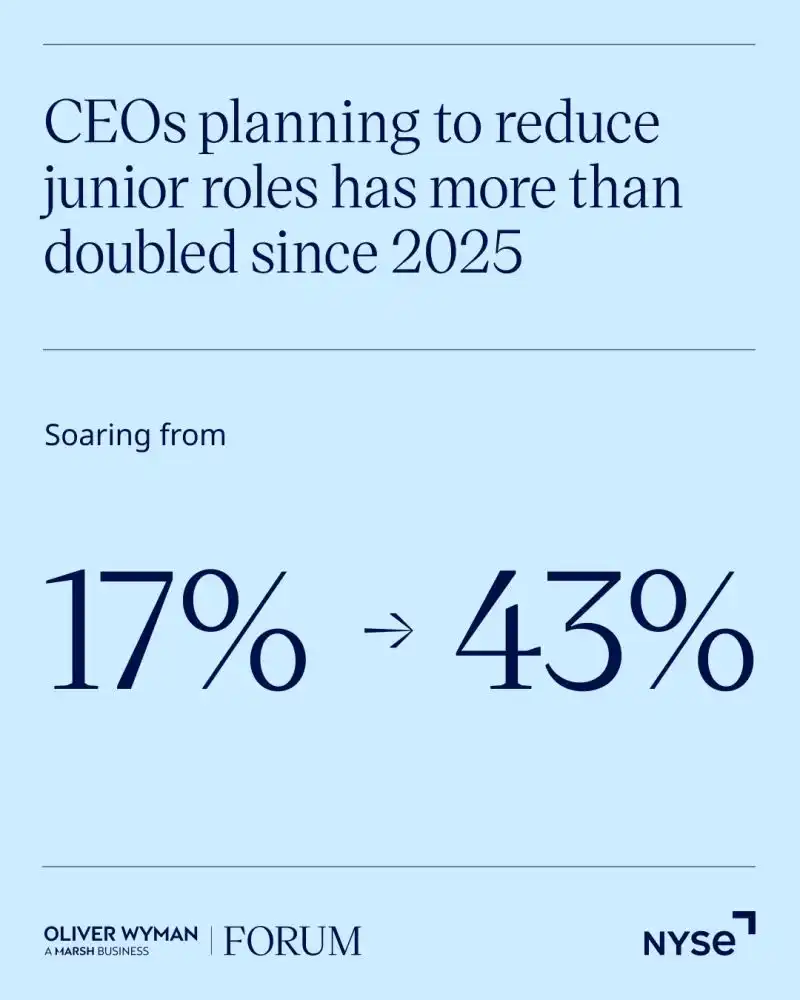
The traditional assumption that senior employees are first in line during layoffs is being inverted in the AI era. A survey of 415 CEOs by Oliver Wyman and the NYSE reveals 43% plan to cut entry-level positions in the next 1-2 years to shift towards a mid-to-senior talent structure, a sharp rise from 17% last year. The logic is that AI excels at automating routine, cognitive tasks typically handled by junior staff (e.g., coding, data review), while the experience and judgment of senior employees remain harder to replicate. Research indicates this shift primarily manifests as a hiring freeze for junior roles rather than mass layoffs. Goldman Sachs estimates AI currently nets a loss of about 16,000 US jobs monthly, disproportionately impacting Generation Z concentrated in highly automatable white-collar roles. This raises long-term concerns about a broken talent pipeline, as companies risk having no future senior managers trained internally. Despite the dominant trend, a minority of successful AI adopters, like IBM and Salesforce, are expanding junior hiring, arguing these employees are adept at using and building AI tools. However, most companies are still in early AI deployment phases, with 67% in planning/pilot stages and many reporting returns below expectations. The overarching reality is a weakening of job security across all levels, as organizations reshape for an AI-augmented, leaner future.

Author: Claude, Shenchao TechFlow

Shenchao's Insight: A recent survey of 415 global CEOs by Oliver Wyman in partnership with the New York Stock Exchange shows that 43% of CEOs plan to reduce junior positions in the next one to two years, shifting their workforce composition towards mid- to senior-level talent. This figure has more than doubled from 17% last year. AI is systematically replacing routine tasks typically handled by junior employees, while experienced employees become more valuable due to their judgment and expertise. Goldman Sachs previously estimated that AI is eliminating a net of approximately 16,000 US jobs per month, with Generation Z being the most affected.

In past waves of layoffs, older, higher-paid employees were often the first targets. But the logic of the AI era is reversing this trend.

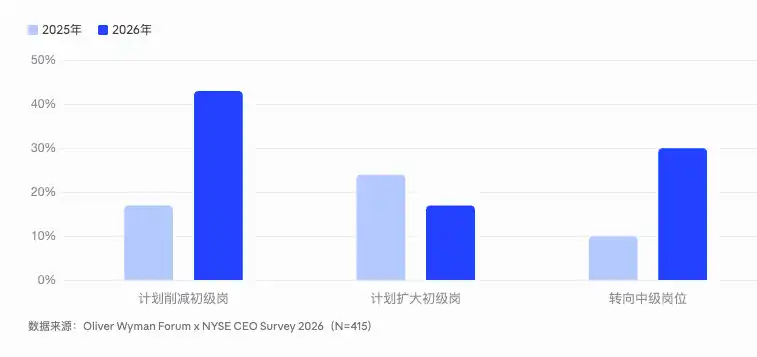
According to a Bloomberg report on May 16th, the 2026 CEO Agenda survey released by management consultancy Oliver Wyman and the New York Stock Exchange reveals that over 40% of CEOs plan to reduce junior positions in the next one to two years, tilting their workforce structure towards more mid- to senior-level employees; only 17% of CEOs indicated they would increase the proportion of junior roles. A year ago, these numbers were almost the opposite.

The survey covered 415 CEOs (266 from public companies, 149 from private companies), with the public company sample representing about 10% of global market capitalization, including 65 Fortune 500 CEOs.

John Romeo, Head of the Oliver Wyman Forum, told Bloomberg in an interview, "The difficulty for junior employees to enter the workforce is indeed increasing. CEOs now place greater emphasis on mid- to senior-level employees to drive productivity."
43% of CEOs Plan to Cut Junior Positions, AI's 'Experience Bias' Effect Emerges

The logic behind this shift is not hard to understand: the tasks that AI agents are currently capable of performing are highly concentrated in the typical scope of work for junior employees. Writing code, evaluating sales leads, reviewing documents, compiling data reports—these routine cognitive tasks previously handled by junior staff are being rapidly replaced by AI systems.

However, what AI currently cannot replicate is the judgment formed through years of industry experience. Future of work advisor Ravin Jesuthasan told Bloomberg that the corporate attitude is shifting to "I need someone who has actually done this, because her experience, judgment, and problem-solving ability make her more valuable than the AI."

This phenomenon has data support in academia. A paper by Harvard University researchers Seyed M. Hosseini and Guy Lichtinger analyzed resume and hiring data covering 62 million employees and 285,000 US companies. The results show that since early 2023, among companies actively adopting generative AI, the number of junior employees decreased by 7.7% over six quarters compared to non-adopting firms, while the number of senior employees was largely unaffected. A key finding is that this decline primarily stems from a hiring slowdown, not large-scale layoffs. In other words, they are not firing people, but simply not hiring them.
The Oliver Wyman report states the implication of this trend more bluntly: "CEOs with the longest planning horizons are the most likely to plan for headcount reductions. This suggests they anticipate that organizations will become leaner, enhanced by AI, not as a cost-cutting measure, but as an end-state."

Goldman Sachs Estimates: AI Net Eliminates 16,000 US Jobs Monthly, Generation Z Bears the Brunt

Goldman Sachs economist Elsie Peng estimated in an April research report that the AI substitution effect eliminated about 25,000 jobs per month over the past year, while the AI augmentation effect created about 9,000 jobs per month in the same period, resulting in a net elimination of about 16,000 jobs. Frontierbeat

The impact is highly unevenly distributed. In occupations with the highest exposure to AI substitution, the unemployment rate gap between entry-level workers under 30 and experienced workers aged 31 to 50 has widened significantly compared to pre-pandemic levels. The wage gap has also worsened concurrently; Goldman's regression analysis estimates that for every one standard deviation increase in AI substitution exposure, the wage gap between entry-level and experienced workers widens by approximately 3.3 percentage points. Fortune

Generation Z is disproportionately concentrated in routine white-collar roles such as data entry, customer service, legal support, and billing processing—precisely the areas AI is most adept at automating. They lack the experiential buffer that senior employees possess. Fortune

A Stanford University study from last November further confirms this: in fields with the highest AI exposure, young employees are 16% more likely to be unemployed than other groups. Fortune

Long-Term Risks of a Broken Talent Pipeline

While cutting junior positions can lower costs and improve efficiency in the short term, the hidden costs are raising alarms.

Helen Leis, Global Head of Leadership and Change at Oliver Wyman, pointed out to Bloomberg that if companies want to have mid- to senior-level talent to manage AI-driven workflows in the future, "these people need to first learn the job within the company." Not hiring junior employees is akin to cutting off one's own talent pipeline.

Andrew McAfee, co-director of MIT's Initiative on the Digital Economy, previously expressed similar concerns to the Harvard Business Review: "Other than on-the-job learning and apprenticeship training, how are people supposed to learn how to do a job?"

Monster survey data shows that nearly 90% of the class of 2026 are worried that AI or automation will replace entry-level positions, a sharp rise from 64% in 2025. Fortune

These concerns are not unfounded. According to a SignalFire report, from 2023 to 2024, the hiring volume for junior positions at the 15 largest US tech companies fell by 25%. The situation in the UK is more severe, with graduate roles in the tech sector decreasing by 46% in 2024, projected to drop another 53% by 2026. IEEE SpectrumRezi

A Few Companies Go Against the Grain: AI 'Winners' Actually Value Junior Employees More

Interestingly, companies most successful in AI deployment are adopting a different talent strategy.

The Oliver Wyman report points out that "a cohort of contrarian, advanced AI adopters believe this technology is increasing the value of junior talent, not displacing them." Among companies with higher ROI from AI investments, the proportion leaning towards increasing junior positions is higher than among those not yet seeing returns.

IBM announced in February this year its plan to triple its hiring of US junior positions and rewrite job descriptions for the AI era. Salesforce CEO Marc Benioff announced this week the hiring of 1,000 recent graduates and interns to build its AI systems, writing on platform X: "They say AI will kill junior jobs. But these grads & interns are BUILDING AI." Amazon Web Services CEO Matt Garman publicly stated that replacing junior employees with AI is "one of the dumbest decisions a company can make," reasoning that junior employees are often the most proficient users of AI tools.

However, these cases remain the minority in the overall trend. The Oliver Wyman survey shows that 74% of CEOs are freezing or reducing headcount, up from 67% last year. The most aggressive cuts are happening in the technology, media, and telecom industries.

AI's ROI Dilemma: Most Companies Still in the 'Money-Burning Experimentation' Stage

There is a significant gap between CEOs' confidence in AI's ability to change workforce structures and the actual returns AI is delivering.

The Oliver Wyman survey reveals that 67% of corporate AI deployments remain in the planning and pilot stages. 53% of CEOs say it is too early to assess AI investment returns, a figure that has increased from 41% last year. Only 27% of CEOs report that AI investment returns meet or exceed expectations, down from 38% last year. Nearly a quarter say AI has had no impact on revenue whatsoever.

The report describes this as "not a crisis of confidence, but a recognition that redesigning work at scale is slower and more difficult than initial enthusiasm anticipated."

However, the report also notes that companies deploying AI across more than two application areas report cost savings and revenue growth roughly double that of companies with single-scenario deployments. The value curve for AI is non-linear, with real returns concentrated after scaled deployment.

A statement by economist Teresa Ghilarducci of The New School to Bloomberg perhaps sums up the current situation: Even if AI tilts the workplace balance in favor of experienced employees, it does not mean they have gained job security. "Companies are increasingly less committed to their employees."


Связанные с этим вопросы

QAccording to the Oliver Wyman survey, what is the key change in CEO hiring plans for junior positions?

AOver 40% of CEOs plan to reduce junior positions over the next one to two years, shifting their workforce structure towards more mid- to senior-level talent. This figure has more than doubled from 17% the previous year, representing a significant reversal in hiring strategy.

QWhat is the 'seniority bias' effect of AI on the workforce mentioned in the article?

AThe 'seniority bias' effect refers to the trend where AI is systematically automating routine, cognitive tasks typically performed by junior employees (e.g., coding, document review, data reporting). Meanwhile, senior employees, whose value lies in experience, judgment, and complex problem-solving abilities that AI cannot yet replicate, are becoming more valuable and less likely to be replaced.

QWhat does the Goldman Sachs research cited in the article say about AI's net impact on US jobs?

AGoldman Sachs economists estimate that AI is currently displacing about 25,000 US jobs per month while simultaneously creating around 9,000 new ones. This results in a net loss of approximately 16,000 jobs per month, with Generation Z workers being disproportionately affected.

QWhat long-term risk does cutting junior positions pose to companies, according to experts in the article?

ACutting junior positions risks severing a company's talent pipeline. Experts warn that future mid- and senior-level leaders, who will need to manage AI-driven workflows, must first learn the business from within the company. By not hiring and training junior employees, companies are undermining their own long-term succession planning and leadership development.

QHow do the most successful AI-adopting companies differ in their approach to hiring junior staff, according to the article?

AA minority of successful, advanced AI adopters are taking a counter-trend approach. Companies like IBM, Salesforce, and Amazon Web Services are expanding hiring for junior roles. They view AI as a tool that enhances the value of junior talent (who often become skilled AI users) rather than simply replacing them, and they are actively recruiting graduates to help build and work with AI systems.

Похожее

WSJ: Unveiling the Secret Jury That Controls Disputes on Polymarket

Last month, Garrick Wilhelm lost a $567 bet on the Polymarket prediction platform about whether a ceasefire would be reached with Hezbollah. When a truce was announced, some traders argued it counted, but Wilhelm disagreed. The dispute was settled not by Polymarket, but by a decentralized group of UMA token holders who vote on such disagreements. As trading surges, resolving ambiguous outcomes is a growing challenge for prediction markets. Unlike competitors like Kalshi that decide internally, Polymarket outsources dispute resolution to UMA. Its token holders, mostly anonymous and with voting power weighted by holdings, arbitrate cases. Critics argue this system is prone to manipulation, as voters can also bet on the same markets they judge. A Wall Street Journal analysis found that over the past year, at least 60% of active UMA voters had corresponding Polymarket accounts and held positions in disputes they voted on. Voting power is also concentrated among a few large holders. Polymarket says only 0.2% of bets go to UMA and that the system disperses authority. Its founder has acknowledged flaws and promised fixes. UMA's backers deny any proven manipulation, dismissing critics as sore losers. The platform penalizes voters in the minority to incentivize "correct" outcomes. Disputes are rising, covering topics from a streamer's pregnancy announcement to Iran. This model also helps Polymarket argue it's an offshore platform outside U.S. regulation, a shift made after a 2022 settlement with the CFTC. Some losing traders have formed groups to protest, targeting entities like UMA.rocks, which aggregates votes. Its founder says traders often blame UMA for their own mistakes. A recently ousted committee member, Scout, admitted to both betting and voting but argued involved voters research more thoroughly. He highlighted the dilemma: "Either you have conflicted traders deciding, or you have uninformed outsiders voting. There is no perfect answer right now."

marsbit39 мин. назад

WSJ: Unveiling the Secret Jury That Controls Disputes on Polymarket

marsbit39 мин. назад

China's AI Circle Has Just Established a Pecking Order, and Capital Is Already Changing the Rules Again

The article describes how the valuation logic for major Chinese AI model companies has undergone three dramatic shifts between 2022 and 2026, driven by capital's changing priorities. The first phase (around 2022) was **technology-driven valuation**, where funding was based on model performance and benchmark scores. This logic was disrupted when DeepSeek's R1 model demonstrated that comparable capabilities could be achieved at a fraction of the cost, challenging the notion of technical superiority as an unassailable moat. The second phase shifted to **IPO window-driven valuation**. Following favorable listing conditions in Hong Kong, capital flowed to companies like Zhipu and MiniMax with the clearest path to a public listing. However, this focus on liquidity over fundamentals became apparent as their Annual Recurring Revenue (ARR) lagged far behind international peers like Anthropic. The third and current phase is **national strategy-driven valuation**. This shift was marked by the state-backed "Big Fund" leading a major investment in DeepSeek, signaling that leading domestic AI models are now viewed as strategic national assets comparable to semiconductor manufacturing. This new logic, combined with soaring US valuation benchmarks (e.g., OpenAI at $850B), propelled the combined valuation of China's top AI firms ("The Four Dragons"/"Five Strong") past 1 trillion RMB. The article presents a "pricing leap model": each shift is triggered by a key event that invalidates the old logic, leading to rapid capital reallocation under a new narrative before its flaws (particularly the gap in fundamental ARR metrics) become evident. It concludes that the next major test for these valuations will be a return to scrutinizing core business fundamentals, specifically ARR growth, suggesting a fourth pricing shift is imminent.

marsbit1 ч. назад

China's AI Circle Has Just Established a Pecking Order, and Capital Is Already Changing the Rules Again

marsbit1 ч. назад

'Stock God' Trump's 3,642 Trades Disclosed: The 'Perfect Closed Loop' of Policy and Portfolio

Summary: Donald Trump's First Quarter stock trades, totaling 3,642 transactions, have been disclosed. While the White House maintains the trades were managed by an advisor and complied with disclosure laws, they reveal a portfolio heavily aligned with his policy agenda. The trades show a rotation away from major tech stocks like Microsoft, Amazon, and Meta, and into semiconductor and AI hardware companies such as NVIDIA, AMD, Broadcom, Dell, and Intel. Notably, Trump's account purchased Dell stock before he publicly praised the company, after which its stock rose. The Dell family also pledged funds to a Trump-affiliated policy project. A critical case is Intel. The Trump administration converted $8.9 billion in CHIPS Act subsidies into a 9.9% equity stake, making the U.S. government Intel's largest shareholder. Months later, Trump's personal account also bought Intel stock. This intertwines national industrial policy with potential personal financial interest. Unlike typical insider trading concerns, this situation creates a "closed loop": policy decisions (e.g., subsidies, tariffs, crypto regulation) can boost the value of his holdings, and those holdings may, in turn, influence future policy directions. This blending of presidential power and personal portfolio, while legally disclosed, raises profound questions about conflicts of interest that current rules do not address.

marsbit1 ч. назад

'Stock God' Trump's 3,642 Trades Disclosed: The 'Perfect Closed Loop' of Policy and Portfolio

marsbit1 ч. назад

Dialogue with Figure Robotics Founder: Behind the $39 Billion Valuation Lies Ambition to Mass-Produce Millions of Units

Title: Figure's Founder on the $39B Valuation and the Ambition to Mass Produce a Million Humanoid Robots In a Sourcery podcast interview, Figure founder and CEO Brett Adcock discusses the rapid rise of his humanoid robotics company. With a valuation that surged 15x in 18 months to $39 billion, Figure aims to create general-purpose humanoid robots for work in factories and homes. Adcock states that the company's primary goal is to make robots that perform real, paid work autonomously. He shares Figure's aggressive scaling plan: producing thousands of robots this year, with an ultimate ambition to reach one million units annually. Adcock explains Figure's vertically integrated strategy, designing its own motors, sensors, and joints to control its supply chain and destiny. He details the challenges, including achieving long-term, reliable, end-to-end autonomous operation—a feat no one has yet accomplished. The biggest risk is executing this complex vision at scale, but Adcock believes the potential market is enormous, representing a significant portion of global GDP. The interview also covers his departure from OpenAI, citing that Figure's internal AI team eventually surpassed OpenAI's capabilities for robotics applications. Adcock concludes by highlighting his focus for the year: large-scale commercial deployment of robots and advancing toward a "general robot" capable of any human task, potentially seeing the first signs of AGI (Artificial General Intelligence) in the physical world at Figure.

marsbit1 ч. назад

Dialogue with Figure Robotics Founder: Behind the $39 Billion Valuation Lies Ambition to Mass-Produce Millions of Units

marsbit1 ч. назад

Торговля

Спот
Фьючерсы

Популярные статьи

Как купить PEOPLE

Добро пожаловать на HTX.com! Мы сделали приобретение ConstitutionDAO (PEOPLE) простым и удобным. Следуйте нашему пошаговому руководству и отправляйтесь в свое крипто-путешествие.Шаг 1: Создайте аккаунт на HTXИспользуйте свой адрес электронной почты или номер телефона, чтобы зарегистрироваться и бесплатно создать аккаунт на HTX. Пройдите удобную регистрацию и откройте для себя весь функционал.Создать аккаунтШаг 2: Перейдите в Купить криптовалюту и выберите свой способ оплатыКредитная/Дебетовая Карта: Используйте свою карту Visa или Mastercard для мгновенной покупки ConstitutionDAO (PEOPLE).Баланс: Используйте средства с баланса вашего аккаунта HTX для простой торговли.Третьи Лица: Мы добавили популярные способы оплаты, такие как Google Pay и Apple Pay, для повышения удобства.P2P: Торгуйте напрямую с другими пользователями на HTX.Внебиржевая Торговля (OTC): Мы предлагаем индивидуальные услуги и конкурентоспособные обменные курсы для трейдеров.Шаг 3: Хранение ConstitutionDAO (PEOPLE)После приобретения вами ConstitutionDAO (PEOPLE) храните их в своем аккаунте на HTX. В качестве альтернативы вы можете отправить их куда-либо с помощью перевода в блокчейне или использовать для торговли с другими криптовалютами.Шаг 4: Торговля ConstitutionDAO (PEOPLE)С легкостью торгуйте ConstitutionDAO (PEOPLE) на спотовом рынке HTX. Просто зайдите в свой аккаунт, выберите торговую пару, совершайте сделки и следите за ними в режиме реального времени. Мы предлагаем удобный интерфейс как для начинающих, так и для опытных трейдеров.

744 просмотров всегоОпубликовано 2024.04.12Обновлено 2025.03.21

Как купить PEOPLE

Обсуждения

Добро пожаловать в Сообщество HTX. Здесь вы сможете быть в курсе последних новостей о развитии платформы и получить доступ к профессиональной аналитической информации о рынке. Мнения пользователей о цене на PEOPLE (PEOPLE) представлены ниже.

活动图片