After Privacy Coins Surge, Does It Mean a Bear Market Is Coming?

marsbitPublished on 2026-01-31Last updated on 2026-01-31

Abstract

The article explores the sharp rise in privacy coins like ZEC and XMR as a potential signal of an impending bear market in the crypto cycle. Historically, privacy tokens tend to surge when other narratives—such as DeFi or NFTs—lose momentum, often marking a final speculative push before a downturn. In 2017, coins like ZEC and XMR gained attention as "better Bitcoin" alternatives, fueled by technological appeal and hype. By late 2021 and early 2022, privacy projects like Aleo attracted massive investments, though they ultimately failed to deliver practical, mainstream adoption. The recent surge in late 2025, with ZEC rising 20x in three months, lacked clear catalysts but may reflect growing unease with increasing regulatory scrutiny and reduced financial privacy in crypto. While figures like Arthur Hayes and firms like a16z promoted "privacy-as-a-service," the author suggests this may have been a tactic to facilitate sell-offs rather than genuine growth. The piece argues that extreme privacy features—such as Monero’s fully anonymous transactions—often cater to illicit use cases rather than mainstream needs, making them a target for regulators and exchanges. Most users and regulators seek balanced privacy—protection without complete anonymity—which current privacy tokens fail to provide. Without addressing real-world utility and acceptable levels of privacy, these coins may remain the last resort in cyclical market pumps, often leaving investors at a loss.

Author: Eric, Foresight News

Every bull market has its signs of ending. Looking back, among these signs, the sudden explosion of privacy tokens has never been absent.

This recurring phenomenon has the same reason each time: there's nothing left to hype. After all concepts and narratives have been exhausted, the final dance of capital usually chooses "privacy," a topic that has persisted since 2014.

Hype around privacy at the end of a bull market has logical rationality. After experiencing the noise, many people often suddenly realize, in the void of the bull-to-bear transition, what the original intention of Web3 was, then shout about making privacy and decentralization great again—but the result is just another round of speculation.

Although the process is the same, the triggers each time are not entirely identical.

2017 was the heyday of privacy tokens because there were no impressive DApps, and the sector was still in a phase of finding direction. Back then, ZEC, XMR, and DASH were absolute "hot stars," with discussion levels even surpassing Bitcoin. ZEC and XMR were launched with the "technological innovations" of zero-knowledge proofs and ring signatures, respectively, while DASH combined PoW and PoS.
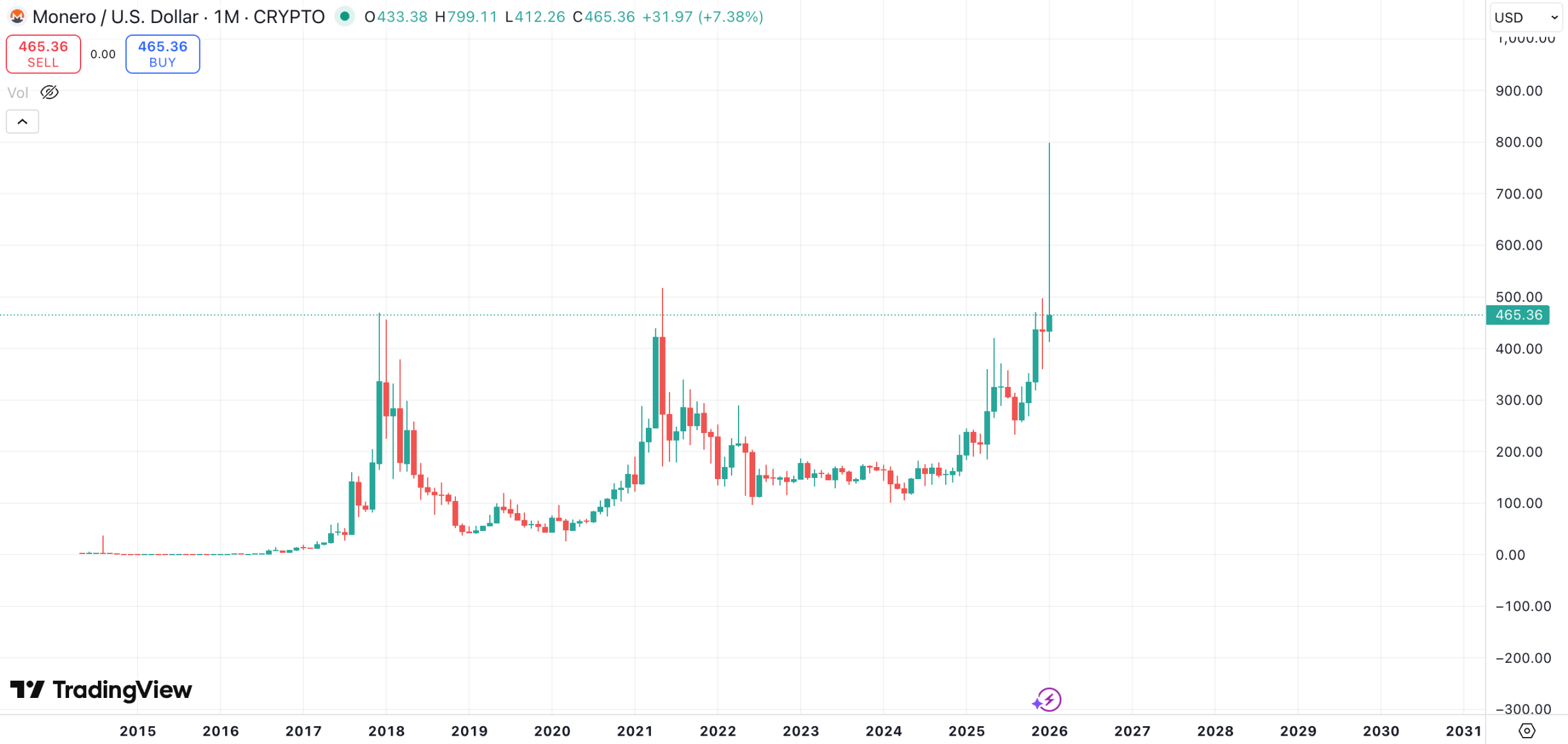
Readers who didn't experience that period might not understand the market's fervor for such tokens at the time. Back then, whether Bitcoin was the absolute core of cryptocurrency was controversial; many such tokens charged ahead under the banner of "better Bitcoin." ZEC's price once surged to $30,000 in early 2018, while Bitcoin's peak price in that cycle was less than $20,000.

Late 2021 and early 2022 were purely about forcing the privacy concept. After experiencing DeFi, NFT, and the metaverse, projects including Aleo received hundreds of millions in funding, with SoftBank, a16z, and Tiger Fund among the investors. The market at that time briefly believed that after the application explosion, privacy could finally move from concept to practical implementation.

Perhaps because everyone was making money and was euphoric, no one truly cared whether privacy was a mass need, or even if there was demand, whether demanders were willing to bear significant costs just to ensure privacy. The result was that it landed—but face-first.

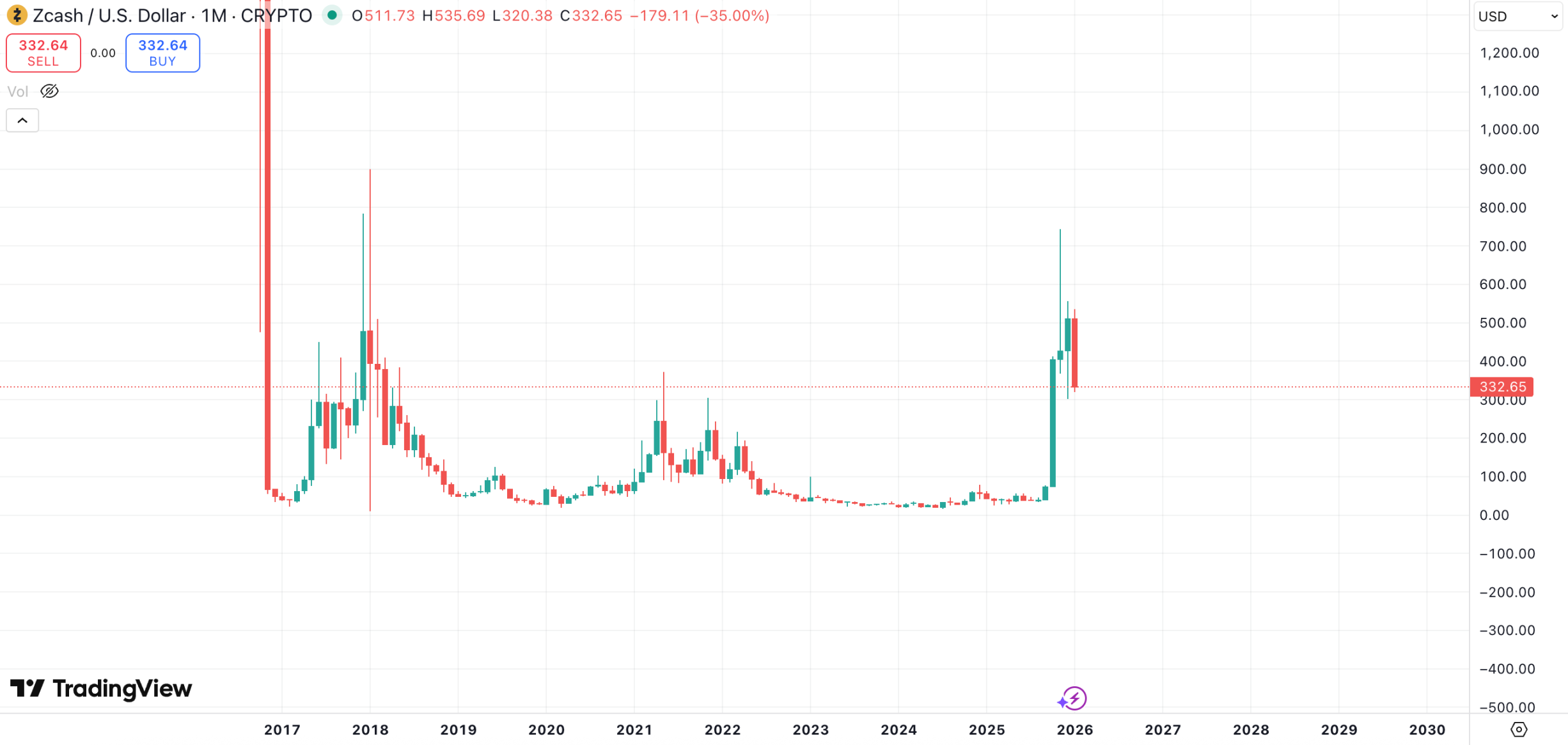
In this cycle, the rise of privacy tokens represented by ZEC began in September 2025. Looking back, it's hard to pinpoint any specific reason at that time to explain why it rose 20 times in three months. If we must find a reason, it might be because it was "not so compliant."
2025 can be said to be the year cryptocurrency was fully legitimized. Multiple countries in Europe and America successively introduced regulatory laws. Even supporting cryptocurrency development couldn't escape scrutiny under regulations like identity verification and anti-money laundering—DeFi was no exception. Thus, although cryptocurrency was no longer considered a security, it essentially wasn't much different from trading securities. Government scrutiny of individuals didn't relax at all; it only temporarily eased regulations on projects and institutions to avoid hindering innovation.

Additionally, the arrest of fraudster Qian Zhimin in the UK, and later the exposure of Chen Zhi whose Bitcoin was confiscated, revealed an open secret: although only you hold the private key, it's not difficult for law enforcement to make you hand it over. When this fact is laid bare again, it might trigger some investors to switch to privacy tokens.

But including BitMEX co-founder Arthur Hayes's shilling and a16z's mention of "privacy as a service" all happened after November. Judging from the price trend, this seems more like cover for dumping rather than driving the rise. XMR might have held on for two more months due to reasons like Iranian officials fleeing with funds or hackers who stole hundreds of millions in Bitcoin converting it to XMR, but it also peaked and fell rapidly.

Although we can't definitively say the bull market is over now, at least at the end of the last bull market, there were no shortage of well-known figures and institutions shilling privacy. The extremely similar plot should at least make us more vigilant.

The privacy concept has persisted from 2014 to today without dying out because it genuinely meets some gray demands, but it conflicts with actual "privacy" needs. In reality, what most people recognize as privacy protection isn't making data completely untraceable, but more about not being easily exposed. In financial transactions, dark pools exist to prevent large capital actions from affecting the market or being targeted by other funds, but this doesn't mean the transaction information itself can't be verified.

The privacy concept in Web3 is sometimes overly extreme. Zcash's privacy transactions are optional, while XMR is private by default—sender, receiver, and amount can't be verified on-chain, which is also the core reason XMR was delisted by over 70 global cryptocurrency exchanges in 2025. For most people, there seems to be insufficient reason to use XMR to hide traces. Moreover, the process of buying XMR itself is traceable; when you buy XMR, you might be suspected of engaging in illegal activities.

Simply put, most people just want their behavioral records protected and respected, not completely hidden; regulatory agencies especially cannot accept channels almost tailor-made for money laundering. With current technology, anonymous on-chain transfers of USDT are also achievable, so there's really not much reason to use a targeted asset just for privacy.

Web3 has been talking about privacy for over 10 years but seems to always avoid the question: "What level of privacy do we actually need?" Without finding real scenarios, privacy tokens may forever be the last bagholders in sector rotation.


Related Questions

QAccording to the article, what is a common sign that a bull market in cryptocurrency might be ending?

AThe article states that a sudden surge in privacy coins is a common sign that a bull market might be ending, as it often represents the 'last dance' for capital when other narratives have been exhausted.

QWhat was the primary reason given for the rise of privacy coins like ZEC in September 2025?

AThe article suggests the main reason was that privacy coins were 'less compliant' with the increasing regulatory scrutiny on mainstream cryptocurrencies, which led some investors to seek assets that offered more anonymity.

QWhy does the author believe the 'privacy' narrative in Web3 is problematic?

AThe author argues that the Web3 privacy narrative is often too extreme, focusing on complete anonymity which is at odds with what most people and regulators actually want—protection and respect for data, not complete untraceability, which is often associated with illicit activities.

QWhat historical example does the article use to show the market's past enthusiasm for privacy coins?

AThe article cites the 2017 bull market where ZEC's price briefly reached $30,000, surpassing Bitcoin's price at the time, due to intense market speculation and the belief that these coins were 'better versions of Bitcoin'.

QWhat fundamental question does the article claim the Web3 privacy space has avoided for over a decade?

AThe article states that the space has avoided the crucial question: 'What degree of privacy do we actually need?', leading to a lack of real-world use cases and making privacy coins the last resort in market cycles.

Related Reads

The Niche Consensus Among Elites: Has College Become an Expensive Waste?

**Summary:** A growing "anti-college" movement is gaining traction among elite circles in Silicon Valley, challenging the traditional value of a four-year university degree. Proponents argue that college has become an expensive, slow, and increasingly irrelevant waste of time, especially in the fast-paced tech world where opportunities pass by quickly. The movement is led by figures like billionaire Peter Thiel, who criticizes universities for high costs, ideological indoctrination, and stifling true innovation. His "Thiel Fellowship" pays young people to drop out and pursue ventures. Companies like Palantir Technologies (co-founded by Thiel) fuel this trend with programs like the "Meritocracy Fellowship," which offers high school graduates paid internships as an alternative to immediate college enrollment, promising a practical "Palantir Degree." Key drivers include: 1. **Economics:** Skyrocketing student debt versus the allure of immediate, high-paying tech jobs or startup funding. 2. **Technology:** AI and online tools lowering barriers to self-education and product development, making formal instruction seem inefficient. 3. **Culture:** A backlash against perceived "woke" ideology and DEI policies in universities, coupled with a belief that these institutions suppress meritocracy and masculine drive. The movement is notably male-dominated. Critics, like economist David Deming, warn against overgeneralizing from dropout success stories (survivorship bias). He emphasizes that genuine autodidacts are rare, corporate training is narrowly focused, and the "college wage premium" remains high for most people. University liberal arts education, he argues, builds adaptable problem-solving skills and broad perspectives. The debate highlights a deeper crisis in education. The core model of the modern university appears increasingly mismatched with the speed of the information age. The movement signals a shift in the locus of learning from institutional "education" to personal, active "learning" powered by the internet and AI. Ultimately, this may not mean the end of university, but rather a painful evolution. The future likely holds more hybrid, personalized, and lifelong learning pathways. The central question becomes: in a world changing faster than any curriculum, how do we best learn?

marsbit12m ago

The Niche Consensus Among Elites: Has College Become an Expensive Waste?

marsbit12m ago

From Subsidies to Token-Based Pricing to Price Cuts: Is OpenAI Sparking a Price War? Is the Inflection Point for Token Economics Nearing?

The commercialization of generative AI is facing a critical inflection point as a potential price war looms. According to The Wall Street Journal, OpenAI is considering a significant cut to its token fees to compete with rival Anthropic, signaling a shift from a growth-at-all-costs model focused on token consumption. This move comes as both companies, reportedly losing billions on compute, prepare for IPOs, and as enterprise customers face "bill shock" from switching to usage-based token billing. Reports indicate poor ROI, with one analysis finding only 18 cents of every dollar spent on AI tokens generates user-facing value. The industry's initial phases—from flat-rate subscriptions to aggressive subsidies—have given way to a reckoning with real costs. Analysts debate the future: some predict a bifurcation between premium, high-cost models for complex tasks and cheaper alternatives for routine work, while others believe overall spending will still rise as agentic AI increases tokens per task. Notably, Chinese model DeepSeek's low-cost API is gaining traction with U.S. enterprises, adding competitive pressure. The core challenge is redefining value beyond token volume ("tokenmaxxing") toward measurable productivity ("valuemaxxing"), as the entire AI value chain, from cloud providers to chipmakers, feels the ripple effects of unsustainable pricing.

marsbit16m ago

From Subsidies to Token-Based Pricing to Price Cuts: Is OpenAI Sparking a Price War? Is the Inflection Point for Token Economics Nearing?

marsbit16m ago

Trading

Spot
Futures
活动图片