After Falsifying Revenue, Why Did This CEO Choose a 'No Pants' Response?

比推Published on 2026-03-11Last updated on 2026-03-11

Abstract

CEO Roy Lee, founder of AI startup Cluely, responded to accusations of inflating revenue figures not with a traditional apology, but with a deliberately absurd video performance. After being accused of falsely claiming $7M in annual recurring revenue in a TechCrunch interview, Lee first admitted to casually providing the number, then released a video where he appeared professionally dressed from the waist up—only to stand up and reveal he was not wearing pants. The company, which began by creating an AI-powered interview cheating tool and was co-founded after Lee was expelled from Columbia University, has consistently leveraged controversy as a core growth strategy. Rather than mitigating the scandal, Lee turned it into a viral moment, echoing a broader trend in tech and crypto where attention itself is monetized. Major investor a16z has backed Cluely, with partners arguing that in an era of commoditized AI models, viral storytelling and public attention are the new moats. Lee’s response exemplifies how some founders now treat controversy not as risk, but as fuel for growth.

Author: DingDang

Original Title: CEO Uses Humor to Respond to Crisis, AI Entrepreneurs Steal Crypto's Marketing Playbook


In most startups, if exposed for 'falsifying revenue,' it would likely lead to a PR crisis—issuing a statement, explaining the misunderstanding, correcting data metrics, apologizing, and then steering the conversation back to product or business growth.

But Cluely's CEO Roy Lee clearly had no intention of doing that.

A Company That Started with a 'Cheating Tool'

Cluely was founded in 2025, and its initial product came from a project called Interview Coder, developed by Roy Lee and his college roommate Neel. This was a tool that used AI to help users cheat in LeetCode interviews. Due to this project, both were eventually expelled from Columbia University.

For most people, being expelled from school would be a black mark to cover up. But Roy Lee turned this incident into a marketing opportunity, even a 'turning point in life.'

Cluely's initial product slogan was: 'Cheat on Everything.' It wasn't until November 2025 that Cluely began shifting its product narrative from a 'cheating tool' to an AI note-taking assistant, such as using AI to automatically organize meeting content, optimize collaboration efficiency, and even modify attendees' expressions to hide distractions. But no matter how the product evolved, the company, or rather, its CEO, never shook off a very distinct vibe: it almost grew through controversy.

And the ensuing storm, in a way, continued down this path.

A Farce Triggered by 'Falsified Revenue'

The incident began when someone dug up a July 2025 report by TechCrunch. The article mentioned that Cluely's Annual Recurring Revenue (ARR) had doubled in a week, reaching $7 million. This data was questioned as fraudulent.
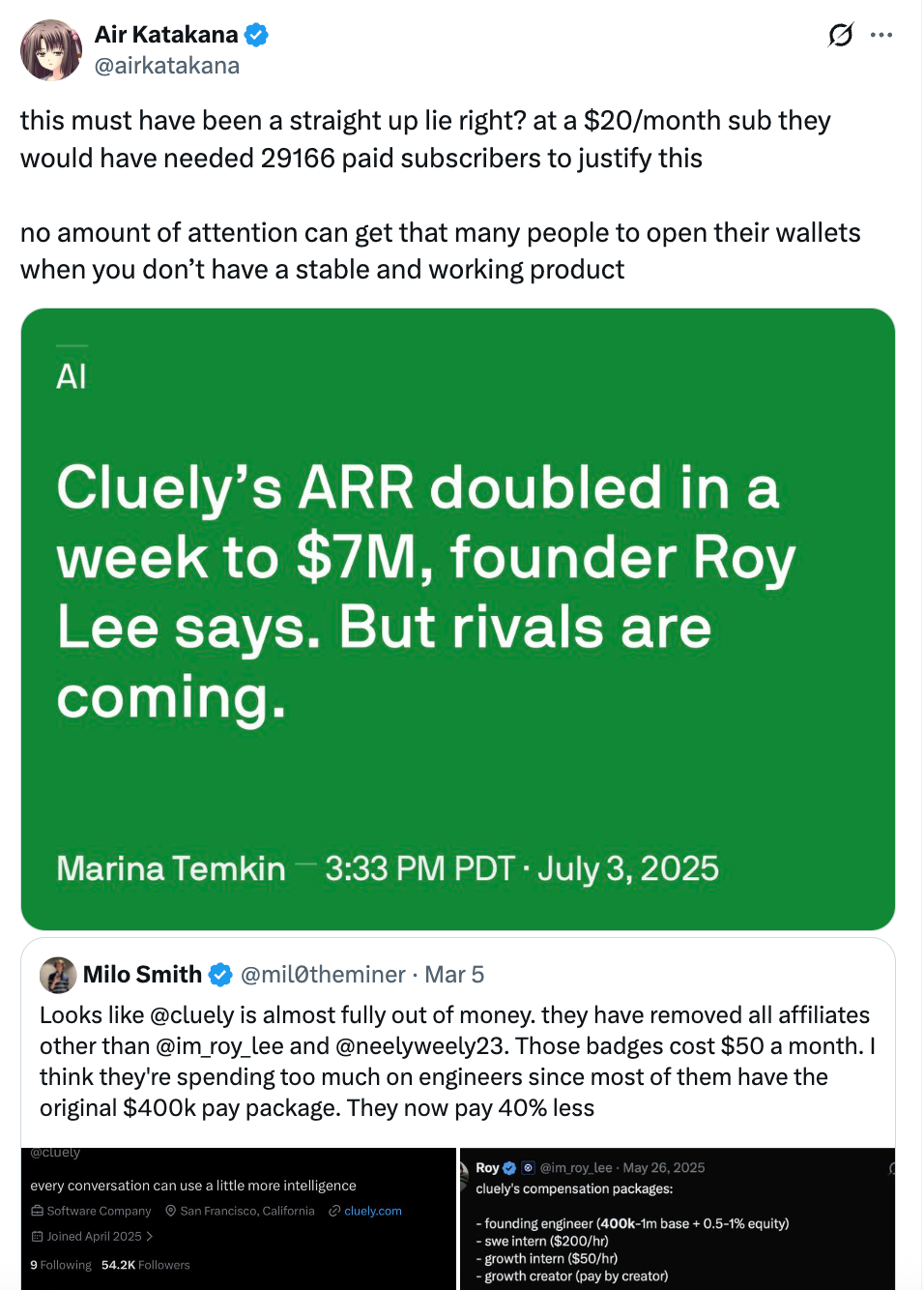
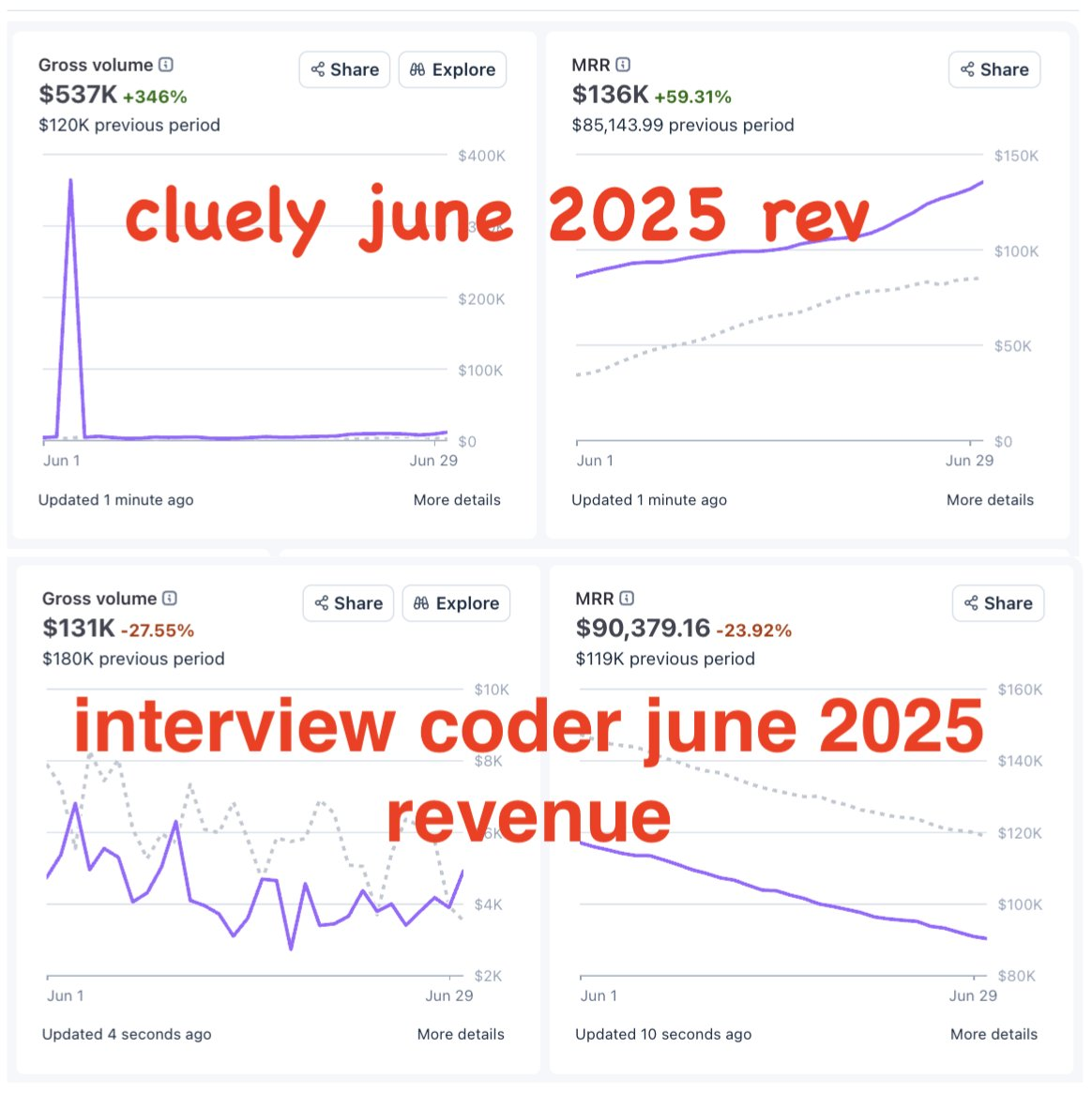
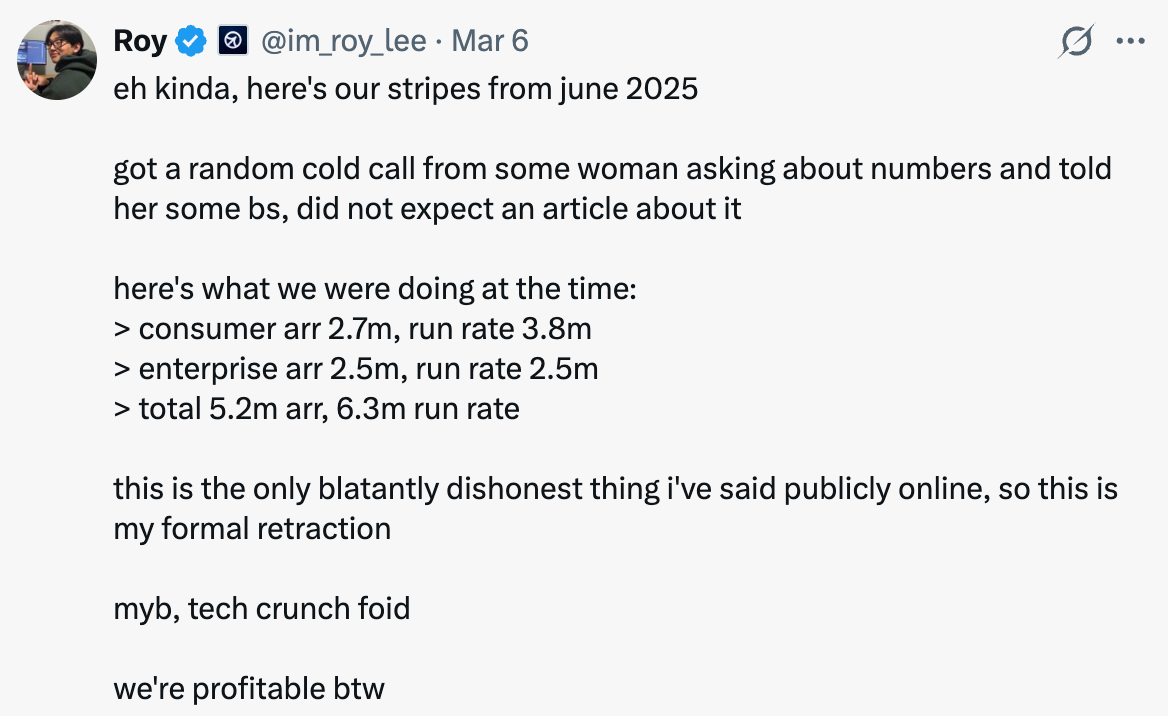
Facing the质疑, Cluely CEO Roy Lee was quite candid. He quickly posted to admit that he had casually mentioned the number when a reporter called him, not expecting it to be included in a formal article. Seemingly to prove it wasn't an intentional exaggeration, he also posted Cluely's actual data from June 2025: consumer business annual revenue of $2.7 million and enterprise business annual revenue of $2.5 million, totaling $5.2 million.

Up to this point, there was nothing sensational, and the explanation was plausible.
But on the same day, TechCrunch reporter Julie Bort published a rebuttal to Roy's claim. She stated that the interview was arranged proactively by Cluely's PR team, was documented, and was not a casual chat.

Roy Lee didn't continue with a written explanation but chose a more dramatic way to respond. He released a video with the caption, 'Breaking News: Cluely CEO Officially Responds to TechCrunch.'

In the video, he sat in front of the camera wearing sunglasses and a suit, with a microphone on the desk, looking as if he was about to make a serious statement. But the setting wasn't an office; it looked more like a living room, with an old desktop computer next to him playing Subway Surfers—a classic time-wasting game. Roy's response was also completely informal, more like a self-deprecating performance, mixed with self-mockery and bragging, his tone reminiscent of a rapper freestyling.

Even more absurdly, at the end of the video, he stood up from behind the desk, revealing that this CEO, formal from the waist up, was wearing no pants......

Thus, a crisis PR situation originally about 'falsified revenue' was handled as a traffic-grabbing, self-mocking performance.

What a16z Is Betting On Is Actually the Attention Economy

The capital market doesn't seem to mind this kind of performative founder personality either. In June 2025, Cluely announced the completion of a $15 million Series A funding round, with participating institutions including the renowned venture capital firm Andreessen Horowitz (a16z). Its partner Bryan Kim once mentioned on a podcast: In the AI era, the traditional 'artisan product + slow growth' model is no longer sufficient; viral spread itself is part of the product.

What he considers the 'new AI startup template' is that in an era where model capabilities are increasingly commoditized, attention itself is becoming a key resource. Whoever can capture user attention first may build a new moat.

From the 'cheating controversy' of Interview Coder, to the entrepreneurial story of being expelled from Columbia, to this absurd 'response video,' Roy Lee's entire personal brand has been built along this path: controversy itself is the content for propagation. This might also explain why a16z chose to invest in Cluely, to invest in Roy Lee.

When Controversy Becomes a Growth Strategy

In past entrepreneurial narratives, growth typically came from product capability, technological barriers, and business models. But in today's internet environment, another resource is becoming increasingly important—attention.

This logic has actually been proven in the crypto industry long ago. Many crypto projects capture user attention by creating topics, controversies, or even dramatic events, and then convert this traffic into product growth or commercial value, especially with the rise of Memes—pure propagation, no (traditional) product.

In a way, Roy Lee's response video is a classic case of this logic: when negative news emerges, rather than trying to suppress the controversy, repackage the controversy itself as传播 content.

Evidently, in the current internet environment, attention is often more valuable than explaining the truth.


Twitter:https://twitter.com/BitpushNewsCN

Bitpush TG Discussion Group:https://t.me/BitPushCommunity

Bitpush TG Subscription: https://t.me/bitpush

Original link:https://www.bitpush.news/articles/7618818

Related Questions

QWhat was the initial product developed by Cluely's CEO and co-founder, and what was the consequence of its creation?

AThe initial product was Interview Coder, an AI tool designed to help users cheat on LeetCode coding interviews. As a result, both Roy Lee and his roommate were expelled from Columbia University.

QHow did Cluely's CEO, Roy Lee, respond to the allegations of falsifying revenue reported by TechCrunch?

ARoy Lee first admitted in a post that he had casually provided the number during a call with a journalist without expecting it to be published. He then released a satirical video response where he appeared professionally dressed from the waist up but was not wearing pants, turning the crisis into a performance to attract attention.

QWhich prominent venture capital firm invested in Cluely's Series A funding round, and what was their stated reasoning for such investments in the AI era?

AAndreessen Horowitz (a16z) participated in Cluely's $15 million Series A funding round. Their partner, Bryan Kim, stated that in the AI era, viral marketing itself is part of the product, and capturing user attention is a critical resource for building a moat.

QAccording to the article, what is the 'new AI startup template' that Cluely's strategy exemplifies?

AThe 'new AI startup template' is one where, in an era of increasingly commoditized model capabilities, attention itself becomes a key resource. The strategy involves generating controversy and using viral, dramatic events to capture user attention and drive growth, rather than relying solely on traditional product capability or technological barriers.

QHow did the company's product narrative evolve from its origins to late 2025?

AOriginally promoted with the slogan 'Cheat on Everything' as a tool for cheating, the company began shifting its product narrative in November 2025 towards an AI note-taking assistant. This new focus included features like automatically organizing meeting content, improving collaboration efficiency, and even modifying attendees' expressions to hide distraction.

Related Reads

Has the 'Digital Gold' Narrative for BTC Failed?

**Title: Has the "Digital Gold" Narrative for Bitcoin Failed?** The article argues that Bitcoin's "digital gold" narrative remains valid despite a recent sharp price decline (from a peak near $126k in Oct 2025 to briefly under $61k in Feb 2026). It presents a long-term investment framework based on three core points: **1. Viewing Bitcoin as an Asset:** Bitcoin is presented as a superior potential store of value compared to gold. Key arguments are its absolute scarcity (21 million cap), superior portability, and transparent auditability via its public ledger. While acknowledging its current use in early, volatile stages (~3-4% global adoption), the author draws parallels to the early, disruptive phases of the internet and e-commerce. **2. Understanding the Recent Downturn:** The current ~50% correction is framed as a predictable, consensus-driven cycle following its post-halving peak (the 2024 halving preceded the Oct 2025 high). A crucial factor is a historic "changing of hands": the influx of new institutional buyers via ETFs allowed early, low-cost holders (miners, OG believers) to take profits. The author notes that while severe, Bitcoin's historical drawdowns (e.g., 93% in 2011, 77% in 2021-22) have been progressively smaller, suggesting maturing holder structure and decreasing volatility over time. **3. The Long-Term Perspective:** The long-term thesis hinges on Bitcoin capturing a portion of gold's market value. With Bitcoin's market cap at ~$1.4 trillion (at $70k) versus gold's ~$20 trillion, significant upside potential exists if the "digital gold" narrative is partially realized. However, the author strongly cautions that short-term risks remain, the bottom is unpredictable, and high volatility is inherent. The real risk is not Bitcoin failing but poor personal position management (over-leverage, wrong capital) and a lack of deep understanding, which can force investors out during severe downturns. The conclusion uses Amazon's 95% crash post-2000 dot-com bubble and subsequent 42x recovery as an analogy. The ultimate question is not if Bitcoin's price will rise, but if an investor's strategy and conviction can withstand the volatility to see the long-term play out. The recent divergence (gold up, Bitcoin down) is posed not as a narrative failure, but as potential evidence of this ongoing, painful transition from a speculative asset to a mainstream allocation.

marsbit5h ago

Has the 'Digital Gold' Narrative for BTC Failed?

marsbit5h ago

Has BTC's 'Digital Gold' Narrative Failed?

The article discusses Bitcoin's "digital gold" narrative, its recent price drop, and long-term outlook through the perspective of "Jason". It argues the narrative is not a failure but that Bitcoin represents a superior, new asset class due to its fixed supply (21 million), portability, and auditability. The piece compares its current ~3-4% global adoption rate to early internet/e-commerce, suggesting significant growth potential. Regarding the 2025-2026 price decline (from ~$126k to briefly under $61k), the author views it as a predictable, consensus-driven sell-off within Bitcoin's ~4-year cycle post-halving, exacerbated by a major "handover" from early, low-cost holders to new institutional buyers via ETFs. A key observation is that historical peak-to-trough drawdowns have lessened over time (e.g., 93% in 2011 to ~50% in 2026), indicating maturing volatility as holder structure changes. For the long term, the author uses a simple framework: Bitcoin's total market cap (~$1.4T at $70k) is only about 7% of gold's (~$20T). Even capturing 30-50% of gold's value would imply substantial upside. However, the article strongly cautions against viewing this as investment advice, emphasizing extreme volatility and the critical importance of risk management, position sizing, and deep fundamental understanding to survive severe drawdowns. It concludes by drawing a parallel to Amazon's 95% crash in 2000 and subsequent 42x recovery, stressing that the key is surviving market cycles to realize long-term potential.

链捕手5h ago

Has BTC's 'Digital Gold' Narrative Failed?

链捕手5h ago

From Code to Cognition: A Ten-Thousand-Word Guide to the Evolution of the Robot Brain

"From Code to Cognition: The Evolution of Robot Brains" The journey of robotic intelligence has shifted dramatically from manually coded systems to AI-driven brains. For decades, robots relied on layered software stacks—perception, state estimation, planning, control—each handcrafted. While predictable, they lacked adaptability. The 2010s saw deep learning revolutionize perception (e.g., object detection) and control (via reinforcement learning), but learned skills remained narrow. The arrival of Large Language Models (LLMs) marked a turning point. LLMs acted as high-level planners, interpreting natural language instructions and generating sequences of actions for traditional robotic systems to execute. However, true integration came with Visual-Language-Action (VLA) models, which fused vision, language, and motion prediction into a single network. Pioneered by models like RT-2 and open-source projects like OpenVLA, VLAs enable robots to reason and act directly from visual input and commands. The most advanced humanoid robots now employ a "dual-brain" architecture: a slow-thinking, large VLA (System 2) for reasoning and planning, and a fast-reacting, small network (System 1) for high-frequency motion control, sometimes with an even lower-level System 0 for balance. This split balances cognition with the physics of real-time movement. Computation is split between onboard hardware (e.g., NVIDIA Jetson) for safety-critical control loops and cloud/edge servers for non-critical tasks like learning and interfaces. A crucial driver is the open-source ecosystem—models like GR00T and OpenVLA allow startups to build upon pre-trained brains and fine-tune them with their own data, accelerating development. Despite progress, current systems struggle with recovery from errors, sample inefficiency, and long-horizon tasks. This has spurred the rise of **World Models**—neural networks that predict the consequences of actions. By simulating possible futures before acting (like NVIDIA Cosmos or Meta V-JEPA), robots can plan, recover, and generalize better. This represents the next frontier: shifting intelligence from learned reactions to an internal model of physics and cause-and-effect. The field is rapidly evolving. While not yet at its "ChatGPT moment," the convergence of cheaper hardware, scalable simulation, and world models points toward robots that are increasingly capable, adaptive, and useful. The question is shifting from "what can robots do?" to "what *should* they do?"

marsbit5h ago

From Code to Cognition: A Ten-Thousand-Word Guide to the Evolution of the Robot Brain

marsbit5h ago

Trading

Spot
Futures
活动图片