Ads During the American Super Bowl Look Like Scams

marsbitPublished on 2026-02-12Last updated on 2026-02-12

Abstract

The 2026 Super Bowl, often called the "American Super Bowl," was a spectacle of sports, entertainment, and high-stakes marketing. This year’s event featured three notable incidents that highlight the intersection of prediction markets, insider information, and viral marketing. First, a newly created account on the prediction market Polymarket placed nearly $80,000 in bets—with 17 out of 19 wagers correctly predicting details of the halftime show, including appearances by Lady Gaga and the absence of Travis Scott. The account’s near-perfect accuracy led to suspicions of insider trading, possibly linked to the event’s production team. Second, a trader named Alex Gonzalez ran onto the field during the game with promotional messages painted on his body. Reports indicate he had previously bet on such a field invasion occurring, after accounting for legal fees and bail, netted around $70,000. His actions blurred the line between predicting and creating events for profit. Finally, a viral “leaked” video showed influencer Logan Paul apparently betting $1 million on Polymarket during the game. It was later revealed to be a marketing stunt orchestrated by Polymarket itself, in which Paul has investment ties. Together, these events illustrate how prediction markets can be manipulated through insider knowledge, performative acts, and staged publicity—raising questions about authenticity in high-profile events.

This year's "American Super Bowl" once again captured the world's attention, much like previous years. The game itself, Mr. Beast's one-million-dollar bounty puzzle game, the halftime show... A sports event that was originally popular only in the United States has attracted global attention thanks to numerous entertainment and cultural elements.

Before we begin, let's experience just how lively the American Super Bowl is from a first-person perspective:

Amidst this density of attention, three viral events perfectly illustrate our expectations for prediction markets: an insider with a perfect winning rate betting on the halftime show performers on the prediction market Polymarket, a "fanatic fan" arrested on the spot, and a viral video of a major influencer secretly filmed using a prediction market that was later revealed to be a marketing stunt.

The "Perfect Win Rate" of Prediction Markets: New Account Achieves Extremely High Win Rate Betting on Halftime Show Lineup

Approximately 48 hours before the Super Bowl kickoff, nearly $80,000 was deposited into a newly registered account on the prediction market Polymarket. Subsequently, this account concentrated all its funds on bets related to the halftime show performers and setlist events, covering multiple specific predictions such as Lady Gaga performing and Travis Scott not performing, totaling 19 prediction bets.

After the halftime show concluded, 17 of these 19 bets hit, yielding a profit of $17,600. A new account, heavily concentrated on a single event, with a near-perfect hit rate. This goes far beyond just good luck.
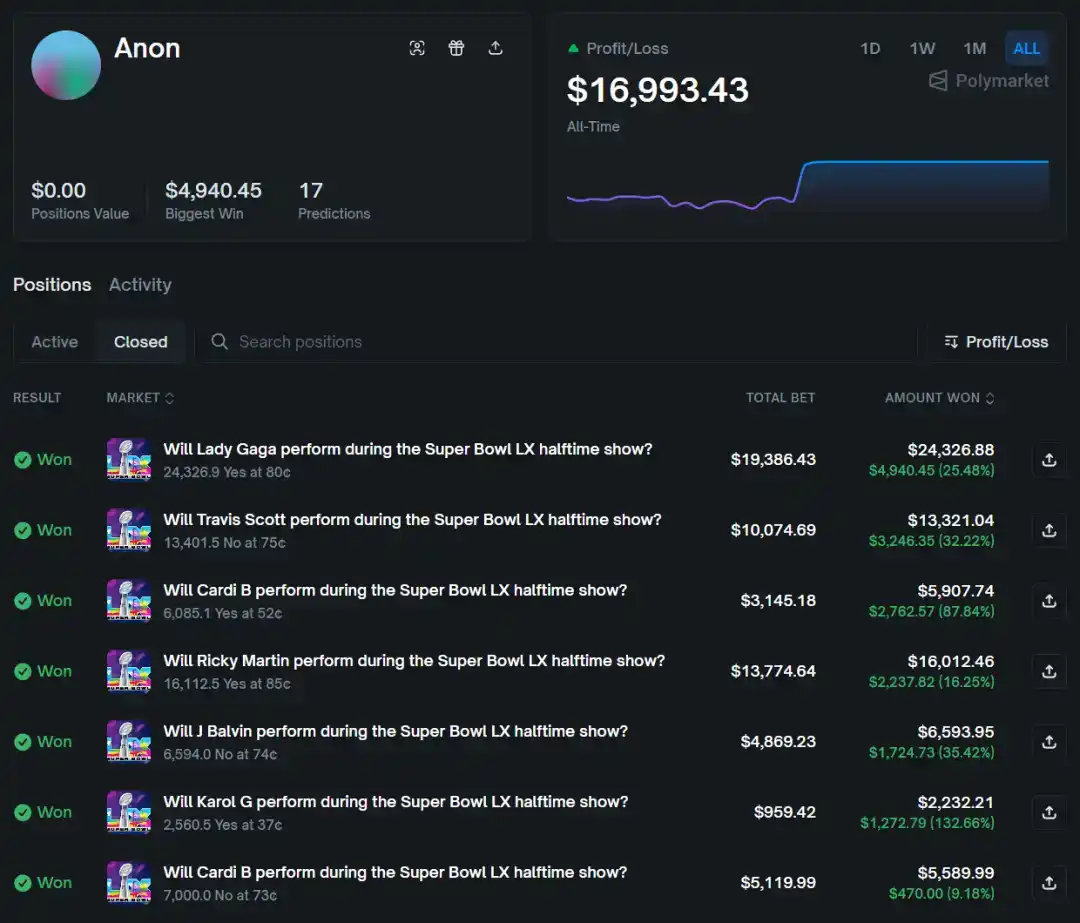
Since the Super Bowl halftime show has long been planned and produced by the company Roc Nation, the community quickly began to speculate that the account holder likely had access to insider information, or was even connected to the production team. In an event with trading volume exceeding ten million dollars, while ordinary traders were placing blind bets, this insider was perhaps holding the setlist in their left hand and locking in profits with their phone in their right.

However, the anonymous nature of blockchain also means this remains merely speculation. This transaction has become another classic case study defining prediction markets as a means for insiders to monetize information asymmetry.

Trader Bets "Someone Will Rush the Field" and Then Rushes the Field

If the insider trader was profiting from information asymmetry in the shadows, then the move by a "fan" during the game was an open stratagem. He is also the protagonist in the video at the beginning of our article.

In the fourth quarter of the game, a shirtless fan climbed over the barrier and rushed onto the Super Bowl field. Instantly, all cameras and the television broadcast focused on this intruder. His bare chest was painted with body paint, his front reading "Trade in the blind spot," and his back displaying his account ID "@fxalexg" and the advertisement "Trade with Athena."

From the moment he stepped onto the field until he was tackled by security, he ran for 30 seconds. The going rate for a 30-second ad spot during the Super Bowl is $7 million.

When viewers took out their phones to search for his account, they discovered this "fan" was not an ordinary spectator but a trader—Alex Gonzalez. The slogans on his body were essentially a moving advertisement.

Even more intriguingly, according to Sportscasting, Gonzalez had performed a similar stunt back in 2024. He reportedly bet $5,000 that "someone would rush the field during the Super Bowl," then rushed the field himself during the game, ultimately profiting about $110,000; after deducting bail and legal fees, his net gain was still around $70,000.

In other words, he not only creating the event on the field but potentially also betting on the event he himself would create in the prediction market.

When the odds are high enough, some people stop predicting the future and instead create it themselves. This is also our most extreme, and most ironic, expectation for prediction markets.

The "Secretly Filmed" Video of an Influencer Betting a Million Dollars Was Actually a Marketing Stunt

Another video from this Super Bowl that went viral across the internet came from top influencer Logan Paul—in the footage, his phone screen is lit up with the Polymarket betting interface, showing him placing a one-million-dollar bet on which team would win. The image is blurry, the angle is tilted, very much like a casual shot taken by a spectator in the back seat.

Soon after this 12-second "secretly filmed" video spread, it was reposted by the official Polymarket account, and the heat and traffic came as expected. However, this transaction never appeared in the information flow of PolyBeats, which focuses on monitoring prediction market trades.

After in-depth research, it was found that the so-called "million-dollar bet" never actually occurred. This seemingly explosive "behind-the-scenes moment," which satisfied the public's voyeuristic desires, was nothing more than a carefully packaged marketing performance: as early as December 2025, Logan Paul joined the venture capital firm Anti Fund as a partner, and this firm was one of the investors in Polymarket's Series B round in 2025.

When a globally watched sporting event simultaneously overlaps with probability markets, advertising markets, and attention markets, the boundaries of the game are no longer confined to just the two teams on the field. Beyond the odds, there's the pricing of exposure; beyond the betting lines, there's narrative design.

Driven by money and attention, the "viral moments" we scroll past on social media might not be spontaneous but the result of months of planning.


Trending Cryptos

Related Questions

QWhat was the 'American Super Bowl' event mentioned in the article, and why is it attract global attention?

AThe 'American Super Bowl' refers to the annual championship game of the National Football League (NFL). It attracts global attention not just for the sport itself, but due to its heavy integration of entertainment culture, such as the high-profile halftime show, celebrity appearances, and major advertising events, which collectively draw a worldwide audience.

QHow did a new Polymarket account achieve a near-perfect prediction rate for the Super Bowl halftime show, and what does this suggest?

AA new Polymarket account deposited nearly $80,000 and placed 19 concentrated bets on specific halftime show details, like Lady Gaga appearing and Travis Scott not appearing, with 17 of them being correct. This near-perfect success rate, far beyond luck, strongly suggests the account owner had insider information, likely connected to the show's production company Roc Nation, exploiting information asymmetry for profit on the prediction market.

QWho was Alex Gonzalez, and how did he allegedly profit from the Super Bowl event according to the article?

AAlex Gonzalez was a trader who ran onto the field during the Super Bowl with painted advertisements on his body. The article suggests he had previously placed a $5,000 bet on the prediction market that 'someone would rush onto the field during the Super Bowl' and then created the event himself by doing so. He reportedly profited approximately $110,000 from that bet, with a net gain of around $70,000 after legal fees and bail.

QWhat was revealed about the viral 'secretly recorded video' of Logan Paul placing a million-dollar bet on Polymarket?

AThe viral 12-second 'secretly recorded' video of Logan Paul apparently placing a million-dollar bet on Polymarket was revealed to be a staged marketing campaign. The bet never actually placed on the market, and the video was a carefully orchestrated promotion. This was because Logan Paul is a partner in Anti Fund, a venture capital firm that was an investor in Polymarket's Series B funding round.

QWhat overarching point does the article make about prediction markets, advertising, and major events like the Super Bowl?

AThe article argues that during globally watched events like the Super Bowl, prediction markets, advertising markets, and attention economies converge. This creates an environment where what appears to be spontaneous moments—such as an insider making profitable trades, a fan rushing the field, or a viral video—are often the result of months of planning and manipulation for financial gain and exposure, blurring the lines between gambling, advertising, and narrative creation.

Related Reads

Are Meme Coins a Shortcut or a Trap? Robinhood Chain Faces a Crucial Decision

Robinhood Chain, the blockchain initiative by the brokerage platform, is experiencing a strong initial surge in activity. Key metrics include over 300,000 daily active addresses, daily DEX trading volume surpassing $1 billion (ranking second among public blockchains), and a TVL exceeding $3 billion. However, the article expresses significant concern that this growth is overwhelmingly driven by memecoin trading, as observed on the Robinhood Wallet. The author argues this is a dangerous shortcut. While memecoins can rapidly boost user numbers, trading volume, and liquidity, they often result in substantial investor losses, erode trust in the ecosystem, and risk cementing Robinhood's reputation as a speculative, meme-driven platform—a perception Wall Street already holds. The piece contrasts this path with that of Coinbase's Base chain, which has emphasized fostering applications with real utility and sustainable business models. It urges Robinhood Chain to avoid becoming a "memecoin chain" and instead focus its resources on substantial use cases, particularly the tokenization of real-world assets (RWA). The proposed strategic pivot is toward facilitating global access to tokenized stocks, RWA, and other real financial instruments through its chain. This aligns with crypto's original promise of democratizing finance and represents Robinhood's largest growth opportunity: tapping into over 100 million potential new international users beyond its nearing-saturation U.S. market. Success in this direction could drive significant future revenue and redefine the company's legacy beyond the meme-stock narrative. The core message is a plea to Robinhood's leadership: choose sustainable, value-creating finance over the fleeting and damaging allure of memecoins.

Foresight News9m ago

Are Meme Coins a Shortcut or a Trap? Robinhood Chain Faces a Crucial Decision

Foresight News9m ago

The Biggest Bull Market in History: Did It Cause 320,000 South Koreans to Go Bankrupt Overnight?

South Korea's stock market experienced extreme volatility in mid-2026, leading to massive losses for retail investors. The KOSPI index, driven heavily by semiconductor giants Samsung Electronics and SK Hynix, plunged about 25% from its June high, entering a technical bear market. On July 13 alone, SK Hynix shares crashed over 15%, its worst single-day drop in two decades, triggering margin calls for over 1.2 million leveraged散户 accounts. Approximately 320,000 of these were forcibly liquidated. The dramatic sell-off followed a historic bull run where the KOSPI had doubled in six months, with SK Hynix soaring 300%. This fueled a national投机 frenzy, with散户 extracting savings and taking on record leverage to chase AI and semiconductor stocks. However, data revealed that even during the rally, about 73% of散户 lost money in the top 50 most-traded stocks. The market's extreme concentration—Samsung and SK Hynix alone comprised half the KOSPI's市值—made it highly volatile. Five全市场熔断 occurred in just five weeks. The downturn sparked widespread distress, including reports of a suicide attempt and a stabbing linked to investment losses. A sharp rebound occurred on July 15, with the KOSPI soaring over 7%, but the episode highlighted the risks of a highly leveraged, sentiment-driven market. Analysts note a recurring pattern in Korea of rapid, narrative-driven booms and busts—from the Han River Miracle to internet stocks and now AI—driven by a "compressed modernity" and a pervasive "get-rich-quick" mentality among investors across all ages.

marsbit18m ago

The Biggest Bull Market in History: Did It Cause 320,000 South Koreans to Go Bankrupt Overnight?

marsbit18m ago

From Blockchain's First Share to the Edge of Delisting: Canaan Technology Trapped in a 'Fight for Survival'

Canaan Inc., once hailed as the "first global blockchain stock," is now fighting to avoid delisting from Nasdaq. On July 15, the company received a 180-day extension, until January 11, 2027, to regain compliance after its ADS price fell below $1 for 30 consecutive trading days. Its market cap has plummeted over 90% from its peak after its 2019 IPO. The financial picture is grim. Q1 2026 results showed a 24.3% year-over-year revenue decline to $62.7 million and a net loss of $88.7 million. The company recorded a gross loss, including approximately $25 million in non-cash inventory writedowns for its mining machines, signaling collapsing demand. Its Q2 revenue guidance is a weak $35-45 million. A costly strategic misstep contributed to its troubles. In June 2025, Canaan terminated its non-core AI chip business after years of development yielded minimal revenue but significant operating expenses, forcing a full retreat to its core Bitcoin mining hardware and proprietary mining operations. However, the core business faces intense pressure. The mining machine industry is highly cyclical and tied to Bitcoin's price. In the current "post-halving" environment with lower marginal returns, demand has cooled sharply. Canaan's product revenue crashed to $42.9 million in Q1 2026 from $164.9 million in Q4 2024. In response, management is pivoting from a pure hardware seller to a "computing power infrastructure service provider." It is expanding proprietary mining, with total hash rate in joint projects reaching 11 EH/s, and exploring energy integration projects like using mining heat for agriculture. It also secured $72 million in strategic investment in late 2025. Canaan's struggle reflects the broader crypto mining winter, where capital has shifted toward AI and high-performance computing. The company must now prove its viability within the 180-day grace period, with a potential reverse stock split on the table, as the market focuses on cash flow and profitability over mere narrative.

Foresight News41m ago

From Blockchain's First Share to the Edge of Delisting: Canaan Technology Trapped in a 'Fight for Survival'

Foresight News41m ago

New Fire Research Institute: Rising Middle East Tensions and Capital Outflows Put Short-Term Pressure on the Crypto Market

New Fire Institute Research: Crypto Market Under Short-Term Pressure Amid Rising Middle East Tensions and Capital Outflows **Market Recap:** US military strikes in the Middle East escalated tensions, driving oil prices and US Treasury yields higher while pressuring Asian risk assets. Against a backdrop of weaker gold and a strong US dollar, crypto market risk appetite faced external pressure. The total stablecoin market cap has shrunk by $10 billion since May, with a net outflow of $7.7 billion in June alone. Trading volume on South Korea's top five crypto exchanges hit a near-2.9-year low. Despite broad market pressure, Robinhood's L2 network saw over $70 million in ETH bridged in its first week, boosting optimism for the Ethereum ecosystem. Circle's approval to establish a US national trust bank also injected confidence into long-term compliant funding channels. A correction signal in the AI sector is notable, with US AI stocks pulling back over 30% from recent highs. Macro-geopolitical risks and shrinking on-chain liquidity suggest the crypto market is in a short-term, 'risk-off' defensive phase, with Bitcoin price fluctuating in a 'high-value range'. **Outlook:** The US Senate will review the *CLARITY Act* on July 20th, with its direction potentially reshaping the industry's compliance framework. Key debates center on ethics restrictions for government officials in crypto, developer liability, and stablecoin rewards. Escalating Middle East tensions could reignite inflation concerns, impacting Fed policy expectations. The Bank of Japan's likely rate hold in July may temporarily ease liquidity pressure from yen carry trades. Monitoring oil prices and the strong dollar's impact on risk assets is crucial. Notably, Hyundai Motor became the first major South Korean firm to adopt internal stablecoin transfers, accelerating the trend of traditional giants embracing Web3. **Market View:** The market is currently in a state of 'macro risk-off versus price action博弈'. With momentum limited by Middle East tensions and capital outflows, and with significant regulatory developments pending, sidelined capital is adopting a wait-and-see approach. The market is likely to maintain range-bound, liquidity-seeking consolidation in the near term.

marsbit1h ago

New Fire Research Institute: Rising Middle East Tensions and Capital Outflows Put Short-Term Pressure on the Crypto Market

marsbit1h ago

Trading

Spot

Hot Articles

How to Buy SUPER

Welcome to HTX.com! We've made purchasing SuperFarm (SUPER) simple and convenient. Follow our step-by-step guide to embark on your crypto journey.Step 1: Create Your HTX AccountUse your email or phone number to sign up for a free account on HTX. Experience a hassle-free registration journey and unlock all features.Get My AccountStep 2: Go to Buy Crypto and Choose Your Payment MethodCredit/Debit Card: Use your Visa or Mastercard to buy SuperFarm (SUPER) instantly.Balance: Use funds from your HTX account balance to trade seamlessly.Third Parties: We've added popular payment methods such as Google Pay and Apple Pay to enhance convenience.P2P: Trade directly with other users on HTX.Over-the-Counter (OTC): We offer tailor-made services and competitive exchange rates for traders.Step 3: Store Your SuperFarm (SUPER)After purchasing your SuperFarm (SUPER), store it in your HTX account. Alternatively, you can send it elsewhere via blockchain transfer or use it to trade other cryptocurrencies.Step 4: Trade SuperFarm (SUPER)Easily trade SuperFarm (SUPER) on HTX's spot market. Simply access your account, select your trading pair, execute your trades, and monitor in real-time. We offer a user-friendly experience for both beginners and seasoned traders.

5.5k Total ViewsPublished 2024.03.29Updated 2026.06.02

How to Buy SUPER

Discussions

Welcome to the HTX Community. Here, you can stay informed about the latest platform developments and gain access to professional market insights. Users' opinions on the price of SUPER (SUPER) are presented below.

活动图片