AAOI Breaks Through Bull Flag! Amazon Lock-up + Profits Double, Still Worth Chasing?

Published on 2026-08-17Last updated on 2026-08-17

Abstract

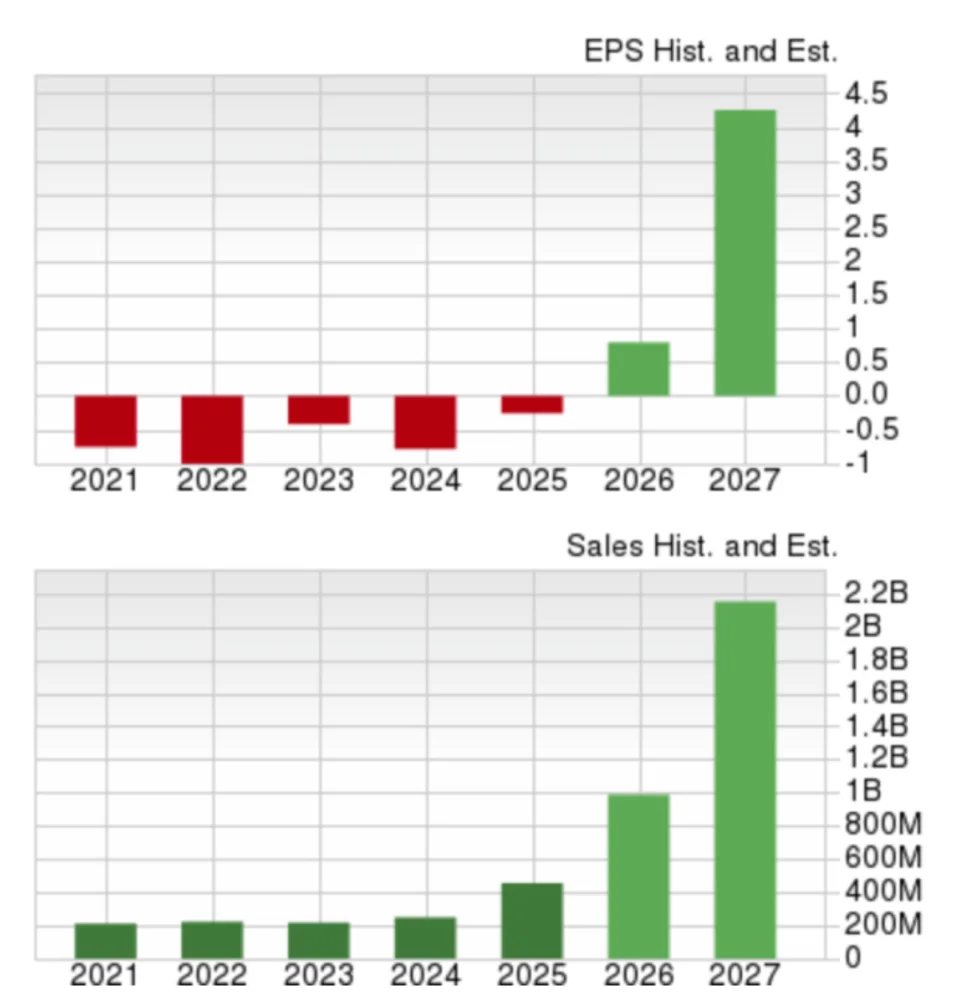
Analysts predict AAOI's EPS and revenue growth rates will reach triple digits in 2026 and 2027.

AAOI's hottest business area is the artificial intelligence data center market. In order to establish a foothold in the AI market, major tech companies are building some of the largest commercial data centers in history to train complex AI models. These massive data centers are equipped with thousands of Nvidia (NVDA) Graphics Processing Units (GPUs). Traditionally, GPUs were connected using copper cables. However, traditional copper interconnects have physical limitations in transmission distance, power consumption, and heat dissipation. Furthermore, copper prices have surged significantly over the past year, making optical fiber interconnects more attractive for these applications.

Therefore, AAOI's current revenue and profit growth rates are both in the high double digits. However, analysts in the Zacks consensus estimate predict that AAOI's EPS and revenue growth rates will reach triple digits in 2026 and 2027.
Amazon Deal Provides Revenue Visibility

Last year, Applied Optoelectronics, Inc. (AAOI) announced a major, multi-year agreement with Amazon (ticker: AMZN). Amazon will invest up to 8 million shares of AAOI stock in exchange for the supply of AAOI's advanced optical transceivers and data center networking products. This agreement provides AAOI with multi-year revenue security and validation from a leading hyperscale data center operator.

Rising Profit Margins

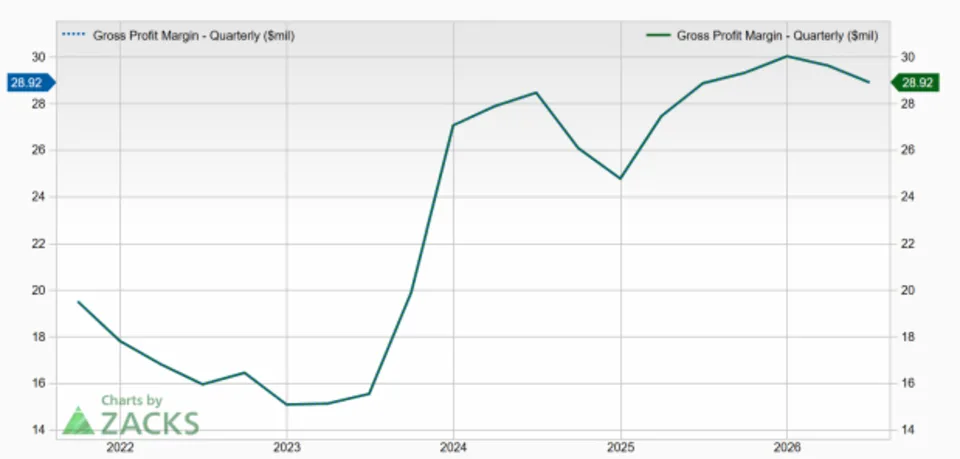
The company's profit margins have grown significantly, nearly doubling since 2023.
Geopolitical Insulation

As Western nations seek to reduce supply chain risks associated with Chinese optical suppliers, AAOI stands to benefit. The company's primary manufacturing base is located in Texas, making it one of the few domestic US optical manufacturers.

AAOI Technical Analysis

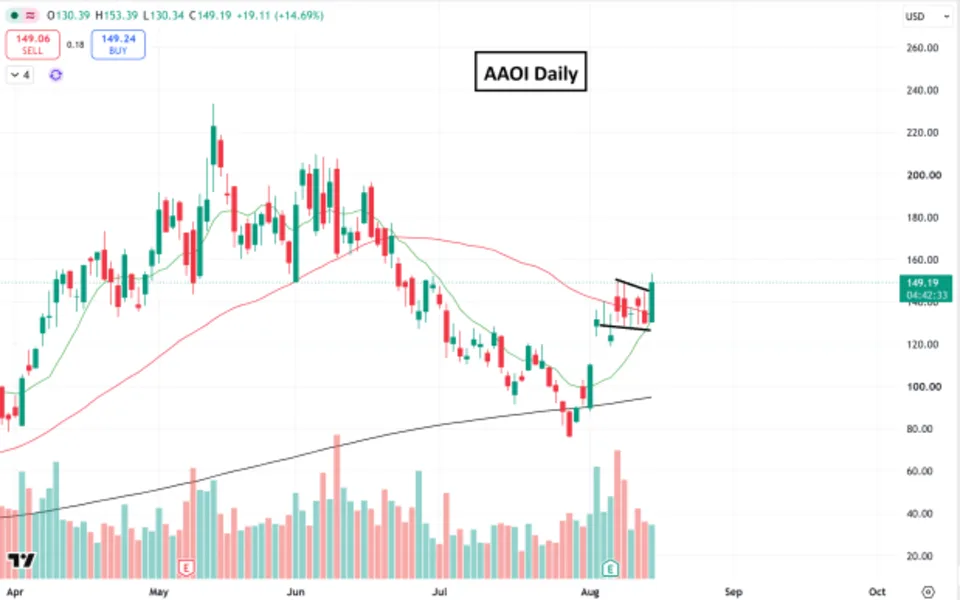
AAOI stock has reclaimed its 50-day moving average and broken out from a perfect bull flag pattern.
Conclusion

With traditional copper-based infrastructure being replaced by high-speed optical transceivers, AAOI's vertical integration, expanding profit margins, and multi-year agreements position it to fully capitalize on the AI boom.
Related Reads

Google and Meta Called Out for Benchmark Gaming

Recently, analysis firm SemiAnalysis accused tech giants Google and Meta of "benchmark gaming" with their AI models Gemini 3.8 Flash and Muse Spark 1.3. The accusation stems from a dramatic performance drop between two versions of the Terminal-Bench evaluation for AI agents. On the older, public Terminal-Bench 2.1, Gemini 3.8 Flash scored 89.4, ranking second and beating GPT-6 Astra, while Muse Spark 1.3 scored 88.8. However, on the newly released, more secure Terminal-Bench 4.0, their scores plummeted to 19.1 and approximately 33.3 respectively, far behind competitors. SemiAnalysis argues this indicates "benchmark contamination," where companies train models not on the public test questions themselves, but on expensive, privately purchased training data specifically designed to mimic the benchmark's style. This has evolved into a lucrative industry, with specialized firms selling tailored training tasks for thousands to hundreds of thousands of dollars. The article specifically points to Datacurve, a company that both sells expert coding data and runs its own benchmark (DeepSWE), where the accused models also performed well. Meta's Chief AI Officer, Alexandr Wang, dismissed the claims as a "silly argument," pointing out similar performance drops for other models like GPT-5.6 Sol. He stated Meta never claimed Muse Spark 1.3 was as powerful as top-tier models, only that it offered better value. The report concludes that this is the inevitable fate of all high-quality public benchmarks—they become "gamed" over time. The proposed solution of private, high-quality benchmarks comes with a significant downside: it would erode public transparency, turning open rankings into marketing tools and leaving developers without a common, fair measure to compare AI models.

marsbit2h ago

Google and Meta Called Out for Benchmark Gaming

marsbit2h ago

Crypto's Nouveau Riche Strikes Gold in the Real World: Coinbase Co-founder's Venezuelan Oil Field Adventure

Coinbase co-founder Fred Ehrsam is venturing into the oil fields of Venezuela, a surprising shift for a prominent figure in the digital asset space. Through his company Primavera Infinita, he recently secured a production contract for the Budare-Elotes block with Venezuela's state oil firm PDVSA. This move into a politically volatile, sanction-scarred country highlights a bet on high returns from its reopening under new leadership and shifting U.S. foreign policy. Ehrsam’s investment reflects a venture capital-style appetite for risk, targeting assets deeply discounted by political uncertainty. He is not alone; smaller, politically connected U.S. firms like Aspect Holdings and Hunt Oil are also entering, while established giants like ExxonMobil remain cautious due to past expropriations. To manage the complex, capital-intensive nature of oil, Ehrsam is assembling a professional team. This trend extends beyond Ehrsam. Other crypto wealth, like BitMEX's Arthur Hayes and Tether, is diversifying into traditional hard assets—energy, metals, and agriculture—seeking physical scarcity as a long-term anchor. Tether, for instance, took a controlling stake in agricultural giant Adecoagro. These moves signify crypto capital's evolving interest: not just tokenizing real-world assets (RWA), but directly acquiring and operating them. Ultimately, Ehrsam's gamble is less on oil geology and more on the duration of Venezuela's current political window. It underscores a broader narrative where digital-era wealth seeks stability and scale in the physical world's most traditional, immovable resources.

marsbit2h ago

Crypto's Nouveau Riche Strikes Gold in the Real World: Coinbase Co-founder's Venezuelan Oil Field Adventure

marsbit2h ago

Refuting the Ethereum 'Abandoning' ETH Narrative: What Does It Really Mean to Pay Gas Without ETH?

Title: Refuting the "Ethereum Abandoning ETH" Argument: What Does Paying Gas Without ETH Really Mean? The debate sparked by Vitalik Buterin's discussion of EIP-8141 (Frame Transactions), which suggests users could pay transaction fees without holding ETH, has led to extreme claims that ETH will lose its value. However, this perspective misunderstands the proposal. Currently, an Ethereum user initiating a transaction must also pay the network's Gas fee in ETH. EIP-8141 aims to decouple these actions. It allows a transaction to be split into separate "frames." A user could sign a transaction to, for example, send USDC, while a separate Paymaster account pays the required ETH Gas fee on their behalf. The user would then settle the cost with the Paymaster using USDC or another token. From the user's perspective, they pay in a stablecoin without interacting with ETH. Crucially, from the Ethereum protocol's perspective, the Gas is still paid in ETH; only the settlement layer between the user and Paymaster changes. This concept isn't entirely new; ERC-4337's Account Abstraction already allows similar Gas sponsorship. EIP-8141 seeks to integrate this capability more natively. The core goal is to drastically improve user experience by abstracting away the complexity of Gas, similar to how one pays with a credit card abroad without handling the local currency. It also enables atomic operations, like bundling token approval with a swap, which would revert together if the swap fails. Regarding ETH's value, the argument that "no ETH is needed" is incorrect. While users may not hold ETH, Paymasters and services must still acquire and spend ETH to pay network fees on the backend. The demand for ETH shifts from being distributed across millions of user wallets to being concentrated in the balances of these service providers. The key variable is whether this improved usability attracts significant new users and increases overall network activity. If it does, total ETH burned in fees could rise substantially. If it doesn't, the change merely reshuffles who holds the ETH needed for Gas. In summary, EIP-8141 aims to lower the entry barrier by hiding Gas complexity, betting that this will drive broader adoption and increase the fundamental utility—and thus demand—for the Ethereum network and ETH itself.

marsbit2h ago

Refuting the Ethereum 'Abandoning' ETH Narrative: What Does It Really Mean to Pay Gas Without ETH?

marsbit2h ago

Trading

Spot
活动图片