A Repeat Of February? Watch Out For These Bitcoin Price Levels In March

bitcoinistPublished on 2026-02-28Last updated on 2026-02-28

Abstract

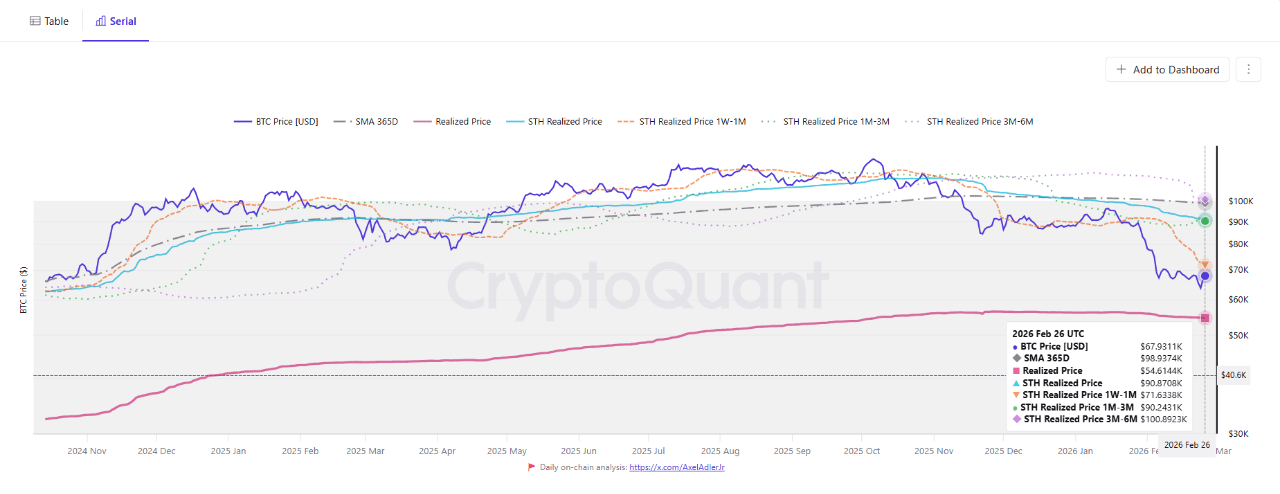
The Bitcoin price had a disappointing performance in February, struggling to sustain a break above the $70,000 level and facing sharp reversals after briefly reaching $71,000. A market analyst highlights several key price levels to watch in March. The strongest support is the realized price at approximately $54,600, which has historically acted as a critical floor. On the upside, significant resistance levels include the 1-4 Week Realized Price at $71,600, where recent buyers may look to exit at break-even. A decisive break above the Short-Term Holder Realized Price (STH RP) at $90,800 could signal a shift from a bearish to a bullish trend. Further resistance exists at the 365-day Simple Moving Average ($98,900) and the 3-6 Month Realized Price (~$100,800). Bitcoin is currently in a bearish phase and must overcome these resistance levels for a meaningful recovery. As of the time of writing, BTC is trading around $63,696, down over 5% in 24 hours.

The Bitcoin price performance was quite disappointing over the past month. The flagship cryptocurrency has struggled to break sustainably above $70,000 throughout February, with prices only reaching $71,000 before facing sharp reversals.

It, then, becomes intuitively evident that this price region might be a key level acting as resistance to Bitcoin’s bullish attempts. Below are some other crucial levels to watch for in March and what they could potentially mean for the Bitcoin price.

BTC Realized Price Sits At $54,600 – What This Means

In a Quicktake post on the CryptoQuant platform, market analyst Burak Kesmeci highlighted five “cost clusters” that might reveal the next move for the Bitcoin price. For context, Cost clusters are essentially price levels that represent the average acquisition price of an asset (Bitcoin, in this case) by different investor cohorts

To start with, Kesmeci immediately revealed Bitcoin’s surest support price — the realized price — to be around the $54,600 mark. The realized price is a strong support region because it reflects the average cost basis of all the BTC in circulation.
Source: CryptoQuant

Also, realized prices have historically served as long-term price support during bear phases. As a result, when the Bitcoin price trades above this level, it is often a sign of extant structural strength, while a break beneath the realized price is usually a sign of impending doom.

Bitcoin Could Switch Bullish In March — But On This Condition

While the Bitcoin price may be displaying its higher timeframe backing, it is also true that the world’s leading cryptocurrency has a series of battles to fight as it ascends. According to the crypto pundit, four resistance zones lie in wait to reject possible upward recovery.

The first of these zones is the 1 – 4-Week Realized Price, which reveals the average price at which recent buyers entered the BTC market. According to the highlighted CryptoQuant data, this cost basis stands at around the $71,600 level.

When the Bitcoin price trades beneath this level, it signals that the latest participants are under severe heat. Hence, recovery attempts towards this price level would typically be met with significant resistance, as this cohort would want to exit at break-even.

The analyst further highlighted that the Short-Term Holder Realized Price (STH RP) is around $90,800; this concerns investors who have held BTC for less than 155 days. If the Bitcoin price manages to overcome the evident resistance at this level, it could signal a change in Bitcoin’s trend from bearish to bullish.

Beyond the STH RP, the 365-day Simple Moving Average sits, occupying the $98,900 price level; then, a little more up North, the 3–6 Month Realized Price stands around $100,800. These metrics reflect the activity of Bitcoin’s medium-term holders, showing their realized price and average closing prices over the past year.

In the grand scheme, Bitcoin is clearly in a bearish phase. Thus, before March can stand as the pivotal month for market participants, BTC has to overcome those critical resistance levels. As of this writing, Bitcoin is valued at around $63,696, reflecting an over 5% decline in the past 24 hours.

The price of BTC on the daily timeframe | Source: BTCUSDT chart on TradingView


Related Questions

QWhat is the realized price of Bitcoin and why is it considered a strong support level?

AThe realized price of Bitcoin is around $54,600. It is considered a strong support level because it reflects the average cost basis of all the BTC in circulation and has historically served as long-term price support during bear phases.

QWhat is the four resistance zones that Bitcoin needs to overcome for an upward recovery according to the analyst?

AThe four resistance zones are: the 1-4 Week Realized Price at ~$71,600, the Short-Term Holder Realized Price (STH RP) at ~$90,800, the 365-day Simple Moving Average at ~$98,900, and the 3-6 Month Realized Price at ~$100,800.

QWhat could a break above the Short-Term Holder Realized Price (STH RP) signal for Bitcoin's trend?

AIf the Bitcoin price manages to overcome the resistance at the Short-Term Holder Realized Price (~$90,800), it could signal a change in Bitcoin's trend from bearish to bullish.

QWhy would the 1-4 Week Realized Price level act as significant resistance for Bitcoin's price?

AThe 1-4 Week Realized Price (~$71,600) reveals the average price at which recent buyers entered the market. When the price is below this level, these buyers are at a loss, so they are likely to sell at break-even, creating significant selling pressure and resistance.

QWhat was the Bitcoin price performance like in February and what is its value as of the writing of the article?

AIn February, Bitcoin struggled to break sustainably above $70,000, only reaching $71,000 before facing sharp reversals. As of the writing of the article, Bitcoin is valued at around $63,696, reflecting an over 5% decline in the past 24 hours.

Related Reads

Apple Also Has to Pay Rent Now

Apple Pays Rent Too: The Two-Way Flow of "Traffic Tax" and "AI Capability Rent" Between Tech Giants For over two decades, Google has paid Apple an estimated $20 billion annually to remain the default search engine on Safari, a "traffic tax" for a critical user entry point. However, in 2026, the direction of this cash flow partially reversed. Apple agreed to pay Google roughly $1 billion per year to license its Gemini AI models, as Apple's own models reportedly struggled with complex tasks. This creates a unique dynamic: Apple acts as the "landlord" in the established search ecosystem, collecting rent from Google for access. Simultaneously, in the emerging AI arena, Apple becomes the "tenant," paying Google for access to cutting-edge AI capabilities it cannot currently match internally. While Apple claims its new models are "distilled" from Gemini outputs and contain "not a drop" of Google's original code, core dependencies remain. Its knowledge base is refined using Gemini's outputs, and its most powerful cloud model runs on Google's infrastructure. Apple has structured the deal as non-exclusive, allowing it to theoretically switch AI suppliers—a hedge against over-reliance. The future hinges on whether advanced AI models become a commodity (cheap and abundant) or remain a concentrated, scarce resource (expensive and controlled by few). Apple is betting on the former, leveraging its massive device ecosystem to be a powerful, choosy customer. If the latter proves true, its bargaining power could erode. This power dynamic is extending to developers. Apple, Google, and WeChat are all pushing for apps to expose their core functions as standardized "actions" or "intents" that their respective AI assistants (Siri, Gemini, WeChat AI) can directly call. The new scarce resource is no longer just app store visibility, but "being selected by the AI." The currency of "rent" has changed from a 30% revenue share to ceding control over how users interact with an app's functions.

marsbit37m ago

Apple Also Has to Pay Rent Now

marsbit37m ago

Missed the SpaceX IPO? WEEX's "First Trade Protection" Lets You Experience US Stock Trading Risk-Free.

With the excitement around SpaceX's recent public listing reigniting interest in the US stock market, Chinese investors face significant challenges accessing compliant and convenient trading channels following regulatory actions against major online brokers. This article explores the available options, highlighting their risks and limitations. Traditional paths for US stock investments remain problematic. Qualified Domestic Institutional Investor (QDII) and Listed Open-Ended Fund (LOF) products, while compliant, suffer from high fees, significant purchase premiums, and a very limited selection of assets. Small, unregulated offshore brokers pose substantial risks, including potential insolvency. While secure, VIP accounts at banks in Hong Kong or Singapore require high minimum deposits (often 1-2 million RMB) and in-person visits, placing them out of reach for most retail investors. The article positions cryptocurrency exchanges, specifically their TradFi (traditional finance on-chain) offerings, as a compelling alternative. Platforms like WEEX are noted for providing access to a wide range of US stocks and ETFs, including SpaceX (SPCXON), through tokenized assets. This method offers advantages such as a single account for both crypto and traditional assets, USDT-based settlement avoiding fiat complexities, flexible leverage, and robust risk management. To attract users, WEEX is promoting a "First Trade Guarantee" campaign. Running from June 15 to July 8 (UTC+8), it features a $30,000 prize pool. Users who trade $500 worth of US stock contracts can qualify for a guarantee on their first eligible trade: 100% loss coverage up to $30 or a 20% bonus on profits up to $30. The campaign is presented as a low-risk opportunity for both crypto natives and traditional investors to experience US stock trading.

marsbit39m ago

Missed the SpaceX IPO? WEEX's "First Trade Protection" Lets You Experience US Stock Trading Risk-Free.

marsbit39m ago

How Difficult is Chip Making? A Division Error Costs 475 Million Dollars

How Hard Is It to Make a Chip? A Division Error Cost $475 Million Chip expert Shi Kan, a researcher at the Chinese Academy of Sciences and a popular tech creator, explains the immense challenges of chip development. Chips are foundational to modern technology, but their creation is extraordinarily difficult. The journey from sand to a functional chip involves complex design and manufacturing, but a critical bottleneck is verification—ensuring the design works flawlessly before costly production. A single, undetected bug can have catastrophic consequences, as illustrated by the infamous 1994 Intel Pentium FDIV bug. A flaw in the floating-point division unit forced a recall costing $475 million. Unlike software, chips cannot be easily patched after manufacture, making "first-time success" paramount. However, industry surveys show only 24% of chip projects achieve this; over three-quarters require at least one costly re-spin due to design flaws. Verification has thus become the dominant phase, consuming up to 70% of the design cycle. The core challenge is a "verification impossible triangle" between high performance, good debuggability, and low cost. Exhaustively verifying a modern CPU core could take 15,000 years with software simulation, or 30 years with advanced hardware emulation—timeframes utterly impractical for development. Despite being essential, verification is often seen as unglamorous "dirty work," receiving less academic attention than fields like AI. Shi and his team are tackling this by developing an agile verification research framework called ENCORE, based on FPGA technology, to improve verification efficiency and debug capability. Beyond research, Shi engages in public science communication through long-form video content, aiming to demystify chip technology, AI, and computer science. He argues for the value of pursuing "hard and long-term" endeavors, whether in the meticulous world of chip verification or in creating substantive educational content, believing such sustained effort is likely the right path forward.

marsbit48m ago

How Difficult is Chip Making? A Division Error Costs 475 Million Dollars

marsbit48m ago

Trading

Spot
Futures

Hot Articles

How to Buy F

Welcome to HTX.com! We've made purchasing Synfutures (F) simple and convenient. Follow our step-by-step guide to embark on your crypto journey.Step 1: Create Your HTX AccountUse your email or phone number to sign up for a free account on HTX. Experience a hassle-free registration journey and unlock all features.Get My AccountStep 2: Go to Buy Crypto and Choose Your Payment MethodCredit/Debit Card: Use your Visa or Mastercard to buy Synfutures (F) instantly.Balance: Use funds from your HTX account balance to trade seamlessly.Third Parties: We've added popular payment methods such as Google Pay and Apple Pay to enhance convenience.P2P: Trade directly with other users on HTX.Over-the-Counter (OTC): We offer tailor-made services and competitive exchange rates for traders.Step 3: Store Your Synfutures (F)After purchasing your Synfutures (F), store it in your HTX account. Alternatively, you can send it elsewhere via blockchain transfer or use it to trade other cryptocurrencies.Step 4: Trade Synfutures (F)Easily trade Synfutures (F) on HTX's spot market. Simply access your account, select your trading pair, execute your trades, and monitor in real-time. We offer a user-friendly experience for both beginners and seasoned traders.

6.2k Total ViewsPublished 2024.12.21Updated 2026.06.02

How to Buy F

Discussions

Welcome to the HTX Community. Here, you can stay informed about the latest platform developments and gain access to professional market insights. Users' opinions on the price of F (F) are presented below.

活动图片












