Bitcoin vs. gold: Why the BTC/XAU ratio could be key in July

ambcryptoPublished on 2026-07-09Last updated on 2026-07-09

Abstract

The article discusses the significance of the Bitcoin-to-gold (BTC/XAU) ratio as a key macro indicator for July, amid resurgent market volatility. Geopolitical tensions, specifically the collapse of the U.S.-Iran ceasefire, triggered a spike in oil prices and renewed inflation concerns. This has increased market expectations for a more hawkish Federal Reserve, putting pressure on risk assets like Bitcoin. Historically, both Bitcoin and gold have performed well in July. However, the current volatile macro backdrop forces a clearer choice between the two as a hedge. While the BTC/XAU ratio is up over 4.5% for the month, indicating Bitcoin's continued outperformance, the article suggests this trend is under pressure. The ratio will serve as a critical gauge for whether capital remains in Bitcoin or rotates back into the traditional safe haven of gold as macro uncertainty persists.

July has officially kicked off, bringing the hedge narrative back into focus.

At the macro level, volatility is picking up again. On the 8th of July, the U.S.-Iran ceasefire collapsed, sending Bitcoin back toward $62k and wiping out $300 million in long positions shortly after the news broke. At the same time, oil jumped over 4%, reclaiming the $75/barrel level for the first time since losing it in mid-June.

While U.S. President Donald Trump later said Iran is open to another round of negotiations, the damage to risk sentiment has already been done. On Polymarket, the odds of oil trading above $80/barrel this month have surged from just 13% to 65%, reflecting growing expectations of further geopolitical escalation and tighter energy markets.
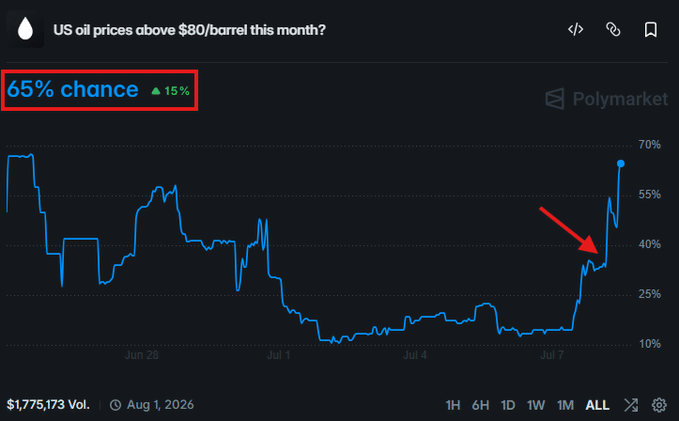
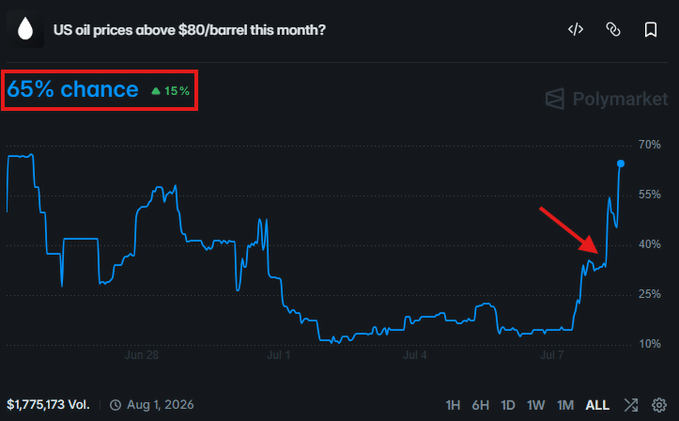
Source: Polymarket

Notably, the shift is already showing up across macro data.

According to FedWatch, the probability of a rate hike at the upcoming FOMC meeting has climbed to 29.4%, marking the highest pricing in over a month. The move suggests markets are beginning to price in a more hawkish Fed as higher oil prices fuel fresh inflation concerns.

Naturally, that adds another layer of pressure on Bitcoin [BTC]. On-chain data already shows that 50% of the BTC supply is now underwater, marking the sharpest decline in months. With market sentiment already fragile, any further macro shock could quickly accelerate downside volatility, triggering market-wide capitulation.

Against this backdrop, the seasonal setup between gold and BTC is back in focus. Historically, both assets have performed well in July, putting the BTC/XAU ratio at the center of attention. If macro FUD continues to build, the ratio could offer an early read on whether capital continues rotating into Bitcoin or shifts back toward gold as the preferred hedge.

Bitcoin/Gold ratio emerges as July’s most important macro signal

The ongoing macro volatility is what sets this cycle apart.

The setup is fairly simple. Historically, both Bitcoin and gold tend to outperform in July. This time, though, the backdrop is quite different. Renewed geopolitical tensions have brought rate-hike expectations back into focus, forcing investors to choose between risk and safety rather than chasing both.

As the chart below shows, Bitcoin has posted strong July returns even during weaker market cycles. In 2018 and 2022, BTC rallied 20% and 17%, respectively. With BTC entering this July after bouncing from its $57k cycle low, seasonality continues to favor the bulls. The key takeaway? Gold is showing a similar pattern.
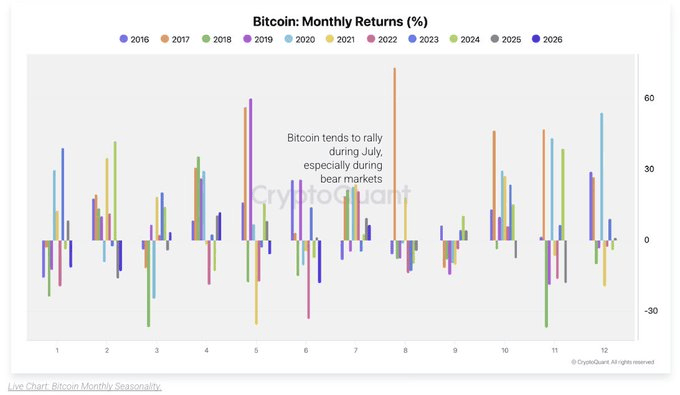
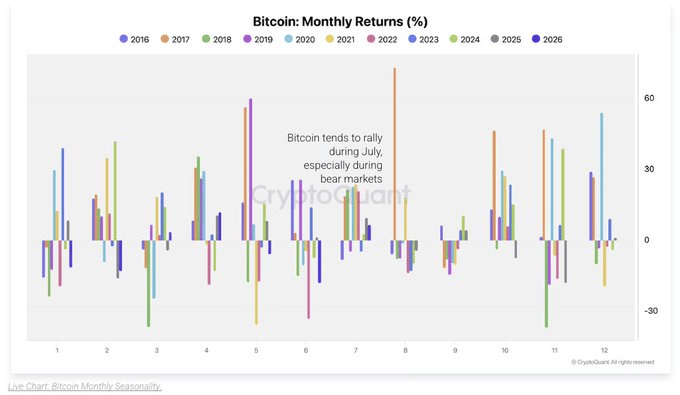
Source: CryptoQuant

According to the Kobeissi Letter, gold has averaged a 1.5% gain in July over the past 20 years, making it its second-strongest month of the year. With both assets entering a historically strong month, the BTC/XAU ratio naturally becomes the metric to watch. So far, the flows still favor Bitcoin.

From the technical standpoint, the BTC/XAU ratio is already up more than 4.5% this month, showing BTC continues to outperform gold despite the return of macro volatility.

The question now is whether that trend can continue. If geopolitical tensions keep driving oil higher and rate-hike expectations continue to build, the balance could quickly shift back toward gold, making the BTC/XAU ratio one of the clearest gauges of capital rotation this month.


Final Summary

  • The BTC/XAU ratio is up over 4.5% this month, showing Bitcoin is still outperforming gold despite rising macro uncertainty.
  • If macro risks continue to build, the BTC/XAU ratio could reveal whether capital stays in Bitcoin or rotates back into gold.


Trending Cryptos

Related Questions

QAccording to the article, what is the primary reason the BTC/XAU ratio is considered a key metric to watch in July?

ABecause both Bitcoin and gold historically perform well in July, and with rising macro volatility and geopolitical tensions, the ratio can indicate whether capital is rotating into the higher-risk hedge (Bitcoin) or the traditional safe-haven asset (gold).

QWhat specific geopolitical event triggered increased market volatility at the start of July as mentioned in the article?

AThe collapse of the U.S.-Iran ceasefire on July 8th, which caused Bitcoin to drop and oil prices to surge.

QHow has the probability of a Fed rate hike changed according to FedWatch data cited in the article?

AThe probability of a rate hike at the upcoming FOMC meeting has climbed to 29.4%, the highest level in over a month.

QWhat does the article state about the performance of the BTC/XAU ratio at the time of writing?

AThe BTC/XAU ratio is up more than 4.5% for the month, indicating that Bitcoin is still outperforming gold despite the macro uncertainty.

QBased on the Kobeissi Letter data referenced, how has gold historically performed in the month of July?

AGold has averaged a 1.5% gain in July over the past 20 years, making it its second-strongest month of the year.

Related Reads

Beyond Private Keys: From Wallets and L2 to Supply Chains, How to Guard the Security Perimeter of Web3?

Beyond Private Keys: Securing Web3's Expanding Attack Surface from Wallets to L2s and Supply Chains The crypto space faced a wave of security incidents in June, with over $75 million lost across 40 major attacks. These breaches highlighted risks beyond private key theft, exposing vulnerabilities across the entire user interaction chain. Wallet security was compromised not through stolen seed phrases, but via a critical flaw in the Cardano wallet SecondFi's signing implementation. This bug allowed attackers to potentially derive private keys from publicly visible signature data, emphasizing that wallet security depends on correct cryptographic implementation, ideally in open-source, auditable code. Layer-2 networks also revealed complex trust chain risks. Attacks on legacy Aztec deployments exploited inconsistencies in proof systems, showing that a valid zero-knowledge proof is only as secure as its underlying rules. Another attack on Taiko's SGX-based prover stemmed from a leaked signing key and inadequate verification checks. Furthermore, a technical glitch halted Base's block production, underscoring that L2 security encompasses network availability and reliable user exit paths as much as asset safety. Finally, the Polymarket incident demonstrated that even audited smart contracts are not immune. A compromised third-party supplier led to a malicious script being injected into the platform's frontend, resulting in user fund losses. This "supply chain attack" shows that the security of the entire interaction path—from the webpage to the wallet signature—is critical. The conclusion is clear: Web3 security now involves safeguarding the entire journey from transaction intent to on-chain settlement. Users must adopt layered security habits: isolating long-term holdings, using dedicated wallets for daily interactions, scrutinizing transaction details before signing, and managing authorizations cautiously. Defense must evolve from protecting a single point (the private key) to securing a complete chain of interactions.

marsbit30m ago

Beyond Private Keys: From Wallets and L2 to Supply Chains, How to Guard the Security Perimeter of Web3?

marsbit30m ago

Robinhood Chain Goes Viral in One Week: Memes Drive Traffic, Stablecoins Support TVL

Robinhood Chain, an Arbitrum-based Layer 2 network launched on July 1st, experienced explosive growth in its first week. While meme coin hype drove user activity, stablecoin deposits fueled its surge in Total Value Locked (TVL). The chain's rapid adoption was driven by multiple factors. CEO Vlad Tenev reversed his initial stance, endorsing the chain for meme coins despite its original focus on Real-World Assets (RWA). The integration of the popular Solana-based launchpad Pump.fun significantly lowered the barrier for meme trading. Furthermore, the prediction market application World announced a migration from Solana to Robinhood Chain. Meme coin mania, led by tokens like CASHCAT, generated massive trading volume, with daily active addresses skyrocketing from near zero to hundreds of thousands. However, the primary driver of the chain's TVL, which soared past $234 million, was a major institutional deposit. Ethena injected approximately $50 million in stablecoins into the Morpho lending protocol, which underpins Robinhood's Earn product, accounting for the bulk of locked value. This highlights two concurrent narratives: retail-driven meme speculation boosting transactions, and institutional stablecoin deposits building foundational liquidity. In contrast, the chain's flagship RWA offerings, like tokenized stocks, remain a minor part of the ecosystem at around $12.8 million. The first week demonstrates a path where speculative trading and yield-seeking capital provide initial momentum, while the core RWA vision is still in early development.

Foresight News1h ago

Robinhood Chain Goes Viral in One Week: Memes Drive Traffic, Stablecoins Support TVL

Foresight News1h ago

The Illusion of a Prodigy

The Illusion of the "Genius Youth" The article discusses the recent interview incident involving Li Bojie, a former "Huawei Genius Youth," and AI company DeepSeek. It highlights the core conflict not as a simple case of suspected cheating during a coding test, but as a profound mismatch in expectations. Li, with an impressive background including entrepreneurship, a role at Huawei, and a position as a chief scientist, was deeply affected by a standard remote interview where the interviewer questioned his actions. The key point is his stated view of DeepSeek as the "pinnacle of the Chinese tech world." For him, the interview was a quest for identity validation—proof he belonged at the center of the new AI era. For DeepSeek, it was a routine skills assessment. The article argues that Li, while publicly rejecting the "genius" label, subconsciously expected to be treated as a peer for discussion, a courtesy extended by other companies like MiniMax and Xiaomi. DeepSeek, however, adhered strictly to its standardized process, prioritizing consistent, merit-based evaluation over individual prestige. This clash symbolizes a larger shift in the tech industry. The core thesis is that the AI era is dismantling the old system where past titles, companies, and accumulated experience guaranteed status. Now, with rapid knowledge obsolescence, "excellence is calculated in real-time." Li's anxiety—waiting weeks for the DeepSeek interview despite other offers—stems from the fear that rejection means being left behind by technological progress. The article concludes that this incident is a harbinger; soon, everyone will face a constant, implicit "interview" with the AI age itself, asking: "You were excellent yesterday. What about today?"

marsbit1h ago

The Illusion of a Prodigy

marsbit1h ago

Vanguard Group Enters the Arena, Opening a New Crypto Portal for 50 Million Traditional Investors

Vanguard Group, the world's second-largest asset manager with $12 trillion in assets under management and over 50 million investors, has signaled a significant strategic shift by posting a job opening for a "Head of Digital Assets, Personal Wealth." The role entails developing a comprehensive digital asset strategy, establishing long-term plans, and overseeing the full integration of digital assets into Vanguard's wealth management platform, covering areas like custody, settlement, asset tokenization, and stablecoins. This move marks a notable reversal from the firm's previous stance. In 2024, Vanguard refused to list spot Bitcoin ETFs and removed Bitcoin futures products. By late 2025, it allowed some third-party crypto ETF trading but reiterated it would not create its own crypto funds. The new hire represents a third step: building an internal team to integrate digital assets into its core infrastructure, moving beyond merely listing products. The initiative focuses on foundational financial infrastructure—how tokenized assets and digital settlement systems can connect to Vanguard's existing platform, which primarily serves long-term, conservative investors. While Vanguard maintains it will not launch proprietary crypto ETFs, it is proactively preparing its systems for a future involving tokenized assets and stablecoins, which Citigroup projects could reach a $5.5 trillion market by 2030. Vanguard's scale means its chosen standards for custody, settlement, and compliance could set de facto rules for the broader wealth management industry. The firm is acting despite regulatory uncertainty and cautious market sentiment (e.g., Citi recently lowered crypto price targets). Analysts suggest even a minimal 0.01% allocation from Vanguard's asset base would bring ~$12 billion into digital assets, forcing the development of robust risk and operational frameworks. Ultimately, Vanguard's focus is on building the plumbing for digital assets to potentially serve its vast client base, an effort whose impact may extend far beyond any single market cycle.

Foresight News1h ago

Vanguard Group Enters the Arena, Opening a New Crypto Portal for 50 Million Traditional Investors

Foresight News1h ago

Trading

Spot

Hot Articles

What is $BITCOIN

DIGITAL GOLD ($BITCOIN): A Comprehensive Analysis Introduction to DIGITAL GOLD ($BITCOIN) DIGITAL GOLD ($BITCOIN) is a blockchain-based project operating on the Solana network, which aims to combine the characteristics of traditional precious metals with the innovation of decentralized technologies. While it shares a name with Bitcoin, often referred to as “digital gold” due to its perception as a store of value, DIGITAL GOLD is a separate token designed to create a unique ecosystem within the Web3 landscape. Its goal is to position itself as a viable alternative digital asset, although specifics regarding its applications and functionalities are still developing. What is DIGITAL GOLD ($BITCOIN)? DIGITAL GOLD ($BITCOIN) is a cryptocurrency token explicitly designed for use on the Solana blockchain. In contrast to Bitcoin, which provides a widely recognized value storage role, this token appears to focus on broader applications and characteristics. Notable aspects include: Blockchain Infrastructure: The token is built on the Solana blockchain, known for its capacity to handle high-speed and low-cost transactions. Supply Dynamics: DIGITAL GOLD has a maximum supply capped at 100 quadrillion tokens (100P $BITCOIN), although details regarding its circulating supply are currently undisclosed. Utility: While precise functionalities are not explicitly outlined, there are indications that the token could be utilized for various applications, potentially involving decentralized applications (dApps) or asset tokenization strategies. Who is the Creator of DIGITAL GOLD ($BITCOIN)? At present, the identity of the creators and development team behind DIGITAL GOLD ($BITCOIN) remains unknown. This situation is typical among many innovative projects within the blockchain space, particularly those aligning with decentralized finance and meme coin phenomena. While such anonymity may foster a community-driven culture, it intensifies concerns about governance and accountability. Who are the Investors of DIGITAL GOLD ($BITCOIN)? The available information indicates that DIGITAL GOLD ($BITCOIN) does not have any known institutional backers or prominent venture capital investments. The project seems to operate on a peer-to-peer model focused on community support and adoption rather than traditional funding routes. Its activity and liquidity are primarily situated on decentralized exchanges (DEXs), such as PumpSwap, rather than established centralized trading platforms, further highlighting its grassroots approach. How DIGITAL GOLD ($BITCOIN) Works The operational mechanics of DIGITAL GOLD ($BITCOIN) can be elaborated on based on its blockchain design and network attributes: Consensus Mechanism: By leveraging Solana’s unique proof-of-history (PoH) combined with a proof-of-stake (PoS) model, the project ensures efficient transaction validation contributing to the network's high performance. Tokenomics: While specific deflationary mechanisms have not been extensively detailed, the vast maximum token supply implies that it may cater to microtransactions or niche use cases that are still to be defined. Interoperability: There exists the potential for integration with Solana’s broader ecosystem, including various decentralized finance (DeFi) platforms. However, the details regarding specific integrations remain unspecified. Timeline of Key Events Here is a timeline that highlights significant milestones concerning DIGITAL GOLD ($BITCOIN): 2023: The initial deployment of the token occurs on the Solana blockchain, marked by its contract address. 2024: DIGITAL GOLD gains visibility as it becomes available for trading on decentralized exchanges like PumpSwap, allowing users to trade it against SOL. 2025: The project witnesses sporadic trading activity and potential interest in community-led engagements, although no noteworthy partnerships or technical advancements have been documented as of yet. Critical Analysis Strengths Scalability: The underlying Solana infrastructure supports high transaction volumes, which could enhance the utility of $BITCOIN in various transaction scenarios. Accessibility: The potential low trading price per token could attract retail investors, facilitating wider participation due to fractional ownership opportunities. Risks Lack of Transparency: The absence of publicly known backers, developers, or an audit process may yield skepticism regarding the project's sustainability and trustworthiness. Market Volatility: The trading activity is heavily reliant on speculative behavior, which can result in significant price volatility and uncertainty for investors. Conclusion DIGITAL GOLD ($BITCOIN) emerges as an intriguing yet ambiguous project within the rapidly evolving Solana ecosystem. While it attempts to leverage the “digital gold” narrative, its departure from Bitcoin's established role as a store of value underscores the need for a clearer differentiation of its intended utility and governance structure. Future acceptance and adoption will likely depend on addressing the current opacity and defining its operational and economic strategies more explicitly. Note: This report encompasses synthesised information available as of October 2023, and developments may have transpired beyond the research period.

685 Total ViewsPublished 2025.05.13Updated 2025.05.13

What is $BITCOIN

Discussions

Welcome to the HTX Community. Here, you can stay informed about the latest platform developments and gain access to professional market insights. Users' opinions on the price of BTC (BTC) are presented below.

活动图片