Will the CLARITY Act miss out on approval? ‘The window continues to narrow each day’

ambcryptoPublished on 2026-06-28Last updated on 2026-06-28

Abstract

Galaxy Research has downgraded the odds of the CLARITY Act passing to 50/50 (neutral), citing a narrowing legislative window. The bill passed a Senate committee vote in May but faces a crowded Senate calendar, intensified by President Trump's demand to prioritize another bill. Key obstacles remain, including the need to reconcile different Senate committee versions into a final text and resolve contentious issues like stablecoin yields and developer protections (Section 604). With the Senate scheduled for a two-week July recess and an August break starting in early August, there are roughly four weeks for progress. No final bill text or floor vote date has been set, increasing urgency. Advocates warn the opportunity is shrinking daily.

Galaxy Research has reviewed its CLARITY Act outlook downwards from 60% to 50/50 (neutral).

According to Alex Thorn, head of research at Galaxy, the tight Senate calendar following recent President Donald Trump’s stance on a separate, unrelated bill was the main reason for the downgrade.

President Trump said Wednesday he won’t sign a housing bill unless Congress passes the SAVE Act, intensifying competition for scarce Senate floor time, and thereby hurting the CLARITY Act’s odds.

AD

After passing the Senate Banking Committee vote last May, the bill cleared a key hurdle to proceed to the Senate floor vote.

However, before that, both the bill’s versions from the Senate Banking and Agriculture committees must be reconciled into a single piece of legislation.

On a positive note, Galaxy noted there was some ‘constructive’ progress on the reconciliation efforts.

Reconciliation of the Banking and Agriculture committee texts continues at the staff level, and there are some indications that constructive negotiations continue.

However, Thorn cautioned that,

But there has been no public announcement that Banking and Agriculture have agreed on a combined bill, no release of unified legislative text, and no signal on timing for floor consideration.

He added that the sticky issues, such as stablecoin yield, ethics provision, and Section 604 (developer protections), remained largely unaddressed.

Less than four weeks to pass the CLARITY Act

That said, the Senate will take a two-week break after the 4th of July. They’ll resume on the 13th of July.

Notably, the August recess will begin on the second week of the 10th, leaving about four weeks of Senate calendar for active sessions.
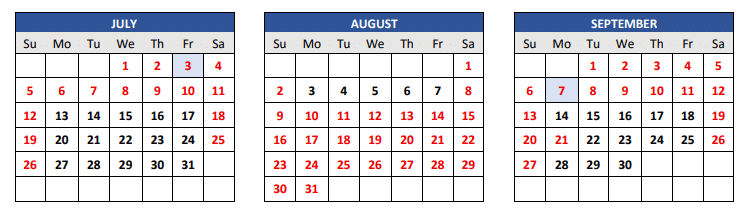
Source: Senate Calendar 2026 (red dates mean the Senate is not in session)

So, what exactly is the issue and path forward for the bill?

The main problem is that no scheduled floor vote date has been issued. Besides, the final text of the bill has not been made public. The final text of the bill is speculated to be released in early July.

In fact, Stand With Crypto, a lobby group affiliated with Coinbase, also echoed the urgency and reinforced Thorn’s concerns.

The Senate going on recess without voting means the Clarity Act doesn’t disappear, but it slips. The Senate has a crowded calendar, and the window for Clarity continues to narrow each day.

That said, on the contentious Section 604, Ark Invest’s Cathie Wood backed a “thoughtful, nuanced” approach that does not push the market overseas again.
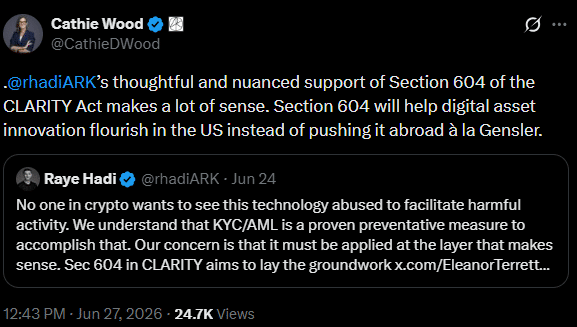
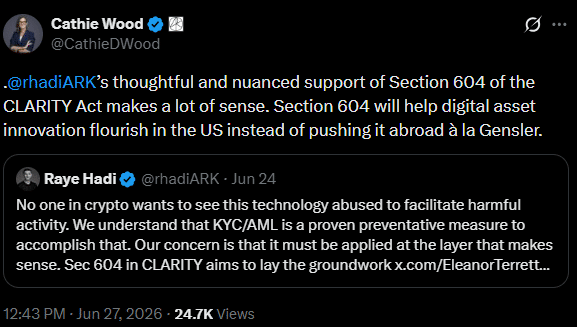
Source: X

Overall, the bill may hit a wall if the next four weeks don’t present material progress on key issues and the Senate floor vote date.


Final Summary

  • Galaxy reduced its CLARITY Act passage chance from 60% to 50%.
  • Cathie Wood backed the contentious Section 604 but asked for a ‘thoughtful, nuanced’ application.


Related Questions

QWhy did Galaxy Research lower the CLARITY Act passage probability from 60% to 50%?

AGalaxy Research lowered the probability primarily due to the tight Senate calendar following President Donald Trump's stance on a separate, unrelated bill (the SAVE Act), which intensifies competition for scarce Senate floor time.

QWhat key issues remain unaddressed in the CLARITY Act, according to the article?

AThe key issues that remain largely unaddressed are stablecoin yield, ethics provisions, and the contentious Section 604 regarding developer protections.

QHow many weeks of active Senate sessions are left before the August recess to pass the CLARITY Act?

AThere are about four weeks of active Senate sessions left before the August recess begins on the second week of the 10th.

QWhat two things must happen before the CLARITY Act can proceed to a Senate floor vote?

ABefore a Senate floor vote, the bill's versions from the Senate Banking and Agriculture committees must be reconciled into a single piece of legislation, and then a scheduled floor vote date must be issued.

QWhat is Stand With Crypto's main concern regarding the CLARITY Act's timeline?

AStand With Crypto is concerned that the Senate's crowded calendar means the window of opportunity for the CLARITY Act to pass continues to narrow each day.

Related Reads

SpaceX Faces Heavy Selling After IPO Followed by Massive Bond Issue 'Angers' the Market

Following a record-breaking IPO, SpaceX's massive $25 billion bond issuance faced fierce selling pressure in the secondary market. The aggressive financing pace of the long-unprofitable rocket and AI company quickly backfired, eroding investor confidence and causing its bond spreads to widen sharply, nearing speculative-grade ("junk") levels. Within 48 hours of pricing, SpaceX's bonds plummeted. The 10-year bond yield rose to nearly 6%, with its spread over US Treasuries widening to over 160 basis points (bps). Longer-dated bonds saw spreads surge to 193 bps and 201 bps, significantly worse than the average spread for BB-rated junk bonds at 167 bps. This rapid deterioration shocked fixed-income traders. Initial strong demand, with nearly $90 billion in orders, was driven largely by short-term speculative "fast money" rather than traditional buy-and-hold investors. When these funds sought quick profits, heavy selling ensued. Analysts describe a "perfect storm" caused by SpaceX's post-IPO market cap decline, technical selling pressure from the enlarged deal size, and investor uncertainty in pricing its unique risk profile. The core concern for bond investors is SpaceX's fundamentals: while it reported $18.7 billion in 2025 revenue, it posted a net loss of $4.9 billion. Creditors focus on actual cash flow for debt repayment, not future growth expectations tied to AI. Heavy reliance on CEO Elon Musk's leadership and weak corporate governance were also cited as key credit weaknesses. The selloff highlights broader systemic risks as tech giants embark on a massive debt spree to fund AI projects. AI-related debt issuance has soared 357% year-to-date. This supply surge is increasing sector leverage and putting pressure on credit spreads across the market, potentially threatening the tech capital expenditure cycle if the pace continues.

marsbit1h ago

SpaceX Faces Heavy Selling After IPO Followed by Massive Bond Issue 'Angers' the Market

marsbit1h ago

Metrics Ventures Market Observation: The World's Fragility is Rapidly Accumulating

Metrics Ventures' market observation highlights the rapid accumulation of global fragility. Since 2022, persistent supply chain disruptions have progressively eroded the economic resilience and policy autonomy of nations like Japan, South Korea, and Europe, building momentum for potential future capital market shocks. Market trends reveal a liquidity drought across most sectors except AI and specific commodities. Vulnerable economies are increasingly doubling down on concentrated trades—a risky strategy unlikely to succeed in the current geopolitical climate. For cryptocurrency markets, these global pressures have formed a significant overhang since late last year, raising the unprecedented need to evaluate the possibility of MSTR liquidating part of its BTC holdings. Furthermore, the appeal of BTC as a short-side hedge against other assets is growing, presenting a challenging medium-term outlook. Technically, key markets are at critical junctures: Japanese and Korean equities face major resistance, the US Dollar Index has broken past a year-long ceiling, and the US 2-Year Treasury yield shows an upward trend. A potential sudden liquidity contraction could trigger algorithm-driven sell-offs from leveraged funds, amplifying global volatility. While precious metals like gold and silver may face short-term pressure, such a shakeout could precede a major rally. For Bitcoin, a deeper-than-expected correction is a plausible scenario within this risk-release cycle. Despite unforeseen events like the Hormuz situation shaping H2, this period of elevated risk also presents significant opportunities.

marsbit1h ago

Metrics Ventures Market Observation: The World's Fragility is Rapidly Accumulating

marsbit1h ago

Trading

Spot
活动图片