Author: Max.S
Original Title: Don't Let OpenClaw Steal Your Independent Thinking: A Psychological Disaster Prevention Manual for Web3 People
Recently, most circles, including Web3, have been taken over by the "Red Lobster." Opening Twitter or diving into various communities, various AI Agents similar to Claw have exploded, promoting "letting AI autonomously take over the computer to work," which has truly impressed many and made even more people feel a sense of unease.
In a world where industries are extremely competitive, faced with overwhelming AI information and tools, many practitioners do not feel the relief brought by tool upgrades. Instead, it's like "drinking seawater"—the more they consume vast amounts of AI information and tools, the more lost, suffocated, and anxious they feel.
As AI developer @yetone bluntly stated on social media: "I am extremely disgusted by FOMO, which has already plunged the entire society into a massive bipolar disorder: either extremely euphoric, believing humans have become gods; or extremely depressed, feeling that humanity is dead."
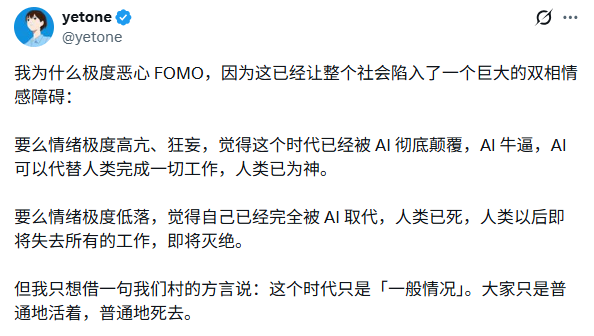
We are now at the center of this "manic episode" storm. AI anxiety is no longer exclusive to programmers or tech giants; it has become a widespread psychological issue in the digital society. I will attempt to delve into the psychological roots behind the狂热 phenomenon of "the entire internet raising lobsters" and propose a set of "counter-consensus" coping strategies.
Decision Fatigue: "Copying Homework" to Avoid Thinking
Why do people so easily hand over sensitive permissions of many software to an unknown AI Agent? This is not merely technical enthusiasm but更像 a collapse of collective psychological defense mechanisms.
The modern human brain is already overloaded. Globalization and 24/7 digital life keep us under high-pressure, fast-paced information bombardment every day, causing severe "ego depletion" in the brain. Faced with endless new technologies, concepts, and workplace demands, our decision-making abilities are already exhausted.
Decision fatigue in psychology perfectly explains this. When a tool like OpenClaw, which claims to "handle everything," appears, it is like the last straw for a drowning person. Many people follow the trend to deploy it not to solve actual work problems but to avoid thinking.
"If others install it, I'll install it too"—isn't this just "copying homework"? It's worry-free and requires no brainpower. But this behavior, using "tactical diligence" to掩盖 "strategic laziness,"反而加剧es deep-seated anxiety—watching the computer run, the tools operate, but the brain completely "crashes" due to information overload.
Group Identity and Pathological FOMO: The Backlash of Tribal Genes
Humans are social animals. The ancient gene of "following the tribe for safety" is infinitely amplified in Web3 community culture. When your朋友圈, WeChat groups, and even various communities are all posting screenshots of deploying AI Agents, FOMO is no longer just a desire for wealth but a fear of "social death."
What you are truly anxious about may not be "will AI take my job?" but "if I don't follow the trend, I will be labeled as outdated and excluded from the current circle." This herd mentality, sacrificing rationality for "group security," turns the entire society into a massive echo chamber, infinitely amplifying the panic brought by uncertainty.
Additionally, AI Agents (like OpenClaw) are essentially huge "black boxes." What is their decision-making basis? We根本无法完全理解其内部逻辑.
When you try to use a highly centralized, unexplainable AI black box to handle your most sensitive personal assets, private data, and career decisions, a strong cognitive dissonance arises.
This psychological撕裂, caused by the冲击 of our底层信仰 in life control, directly打击s our self-efficacy.随之而来的是真实的安全噩梦: privacy leaks, sky-high bills,甚至系统被黑客控制. These real threats make anxiety彻底具象化.
AI anxiety is a physiological discomfort brought by technological development. We cannot eliminate it completely but can learn to驾驭 it. We need to establish a scientific defense and counterattack mechanism from three aspects: cognition, behavior, and self-positioning.

Faced with狂热, the most effective psychological intervention is to force yourself to calm down.
24–48 Hour Cooling-Off Period: When the next "Lobster"-level application floods your screen, don't immediately open the terminal to type code. Force yourself to stop and cool off for 24 to 48 hours. Ask yourself a soul-searching question: If no one on social media posted about this, would I still use it?
Break the Information Cocoon, Actively Seek FUD: Algorithms always push content that makes you FOMO. You need to actively search for "vulnerabilities," "complaints," and "security risks" of this AI product. Use rational FUD (Fear, Uncertainty, Doubt) to对抗 blind group excitement and regain control of independent thinking.
Instead of mutually infecting anxiety in group chats, it's better to directly seek answers from the source of anxiety.
Treat AI as a Psychological疏导 and Collaboration Partner: In this technological transformation, a Web3 community builder set a great example. While group members were疯狂 deploying AI, he directly asked AI: "What should I do about AI anxiety?" AI's response was very objective: "Maintain your own pace, trust your own judgment." This interaction of "using magic to defeat magic" not only breaks the mysterious and lofty filter of AI but also subconsciously establishes the psychological positioning of "I am the leader, AI is the assistant."
Small Steps, Fast Iterations, Reject Grand Narratives: Don't try to understand the underlying logic of all large models. Break down your workflow and find the smallest pain points. For example, only let AI help you summarize long reports or write a simple smart contract test case. Through small but certain successes, gradually rebuild your self-efficacy in the AI era.
Redefining Personal Moat: From "Knowing Prompt" to "Knowing How to Build Trust"
This is the core strategy to alleviate the threat of job replacement. Shift your focus from "what AI can do" to "what AI cannot do."
Deepen "Human Soft Skills" That AI Cannot Calculate: AI can instantly write tens of thousands of words of project analysis, but it cannot安抚 team emotions in a crisis; it cannot build trust through a glance at an offline gathering; it更无法 make judgments based on human morality and intuition for highly controversial business decisions. Emotional intelligence, empathy, complex interpersonal coordination, and political博弈 will be the ultimate, unassailable advantages of modern practitioners.
In terms of cognitive flexibility, we need to lengthen the historical cycle and jump out of the immediate 15-minute视野. Use a broader historical perspective to dilute the current cognitive overload. History tells us that looking back at the era when steam engines or electricity were first普及, it was also accompanied by extreme panic and bubbles. Technology is indeed reshaping productivity, but extreme二元论 like "humanity is dead" or "humanity has become gods" is just the noise of the times. Only when the bubble bursts will the killer applications truly land.

The Best Trend Is to Be Yourself
At this historical turning point where "software moves from scarcity to surplus," cognitive overload and近乎狂躁的社会情绪 are the growing pains of the era. But remember, blindly following the trend to deploy a red lobster will not make you a pioneer of the times; it will only make you a "肉鸡" (bot) providing computing power and data.
AI is the lever of the era, but the fulcrum is always your own independent judgment and core mentality. Next time anxiety surges in like seawater, try turning off the screen, take a deep breath, and tell yourself: More important than not falling behind the times is not losing yourself.
As an author from the Web3 industry, I have experienced more deeply than anyone this extreme insecurity torn between FUD and FOMO. In a world where "code is law," we understand better than anyone the cost of "Don't Trust, Verify." The cognitive dissonance brought by AI appears格外尖锐 under Web3's "trustless"信仰.
Therefore, I want to say to my peers even more: Surviving in a competitive market and maintaining a healthy psychological state is more important than catching every fleeting AI wave. Shift your focus from "AI will replace me" to "what trust crises does AI bring?" Solving these crises is our moat in the Web3 world.
Twitter:https://twitter.com/BitpushNewsCN
Bitpush TG Discussion Group:https://t.me/BitPushCommunity
Bitpush TG Subscription: https://t.me/bitpush