All about CleanSpark’s addition of 454 Bitcoin and what it means

ambcryptoPublished on 2026-07-11Last updated on 2026-07-11

Abstract

CleanSpark, a publicly traded company, added 454 Bitcoin to its holdings, bringing its total treasury to 13,924 BTC worth $897.1 million. In 2026, it has sold 258 BTC while adding 1,171 BTC. The news follows a 28% rise in its stock price this year. Other major firms also increased their Bitcoin reserves in June and July. Public companies collectively added nearly 9,000 BTC in June, led by purchases from Strategy and Strive. Notable buyers included DDC Enterprise, MARA Holdings, and CIMG. In July, Strive, American Bitcoin Corp., Boyaa Interactive, and OranjeBTC also expanded their holdings. However, Strategy, the world's largest Bitcoin holder, sold 3,588 BTC for approximately $216 million, citing active balance sheet management rather than a bearish outlook. Meanwhile, Bitcoin ETFs saw net inflows of $35.4 million in July. Overall, corporate Bitcoin accumulation remains strong, with CleanSpark among the key players.

CleanSpark, a publicly traded company, is in the news after adding another 454 Bitcoin [BTC] to its treasury. This addition has pushed its total stash to 13,924 BTC, worth $897.1 million.

In 2026, CleanSpark has sold 258 BTC and added 1171 BTC.

Its latest move came as CleanSpark’s stock price was trading at $12.89 at press time. The same has risen by about 28% in the year so far. For its part, Bitcoin was trading at $64,411.66 at the same time, on the back of a 42% decline this year.

As it stands, the Governor and Executive Council of New Hampshire are reviewing a proposal that would permit a borrower connected to CleanSpark to purchase Bitcoin with up to $100 million in taxable revenue bonds.

CleanSpark is not the only company to add Bitcoin to its treasury recently though.

Purchases in the months of June and July by other firms

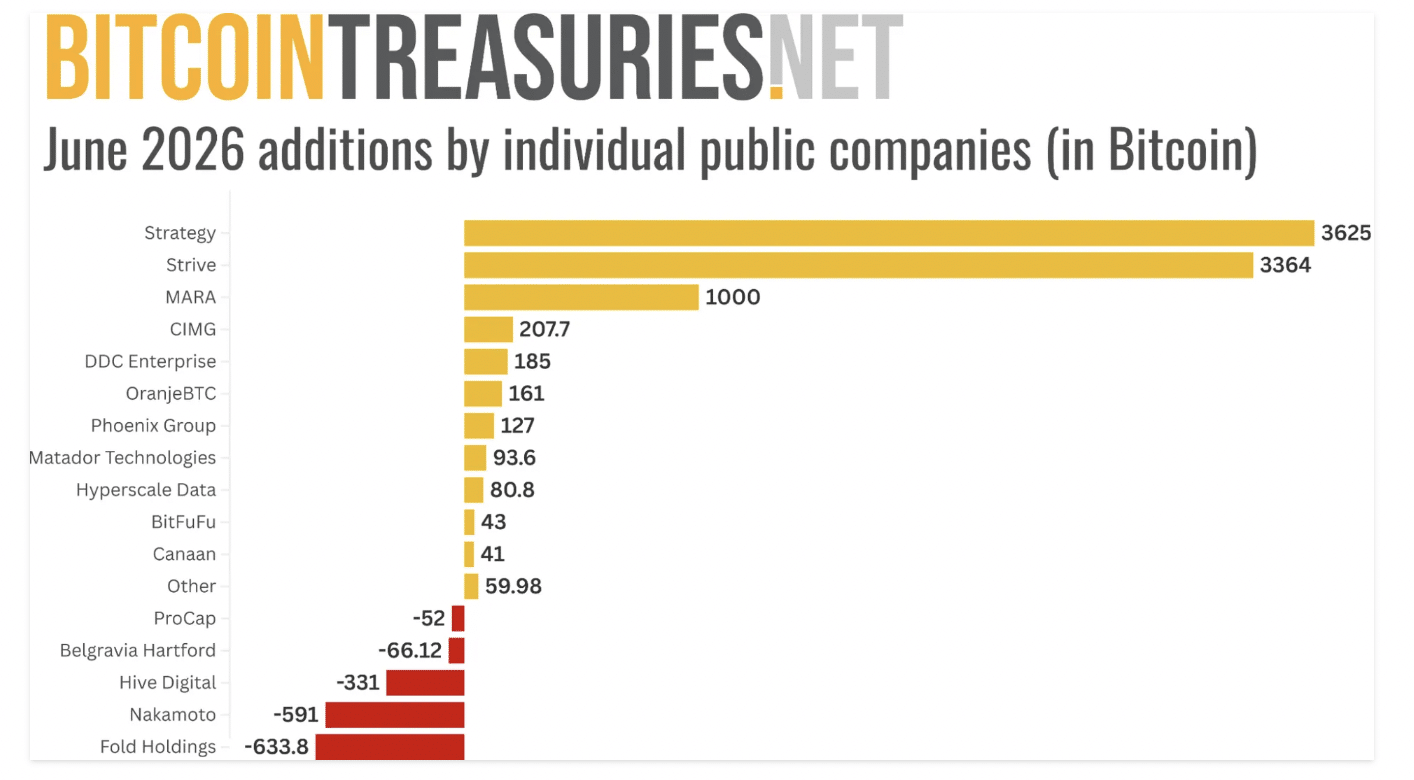
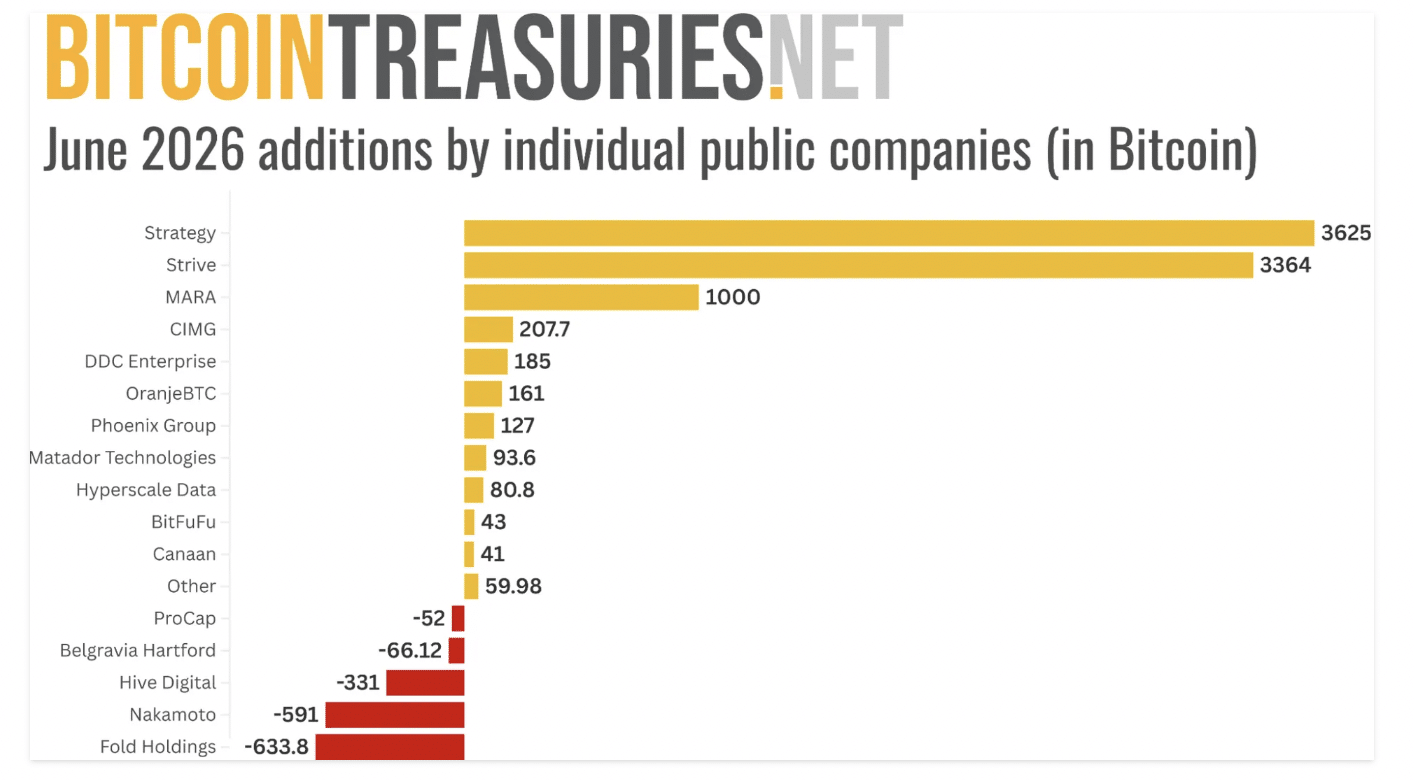
In June, public companies added almost 9,000 Bitcoin worth approximately $525 million. The majority of this accumulation was made up of nearly 7,000 BTC from Strategy and Strive, respectively.

It is probable that both businesses used the proceeds from their digital credit instruments, SATA and STRC, to finance their acquisitions. While Strive bought 3,364 BTC, including a single 2,500 BTC purchase that was one of its largest to date, Strategy led the month with a net addition of 3,625 BTC despite selling 32 BTC.
Source: BitcoinTreasuries.NET

Other noteworthy buyers included DDC Enterprise, which bought 185 BTC in two different transactions. MARA Holdings with a contribution of 1,000 BTC followed suit. So did CIMG after it bought 207.7 BTC in a $13.5 million stock-and-warrant transaction that was fully settled in Bitcoin.

Additionally, Strive also increased its Bitcoin purchase by 18 BTC in July, bringing it to 19,882 BTC. Meanwhile, American Bitcoin Corp. accumulated 500 BTC, pushing the total value to $514.5 million or 8,000 BTC. Boyaa Interactive International Limited also added 108 Bitcoin to its total, worth $270.3 million. Finally, OranjeBTC increased its total stash by 5 BTC to 3,904 BTC.

The plot twist

Here, it’s worth noting that the world’s largest Bitcoin DAT, Strategy, sold 3,588 Bitcoin for about $216 million. After the transaction, Strategy had 843,775 BTC.

Even though the majority of publicly traded companies kept buying Bitcoin, Strategy decided to take a different tack and sold 3,588 BTC for roughly $216 million. Now, this does not imply a pessimistic view of Bitcoin. The company’s new treasury framework, which enables it to actively manage its balance sheet and create liquidity when required, was used to finance the sale instead.

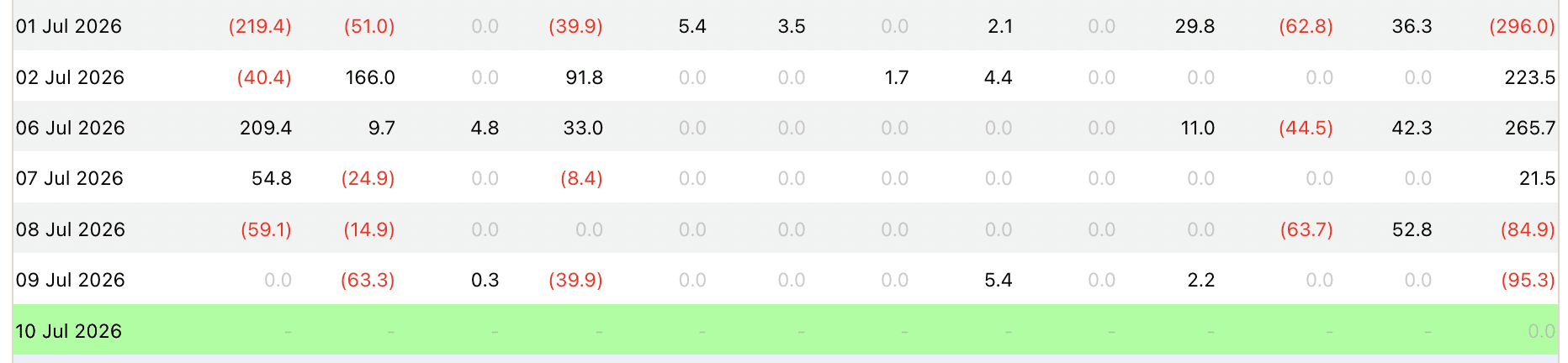
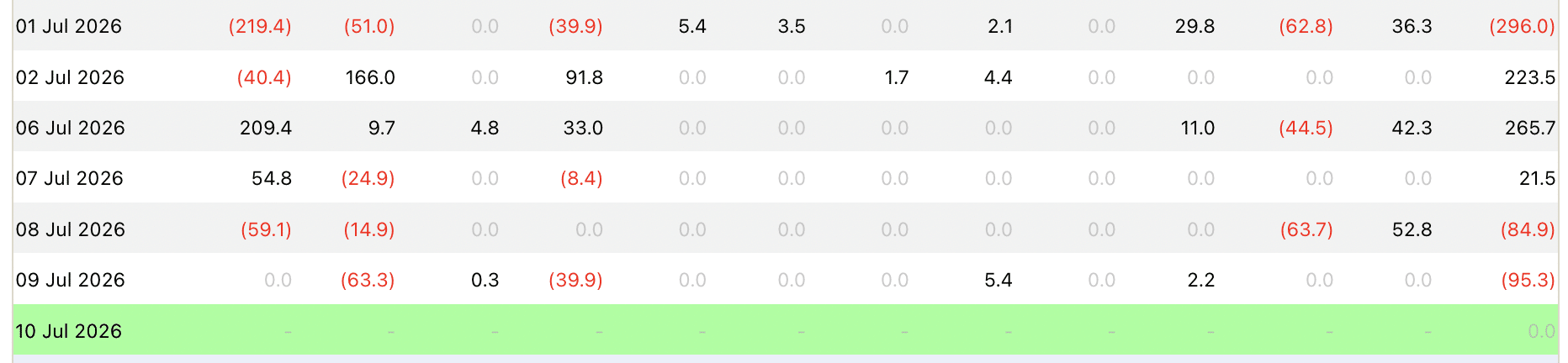
Outside of the consistent additions of Bitcoin to treasuries, BTC ETFs also saw $510.7 million in inflows and $475.3 million in outflows in July.
Source: Farside Investors

Final Summary

  • CleanSpark added 454 BTC while its stock price action highlighted positive momentum.
  • It was just one of the many firms to buy more Bitcoin over the past month.

Trending Cryptos

Related Questions

QWhat was the total value of CleanSpark's Bitcoin holdings after its latest addition, and how many BTC does the company now hold?

AAfter adding 454 Bitcoin, CleanSpark now holds 13,924 BTC, which are worth $897.1 million.

QAccording to the article, how much Bitcoin did public companies collectively add in June, and which two firms were the primary contributors?

APublic companies added nearly 9,000 Bitcoin worth approximately $525 million in June. The majority of this accumulation came from Strategy (a net addition of 3,625 BTC) and Strive (which bought 3,364 BTC).

QWhat significant sale of Bitcoin did the world's largest Bitcoin DAT, Strategy, make, and what was the stated reason for this sale?

AStrategy sold 3,588 Bitcoin for about $216 million. The company stated this was not due to a pessimistic view of Bitcoin, but was instead part of its new treasury framework to actively manage its balance sheet and create liquidity when required.

QWhat was the net flow (inflows minus outflows) for Bitcoin ETFs in July, as mentioned in the article?

AIn July, Bitcoin ETFs saw $510.7 million in inflows and $475.3 million in outflows, resulting in a net inflow of $35.4 million.

QWhat is the legislative proposal currently under review in New Hampshire that is connected to CleanSpark?

AThe Governor and Executive Council of New Hampshire are reviewing a proposal that would permit a borrower connected to CleanSpark to purchase Bitcoin with up to $100 million in taxable revenue bonds.

Related Reads

From Auto Finance to Bitcoin to AI Engines: An Analysis of Cango's 'What Not to Do' Strategy

From Auto Finance to Bitcoin and Now AI: Cango's "What Not to Do" Strategy Cango, a Chinese auto finance platform that went public on the NYSE in 2018, is undergoing its third major transformation. After selling its entire auto business in 2024, it pivoted to become a large-scale Bitcoin miner, acquiring 50 exahash of mining rigs from Bitmain. However, its true goal was never Bitcoin, but owning and controlling energy infrastructure. Now, Cango is pivoting again. While most listed Bitcoin miners are leasing power to giant hyperscalers for AI training clusters, Cango is taking the opposite path. It has launched an AI inference subsidiary called EcoHash, focusing not on training but on distributed inference. The company's strategy hinges on the insight that over 70% of mining industry power is controlled by small, independent sites (10-50 MW), which are too small for hyperscalers but ideal for low-latency AI inference. Cango aims to partner with these small operators, providing the AI technology, customers, and financing through its EcoLink software layer, which can distribute workloads across sites for reliability. Cango maintains a hybrid model, running roughly 31.7 EH/s of Bitcoin mining for cash flow while aggressively cleaning its balance sheet—slashing long-term debt by 94.5% to $30.6 million and raising $75 million for its AI venture. Its first AI deployment will be at a 50 MW site in Georgia. The strategy faces skepticism, given the high costs of converting mining sites and the potential for an AI bubble. However, Cango's leadership believes discipline around "what not to do"—avoiding direct competition with hyperscalers in training—positions it to capture the long-tail demand for distributed AI inference power.

Foresight News15m ago

From Auto Finance to Bitcoin to AI Engines: An Analysis of Cango's 'What Not to Do' Strategy

Foresight News15m ago

Strategy's Bitcoin Sales Cap Far Exceeds $1.25 Billion: A Detail the Market Overlooked

The article discusses how MicroStrategy's potential Bitcoin sales go far beyond the announced $1.25 billion "reserve-building capacity." It clarifies a key distinction in the company's "BTC Monetization Program": selling Bitcoin to *build* a new dollar reserve (the $1.25B cap) versus selling to *replenish* the existing USD Reserve after it's used for expenses like preferred share dividends. The recent $216M BTC sale for dividend payments was a "replenishment," leaving the headline $1.25B building quota untouched. The plan actually outlines three potential funding pools from BTC sales: 1) Building the reserve ($1.25B cap), 2) Covering preferred share/ debt costs (no specified cap), and 3) Funding buyback programs (up to $20B). This means the structured sales potential exceeds $30 billion, not including uncapped replenishment sales. The piece argues this marks MicroStrategy's shift from a passive "buy-and-hold" Bitcoin proxy to an actively managed entity using BTC as a balance-sheet tool to manage its complex capital structure (common stock, preferred shares, debt, reserve). This creates new dynamics and potential conflicts, as actions benefiting one part (e.g., selling BTC to pay dividends) may pressure another (e.g., undermining the "never sell" narrative). Investors must now parse the company's specific terminology ("build" vs. "replenish") to understand the true scope of future BTC sales, which is significantly larger than the market initially perceived.

marsbit21m ago

Strategy's Bitcoin Sales Cap Far Exceeds $1.25 Billion: A Detail the Market Overlooked

marsbit21m ago

Goldman Sachs Report Deconstructs the Competitive Landscape of China's AI Large Models: Who Will Be the Long-Term Winner?

Goldman Sachs analyzes China's AI large language model (LLM) landscape, identifying key players and a strategic shift towards efficiency and global expansion. The report highlights that Chinese open-source/open-weight models are closing the performance gap with top global proprietary models at significantly lower cost, driven by architectural innovations like MoE. This enables a "two-tier" market: a high-end segment (e.g., GLM5.2, Qwen3.7 Max) with pricing at ~$1 per million tokens, and a low-end, price-sensitive global segment. Open-source strategies aid adoption but limit monetization, as deployments via third-party platforms (e.g., AWS Bedrock, Alibaba Cloud) may not generate direct revenue for model creators. The industry is thus moving towards "open-weight + community license" models with revenue-sharing to improve unit economics. Internationally, the focus is shifting from "token maximization" to ROI-driven enterprise adoption, particularly in non-U.S. markets. Major cloud platforms are integrating Chinese models (e.g., DeepSeek, MiniMax). Using a competitive framework based on pricing power, cost advantage, and financial strength, Goldman Sachs identifies **Zhipu AI** and **DeepSeek** as leaders in foundational text models, and **ByteDance** (with Seedance) leading in multimodal/video generation. **MiniMax** and **Kuaishou** are also rated favorably. The firm forecasts China's AI model API/subscription revenue growing from ~RMB 35bn (2026E) to RMB 879bn by 2030.

marsbit21m ago

Goldman Sachs Report Deconstructs the Competitive Landscape of China's AI Large Models: Who Will Be the Long-Term Winner?

marsbit21m ago

$8 Trillion: The Second-Largest IPO in History Has Arrived

SK Hynix Makes History with World's Second-Largest IPO. The global memory chip leader SK Hynix debuted on Nasdaq, raising $26.5 billion and achieving a market cap exceeding $1.2 trillion. This marks the largest U.S. IPO by a foreign company and the second-biggest globally. The company's journey is a remarkable turnaround. Founded in 1983, its predecessor, Hyundai Electronics, faced near-bankruptcy during industry downturns before being acquired by SK Group in 2011. A pivotal early bet on HBM (High Bandwidth Memory) technology, initially with AMD in 2013, ultimately paid off with the AI boom. SK Hynix now supplies HBM3 to NVIDIA and commands 58% of the global HBM market. Driven by soaring AI demand, SK Hynix reported staggering Q1 2026 profits with a 72% operating margin. Its surging stock made it South Korea's second trillion-dollar company. Profits are shared widely with employees through a new bonus system tied to 10% of annual operating profit. The article highlights an ongoing "super memory cycle" fueled by AI, with market forecasts predicting massive growth. This presents a historic opportunity for Chinese memory chip makers. ChangXin Memory Technology (CXMT) is set for a domestic IPO, potentially reaching a ~$420 billion valuation as China's top DRAM producer. Yangtze Memory is also preparing to go public. While these "domestic storage leaders" are gaining ground, the article notes they still face technology and margin gaps compared to established giants like Samsung and SK Hynix.

marsbit4h ago

$8 Trillion: The Second-Largest IPO in History Has Arrived

marsbit4h ago

Trading

Spot

Hot Articles

What is $BITCOIN

DIGITAL GOLD ($BITCOIN): A Comprehensive Analysis Introduction to DIGITAL GOLD ($BITCOIN) DIGITAL GOLD ($BITCOIN) is a blockchain-based project operating on the Solana network, which aims to combine the characteristics of traditional precious metals with the innovation of decentralized technologies. While it shares a name with Bitcoin, often referred to as “digital gold” due to its perception as a store of value, DIGITAL GOLD is a separate token designed to create a unique ecosystem within the Web3 landscape. Its goal is to position itself as a viable alternative digital asset, although specifics regarding its applications and functionalities are still developing. What is DIGITAL GOLD ($BITCOIN)? DIGITAL GOLD ($BITCOIN) is a cryptocurrency token explicitly designed for use on the Solana blockchain. In contrast to Bitcoin, which provides a widely recognized value storage role, this token appears to focus on broader applications and characteristics. Notable aspects include: Blockchain Infrastructure: The token is built on the Solana blockchain, known for its capacity to handle high-speed and low-cost transactions. Supply Dynamics: DIGITAL GOLD has a maximum supply capped at 100 quadrillion tokens (100P $BITCOIN), although details regarding its circulating supply are currently undisclosed. Utility: While precise functionalities are not explicitly outlined, there are indications that the token could be utilized for various applications, potentially involving decentralized applications (dApps) or asset tokenization strategies. Who is the Creator of DIGITAL GOLD ($BITCOIN)? At present, the identity of the creators and development team behind DIGITAL GOLD ($BITCOIN) remains unknown. This situation is typical among many innovative projects within the blockchain space, particularly those aligning with decentralized finance and meme coin phenomena. While such anonymity may foster a community-driven culture, it intensifies concerns about governance and accountability. Who are the Investors of DIGITAL GOLD ($BITCOIN)? The available information indicates that DIGITAL GOLD ($BITCOIN) does not have any known institutional backers or prominent venture capital investments. The project seems to operate on a peer-to-peer model focused on community support and adoption rather than traditional funding routes. Its activity and liquidity are primarily situated on decentralized exchanges (DEXs), such as PumpSwap, rather than established centralized trading platforms, further highlighting its grassroots approach. How DIGITAL GOLD ($BITCOIN) Works The operational mechanics of DIGITAL GOLD ($BITCOIN) can be elaborated on based on its blockchain design and network attributes: Consensus Mechanism: By leveraging Solana’s unique proof-of-history (PoH) combined with a proof-of-stake (PoS) model, the project ensures efficient transaction validation contributing to the network's high performance. Tokenomics: While specific deflationary mechanisms have not been extensively detailed, the vast maximum token supply implies that it may cater to microtransactions or niche use cases that are still to be defined. Interoperability: There exists the potential for integration with Solana’s broader ecosystem, including various decentralized finance (DeFi) platforms. However, the details regarding specific integrations remain unspecified. Timeline of Key Events Here is a timeline that highlights significant milestones concerning DIGITAL GOLD ($BITCOIN): 2023: The initial deployment of the token occurs on the Solana blockchain, marked by its contract address. 2024: DIGITAL GOLD gains visibility as it becomes available for trading on decentralized exchanges like PumpSwap, allowing users to trade it against SOL. 2025: The project witnesses sporadic trading activity and potential interest in community-led engagements, although no noteworthy partnerships or technical advancements have been documented as of yet. Critical Analysis Strengths Scalability: The underlying Solana infrastructure supports high transaction volumes, which could enhance the utility of $BITCOIN in various transaction scenarios. Accessibility: The potential low trading price per token could attract retail investors, facilitating wider participation due to fractional ownership opportunities. Risks Lack of Transparency: The absence of publicly known backers, developers, or an audit process may yield skepticism regarding the project's sustainability and trustworthiness. Market Volatility: The trading activity is heavily reliant on speculative behavior, which can result in significant price volatility and uncertainty for investors. Conclusion DIGITAL GOLD ($BITCOIN) emerges as an intriguing yet ambiguous project within the rapidly evolving Solana ecosystem. While it attempts to leverage the “digital gold” narrative, its departure from Bitcoin's established role as a store of value underscores the need for a clearer differentiation of its intended utility and governance structure. Future acceptance and adoption will likely depend on addressing the current opacity and defining its operational and economic strategies more explicitly. Note: This report encompasses synthesised information available as of October 2023, and developments may have transpired beyond the research period.

717 Total ViewsPublished 2025.05.13Updated 2025.05.13

What is $BITCOIN

Discussions

Welcome to the HTX Community. Here, you can stay informed about the latest platform developments and gain access to professional market insights. Users' opinions on the price of BTC (BTC) are presented below.

活动图片