Expert Says There Will Be No Altcoin Season In 2026, Here’s Why

bitcoinistPublished on 2026-03-07Last updated on 2026-03-07

Abstract

According to crypto analyst Matthew Hyland, a traditional altcoin season is unlikely to occur in 2026. His analysis is based on historical patterns showing that recovery from major cycle lows in altcoin dominance typically takes two to three years. Since the most recent low likely happened around October 2025, the next altcoin season is projected for 2027-2028. Despite this, Hyland notes that the broader crypto market may still see significant gains in 2026, with Bitcoin expected to remain the dominant driver of price action. He also highlights that the current market is in a "max opportunity zone" for long-term accumulation. Supporting evidence shows social media discussions about "altseason" have hit a two-year low, which historically acts as a contrarian buy signal. This sentiment trough often indicates that altcoins are at yearly lows, presenting potential buying opportunities before a future rally.

The timing of the next altcoin season is one of the most debated topics in the cryptocurrency market as traders search for signs that capital could soon rotate away from Bitcoin into smaller assets. However, not every analyst believes that the next phase of the cycle will arrive soon.

According to crypto analyst Hyland, investors may still see significant upside in the broader crypto market once Bitcoin turns bullish again, but an altcoin season might not materialize this year.

Why An Altcoin Season In 2026 May Be Unlikely

Crypto analyst Matthew Hyland, who has built a significant following on X for his crypto market takes, recently made a bold declaration: there will be no altcoin season in 2026. In his post on X, Hyland stated that there will likely be no traditional altcoin season in 2026. His reasoning is tied to how long it historically takes for altcoin dominance to recover after hitting major cycle lows.

He explained that the change from the lowest point of altcoin dominance to a full altcoin season market rally typically takes between two and three years. Based on this pattern, the most recent low in altcoin dominance likely occurred around October 2025.
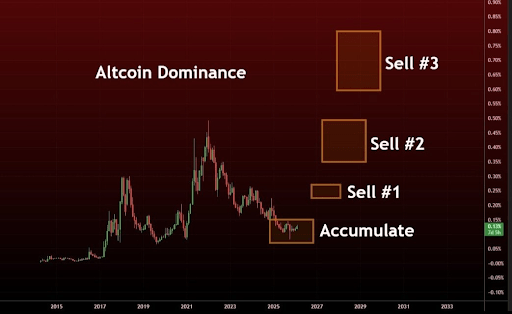
Source: Chart from Matthew Hyland on X

If that timeline holds, the next major altcoin season would be expected sometime between 2027 and 2028. That means that altcoins could still spend much of 2026 in a transition period where Bitcoin keeps being the dominant driving force of price action.

Even though Hyland believes the full altcoin season will not arrive this year, he pointed out that investors may still see substantial upside across the crypto market before that phase begins. Particularly, he noted that the market is currently in the max opportunity zone for long-term crypto accumulation.

AltSeason Hype At Two-Year Low

The most compelling supporting evidence of the current state of the altcoin season and Bitcoin dominance can be seen in crowd behavior. Recent data from the on-chain analytics platform Santiment shows that discussions about an altcoin season have cooled massively across social media platforms.

According to Santiment’s social trends metrics, social mentions of the term “altseason” have dropped to a two-year low. The data tracks the weekly volume of discussions about altcoin season across major social platforms over the past two years.

The chart shows that spikes in social mentions have always appeared around market peaks, when excitement about altcoin rallies is at its highest. However, this kind of sentiment trough has always acted as a contrarian buy signal.

When the crowd stops talking about something, it often means the crowd has given up, and the price action of many altcoins is at yearly lows. That is precisely when the best buying opportunities tend to emerge.

Overall market cap excluding BTC at $963 billion on the 1D chart | Source: TOTAL2 on Tradingview.com

Related Questions

QAccording to analyst Matthew Hyland, why is an altcoin season unlikely to occur in 2026?

ABecause the recovery from the lowest point of altcoin dominance to a full altcoin season typically takes 2-3 years, and the most recent low likely occurred around October 2025.

QWhat is the expected timeframe for the next major altcoin season based on Hyland's historical pattern analysis?

AThe next major altcoin season is expected to occur sometime between 2027 and 2028.

QWhat does the data from Santiment indicate about current social media discussions regarding 'altseason'?

ASocial mentions of the term 'altseason' have dropped to a two-year low, indicating that discussions have cooled massively.

QDespite the prediction of no altcoin season in 2026, what positive outlook does Hyland offer for the crypto market?

AHe states that investors may still see substantial upside across the crypto market and that it is currently in the 'max opportunity zone' for long-term crypto accumulation.

QHow does the article describe the relationship between social media hype about altseason and market peaks?

ASpikes in social mentions of 'altseason' have always appeared around market peaks, when excitement is highest, while low sentiment often acts as a contrarian buy signal.

Related Reads

6 Questions to Understand the Business Trends of AI

The AI industry has entered its "summer" phase, according to a six-dimensional scoring framework assessing its development cycle. Each dimension—narrative vs. delivery, system connectivity, delivery capability, ROI rationalization, common industry trends, and capital environment—scores 1 point, totaling 6 points. This places the industry firmly in summer (5-7 points), characterized by a coexistence of grand promises and tangible deliverables, with increasing pressure to demonstrate value and profitability. Key signals mark this shift. ByteDance's Doubao launched paid subscriptions, while OpenAI introduced an advertising platform. These moves are driven by dual forces: immense cost pressures from scaling user bases and massive compute requirements, and the maturation of commercial opportunities. Major players like Anthropic report explosive growth, highlighting AI's transition into core productivity infrastructure. For businesses, the path forward involves three strategic steps. First, identify a small, high-impact use case to quickly demonstrate a closed-loop value proposition, such as automating customer service or content generation. Second, systematically replicate successful pilots across the organization by standardizing processes, building shared AI capabilities, and aligning talent, incentives, and leadership. Finally, move beyond simply adding AI to existing workflows and undertake systemic reconstruction—redesigning processes for parallel AI-human collaboration, implementing real-time dashboards, and establishing automated trigger chains. The era where storytelling alone secured funding is over. The focus has shifted to delivering measurable efficiency gains, cost savings, and new revenue streams, as evidenced by real-world implementations in companies like Semir, Anta, and Midea. Success now depends on starting with a focused proof point, scaling it organization-wide, and ultimately allowing AI to redefine operational paradigms.

marsbit2h ago

6 Questions to Understand the Business Trends of AI

marsbit2h ago

US Government Lifts Ban on Crypto Perpetual Contracts for the First Time: What Does It Mean for the Market?

The U.S. Commodity Futures Trading Commission (CFTC) has issued guidance permitting 24/7 trading and clearing for crypto asset derivatives, effectively opening the U.S. market to crypto perpetual contracts for the first time. This move ends the previous ban and allows American individuals and institutions to trade these instruments around the clock. Direct beneficiaries include Kalshi, which received approval to list a Bitcoin perpetual contract; Coinbase, now the first CFTC-regulated futures commission merchant for U.S. clients to access global crypto derivatives; and CME, which will transition its Bitcoin futures and options to 24/7 trading. The CFTC emphasized this is a specific allowance for crypto assets, noting that traditional commodities like agriculture may not be suitable for non-stop trading. It also requires platforms to undergo case-by-case reviews for compliance and risk management. Industry leaders like Michael Saylor and Brian Armstrong praised the decision for integrating Bitcoin into capital markets and granting U.S. users access to a major global market segment. However, consumer advocacy group Better Markets criticized the CFTC for allegedly neglecting investor protection and favoring the industry it regulates. Other platforms like Kraken have announced plans to launch regulated perpetual futures for the U.S. market. The policy shift is expected to redirect significant liquidity and institutional participation to the newly accessible U.S. crypto derivatives landscape.

Odaily星球日报14h ago

US Government Lifts Ban on Crypto Perpetual Contracts for the First Time: What Does It Mean for the Market?

Odaily星球日报14h ago

Trading

Spot
Futures

Hot Articles

Discussions

Welcome to the HTX Community. Here, you can stay informed about the latest platform developments and gain access to professional market insights. Users' opinions on the price of S (S) are presented below.

活动图片