Author: Tiger Research
Compiled by: TechFlow
TechFlow Introduction: By 2026, blockchain hasn't yet changed the world, but what will happen in another ten years? This article, through the stories of four ordinary people, depicts changes that might occur by 2036, such as stablecoins replacing fiat currency, all-day asset trading, consolidation of public chains, and the reconstruction of content payment mechanisms—these aren't science fiction, but technological evolutions already underway.
"Does Anyone Still Use Paper Money?"

2036, a currency exchange point in the fictional country Zutopia. Judy, who has been working there for 34 years, takes a bill counter out of the drawer and starts counting the local currency, Bucks.
"So there are still people using Bucks."
It's normal. In this inflation-prone country, the currency's value shrinks every day. Legally it exists, but practically no one uses it. Everyone uses USD stablecoins in daily life.
Clickety-clack.
Listening to the sound of the bill counter, Judy reminisces about these years.
In 2002, 22-year-old Judy experienced a national default. Bank doors were locked tight, people couldn't withdraw their life savings.
"Go exchange it now."
Her father said. As soon as the salary hits the account, you have to immediately exchange it for dollars. Wait a day, and Bucks visibly depreciate. People check the black-market dollar exchange rate more diligently than the front-page news.
"How much is the dollar today?"
This question starts each day. You couldn't buy dollars at the official rate. The government set monthly foreign exchange quotas per person; no one knew when banks would freeze dollar deposits.

In the mid-2020s, young clients started asking her questions she couldn't understand.
"Can I exchange for USDT?"
Initially, only a few freelancers and exporters used it to receive money from overseas. No banks, no queues. With a phone, you could exchange Bucks for stablecoins and swap back when needed.
At the time, Judy never imagined it would replace her job. Older people still needed cash, many businesses also needed it. But the queues grew shorter bit by bit. Young clients vanished first, then middle-aged ones.
By 2030, no one lined up even on payday. Once businesses also had no reason to hold Bucks, they started paying salaries directly in stablecoins. Bucks became a currency needed only for paying taxes and utilities.
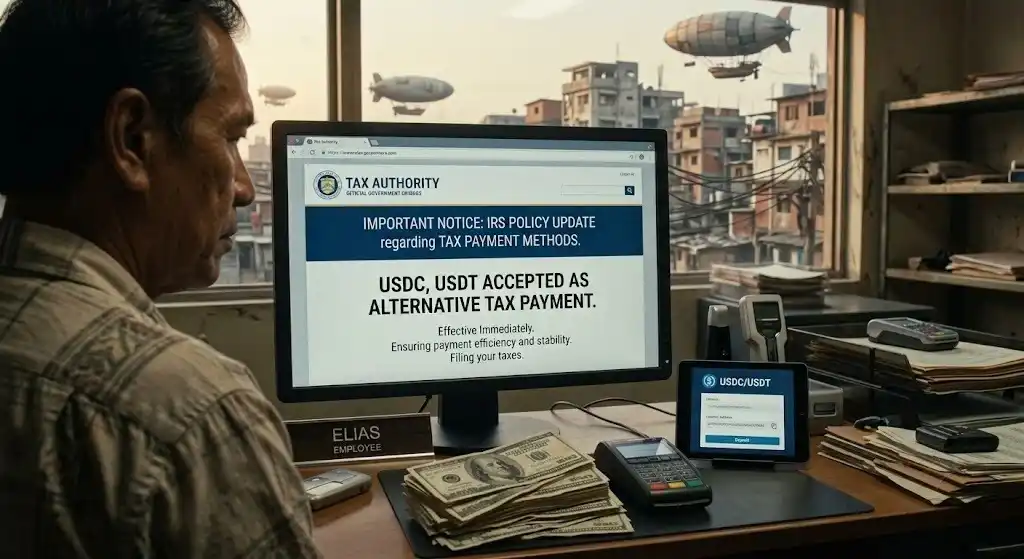
2033, the tax authority changed its stance. The calculation was simple: collecting stablecoins was more reliable than collecting Bucks. A short notice was posted on the website.
"Accepting USDC and USDT as alternative payment methods for taxes"
Bucks still existed, but the state itself announced it preferred to receive someone else's money.
2034, the Treasury followed suit. Bonds issued in Bucks repeatedly failed at auction; the Treasury eventually issued new bonds denominated in USD stablecoins. Civil servant salaries followed closely. In 2035, some local governments started paying half of civil servant salaries in stablecoins—because civil servants receiving only Bucks were hit earliest and hardest by inflation.
Printing money, collecting taxes, paying salaries—these powers once belonging solely to the state were piece by piece transferred to stablecoins.
As of May 2026, the total market cap of stablecoins was about $320 billion, with annual transaction volume of $2.8 trillion. Compared to the U.S. wholesale payment network handling over $2 trillion daily, this was just three weeks' worth. Excluding wash trades and fake transactions, less than 6% was actually used for payments. The remaining 88% circulated only within exchanges—trading, collateralizing, and back.
The question is where that 6% actually occurs. It likely starts in New York and Silicon Valley, but the places truly using this money aren't in the U.S. Americans are fine with credit cards and bank accounts. The people who desperately need stablecoins are those living in countries where their currency shrinks daily.
Judy puts the bill counter back in the drawer. Will there be clients tomorrow?
2 AM, Liquidated in Ten Minutes

2036, a small rented room in Singapore.
2 PM. A notification sounds, Lia glances at her phone. NVIDIA limit order alert.
2 PM Singapore, the New York stock market isn't even open. But on Lia's screen, the NVIDIA chart is still jumping. She clicks buy without hesitation. On the same screen, next to NVIDIA are treasury bonds, real estate REITs, and data center infrastructure funds, all in one interface.
By 2036, you don't just trade stocks—you can trade everything in the world.
"Investing never stops, no matter where you are."
This is something Lia often says. To her, the world has always been like this.
In 2021, 9-year-old Lia saw U.S. retail investors pushing the stock price of the physical game store GameStop to the sky. It was an investment where participation itself became the focus, surpassing asset value—organized not by brokers, but by online communities.
According to a 2025 World Economic Forum survey across 13 countries, 30% of Gen Z started investing as soon as they became adults—far higher than Gen X (9%) and baby boomers (6%). Gen Z's interest is so deep that 86% learned to invest before entering the workforce, compared to only 47% of baby boomers.
In Coinbase's Q4 2025 survey, 73% of young respondents said it was difficult to accumulate wealth through traditional means—higher than the 57% of older generations.
For this generation, investing is just a given—they want exposure to more of everything.
June 2025. Tokens backed 1:1 by major U.S. stocks—Apple, Tesla, NVIDIA—flooded into decentralized exchanges (DEX). No nationality restrictions, no strict KYC. With just a wallet address, U.S. stocks were within reach, with practically unlimited leverage.
Just try again tomorrow.
Lia logs into the borderless trading platform Lemming Brothers, buys a tokenized product of the Korean real estate index. Ten minutes later, her phone vibrates, a liquidation alert. She dismisses the warning on the screen as if nothing happened.

For Lia, in 2036, phone notifications are like background noise in daily life. She checks the endless stream of signals in the trading app, picks up her phone again. This is in stark contrast to her parents, who DCA "safe assets" on regulated exchanges.
In the world Lia lives in, every kind of value is transformed into an asset, operating 24/7 nonstop. This massive, never-sleeping market tempts her with the next trade every day—today, like every day.
The Day $2.2 Billion Evaporated

2036, a startup office in Banqiao Tech Valley.
Do-hyun, an infrastructure engineer with 12 years of experience, stops his hand as he scrolls through the network status dashboard on his monitor. Looking at the list of chains now visible on one screen, he mutters softly.
"Ten years ago you had to scroll forever. Now there aren't even ten."
2024, the year Do-hyun started his engineering career, was truly the era of the great discovery of Layer 2 rollups. Anyone could copy-paste a few lines of framework and stack code, launch their own blockchain under their own name. Do-hyun's company also rode the massive infrastructure wave, setting up validator nodes.

The chain was called Allchain. In June 2024, fueled by airdrop expectations, its Total Value Locked (TVL) surged to $2.2 billion. He still remembers vividly the scene of clinking glasses and cheering in the conference room.
"At this rate, aren't we the next Ethereum?"
But the joy of the listing was fleeting. After the token listed and airdrop rewards dried up, the coin price and chain usage plummeted off a cliff. Those projects and users chasing rewards turned away as soon as Allchain stopped paying; 97% of deposits evaporated within a year.
Allchain's brutal end wasn't unique. Countless independent networks that popped up like mushrooms that year collapsed the same way. They lured development teams with the sweet bait of incentives, but once the funds ran dry, the ecosystem emptied instantly, leaving only silent, hollowed-out infrastructure.
The astronomical fixed costs of running an independent chain exceeded what a single project could bear. Unable to withstand soaring infrastructure maintenance fees, the Allchains announced closures one after another, disappearing into history.
Only a handful survived under capital's cold scrutiny. Hundreds of chains that once seemed poised to change the world carved up the ruins of a market share barely above 10%, then silently marched toward extinction.

"Back then we all thought we would survive, build our own massive ecosystems..."
Around 2026, people mistook the number of chains for blockchain scalability itself. But fragmented chains only broke the user experience and pushed up security costs. What people really wanted wasn't hundreds of complex networks—but a few massive infrastructures providing unbreakable liquidity and optimized speed.
Do-hyun sighs deeply, silently closes the monitor, picks up his bag, and goes home.
The "Human Eyes" That Once Clicked Are Gone

2036, a media startup office in Sangam-dong.
Jae-hoon, while browsing another platform, sees a banner ad in the lower right corner and laughs.
"There are still companies sticking banner ads on screens, waiting for readers."
Jae-hoon is right. That platform's daily visits hit new highs every month, but traditional banner ad revenue just doesn't come; the entire ad model has become a thing of the past.
In the early 2020s, when Jae-hoon first entered the media industry, the formula for the web economy was clear. Write good articles, readers come. Readers come, advertisers pay for banners.
"How many page views today?"
This question at the morning meeting determined the life and death of media companies back then.

But this peaceful formula began to disappear by the late 2020s. By 2029, over half of global web traffic no longer came from humans, but from AI agents and bots. AI would scrape articles and summarize them in a second—but machines have no "eyes" to see banner ads.
At first, like most media companies, they blocked the bots. Server costs exploded, impossible to keep up. But the cost of blocking was brutal. Buried completely outside AI search and recommendation ecosystems, brands were forgotten. Media companies at the time faced a painful choice: block bots and lose traffic, or open the doors but make no money.
"Who exactly are we selling our content to now?"
This desperate question filled the office. The answer wasn't ad boards—it was pricing the content itself.
What opened the floodgates of change was the x402 standard launched by Coinbase in May 2025. It technologically resurrected the HTTP 402 response code—the "Payment Required" signal—that had been abandoned in a corner of web standards for 30 years.
By 2029, the focus was on building infrastructure: Know Your Agent (KYA) verification, settlement rails, etc. The real explosion started in 2030, when a media company began selling data directly to AI via the x402 system. Once validated, other media and data companies immediately adopted x402, jumping into data sales.
Initially there was some ridicule—pocket change, just a few won per transaction, not worth the effort. But when daily machine calls piled up into hundreds of thousands, even millions, real money started flowing into accounts, far exceeding the revenue banner ads ever brought.

"No more worrying about what advertisers think—machines pay the full price, and the company runs on that."
The old web advertising model, selling ads by attracting human eyeballs, slowly came to an end, while the machine economy—AI agents trading via APIs—unfolded in full swing.
Jae-hoon closes the dashboard, picks up his coffee cup. The visitor curve still shows that strange, almost vertical climb, meaningless by old standards—but now this is the norm. He no longer checks how many people visited, but checks how many AI agents paid today.
Tomorrow, hundreds of thousands of agents will again knock on his server's door, and that honest transaction record won't get shorter—not anymore.
This report is prepared based on materials considered reliable. However, we make no express or implied warranties regarding the accuracy, completeness, or suitability of the information. We are not liable for any losses arising from the use of this report or its contents. The conclusions and recommendations in this report are based on information available at the time of preparation and may change at any time without notice. All projects, estimates, forecasts, targets, opinions, and views expressed in this report may change at any time without notice and may differ from or contradict the views of others or other organizations.
This document is for reference only and should not be considered legal, commercial, investment, or tax advice. Any mention of securities or digital assets is for illustrative purposes only and does not constitute investment advice or an offer to provide investment advisory services. This material is not directed at investors or potential investors.
Terms of Use
Tiger Research permits fair use of its reports. "Fair use" is a principle that broadly permits the use of specific content for public interest purposes as long as it does not harm the material's commercial value. If the use aligns with the purpose of fair use, reports may be used without prior permission. However, when citing Tiger Research reports, it is mandatory to 1) clearly indicate "Tiger Research" as the source, and 2) include the Tiger Research logo. If the material needs to be reorganized and republished, separate negotiation is required. Unauthorized use of reports may lead to legal action.