Since the market crash on October 11th, the entire crypto market has been sluggish, with market makers and investors suffering heavy losses. The recovery of capital and sentiment will take time. However, the crypto market is never short of new fluctuations and opportunities, and we remain optimistic about the future market. This is because the trend of mainstream crypto assets integrating with traditional finance to form new business models has not changed; instead, it has been rapidly building moats during the market downturn.
1. Wall Street Consensus Strengthens
On December 3rd, U.S. SEC Chairman Paul Atkins stated in an exclusive interview with FOX at the New York Stock Exchange: "In the coming years, the entire U.S. financial market may migrate on-chain."
Atkins mentioned:
(1) The core advantage of tokenization is that if assets exist on the blockchain, the ownership structure and asset attributes will be highly transparent. Currently, publicly listed companies often do not know who their shareholders are, where they are located, or where the shares are held.
(2) Tokenization also has the potential to achieve "T+0" settlement, replacing the current "T+1" trading settlement cycle. In principle, the delivery-versus-payment (DVP)/receive-versus-payment (RVP) mechanism on-chain can reduce market risks and improve transparency. The time gap between clearing, settlement, and fund delivery is currently a source of systemic risk.
(3) He believes tokenization is an inevitable trend in financial services, and mainstream banks and brokerages are already moving toward tokenization. The world may not even need 10 years... perhaps it will become a reality in just a few years. We are actively embracing new technologies to ensure the U.S. remains at the forefront in areas like cryptocurrency.
In reality, Wall Street and Washington have already built a deep capital network for crypto, forming a new narrative chain: U.S. political and economic elites → U.S. bonds (Treasury bonds) → stablecoins / crypto treasury companies → Ethereum + RWA + L2
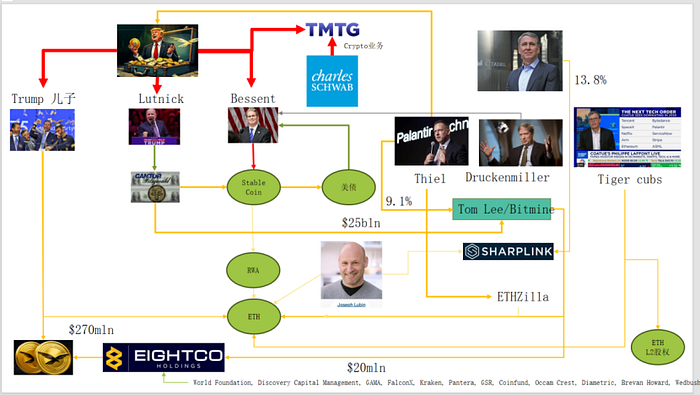
(1) Stablecoins (USDT, USDC, dollar assets behind WLD, etc.)
The majority of reserve assets are short-term U.S. bonds + bank deposits, held through brokers like Cantor.
(2) U.S. Bonds (U.S. Treasuries)
Issued and managed by the Treasury / Bessent side.
Used by Palantir, Druckenmiller, Tiger Cubs, etc., as low-risk interest rate base holdings.
Also the yield assets pursued by stablecoins / treasury companies.
(3) RWA
From U.S. bonds, mortgages, accounts receivable to housing finance.
Tokenized through Ethereum L1 / L2 protocols.
(4) ETH & ETH L2 Equity
Ethereum is the main chain for RWA, stablecoins, DeFi, and AI-DeFi.
L2 equity / tokens represent claims on future trading volume and fee cash flows.
This chain expresses:
U.S. dollar credit → U.S. bonds → stablecoin reserves → various crypto treasuries / RWA protocols → ultimately settled on ETH / L2.
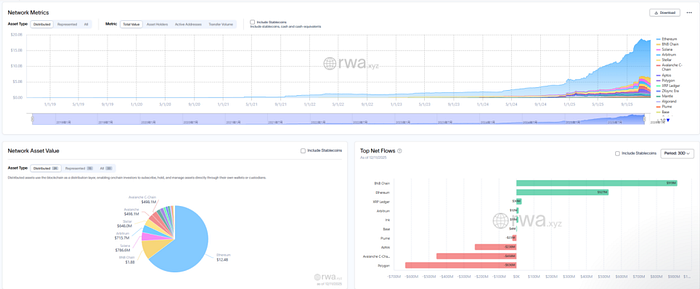
In terms of RWA TVL, compared to other public chains that declined after the October 11th crash, ETH is the only public chain that quickly recovered and rose. Its current TVL is $12.4 billion, accounting for 64.5% of the total crypto market.
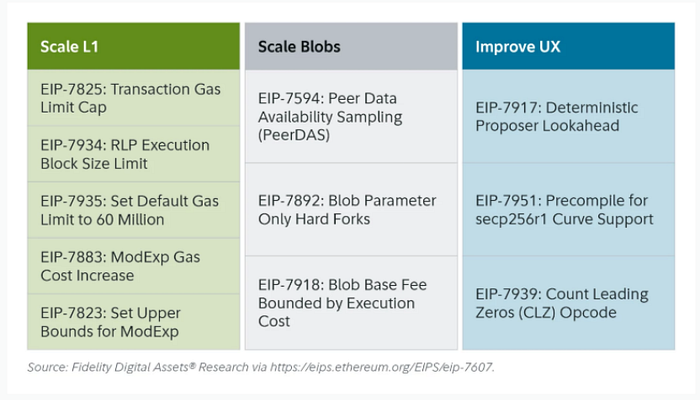
The recent Ethereum Fusaka upgrade did not cause much stir in the market, but from the perspective of network structure and economic model evolution, it is a "milestone event." Fusaka is not just about scaling through EIPs like PeerDAS; it attempts to address the issue of insufficient value capture on the L1 mainnet caused by L2 development.
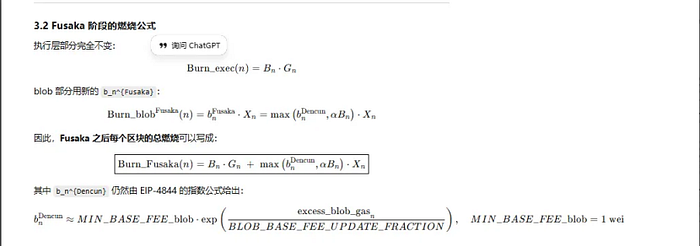
(1) London (single-dimension): Only burns the execution layer; ETH begins to experience structural burning due to L1 usage.
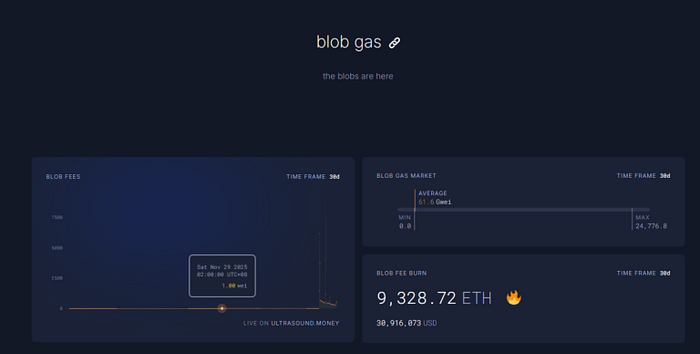
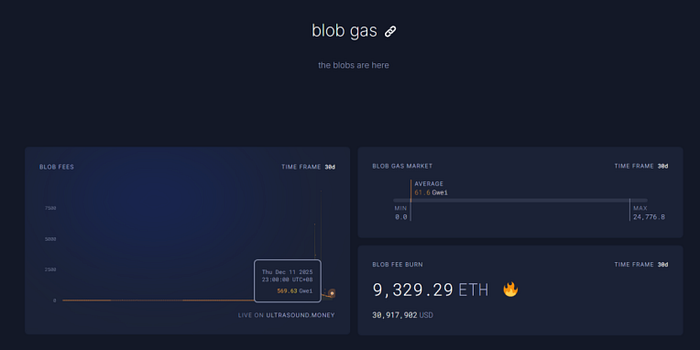
(2) Dencun (dual-dimension + independent blob market): Burns execution layer + blob; L2 data written to blobs also burns ETH, but during low demand, the blob portion is almost zero.
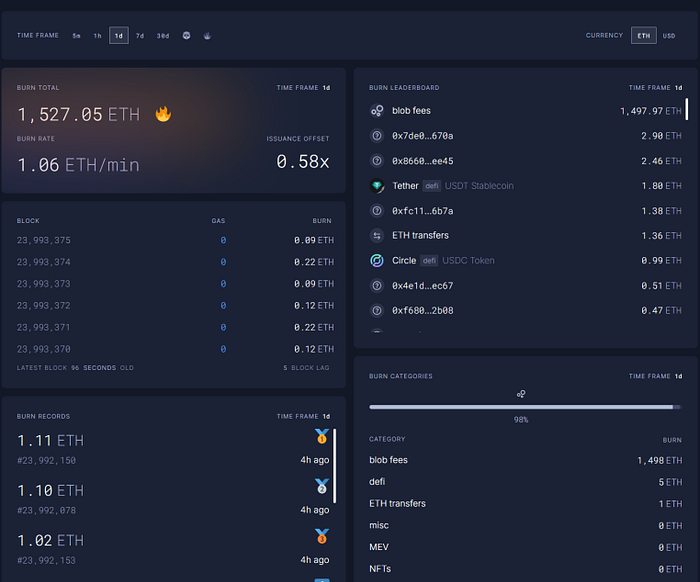
(3) Fusaka (dual-dimension + blob bound to L1): To use L2 (blob), one must pay at least a fixed proportion of the L1 base fee, which is burned. L2 activity is more stably mapped to ETH burning.
3. Ethereum Technical Strength Improves
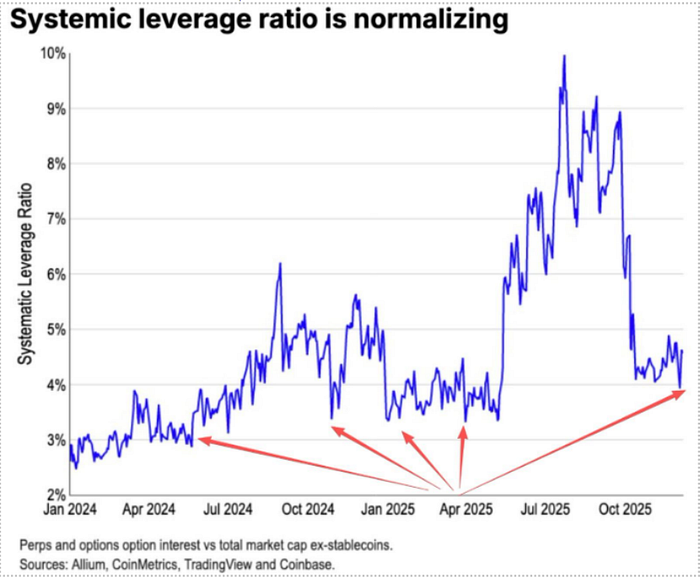
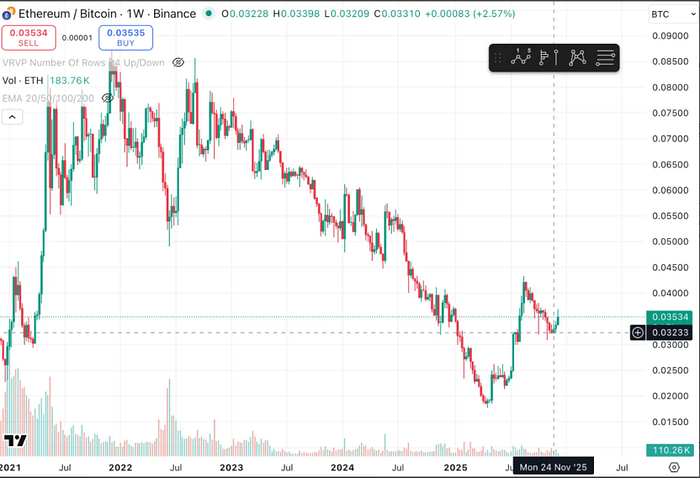
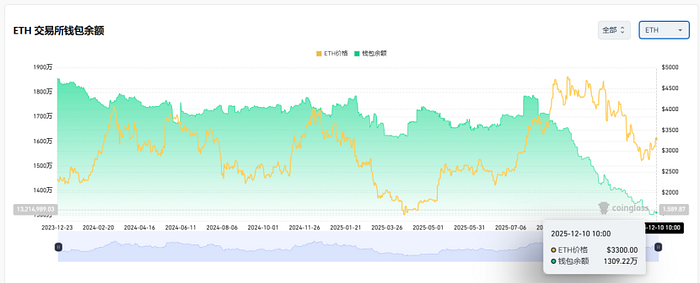
During the October 11th crash, ETH futures leverage was thoroughly cleared, eventually reaching the leverage of spot holdings. At the same time, many with insufficient faith in ETH led to early OG investors reducing their positions. According to Coinbase data, speculative leverage in the crypto space has dropped to a historically low region of 4%.
Press enter or click to view image in full size
The U.S. will actively pursue tax cuts, interest rate reductions, and relaxed crypto regulations, while China will adopt appropriate easing and financial stability measures (suppressing volatility).
Amid expectations of relative easing in both China and the U.S., and scenarios of suppressing downward asset volatility, ETH remains in a favorable "buying sweet spot" during extreme panic, with capital and sentiment not yet fully recovered.