Russia’s Largest Crypto Mining Firm Hit as BitRiver CEO Faces Tax Evasion Allegations

bitcoinistPublished on 2026-02-03Last updated on 2026-02-03

Abstract

Russia's largest cryptocurrency mining company, BitRiver, faces intensified legal and financial pressure as its founder and CEO, Igor Runets, has been detained and charged with multiple counts of tax evasion. A Moscow court placed him under house arrest, restricting his movement during the investigation. This development adds to BitRiver's existing challenges, including U.S. sanctions imposed in 2022 and the loss of key international partnerships. The company, which operates data centers in Siberia, has also faced operational cutbacks, delayed salary payments, and lawsuits from regional energy providers. The case underscores growing regulatory risks for crypto mining firms in Russia and may influence future compliance and governance practices in the sector.

Russia’s biggest crypto mining company is under renewed scrutiny after authorities detained BitRiver founder and CEO Igor Runets on multiple tax evasion charges, deepening the legal and financial pressure on a firm already constrained by sanctions and operational setbacks.

Related Reading: With Bitcoin Below $80K, ARK Reframes The Narrative Around Gold

The case, which is being handled by a Moscow court, has drawn attention to the risks facing large-scale crypto miners operating at the intersection of energy, regulation, and geopolitics.

According to reports from Russian outlets RBK and Kommersant, Runets was detained late last week and formally charged with three counts of alleged tax evasion.

Court filings indicate that the Zamoskvoretsky Court of Moscow ordered him placed under house arrest, a measure that restricts his movement while investigators proceed. His legal team has a limited window to appeal the ruling before it becomes fully enforceable.
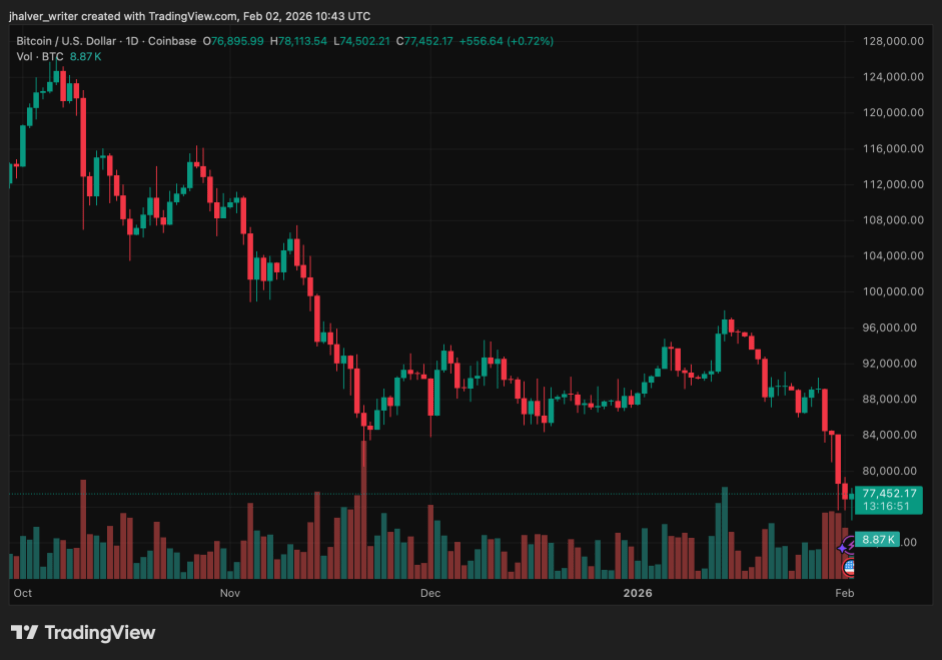
BTC's price trending downwards on the daily chart. Source: BTCUSD on Tradingview

Court Case Adds Pressure On Bitriver

Founded in 2017, BitRiver grew rapidly into Russia’s leading Bitcoin mining operator by building large data centers across Siberia.

The company used the region’s cold climate and relatively low electricity costs to support its mining operations and to provide infrastructure services to corporate clients. At its peak, BitRiver operated thousands of mining rigs across multiple sites and accounted for a significant share of Russia’s legal crypto-mining capacity.

Runets’ detention comes amid mounting challenges for BitRiver. The company was sanctioned by the US Treasury Department in mid-2022 following Russia’s invasion of Ukraine, limiting its access to Western partners and financial systems.

In 2023, Japanese financial group SBI exited its mining arrangement with BitRiver following its withdrawal from Russia, dealing a blow to the firm’s international business.

Financial Strain And Legal Disputes

Reports suggest that BitRiver began cutting costs and scaling back parts of its operations toward the end of 2024, leading to salary payment delays affecting employees.

The pressure continued into early 2025, when regional electricity provider Infrastructure of Siberia filed two lawsuits, alleging that it had paid BitRiver for equipment that was never delivered.

Despite these issues, Russia’s industrial mining sector continued to generate significant revenue in 2024, with BitRiver remaining the market leader. Bloomberg estimated Runets’ net worth at around $230 million in late 2024, largely tied to his role in the crypto mining industry.

Wider Implications for The Crypto Sector

The case against Runets highlights the growing legal and regulatory risks facing crypto executives, both in Russia and abroad. While authorities investigate the alleged tax violations, BitRiver must also manage ongoing litigation, strained partnerships, and scrutiny linked to sanctions.

Related Reading: With Bitcoin Below $80K, ARK Reframes The Narrative Around Gold

As the market awaits the verdict, the case’s outcome could shape how Russian crypto mining firms approach compliance, financing, and governance in an increasingly restrictive environment.

Cover image from ChatGPT, BTCUSD chart from Tradingview

Related Questions

QWhat are the main charges brought against BitRiver's CEO Igor Runets?

AIgor Runets, the founder and CEO of BitRiver, has been detained and formally charged with three counts of alleged tax evasion.

QWhat measures has the Moscow court taken regarding Igor Runets following the charges?

AThe Zamoskvoretsky Court of Moscow ordered Igor Runets to be placed under house arrest, which restricts his movement while the investigation proceeds. His legal team has a limited time to appeal this ruling.

QBesides the tax case, what other significant challenges has BitRiver faced recently?

ABitRiver has faced multiple challenges, including being sanctioned by the US Treasury Department in 2022, the exit of Japanese financial group SBI from their mining arrangement in 2023, cost-cutting measures leading to salary delays, and lawsuits from a regional electricity provider over undelivered equipment.

QHow did BitRiver become Russia's leading Bitcoin mining operator, and what advantages did it utilize?

AFounded in 2017, BitRiver grew rapidly by building large data centers across Siberia. It leveraged the region's cold climate and relatively low electricity costs to support its mining operations and provide infrastructure services to corporate clients.

QWhat broader implications does the case against Runets have for the crypto sector, according to the article?

AThe case highlights the growing legal and regulatory risks for crypto executives globally. Its outcome could influence how Russian crypto mining firms handle compliance, financing, and governance in an increasingly restrictive environment.

Related Reads

Who's at the CFTC Table? A Redistribution of American Innovative Financial Discourse Power

On February 12, 2026, the U.S. Commodity Futures Trading Commission (CFTC) announced the formation of its Innovation Advisory Committee (IAC), a significant step signaling a shift from reactive oversight to collaborative governance in financial innovation. The committee comprises 35 members from diverse sectors, including major cryptocurrency exchanges (Coinbase, Kraken, Gemini), DeFi and blockchain infrastructure leaders (Uniswap, Solana, Chainlink), prediction markets (Polymarket, Kalshi), top investment firms (a16z, Paradigm), traditional financial institutions (Nasdaq, CME Group), and academic representatives. The IAC, replacing the former Technical Advisory Committee, is tasked with providing expert advice on emerging technologies like AI and blockchain, focusing on their impact on derivatives and commodity markets. It aims to help the CFTC develop adaptive regulatory frameworks that foster responsible innovation while maintaining market integrity. Key implications include the legitimization of prediction markets as financial instruments, official recognition of DeFi and public blockchain infrastructure, and the consolidation of compliance advantages for established crypto platforms. This initiative reflects the CFTC’s commitment to engaging with industry stakeholders early in the innovation process, balancing regulatory clarity with support for technological advancement in modern financial markets.

marsbit1h ago

Who's at the CFTC Table? A Redistribution of American Innovative Financial Discourse Power

marsbit1h ago

Trading

Spot
Futures

Hot Articles

Discussions

Welcome to the HTX Community. Here, you can stay informed about the latest platform developments and gain access to professional market insights. Users' opinions on the price of S (S) are presented below.

活动图片