Author: Dou Wanle
July 13, 2026, Seoul.
South Korea's benchmark KOSPI index plummeted 8.95% in a single day, triggering its 7th circuit breaker of the year. SK Hynix, the 'national destiny stock' in the eyes of Koreans, plunged 15.37%, a decline not seen in nearly two decades. Samsung Electronics also fell over 10%.
Margin calls were issued for over 1.2 million leveraged accounts. Brokerage systems automatically liquidated between 320,000 and 460,000 accounts. More heartbreaking is that 62% of those liquidated were young people aged 20 to 30. Some lost their down payment for a wedding apartment, others were trading on margin...
A young man in his 20s in Busan, who lost money following a recommendation from a stock YouTuber, went and stabbed the influencer.
In the past, these phrases would most likely have been used to describe scenes after a crypto market crash. Today, they are recurring in the South Korean, American, and Japanese markets as the tech stock tide recedes.
Sharp rallies and sell-offs are just the surface. What's truly changed is the method of valuation—narrative outweighs fundamentals, leverage amplifies emotions, and social media drives consensus to extremes with unprecedented speed.
Global stock markets, especially tech stocks, are becoming increasingly like the crypto world.
Returning to the Family Home
"Welcome back to the family home."
After the crash, crypto traders who had switched to stocks shared numerous loss stories online. Comments like the one above were ubiquitous.

The so-called "family home" refers to the cryptocurrency world. From the second half of 2025 to early 2026, a major drama of "leaving the family home" unfolded in the crypto space.
A number of KOLs and veteran players who had been in the cryptocurrency market for years began to lose faith. Bitcoin was range-bound with tepid trading volume, meme coins kept getting shaved. Many felt "this circle is boring" and started turning their attention to US stocks.
This choice seemed very reasonable.
Stocks have revenue, profits, financial reports, and SEC oversight. Compared to crypto projects lacking cash flow and priced purely on consensus, US stocks at least appeared to be more mature and safer assets.
The crypto traders didn't just take their liquidity; they brought their trading methods along too.
In the crypto market, they were accustomed to chasing new narratives, hunting for high-volatility targets, using leverage, and swiftly switching positions based on social media sentiment. Upon entering the stock market, this approach barely changed—only the trading objects shifted from tokens to AI, memory chips, and leveraged ETFs, repeatedly achieving significant gains.
Memory stocks soon became the new collective consensus.
The logic was not complicated: AI servers require more high-bandwidth memory (HBM), leading to supply shortages and rising memory prices. Micron, Samsung Electronics, and SK Hynix naturally became the most direct 'shovel sellers.' The phrase "you can never have enough memory" became deeply ingrained.
Numerous crypto KOLs reinvented themselves, starting to talk about US stocks, memory cycles, and AI capital expenditure. Products like the 2x leveraged SK Hynix ETF were also regarded as more 'efficient' betting tools than regular stocks.
Until the market reversed in July.
Bitcoin Becomes the "Low Volatility Asset"
How long does it take to fall from the peak?
Bitcoin took 268 days to halve its value, and silver took 169 days for a similar magnitude of retracement.
In contrast, SanDisk took only 36 days to fall about 55%, and SK Hynix took only 34 days to drop about 53%.
While both experienced a 'halving,' Bitcoin took nearly nine months, while memory stocks took just over one month.
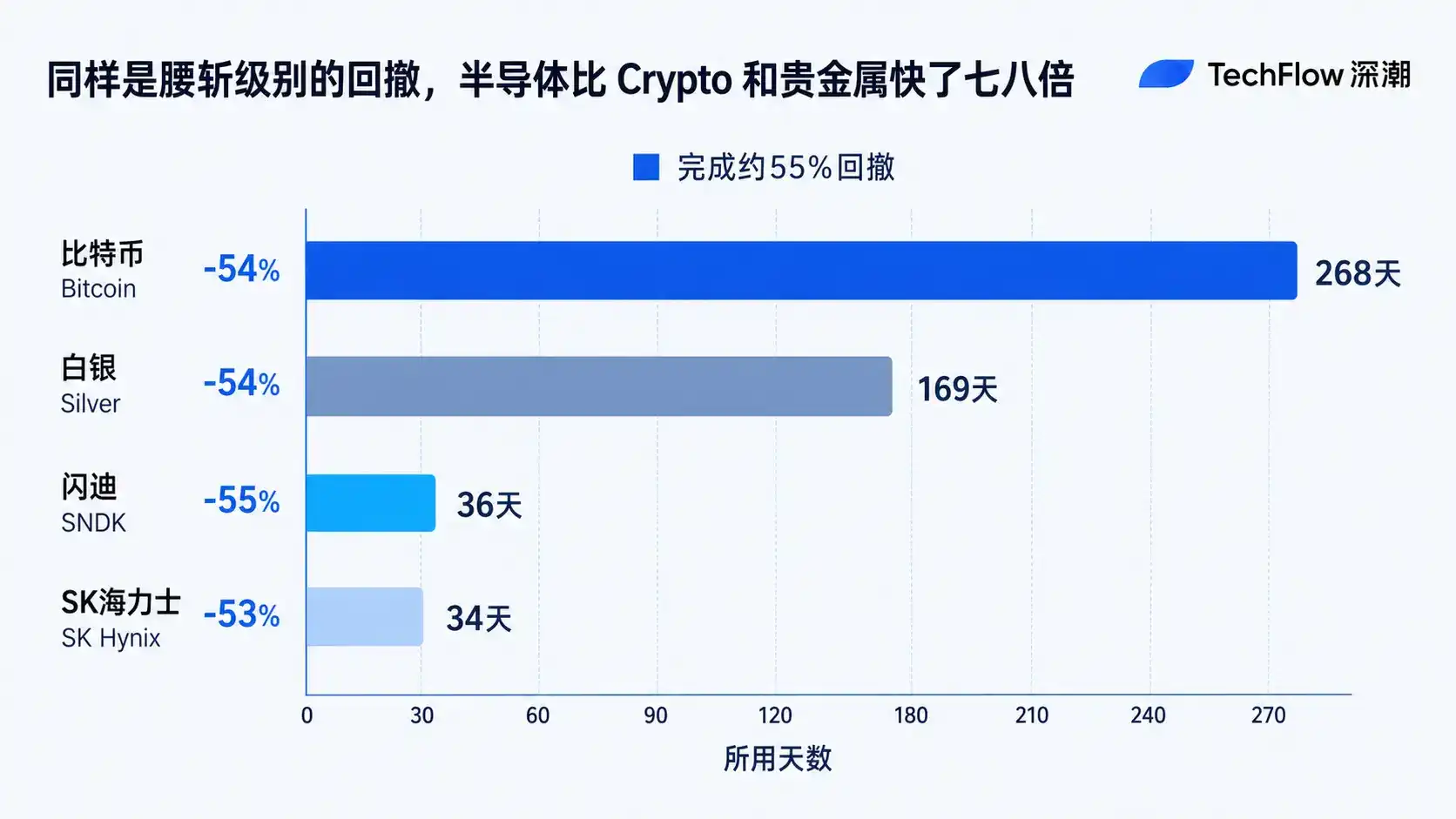
This is the ironic twist of this round of market movements. In the past, investors worried Bitcoin could surge or crash within days, while stocks adjusted slowly based on earnings and valuations. Now, some tech stocks are completing an entire bubble burst in a shorter time frame than cryptocurrencies.
It's very counter-intuitive. Compared to some tech stocks, Bitcoin is becoming relatively stable.
According to Schwab statistics, Bitcoin's historical volatility in 2025 was about 42%, with a maximum drawdown of around 32%. During the same period, Tesla's volatility was about 63% with a max drawdown of 48%, and Nvidia's volatility was about 50% with a max drawdown of 37%.
Bitcoin remains a high-risk asset, but the volatility of some major tech stocks is even greater.
Bitwise even predicted in its 2026 outlook that Bitcoin's overall volatility might continue to be lower than Nvidia's.
So the current situation is quite absurd: Bitcoin is becoming more like tech stocks, while tech stocks are becoming more like Bitcoin.
When Narrative Becomes the Valuation Anchor
There's an old saying in crypto: trading crypto is trading narratives.
In 2026, global tech stocks are turning this saying into reality.
AI is certainly not vaporware. Nvidia, Microsoft, Google, and large cloud computing companies have real revenue and are investing real capital to build data centers.
But there's a long road between "AI will indeed create value" and "any company touching AI is worth buying at any price."
At the height of the frenzy, the market simply skipped that road.
AI servers, optical modules, memory chips, data centers, power equipment, even nuclear energy companies—as long as they could be placed within the AI industrial chain, their stock prices could surge. Businesses were still in the planning stage, orders not yet secured, but the market would price them based on the best possible outcome years in advance.
The story in South Korea was "AI semiconductors are tied to national destiny." As KOSPI kept hitting new highs, more and more families began opening stock accounts for their underage children, gifting popular stocks like Samsung Electronics and SK Hynix as long-term presents.
A similar concentration occurred in the A-share market. In the first half of 2026, the TMT sector's market cap reached 41.78 trillion yuan, accounting for about 31.45% of the total A-share market value. On some trading days, turnover in the tech sector approached half of the entire market's.
The US market has long been priced around a handful of large tech companies. As index gains relied increasingly on just a few firms, and as funds, options, and retail investors flooded into the same stocks, seemingly diversified portfolios were essentially betting on the same AI story.
This is reminiscent of the old crypto world. Dogecoin's surge in 2021 wasn't due to a technological breakthrough, but because Elon Musk tweeted. The surge in tech stocks in 2026 wasn't because all companies experienced explosive earnings growth, but because ChatGPT convinced everyone that "AI will rewrite everything."
That narratives could dominate the market so rapidly is also inseparable from changes in dissemination methods.
In the past, stock information primarily came from financial reports, research notes, and institutional roadshows. Today, more and more people's investment decisions come from YouTube, X, short videos, and paid communities.
Complex company research is compressed into a few sentences: Time will prove compute and optical modules, AI compute will always be insufficient...
Social media algorithms don't reward caution either. Overnight riches are always the traffic magnet: someone doubled their money overnight with options, an office worker achieved financial freedom by heavily investing in memory stocks, someone used leveraged ETFs to earn years' worth of salary in a few months.
Charts are the best advertisement. A large number of housewives and middle-aged women began investing their private savings, and some even sold properties to buy stocks, reminiscent of students dropping out of school to all-in on Web3 a few years ago...
The Leverage Carnival
The scariest thing in crypto isn't volatility; it's the lethal combination of leverage and volatility. In 2026, global stock markets are perfectly replicating it.
On May 27, 2026, the Korea Exchange approved the listing of 16 single-stock leveraged ETFs with 2x leverage, tracking stocks like Samsung Electronics and SK Hynix.
Retail investors went wild. From approval to mid-July, Korean retail investors accumulated a net purchase of 14 trillion won (approx. 64 billion RMB) worth of single-stock leveraged ETFs. During the same period, foreign investors bought only about 2 trillion won.
These ETFs had several fatal design flaws.
These products rebalance their positions daily. The more severe the volatility, the more significant the decay in net asset value. Assume a stock falls 10%, then rises 11.1%—it returns to its original price. The corresponding 2x leveraged product would first fall 20%, then rise 22.2%, ultimately still losing about 2.2%.
The problem is even worse during rapid declines.
To maintain target leverage, the products need to passively reduce risk exposure after a decline. Selling further depresses the underlying price, triggering more position reductions, stop-losses, and margin pressure.
Goldman Sachs later pointed out that the "rapid deleveraging" of these products was the main cause of abnormal intraday volatility in KOSPI, with 62% of institutional net selling stemming from ETF-related liquidations.
Two months later, South Korean regulators urgently halted all new listings of single-stock leveraged ETFs. The minimum margin requirement was drastically raised from 10 million won to 30 million won, and only cash was recognized.
But it was too late. 2.3 trillion won in forced liquidation amounts, and the wealth of hundreds of thousands of families vanished into thin air.
Even the US stock market, the deepest in the world, is experiencing the backlash of leverage.
JPMorgan analysts recently noted that US stocks still have "deleveraging room," needing three months to return to pre-April levels.
The ratio of memory chip stock leveraged ETF assets to underlying market cap is three times the average for all stock ETFs. Even for broad leveraged stock index ETFs, the ratio is high relative to its own history.
A Regression
"Stock markets becoming like crypto" doesn't mean stocks have become completely identical to cryptocurrencies.
Stocks still have companies, assets, revenue, and cash flow behind them. They also have financial disclosures, audits, and regulation. Even when market sentiment fades, a truly profitable company still possesses a calculable value.
What's truly changed is at the trading layer.
In the past, people bought a company's future profits. Now, more and more people are trading the heat of a theme.
The crypto-fication of stock markets is essentially a revolution of de-rationalization.
Traditional stock markets look at P/E, cash flow; crypto-fied markets look at narratives, imagination. Traditional stock markets consider 20% volatility high; crypto-fied markets see individual stocks fluctuating 10-15% daily as the norm.
Traditional markets use leverage via margin trading; crypto-fied markets use ETFs, derivatives, quantitative strategies. Traditional market info comes from research reports, financial statements; crypto-fied market info comes from Twitter, YouTubers, online communities. Traditional markets have institutions rationally pricing; crypto-fied markets have institutions becoming retail-like, quant funds chasing momentum...
What's even more laughable is, now Bitcoin is striving to become like a stock, gaining mainstream financial acceptance through ETFs, institutionalization, and declining volatility.
This is an absurd point of intersection.
Those who transitioned from crypto to stocks ultimately found they hadn't left the "family home." It's the same repeating mechanism: grand narratives, crowded positions, easily accessible leverage, and everyone believing they can exit before everyone else.
The words written by a Korean retail investor on a trading forum are worth everyone remembering: I want to go back to the days before I traded stocks, and get my money back.
But the market never issues refunds.