Wall Street Shows Sharp Divergence in CRCL Valuation on the Eve of Circle's Earnings Report

Odaily星球日报Published on 2026-08-04Last updated on 2026-08-04

Abstract

On the eve of its earnings report on August 5th, significant divergence emerged on Wall Street regarding the valuation of Circle (CRCL). Morgan Stanley downgraded Circle from "Equal Weight" to "Underweight," slashing its target price from $106 to $38. Analyst James Faucette argues that the market has overestimated the growth potential of USDC, noting stagnant circulation since Q3 2025 and a lack of major new use cases beyond remittances and card spending. He warns that slower USDC growth could pressure Circle's core "reserve income" and shift its revenue mix toward lower-margin transaction fees, making current valuations excessive. In contrast, TD Cowen initiated coverage with a "Buy" rating and an $82 target price. Analyst Bryan Bergin believes the market underestimates Circle's potential to evolve from a stablecoin issuer into a broader digital financial infrastructure platform. He focuses on future services like payments, asset management, RWA tokenization, and blockchain infrastructure, forecasting a ~31% CAGR for USDC circulation through 2030 and faster growth in fee-based revenues. A key external variable is the delayed progress of the CLARITY Act, whose uncertainty may pressure market sentiment by slowing regulatory clarity for stablecoins. Ultimately, the split centers on whether Circle's value hinges on USDC growth or its platform transformation. The upcoming earnings report will be scrutinized for details on reserve income, payment services, and RWA initiatives.

Original | Odaily Planet Daily (@OdailyChina)

Author | Azuma (@azuma_eth)
On August 5th, Beijing time, stablecoin issuer Circle (CRCL) is set to release its new quarterly earnings report before the US stock market opens. However, just on the eve of this report, Wall Street has already shown significant divergence regarding Circle's future value.

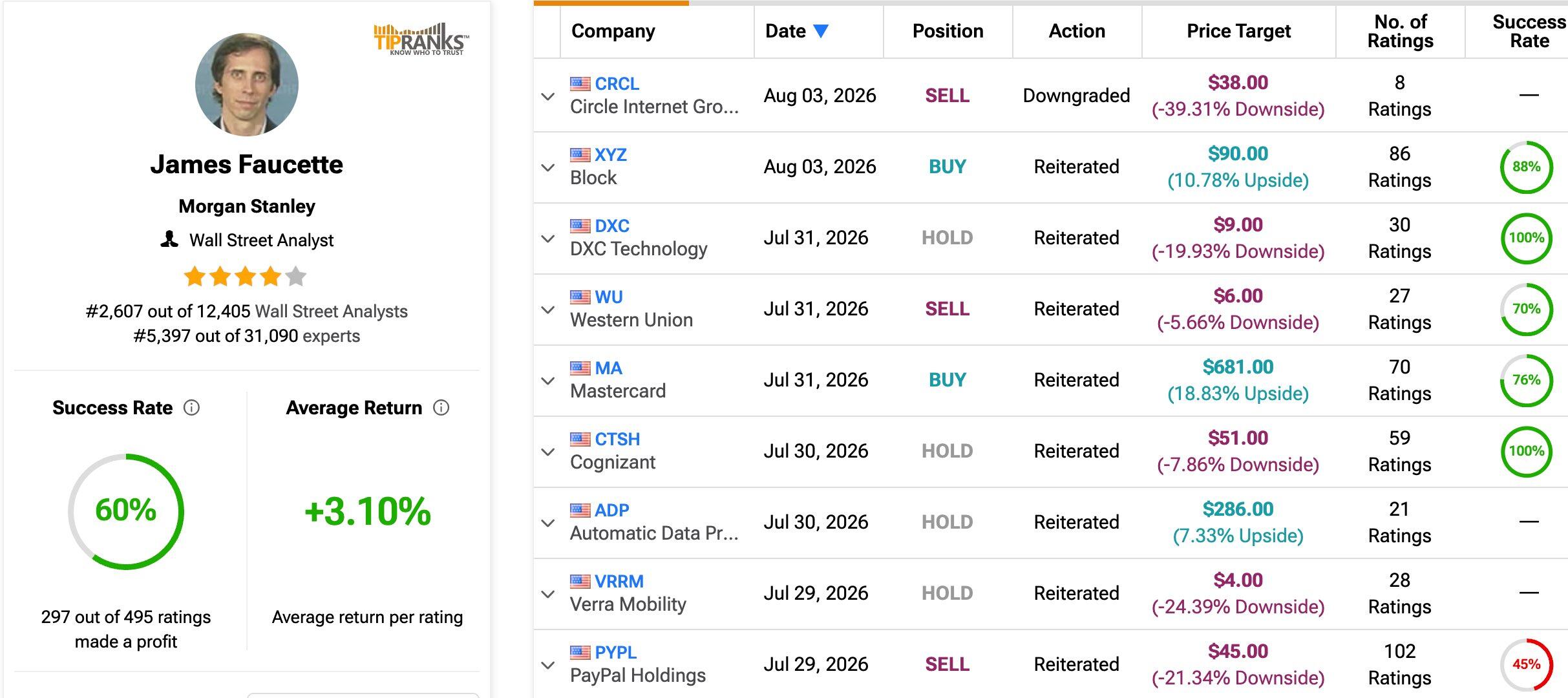
On August 3rd, Morgan Stanley (hereafter referred to as "MS") downgraded Circle's rating from "Equal Weight" to "Underweight" and significantly lowered its target price from $106 to $38.

Meanwhile, TD Cowen initiated coverage of Circle with a "Buy" rating, setting a target price of $82.

The two institutions presented entirely different rating judgments. The core divergence reflected in their views lies in how to define Circle at present — should it continue to be viewed as a stablecoin issuer reliant on USDC circulation growth, or as a technology company evolving into a digital financial infrastructure platform?

Institutional Divergence: Morgan Stanley Bearish on USDC Growth, TD Cowen Bets on Platform Transition

The Morgan Stanley analyst giving the "Underweight" rating is James Faucette. On TipRanks, Faucette holds a four-star rating (out of five) and is widely considered a sell-side analyst significantly above average. Although Faucette's average return rate over the past two years was only 3.1%, his success rate in calls reached 60%.
Faucette's bearish logic primarily revolves around Circle's current revenue model.

In his view, the market may be overestimating USDC's future growth potential, and the expansion speed of stablecoin use cases is also slower than previously expected — since Q3 2025, the circulation scale of USDC has not actually shown growth. Moreover, aside from remittances and stablecoin-related card consumption, USDC has not yet seen large-scale new application scenarios.

This means that Circle's current core revenue source, "reserve income," may face growth pressure. Currently, Circle's primary income heavily relies on allocating USDC reserve assets to cash, short-term U.S. Treasury bonds, and other assets to earn interest income. Therefore, the growth in USDC circulation is often seen as a key driver for the company's profit expansion.

Faucette believes that if USDC scale growth slows, Circle's future revenue structure may gradually tilt towards transaction revenue with lower profit margins. Based on this judgment, he expects Circle's future earnings performance may fall short of market expectations and believes the current valuation already reflects overly high growth expectations.

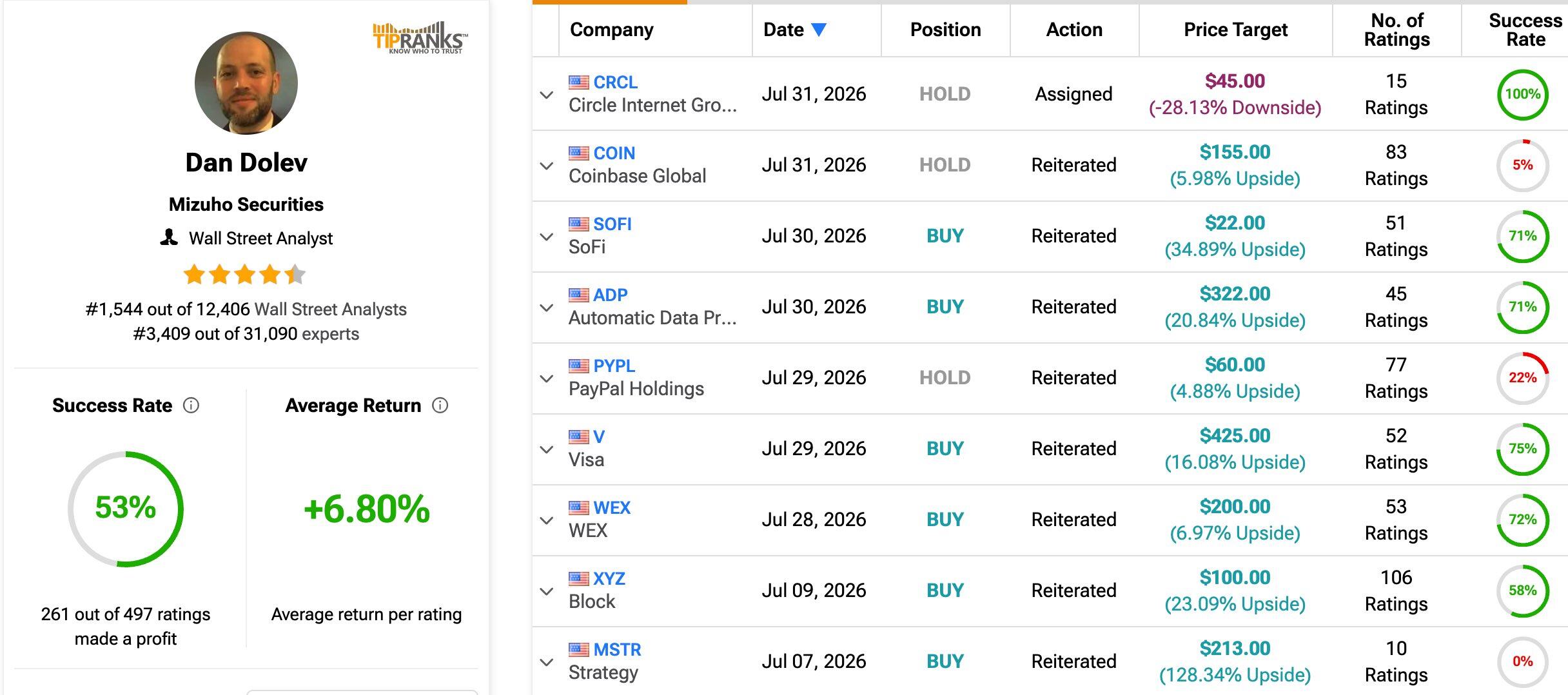
An analyst sharing a similar bearish view is Dan Dolev from Mizuho Securities. Dolev holds a 4.5-star rating on TipRanks, higher than Faucette's. Last Friday, this analyst assigned Circle a "Hold" rating but lowered the target price from $50 to $45.
On the TD Cowen side, the analyst giving the "Buy" rating is Bryan C. Bergin. However, on TipRanks, Bergin's personal track record rating is only half a star, with a historical average return rate of -3.4% and a success rate of only 43%...
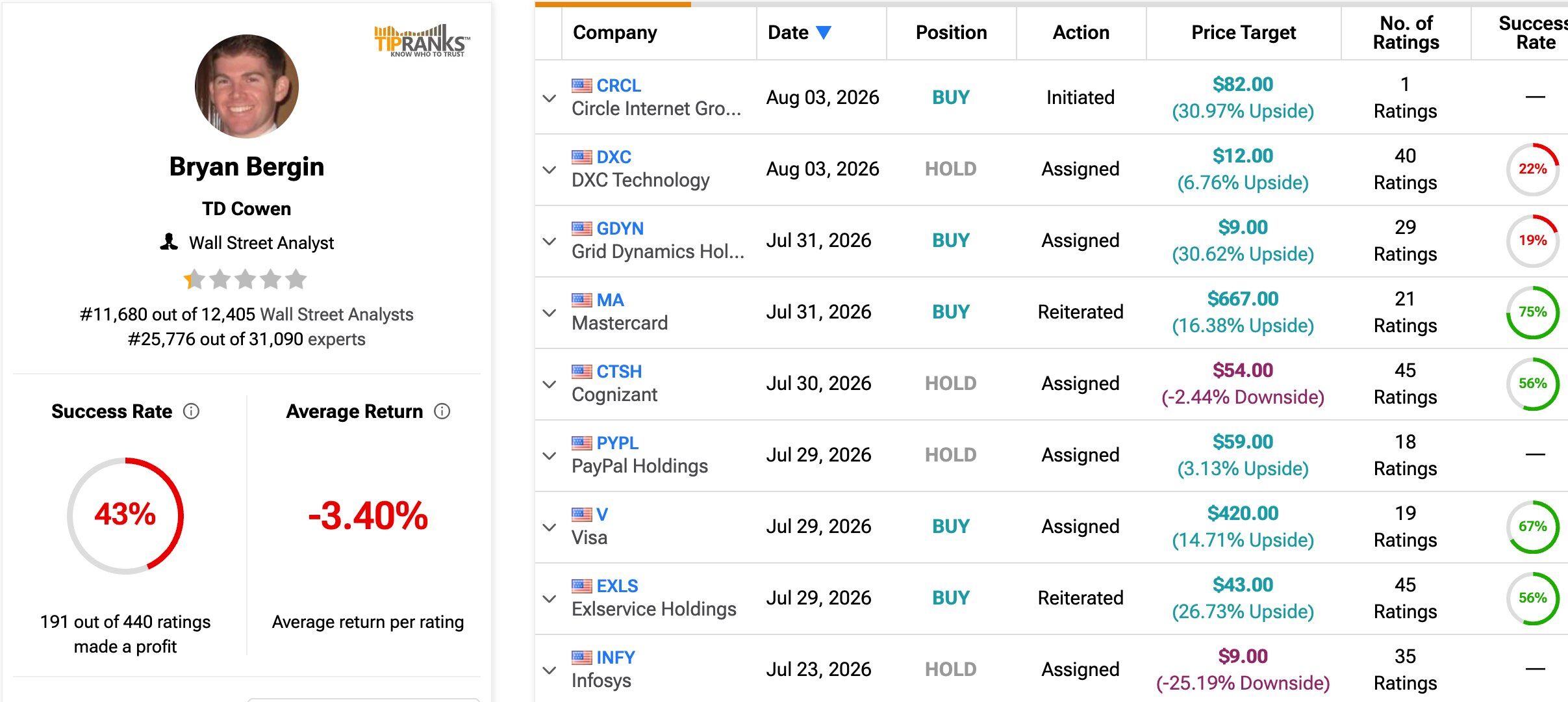
Bergin believes the market may currently be underestimating Circle's potential to transition from a stablecoin issuer to a broader financial infrastructure platform.

Within his analytical framework, Circle's future value does not solely depend on USDC circulation scale, but rather on its ability to build a more comprehensive financial service ecosystem around stablecoins, including businesses such as payments, fund management, real-world asset (RWA) tokenization, developer services, and blockchain infrastructure.

Bergin estimates that by 2030, USDC circulation is expected to maintain a compound annual growth rate of about 31%. Simultaneously, fee-based revenue is projected to grow significantly faster than traditional reserve income. Furthermore, the Arc network that Circle is advancing could be a potential growth catalyst, potentially further expanding Circle's influence in the digital financial infrastructure field.

Another Recent Key Variable: CLARITY Act Progress

Beyond the company's business model, regulatory progress is also an important factor currently affecting market expectations for Circle.

Previously, the market generally viewed the CLARITY Act as a key catalyst for the further development of the stablecoin industry — if the bill ultimately becomes law, stablecoin issuance, trading, and related financial services would obtain a clearer regulatory framework, potentially reducing compliance uncertainty for institutional adoption of stablecoins.

However, currently, the progress of the CLARITY Act does not appear smooth. With only a few working days left before the Senate's summer recess, market expectations for its ability to advance in the short term have noticeably declined.

  • Odaily Note: Refer to "Just One Step Away, Where Is the Clarity Act Stuck?" and "What If the CLARITY Act Ultimately Fails to Pass?"

If the advancement of this bill continues to be delayed, the market may need to reassess the commercialization pace of the stablecoin industry and Circle's growth expectations. Therefore, before the earnings release, the uncertainty surrounding the CLARITY Act has also become a factor suppressing market sentiment towards CRCL.

Earnings Report Approaching, Market Awaits Circle's Answers

Ultimately, Wall Street's divergence on Circle stems not from short-term performance but from differing judgments about the company's future positioning. Bears focus on whether Circle's traditional reserve income model can still support its current valuation if USDC growth slows. Bulls, on the other hand, are betting that Circle can leverage its stablecoin business to gradually grow into a digital financial infrastructure platform.

Therefore, in this earnings report, besides focusing on revenue and profit performance, the market will also closely observe progress in reserve income (especially distribution agreements with Coinbase and other partners), payments, RWA, and other businesses.

After tomorrow night's earnings release, Odaily Planet Daily will promptly bring you an earnings report analysis.


Related Questions

QWhat are the core reasons behind the conflicting valuations of Circle (CRCL) by Morgan Stanley and TD Cowen?

AThe core disagreement lies in how to define Circle. Morgan Stanley sees Circle primarily as a stablecoin issuer dependent on USDC growth, which they believe is slowing, thus making the current valuation too high. TD Cowen views Circle as a technology company evolving into a broader digital financial infrastructure platform, with potential growth beyond just stablecoin issuance.

QWhat specific rating and price target did Morgan Stanley's analyst James Faucette assign to Circle, and what was his main argument?

AJames Faucette of Morgan Stanley downgraded Circle from 'Equal Weight' to 'Underweight' and slashed the price target from $106 to $38. His main argument is that the market has overestimated the future growth potential of USDC's circulation and the expansion of its use cases, which puts pressure on Circle's core 'reserve income' revenue model.

QWhat is TD Cowen analyst Bryan C. Bergin's primary thesis for giving Circle a 'Buy' rating with an $82 target?

ABryan C. Bergin's thesis is that the market underestimates Circle's potential to transform from a stablecoin issuer into a comprehensive digital financial infrastructure platform. He expects growth from services like payments, asset management, RWA tokenization, and the Arc network, with fee-based revenue growing faster than traditional reserve income.

QAccording to the article, what is a key external factor currently influencing market sentiment towards Circle?

AA key external factor is the regulatory progress of the CLARITY Act. Delays in its passage are lowering expectations for the commercialization speed of the stablecoin industry and are seen as a factor suppressing CRCL's market sentiment ahead of the earnings report.

QBeyond revenue and profit, what specific business areas will the market be closely watching in Circle's upcoming earnings report?

AThe market will be closely watching the performance of 'reserve income' (especially distribution agreements with partners like Coinbase), as well as the progress in newer business areas such as payments and Real World Asset (RWA) tokenization services.

Related Reads

Wall Street Morning Report: AI + Cloud Computing Takes Over the Market Again, Amazon Knocks on the Door of $3 Trillion

Wall Street's August began with a strong rally, driven by easing Middle East tensions as President Trump signaled progress on U.S.-Iran talks, prompting a sharp drop in oil prices. Major indices hit record or near-record highs, with the Dow Jones Industrial Average up 1.32%, the Nasdaq Composite surging 2.13%, and the S&P 500 rising 1.48%. The energy sector was the sole decliner. The AI and cloud computing narrative dominated the tech rally. The "Magnificent Seven" index jumped 3.6%. Amazon's market cap surpassed $3 trillion for the first time following robust AWS results, while Nvidia regained a $5 trillion valuation. Meta, Google, and Microsoft also posted significant gains. Other AI-related stocks like Palantir, CoreWeave, and various semiconductor and infrastructure companies saw strong advances. In other markets, gold held above $4,000, supported by central bank buying. Treasury yields fell as oil prices dropped. The U.S. dollar remained stable despite strong manufacturing data. Japan's substantial currency intervention raised concerns, but U.S. officials reassured markets about the mechanism used. Key events ahead include major industry conferences (Ai4 2026, FMS Summit) and earnings reports from companies like SpaceX, AMD, and Pfizer. The White House is also set to host a meeting with leading AI firms to discuss regulatory frameworks.

marsbit7m ago

Wall Street Morning Report: AI + Cloud Computing Takes Over the Market Again, Amazon Knocks on the Door of $3 Trillion

marsbit7m ago

The July Tech Stock Pullback: Which Funds Are Paying the Price for Buying High?

In July, China's technology stocks experienced a sharp correction, causing significant pain for actively managed mutual funds that aggressively increased their holdings in the sector during the second quarter. The sell-off saw major indices like the ChiNext and STAR 50 fall over 25% and 28% for the month, respectively. Funds that piled into tech at its June peak faced steep losses. Notably, several veteran "value investor" fund managers, known for long-term holdings in consumer staples, made dramatic shifts. Star managers like Zhang Kun (E Fund Blue Chip Selected) and Liu Yanchun (Invesco Great Wall Dingyi) drastically reduced positions in liquor stocks like Kweichow Moutai, switching instead to semiconductor and AI hardware companies like SMIC and Ingenic International. Data shows active equity funds' allocation to the electronics sector reached a historical high of 42.64% by end-Q2. Around 67 funds saw their TMT (Technology, Media, Telecom) weighting surge from an average of 6.75% to 54.99%. The consequences were severe in July: these high-TMT funds fell an average of over 20%, with 12 plunging more than 40%. Examples include Jinhua High-Quality Growth and Guoshou Anbao Wenhui, which fell 26.34% and nearly 40% respectively after raising TMT weights above 70%. The article also highlights issues of "style drift," where funds with names like "high-dividend" held high-P/E tech stocks instead, confusing investors. Newly launched funds suffered even more. For instance, Guotai Haitong New Energy RuiXuan Hybrid, launched in mid-June, saw its net asset value plummet to 0.5509 yuan by July 30, a loss of nearly 45%. Analysts note the extreme sector concentration mirrored past bubbles (e.g., 2021 new energy). The intense, crowded trade itself became a major risk. While tech stocks rebounded sharply on July 31, the funds that chased the high face a longer-term market test.

marsbit22m ago

The July Tech Stock Pullback: Which Funds Are Paying the Price for Buying High?

marsbit22m ago

Dalio's Warning: AI Bubble Is Here, Gold Is the Hard Asset

Ray Dalio, founder of Bridgewater Associates, warns that the AI sector is currently in a bubble, drawing parallels to historical examples like the 1929 crash and the dot-com bubble. He explains that revolutionary new technologies lead to excessive excitement and investment, often with investors ignoring price fundamentals and taking on debt, which ultimately creates unsustainable asset valuations. Dalio outlines three key signs that a bubble is about to burst: 1) Rising interest rates, which force asset sales for liquidity. 2) A significant increase in stock supply as companies issue more shares. 3) A shift in ownership from steadfast institutional investors to less knowledgeable, often leveraged, retail investors. To navigate the potential downturn, he strongly advocates for a diversified investment portfolio, criticizing cash as a poor long-term store of value due to inflation. He specifically recommends allocating 5-15% of a portfolio to gold, which he views as a unique "hard asset" and an effective hedge because it is no one else's liability. In contrast, he is skeptical of Bitcoin as "digital gold," citing potential vulnerabilities to future technologies like quantum computing and government intervention. Regarding the AI revolution, Dalio believes the primary beneficiaries will be capitalists who own the automating technology, potentially exacerbating wealth inequality as machines replace both physical and increasingly complex cognitive labor. However, he concludes that humans with exceptional intelligence and strong collaborative skills will continue to thrive by leveraging uniquely human traits like emotion and intuition that AI cannot replicate. Finally, touching on his theory of long-term cycles, Dalio suggests the world is currently approaching a significant inflection point in an approximate 80-year cycle of changing world orders.

marsbit51m ago

Dalio's Warning: AI Bubble Is Here, Gold Is the Hard Asset

marsbit51m ago

On the Eve of Circle's Earnings Report, Wall Street Shows Major Divergence in CRCL Valuation

On the eve of Circle (CRCL) releasing its quarterly earnings report, Wall Street analysts are deeply divided over the company's valuation. Morgan Stanley downgraded Circle from "Equal Weight" to "Underweight," slashing its price target from $106 to $38. Analyst James Faucette argues the market overestimates the growth potential of Circle's core USDC stablecoin, noting its circulation hasn't increased since Q3 2025 and new use cases beyond remittances and card spending are limited. He warns that slowing USDC growth could pressure the crucial "reserve income" and shift revenue toward lower-margin transaction fees. In stark contrast, TD Cowen initiated coverage with a "Buy" rating and an $82 price target. Analyst Bryan Bergin believes the market underestimates Circle's potential to evolve from a stablecoin issuer into a broader digital financial infrastructure platform. He forecasts a ~31% annual growth rate for USDC through 2030 and expects faster growth in fee-based revenue from services like payments, RWA tokenization, and its Arc network. A key external factor adding uncertainty is the stalled progress of the CLARITY Act in the US Senate, whose delay could dampen institutional adoption expectations for stablecoins. The core disagreement lies in whether Circle's future hinges on USDC circulation growth or a successful platform-based transformation. The upcoming earnings report is keenly awaited for insights into reserve income trends and the progress of newer business verticals.

marsbit2h ago

On the Eve of Circle's Earnings Report, Wall Street Shows Major Divergence in CRCL Valuation

marsbit2h ago

Trading

Spot
活动图片