World Cup Quarterfinals Are About to Kick Off, Who Did the AIs Vote to Advance?

Odaily星球日报Published on 2026-07-09Last updated on 2026-07-09

Abstract

The 2026 World Cup quarter-finals are set, with AI models unanimously predicting France, Spain, England, and Argentina to advance to the semi-finals, though they differ on match details. All six AI models (ChatGPT, Claude, Gemini, DeepSeek, Qwen, and Grok) forecast France will defeat Morocco in regulation time, with predicted scores of 2-0 or 2-1. Spain is also favored to beat Belgium, with most AIs predicting a 2-0 or 2-1 win in regular time, though Gemini suggests a possible 1-1 draw leading to a Spanish victory on penalties. The Norway vs. England match is considered the most unpredictable due to Erling Haaland's threat. While all AIs ultimately pick England to advance, predictions range from a 2-1 regulation win to a 2-2 draw requiring extra time. For Argentina vs. Switzerland, AIs predict an Argentine victory, with scores varying from 2-0 to 2-1 in regulation, though Claude and ChatGPT warn the disciplined Swiss could force extra time or a penalty shootout. The core consensus is a final four of France, Spain, England, and Argentina, with the primary disagreements centering on match scores and whether games will require extra time or penalties.

Original | Odaily Planet Daily (@OdailyChina)

Author | Asher (@Asher_ 0210)

With the World Cup quarterfinalists set, the real knockout stage has just begun.

France has maintained a strong team posture, with stable offensive firepower and key players stepping up at crucial moments; Morocco continues its dark horse run, eliminating Canada 3-0 in the round of 16, proving once again they are not a flash in the pan. Spain plays the most steadily, with defensive discipline and possession-based control in place, clinching a last-gasp victory over Portugal in the round of 16 to keep Cristiano Ronaldo out of the quarterfinals; Belgium has reasserted its offensive presence with a resounding 4-1 win over the United States.

On the other side, Norway has become the tournament's biggest surprise, with Erling Haaland leading the team to a 2-1 victory over Brazil, creating the most shocking upset of the knockout stage so far; England, despite a bumpy journey, narrowly defeated Mexico 3-2 thanks to squad depth. Argentina's advancement was the most dramatic, coming back from 0-2 down against Egypt to win 3-2; Switzerland dragged Colombia into a penalty shootout, advancing to the quarterfinals in the most typical "tough nut" fashion.
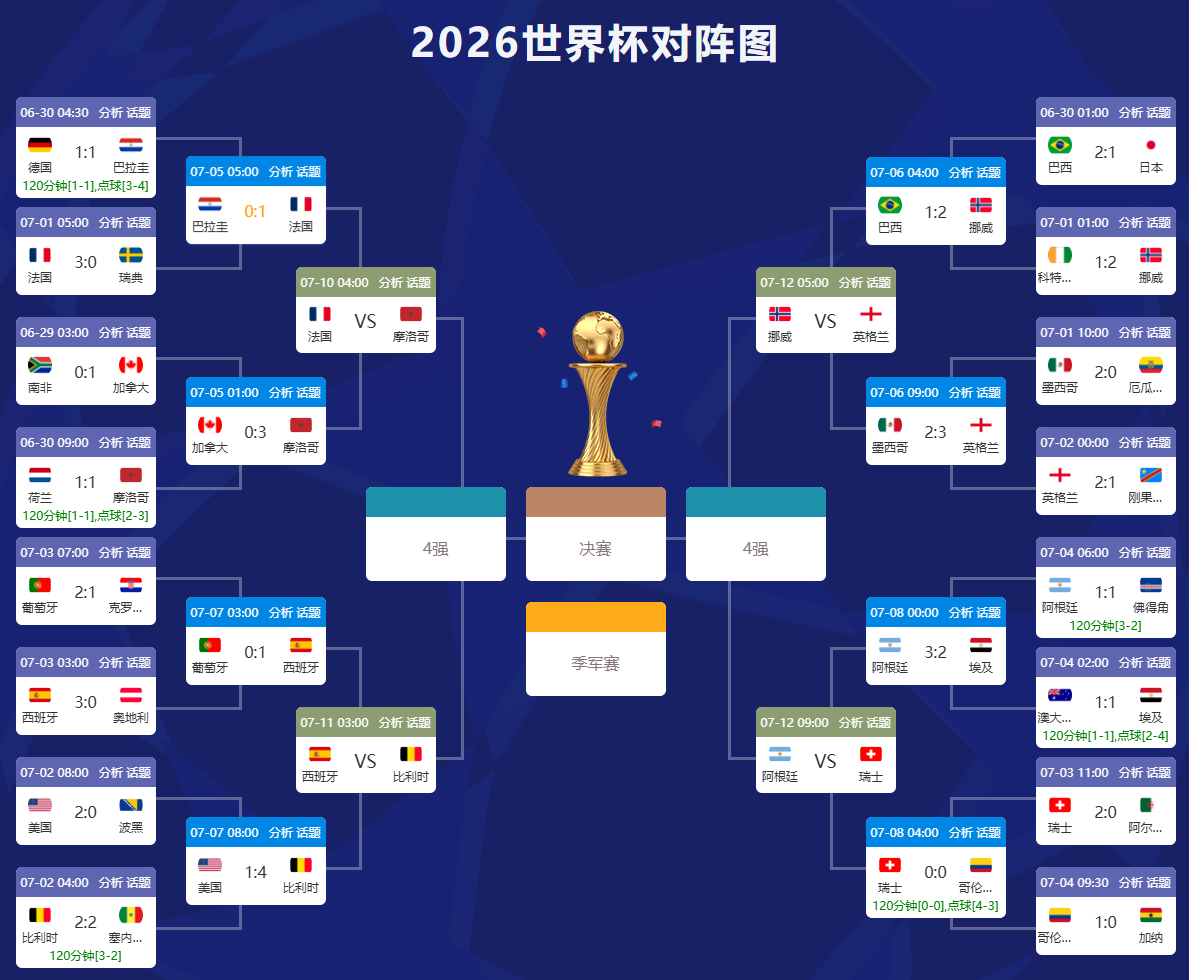
To provide reference for upcoming predictions related to the four quarterfinal matches, I asked ChatGPT, Claude, Gemini, DeepSeek, Qwen, and Grok separately, requesting them to predict the winner, scoreline, and whether each match would go into extra time or penalties for every game.

Looking at the results, the AIs are aligned on the direction of advancement for the four quarterfinal matches, giving the same final four answer: France, Spain, England, and Argentina. The real differences mainly appear in the details such as scores, extra time, and penalties.

AIs All Predict France to Advance, Morocco Unlikely to Repeat Dark Horse Miracle

The first quarterfinal of this World Cup is France vs. Morocco, scheduled for 4:00 AM Beijing Time on July 10th. According to predict.fun data, in regular time, France has a 63% probability of winning; draw probability is 25%; Morocco has a 14% probability of winning. Furthermore, including extra time and penalties, France's advancement probability is 79%, while Morocco's is 22%.
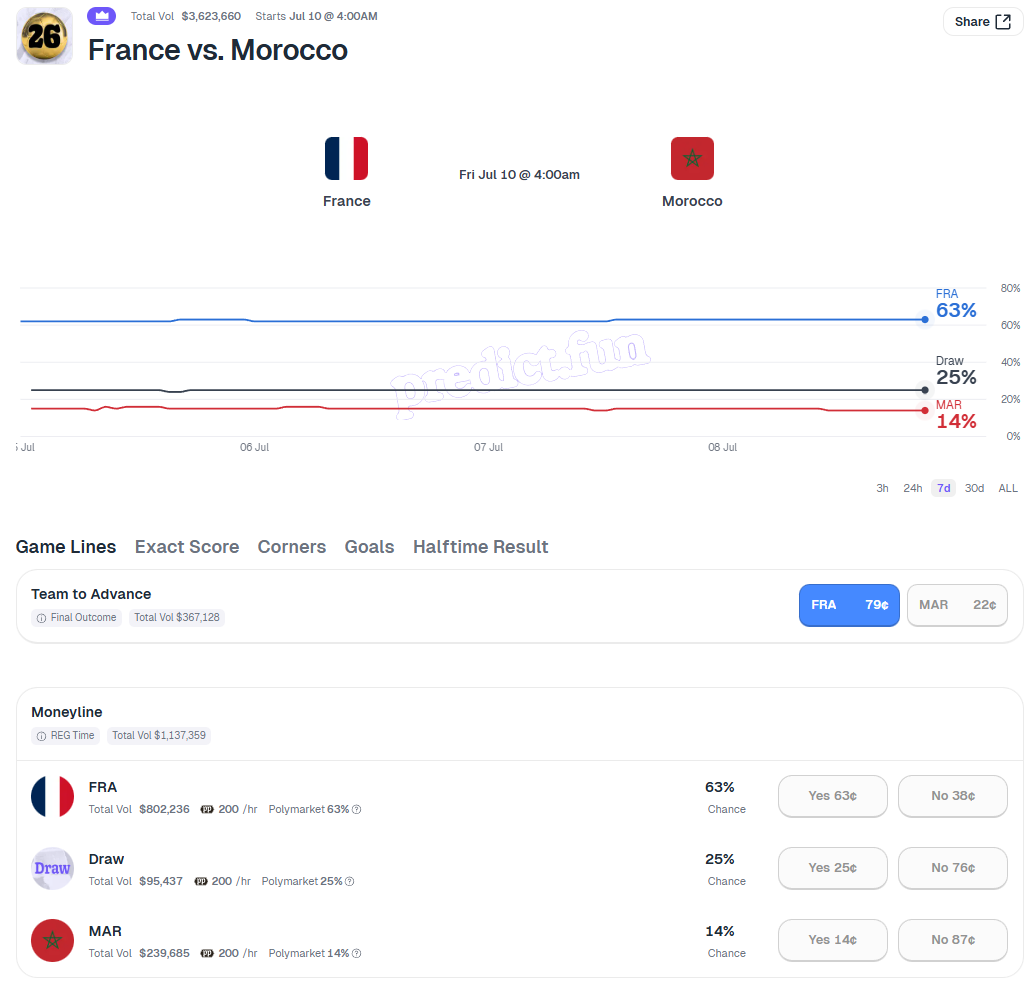
This is also the quarterfinal with the least disagreement among the six AI models. ChatGPT, Claude, Gemini, DeepSeek, Qwen, and Grok all favor France to advance. The only differences lie in whether France will win 2:0 or 2:1, and whether Morocco can score a goal.

Claude and Qwen both predict a 2:0 victory for France. They believe France is the team closest to the championship template this tournament, with forwards like Mbappé, Dembélé, and Olise continuously creating impact, and midfielders like Kanté, Tchouaméni, and Rabiot providing support. France is more complete than Morocco in both offense and defense. While Morocco has proven it's no ordinary dark horse, its squad depth and individual ability are still unlikely to match France head-on.

DeepSeek, Gemini, Grok, and ChatGPT lean more towards a 2:1 win for France. Their judgment is that Morocco won't be easily broken down and still has a chance to create threats through counter-attacks, set pieces, or wing play. However, the issue is that Morocco will find it difficult to consistently contain France's attacking stars for the full 90 minutes. Once the match enters the second half, France's individual quality and bench depth will become increasingly evident.

Overall, the AI models unanimously believe that France will advance within regular time, unlikely to need extra time or penalties.

AIs Place More Trust in Spain, Belgium's Counter-Attack as the Only Variable

The second quarterfinal of this World Cup is Spain vs. Belgium, scheduled for 3:00 AM Beijing Time on July 11th. According to predict.fun data, in regular time, Spain has a 61% probability of winning; draw probability is 25%; Belgium has a 17% probability of winning. Furthermore, including extra time and penalties, Spain's advancement probability is 79%, while Belgium's is 22%.
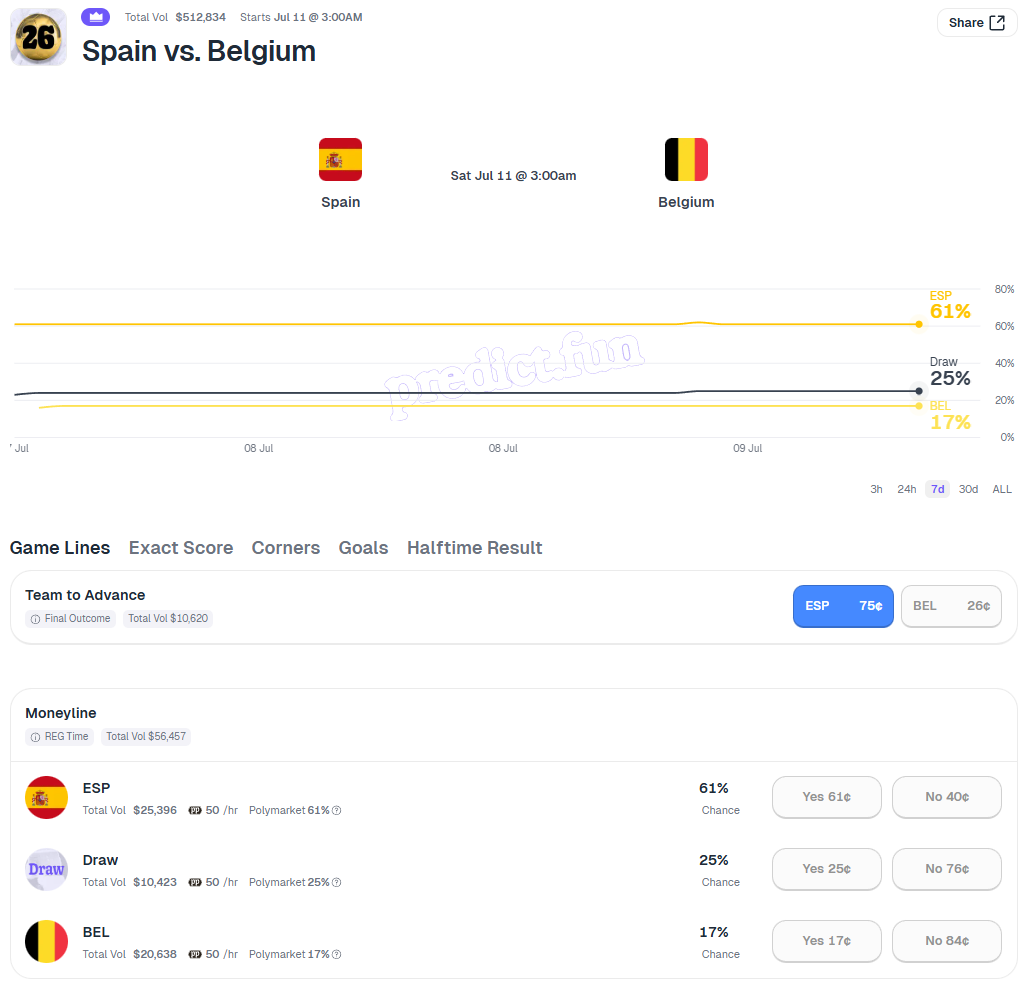
For this match, the six AI models also all favor Spain to advance, but disagreements over the match process are more pronounced than in the France vs. Morocco game.

Claude, Qwen, DeepSeek, and Grok all believe Spain is highly likely to secure victory within regular time, with predicted scores concentrated around 2:0 or 2:1. Their core reasoning is that Spain currently has stronger collective play, with possession, pressing, and defensive discipline all stable, and the match tempo is highly likely to be dictated by Spain.

ChatGPT's prediction is more conservative, favoring a 1:0 win for Spain. It suggests this won't be an open attacking battle but more of a contest between "system stability" and "offensive explosiveness." Spain might not score many goals but is more likely to win the match through possession-based attrition, wing play variations, or a set-piece opportunity.

The only model suggesting extra time and penalties is Gemini. It predicts a 1:1 draw in regular time, with no change in score during extra time, and Spain advancing via a penalty shootout. The key to this prediction is that if Belgium can seize a counter-attack opportunity to score first, Spain could be dragged into a more exhausting, grinding match.

The Match with Greatest AI Disagreement, Haaland Becomes England's Biggest Headache

The third quarterfinal of this World Cup is Norway vs. England, scheduled for 5:00 AM Beijing Time on July 12th. According to predict.fun data, in regular time, Norway has a 23% probability of winning; draw probability is 27%; England has a 53% probability of winning. Furthermore, including extra time and penalties, Norway's advancement probability is 36%, while England's is 66%.
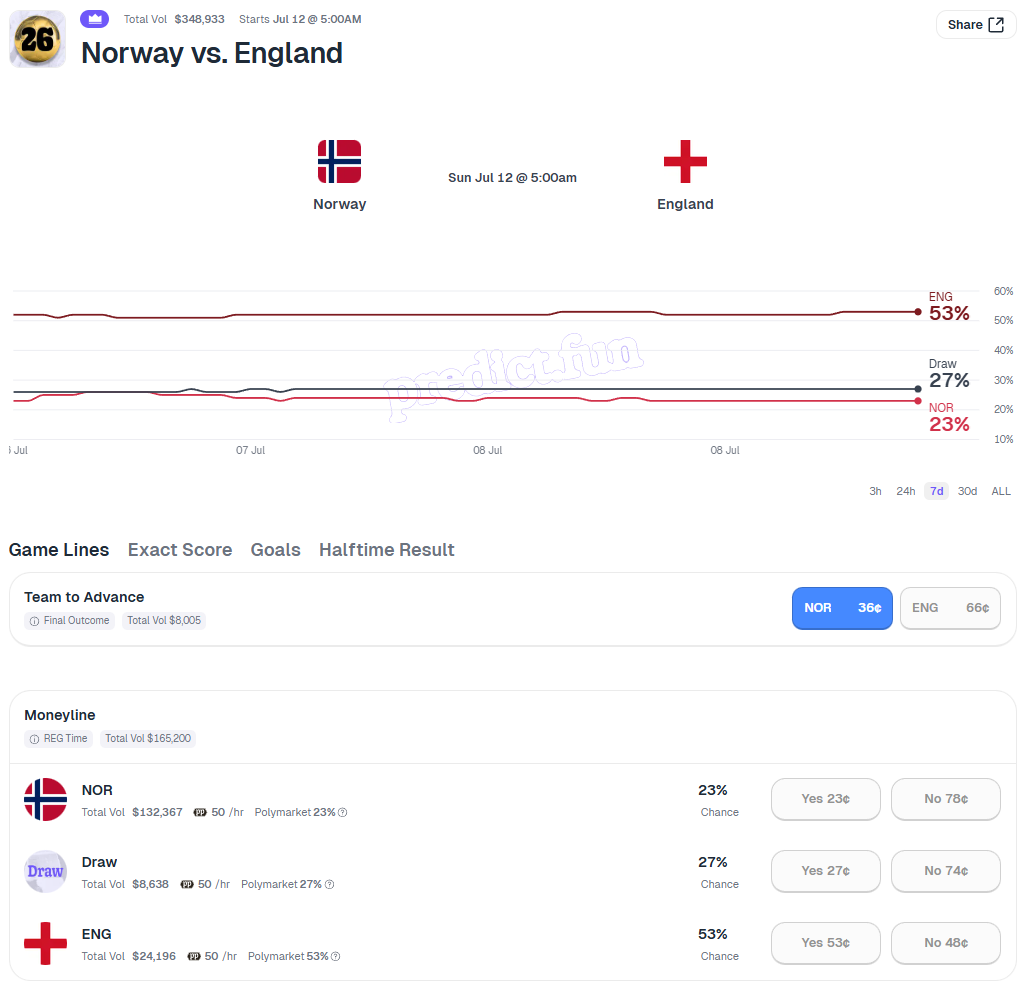
The presence of Haaland makes this knockout match the quarterfinal most likely to produce an upset. Although all six AIs ultimately voted for England to advance, the predictions are noticeably less certain than for the first two matches. Norway's 2:1 victory over Brazil in the previous round is no longer a question of "can they pull off an upset?"—they just did. More importantly, a player like Haaland doesn't need overall dominance; just one opportunity could plunge England into trouble.

Qwen, DeepSeek, and Grok all believe England is highly likely to win 2:1 within regular time. England has better squad depth, with players like Bellingham, Kane, Saka, and Foden all capable of deciding the match. In contrast, Norway's attack relies more heavily on the link-up between Haaland and Ødegaard. Once that connection is cut, Norway's offensive threat will significantly decrease.

However, Claude, Gemini, and ChatGPT are all clearly hedging against the possibility of extra time. Claude thinks England might narrowly win in regular time or be dragged into extra time by Norway; Gemini predicts a 2:2 draw in regular time, with England clinching victory in extra time thanks to bench depth; ChatGPT gives a prediction of 1:1 after 90 minutes, with England advancing 2:1 in extra time.

AIs Favor Argentina to Advance, Switzerland May Drag Match to Penalties

The fourth quarterfinal of this World Cup is Argentina vs. Switzerland, scheduled for 9:00 AM Beijing Time on July 12th. According to predict.fun data, in regular time, Argentina has a 58% probability of winning; draw probability is 28%; Switzerland has a 17% probability of winning. Furthermore, including extra time and penalties, Argentina's advancement probability is 74%, while Switzerland's is 27%.
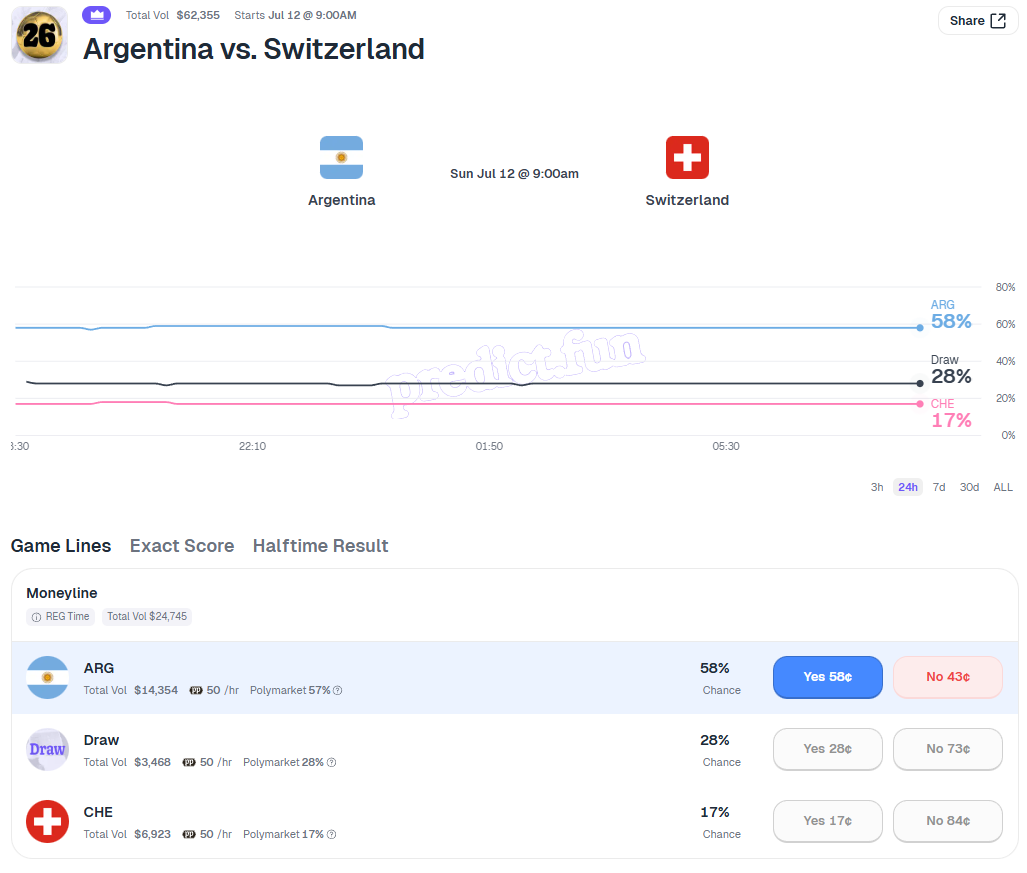
For this match, the AIs unanimously believe Argentina will advance. Unlike the more "dominant favorite" predictions for France and Spain, Argentina vs. Switzerland seems more like a match of patience.

Qwen and Gemini offer the most optimistic predictions, both favoring a 2:0 win for Argentina in regular time. Argentina's comeback from 0:2 down to win 3:2 against Egypt in the previous round has already revitalized the team's form and morale. Facing a team like Switzerland, which isn't particularly prolific in attack, Argentina, as long as they minimize defensive errors, has a chance to settle the match within 90 minutes.

DeepSeek and Grok are more cautious, leaning towards a 2:1 win for Argentina. Switzerland is organized defensively, disciplined, and won't be easily broken down by Argentina. However, the problem lies in Switzerland's lack of sustained offensive pressure. Once Argentina scores first, Switzerland will find it difficult to consistently pull the match back into their preferred rhythm for an extended period.

Those hedging for extra time and penalties are Claude and ChatGPT. Claude believes an opponent like Switzerland could easily force Argentina into a tough battle, possibly leading to a 1:1 draw and extra time, ultimately decided by penalties. ChatGPT directly predicts Argentina advancing via penalties, believing Switzerland has the ability to turn the match into a low-scoring war of attrition, dragging it to the end before relying on goalkeeping and penalty quality.

Related Content

World Cup Kicks Off, Some AI Prediction Models Become Prophets, Others Flop

Predicting World Cup Knockout Matches, Why Such a Big Difference in AI Performance?

Related Questions

QAccording to the article, which four teams did all the AI models unanimously predict to reach the semi-finals of the World Cup?

AAccording to the article, all the AI models (ChatGPT, Claude, Gemini, DeepSeek, Qwen, and Grok) unanimously predicted France, Spain, England, and Argentina to reach the semi-finals.

QWhich quarter-final match did the AI models have the least disagreement about regarding the outcome?

AThe AI models had the least disagreement about the France vs Morocco quarter-final match. All models predicted France would advance without needing extra time or penalties.

QWhy did the article state that the Norway vs England match was the quarter-final with the greatest potential for an upset?

AThe article stated that the Norway vs England match had the greatest potential for an upset because of Erling Haaland's presence. His ability to decide a game with a single chance, coupled with Norway's recent 2-1 upset over Brazil, made the match highly unpredictable despite most AI models still favoring England.

QFor the Spain vs Belgium match, which AI model provided a prediction that involved a penalty shootout?

AFor the Spain vs Belgium match, the Gemini model provided a prediction that involved a penalty shootout. It predicted a 1-1 draw in regular time, no goals in extra time, and Spain advancing via penalties.

QIn the Argentina vs Switzerland match, which AI models predicted the possibility of the game going to extra time or penalties?

AFor the Argentina vs Switzerland match, Claude and ChatGPT predicted the possibility of the game going to extra time or penalties. Claude suggested a 1-1 draw leading to a penalty shootout, while ChatGPT predicted Argentina would advance via penalties.

Related Reads

Manufacturing's Share Drops Below 25%: Is Hangzhou Unconcerned?

Hangzhou is entering a critical phase of industrial restructuring. While its manufacturing-to-GDP ratio has fallen below 25%, the city is not alarmed. Instead, it is strategically navigating a dual focus: advancing advanced manufacturing and expanding its service sector, particularly producer services. Recently, the city celebrated the IPO of a humanoid robotics company, seen as a milestone in moving beyond its e-commerce era. Simultaneously, it set an ambitious target for its service sector: to exceed 2 trillion yuan in value by 2030, with producer services making up over 60%. Data shows a clear trend: the service sector's share of GDP has risen to 75.3%, while manufacturing's share has declined to around 20.1%. This shift revives the debate on whether a strong service sector weakens a city's manufacturing "foundation." Hangzhou's approach challenges the notion of a fixed manufacturing "red line" near 25%. The city argues that the quality and integration of industries matter more than simple ratios. Its strategy is "using software to drive hardware," leveraging its core strengths in digital economy and producer services—like R&D, software, and supply chain management—to empower and add value to manufacturing. This is embodied by its emerging "AI era" companies, whose innovation in Hangzhou feeds into national industrial chains. The city believes that for a hub like Hangzhou, the key is not merely boosting visible manufacturing output, but strengthening the "invisible" competitive edge provided by high-end producer services, which ultimately determine manufacturing profitability. National policy is also shifting from insisting on a "stable" manufacturing share to acknowledging a "reasonable" range, allowing for quality-focused development. Hangzhou's future industrial blueprint aims for a manufacturing share above 22% of GDP by 2027, coupled with a dominant, high-value service sector. The goal is not to choose between manufacturing and services, but to deeply integrate them, using advanced services as the accelerator for next-generation manufacturing.

marsbit5m ago

Manufacturing's Share Drops Below 25%: Is Hangzhou Unconcerned?

marsbit5m ago

SEC Suddenly Proposes "Regulation Crypto": U.S. Token Fundraising May Become Legal Again

On August 18, the U.S. Securities and Exchange Commission (SEC) proposed a landmark set of permanent rules, "Regulation Crypto Assets," specifically designed for crypto asset investment contracts. The 402-page proposal introduces two registration exemption paths and a groundbreaking safe harbor mechanism, representing the SEC's first dedicated crypto-specific regulatory framework. Two exemption tiers are proposed: a "Startup Exemption" allowing a one-time raise of up to $5 million within four years with basic disclosure requirements, and a "Financing Exemption" permitting raises of up to $75 million every 12 months with stricter obligations, including financial statements and ongoing reporting. Both paths require "principles-based narrative disclosure," a flexible approach distinct from traditional IPO forms. The most transformative element is the investment contract safe harbor. It provides a legal path for tokens to "graduate" from being classified as securities. If an issuer completes or permanently ceases its "essential managerial efforts" as promised in the investment contract and meets specific conditions, it can file with the SEC to have the token exit the securities framework. This creates a novel legal lifecycle where a token can begin as a regulated security for fundraising and later become a non-security asset as the network decentralizes. This move is seen as the SEC pragmatically filling a legislative vacuum, as the stalled CLARITY Act in Congress faces significant delays. The proposal aims to offer a compliant pathway for token offerings within the U.S., countering the trend of projects moving overseas. While currently a proposal open for a 60-day public comment period, it signals a major potential shift from an enforcement-heavy approach toward establishing clearer rules for the crypto industry.

marsbit9m ago

SEC Suddenly Proposes "Regulation Crypto": U.S. Token Fundraising May Become Legal Again

marsbit9m ago

Late Qing County Magistrates' 'Official Debt' and the Crypto World's 'Exchange Listings': The Cross-Temporal Truth of Financializing Power

This article draws parallels between financialization of power in late Qing Dynasty China and the modern cryptocurrency industry. It opens with a staggering contemporary corruption case involving billions, illustrating how official positions control massive cash flows, akin to toll booths. The core analysis focuses on Du Fengzhi, a late Qing county magistrate. His 22-year journey from passing the provincial exam to finally obtaining a post highlights how bureaucratic "qualification" (like a VC investment) doesn't guarantee immediate benefit. Crucially, upon receiving his appointment, Du had to borrow heavily—"official debt"—to cover travel and networking costs to actually assume his position. Lenders, seeing his future post as a revenue-generating asset, offered loans with exorbitant effective interest rates (e.g., borrowing 4000 taels but receiving only 2000), effectively discounting and financializing his future power. Once in office, Du faced immense pressure from both public tax quotas and his crippling private debt. His diaries reveal aggressive, sometimes extreme, tax collection methods (sealing ancestral temples, pressuring local gentry) to meet these demands. The article argues this created a system where public duty and private financial survival became indistinguishable, with corruption evolving from operational necessity to normalized practice. The piece consistently analogizes this to crypto: VC funding as mere "qualification," the costly "listing" process on exchanges, the role of market makers and KOLs as intermediaries akin to local gentry, and the relentless pressure on funded projects to deliver returns—often leading to perpetual pivots, artificial metrics, and ultimately, the extraction of value from retail liquidity. Both systems, it concludes, are driven by the financialization of future potential, trapping individuals in cycles of debt and obligation with limited alternatives for upward mobility.

marsbit16m ago

Late Qing County Magistrates' 'Official Debt' and the Crypto World's 'Exchange Listings': The Cross-Temporal Truth of Financializing Power

marsbit16m ago

U.S. Stock Market Trends (August 19th): AI Hardware Rally Loosens, Long-Term Bond Yields Challenge Tech Valuations

U.S. stocks weakened further on Tuesday, with major indices hitting two-week lows for a third consecutive session. Pressure centered on the AI hardware sector, as the previously rebounding Philadelphia Semiconductor Index fell sharply. Meanwhile, persistently high long-term Treasury yields and rising oil prices fueled by Middle East tensions prompted a cautious reassessment of high-valuation tech assets. Key closing data: The S&P 500 fell 0.69%, the Dow Jones dropped 0.22%, and the Nasdaq declined 1.33%. The 10-year Treasury yield hovered near 4.70%, while the 30-year yield briefly touched a new high since 2007 before settling around 5.28%. WTI crude rose to $84.94. The chip sector led the decline, with the Philadelphia Semiconductor Index dropping about 5%. Losses spread across memory, optical communication, and AI infrastructure stocks. This shift indicates investor focus is moving from chasing AI demand momentum to evaluating valuations and earnings timing. The "Magnificent Seven" stocks showed mixed performance, with pressure more concentrated on AI hardware than software giants. The market is observing whether capital will rotate back to large-cap tech, sustaining the internal AI sector rotation, or if the broader AI trade is entering a cooling phase. Chinese stocks were mostly weaker, with the Nasdaq Golden Dragon China Index down about 1%. Baidu's stock fell sharply post-earnings due to profit pressure from AI investments, while Alibaba gained. Persistently high long-term bond yields and rising oil prices are re-emerging as key anchors for U.S. stock pricing, constraining valuation multiples for AI-related companies. Corporate events, including earnings from Home Depot and AI financing news like Anthropic's reported credit line expansion, continue to highlight cost and capital expenditure pressures. Focus for the coming sessions: 1) Whether the 30-year Treasury yield stabilizes below 5.30%, and 2) The market's ability to absorb the chip sector sell-off, determining if it's a pre-earnings consolidation or the start of a broader AI hardware cool-down.

marsbit20m ago

U.S. Stock Market Trends (August 19th): AI Hardware Rally Loosens, Long-Term Bond Yields Challenge Tech Valuations

marsbit20m ago

Galaxy Research: Crypto Lending Contracts for Third Consecutive Quarter, Market Undergoing Orderly Deleveraging

**Galaxy Research Report: Crypto Lending Market Sees Orderly Deleveraging for Third Consecutive Quarter** The crypto asset-backed lending market contracted for a third consecutive quarter in Q2 2026, shrinking by $11.33B (-16.78%) to a total of $56.16B. This represents a 40.13% decline from the Q3 2025 peak. The process is marked by a controlled, "stair-step" decline rather than the sharp, cascading collapses seen in 2022, suggesting a healthier, more orderly deleveraging driven by market retrenchment rather than forced liquidations. Key findings include: * **CeFi vs. DeFi:** Centralized Finance (CeFi) lending ($22.98B) surpassed Decentralized Finance (DeFi) lending ($20.43B) for the first time since Q3 2023, as DeFi loan volumes fell 27.61% quarter-over-quarter. * **Market Leaders:** Tether remains the dominant CeFi lender, holding 58.54% market share. CeFi's top three players (Tether, Maple, Nexo) control nearly 75% of that segment. * **Corporate Debt:** Debt used by companies for digital asset treasury strategies declined by $1.5B to $16.1B, mainly due to a debt buyback by MicroStrategy. * **Rates & Leverage:** Stablecoin borrowing costs edged higher. Analysis of Aave V3 shows e-mode loans, primarily used for leveraged Ethereum staking strategies, carry significantly higher risk (debt-weighted avg. Health Factor ~1.06) compared to standard loans. * **Futures:** Aggregate futures open interest (OI) was relatively stable, down only 3.08% to $103.2B at quarter-end, though it has since rebounded. BTC and ETH futures OI together comprised 65% of the total. In conclusion, the crypto market continues to shed leverage in a measured manner. If this trend persists, the market may avoid the type of disorderly, cascading failures seen in the last cycle, even if lending activity continues to contract.

marsbit41m ago

Galaxy Research: Crypto Lending Contracts for Third Consecutive Quarter, Market Undergoing Orderly Deleveraging

marsbit41m ago

Trading

Spot
活动图片