Germany Widens Lead in MiCA Licenses: EU Register Gains 6 Banks

cryptonews.ruPublished on 2026-08-24Last updated on 2026-08-24

Abstract

Germany has extended its lead in the number of providers licensed under the EU's Markets in Crypto-Assets (MiCA) regulation, with six German cooperative banks newly added to the European Securities and Markets Authority (ESMA) register. The latest ESMA update brings the total number of authorized Crypto-Asset Service Providers (CASPs) to 331. Germany now hosts 79 registered CASPs, significantly more than France (35) and the Netherlands (29). The country's large financial sector, the high number of credit institutions permitted to offer crypto services, and a pre-existing national licensing regime that facilitated a simplified transition to MiCA are cited as key reasons for this lead. ESMA's registers for asset-referenced tokens (ART) and electronic money tokens (EMT) remain unchanged, with the ART list still empty and the EMT list containing 43 entries.

Germany has increased its lead in the number of providers licensed under the EU's Markets in Crypto-Assets (MiCA) Regulation: six German cooperative banks have appeared in the latest version of the register.

The European Securities and Markets Authority (ESMA) updated its MiCA register on Friday, bringing the number of authorized crypto-asset service providers (CASP) to 331.

Compared to the update from August 12, all six new entrants were German cooperative banks: Raiffeisenbank Aidlingen, Ihre Volksbank, VR-Bank Mittelfranken Mitte, Volksbank Euskirchen, VR Bank Ried-Überwald, and Volksbank Backnang.

Germany has 79 registered CASPs — compared to 35 in France and 29 in the Netherlands. According to ESMA data, previously reviewed by Cointelegraph, the total number of providers in Germany rose from 57 at the end of June, when the country was already leading in the number of MiCA licenses.

Germany's Federal Financial Supervisory Authority (BaFin) told Cointelegraph in June that the high number of MiCA authorizations in the country is partly explained by the size of its financial sector and the number of credit institutions eligible to offer crypto services. BaFin also cited Germany's existing national licensing regime, which provided some CASPs with access to simplified authorization procedures during the transition to MiCA.

ESMA's datasets for asset-referenced tokens (ART), e-money tokens (EMT), and non-compliant entities remained unchanged. The ART register is still empty, the EMT register contains 43 entries, and the list of non-compliant entities still has 167 entries.

Read More: Bitpanda Fined in First Published MiCA Penalty in Austria

end-content
Related Questions

QWhat is the main news reported in the article?

AThe main news is that Germany has increased its lead regarding the number of providers licensed under the EU's MiCA (Markets in Crypto-Assets) regulation, with six new German cooperative banks added to the EU's register.

QWhich European authority maintains and updates the MiCA register mentioned in the article?

AThe MiCA register is maintained and updated by the European Securities and Markets Authority (ESMA).

QWhat is the total number of authorized Crypto-Asset Service Providers (CASP) in the EU register after the latest update?

AAfter the latest update, the total number of authorized Crypto-Asset Service Providers (CASP) in the EU register is 331.

QAccording to the German financial regulator BaFin, what are two reasons for Germany having a high number of MiCA licenses?

AAccording to BaFin, the two reasons are: 1) the size of Germany's financial sector and the number of credit institutions entitled to offer crypto services, and 2) a pre-existing national licensing regime that allowed some CASPs access to simplified authorization procedures during the transition to MiCA.

QWhich specific categories within the ESMA dataset remained unchanged, and what are their respective counts?

AThe datasets for Asset-Referenced Tokens (ART), Electronic Money Tokens (EMT), and non-compliant entities remained unchanged. The ART register is still empty, the EMT register has 43 entries, and the list of non-compliant entities still has 167 entries.

Related Reads

US Jobs, China PMI, and Inflation on Stage: Can Global Growth Maintain Resilience?

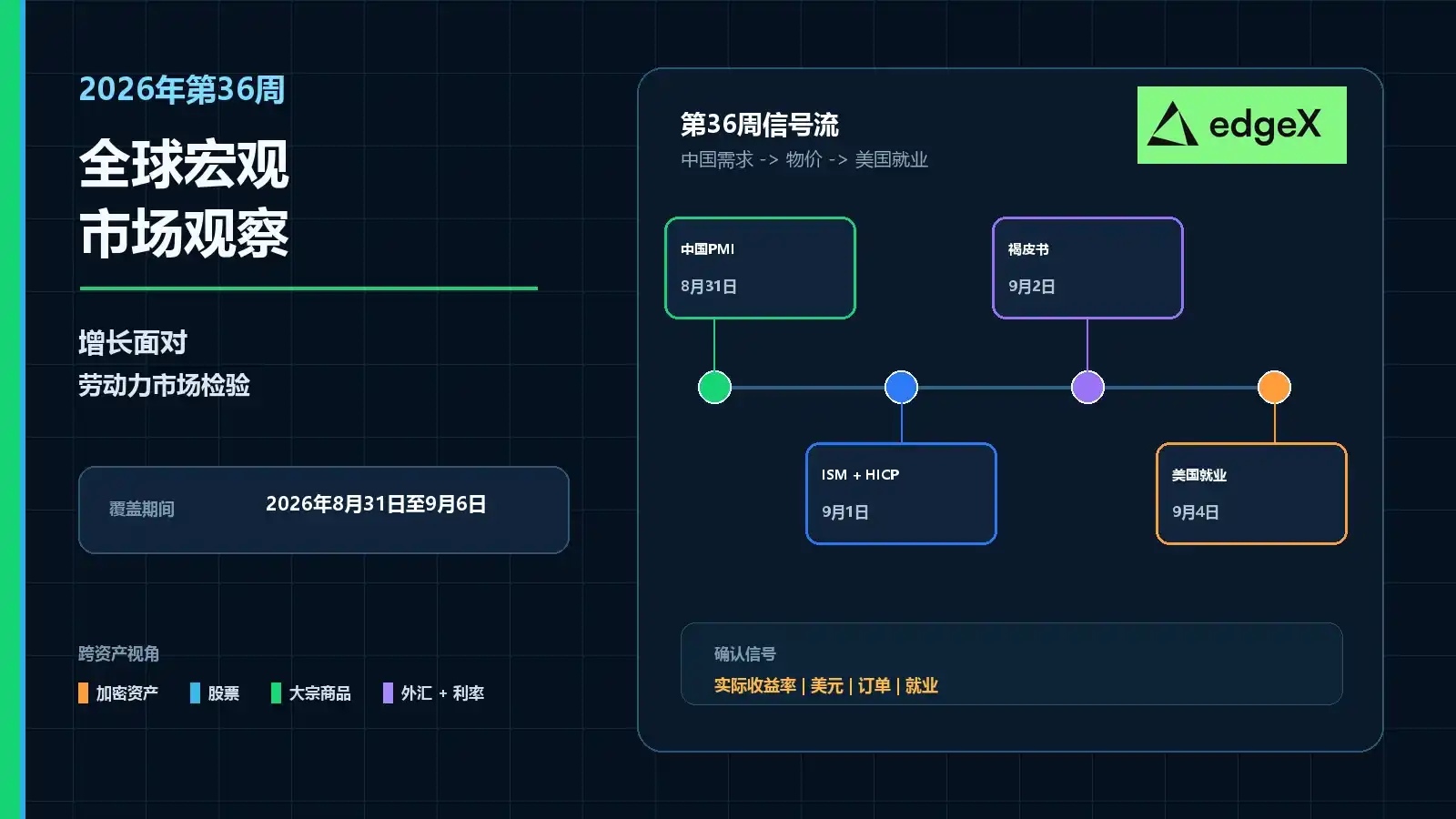
**Week 36 Macro Outlook: Key Data to Test Global Growth Resilience** The week from August 31 to September 6 will shift focus from policy discussions to a critical test of global economic activity. The sequence of events is key, starting with China's official August PMI on Aug 31, which will provide early signals on factory orders, services, and employment following July's contraction. The data flow then broadens. On September 1, US ISM Manufacturing PMI and the Eurozone's flash inflation estimate will offer simultaneous checks on demand, prices, and regional divergence. The subsequent US Federal Reserve Beige Book on September 2 adds granular, qualitative evidence on consumer spending, wages, and regional conditions. Australian Q2 GDP and Canadian trade and jobs data will test resilience in other major economies. The week's pivotal event, however, is the US August employment report on September 4. It will decisively influence expectations for interest rates, the US dollar, and broader risk appetite, acting as a final cross-check for the preceding data. The core question for markets is whether global growth can remain resilient. An ideal outcome would combine a rebound in China's PMI, stable US jobs growth, cooling inflation, and signs of a gradual demand slowdown. Conversely, weak Chinese manufacturing, sticky Eurozone prices, and disappointing US non-farm payrolls would create a more complex scenario of reduced corporate confidence and limited room for aggressive monetary easing, increasing pressure on cyclical assets. Investors should monitor the breadth of improvements—such as new orders and employment—rather than headline PMI figures alone. Confirmation across different data points is crucial. A positive combination of steady activity and disinflation could support equities, industrial commodities, and risk assets like crypto. However, if a growth slowdown triggers lower yields, it must be distinguished from a scenario of rising recession risks that would pressure corporate earnings, potentially limiting rallies. The market's final reaction will hinge on whether the week's signals align to either reinforce or challenge the current growth narrative.

marsbit1m ago

US Jobs, China PMI, and Inflation on Stage: Can Global Growth Maintain Resilience?

marsbit1m ago

Expert Assesses Bitcoin's Growth Prospects After Consolidation Above $74K

Bitcoin remains above the significant technical level of $74,000 and could continue its move toward higher levels in the near future, although the market still faces correction risks, according to Kirill Komalenkov, Director of Strategic Communications at Bitbanker. He maintains a cautious outlook, noting that despite strong recent growth and improved technical indicators, a scenario for a significant correction is still possible. Currently, Bitcoin is trading around $77,3 thousand, consolidating near local highs of approximately $78,000. Komalenkov highlighted that holding above $74,000 increases the likelihood of altering the previous downward market structure, but this is not yet a definitive confirmation of a reversal. The next crucial level for Bitcoin is $82.5 thousand. A decisive break above this level would be a stronger signal of a structural market shift and could pave the way for further gains. In the coming days, the expert expects the main battle to be in the $76,000–$78,000 range. If support in the $74,000–$76,000 zone holds and the price breaks above $78,000, the next short-term targets could be $80,000–$82.5 thousand. Komalenkov warned that even a breakthrough above $82.5 thousand does not preclude a pullback. After a strong rally, the market could first decline to around $68,000 to gather liquidity before resuming its upward move. The next significant resistance zone is identified in the $98,000–$102,000 range. A confident break and hold above this level would substantially increase the probability of Bitcoin reaching new all-time highs. However, the expert also pointed to risks inherent in the modern cryptocurrency market, where many participants follow obvious technical scenarios and substantial liquidity can heavily influence price movements. Despite the current positive momentum, the possibility of a deeper correction remains. In the event of a sharp downturn, Komalenkov views the $44,000–$48,000 range as a potential area for forming a long-term market bottom. In related news, Russian Deputy Finance Minister Ivan Chebeskov stated on June 16 that non-qualified investors in Russia will soon be able to legally purchase Bitcoin, Ethereum, and popular stablecoins, with an annual limit of 300,000 rubles per intermediary.

cryptonews.ru42m ago

Expert Assesses Bitcoin's Growth Prospects After Consolidation Above $74K

cryptonews.ru42m ago

Trading

Spot
活动图片