Ripple Wins Another XRP Lawsuit: Court Throws Out Class Action

bitcoinistPublished on 2026-01-29Last updated on 2026-01-29

Abstract

A US appeals court upheld a summary judgment in favor of Ripple, dismissing a class action lawsuit alleging the sale of unregistered XRP securities. The court ruled the claims were time-barred by the Securities Act's three-year statute of repose, which began with Ripple's public offerings of XRP as early as 2013. The plaintiff argued that a 2017 sale constituted a separate offering, but the court found no material change in the nature of XRP and affirmed that the repose period had expired by the time the lawsuit was filed in 2018.

Ripple scored another courtroom win tied to XRP sales, after the US Court of Appeals for the Ninth Circuit affirmed summary judgment against investors who alleged the company sold unregistered securities, ruling the federal Securities Act claims were time-barred by the statute of repose.

In a not-for-publication memorandum filed Jan. 27, 2026, a three-judge panel upheld the Northern District of California’s decision that the three-year repose period in Section 13 of the Securities Act had already run by the time the class action was filed.

Ripple Wins: Court Punts XRP Securities Claims

The case was led by Bradley Sostack, who purchased XRP in January 2018 on Poloniex. The underlying class complaint was filed later in 2018; Sostack was appointed lead plaintiff in 2019 and amended the complaint in 2020.

At the center of the appeal was when XRP was “bona fide offered to the public” for purposes of the Securities Act’s repose clock. The ruling sided with Ripple, pointing to early XRP distribution and trading activity tied to the XRP Ledger’s built-in exchange.

“According to the record in this case, Ripple was offering XRP to the public as early as 2013. It is undisputed that Ripple sold over 500 million XRP on the Ledger’s built-in digital asset exchange. Those offers were made ‘to the public’ even if only technologically sophisticated consumers could navigate the Ledger to purchase XRP.”

That framing mattered because Section 13’s statute of repose is unforgiving: once the three years run from the first public offering, later buyers can’t revive a federal Section 12(a)(1) registration claim by filing years afterward. The district court had reached the same conclusion in its June 20, 2024 summary judgment order on the federal class claims.

Sostack’s primary effort to avoid the time bar was to argue Ripple’s conduct in 2017, when the company began releasing its XRP holdings in monthly tranches, amounted to a separate, later offering (or effectively a new investment contract) that should restart the clock.

The panel rejected that attempt to split the timeline, emphasizing the nature of the asset itself and the absence of a factual dispute that the 2013 and 2017 activity should be treated as distinct offerings.

“But Sostack has failed to raise a material issue of fact that the 2013 offering and the 2017 offering were separate offerings. The nature of XRP did not change between 2013 and 2017; all XRP cryptocurrency remained fungible and interchangeable.”

With no separate-offering finding, the panel held the repose period began with the 2013 public offering, leaving the 2018/2019 filings outside the window and affirming judgment for Ripple. The decision is also procedurally narrow: because the district court’s Rule 54(b) certification covered only certain claims, the Ninth Circuit said it was limiting its ruling accordingly.

At press time, XRP traded at $1.88.
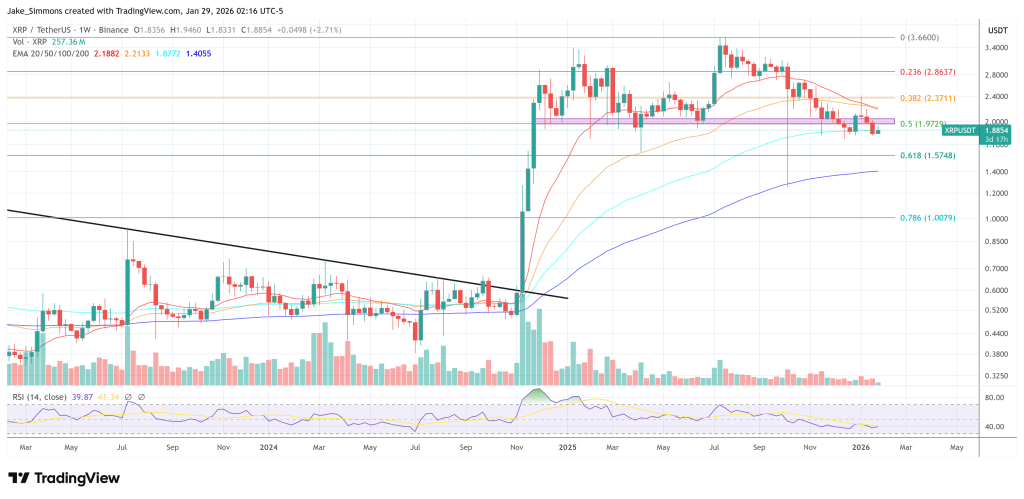
XRP tries to close above the 100-week EMA, 1-week chart | Source: XRPUSDT on TradingView.com

Related Questions

QWhat was the main reason the US Court of Appeals for the Ninth Circuit ruled in favor of Ripple in the class action lawsuit?

AThe court ruled that the federal Securities Act claims were time-barred by the statute of repose, as the three-year repose period had already run by the time the class action was filed.

QWhen did the court determine that Ripple first began offering XRP to the public, which started the repose clock?

AThe court determined that Ripple was offering XRP to the public as early as 2013.

QWho was the lead plaintiff in the class action case against Ripple?

AThe lead plaintiff was Bradley Sostack, who purchased XRP in January 2018 on Poloniex.

QWhat argument did the plaintiff use to try to avoid the time bar, and why did the court reject it?

AThe plaintiff argued that Ripple's conduct in 2017, releasing XRP in monthly tranches, was a separate offering that should restart the clock. The court rejected this, stating that the nature of XRP did not change and the 2013 and 2017 activity were not separate offerings.

QWhat was the trading price of XRP at the time the article was published?

AAt press time, XRP traded at $1.88.

Related Reads

From Leek Glasses to On-Chain Danmaku and DEV Pumping: How Creative Was the Solana Online Hackathon?

From January 20 to 30, 2026, the Solana Online Hackathon, co-hosted by Trends and the Solana Chinese community, was held entirely online with project submissions and presentations conducted via X (formerly Twitter). This open-format event encouraged real-time community feedback and emphasized practical, user-oriented applications across several tracks. The grand prize winner was **The MM Hunter**, a quantitative trading tool using LightGBM machine learning to analyze Binance order books and automate trades via Orderly Network APIs. Other notable winners included: - **Peak Trading**: An AI-powered terminal for trade logging, risk management, and AI-assisted review. - **Eagle Dove Hunter**: Automates macro-economic data parsing and executes trades based on risk signals. - **MoonMate**: A gamified AI trading companion with multi-agent decision systems. - **Chitu**: A system monitoring smart money movements on Solana and sending alerts via DingTalk. - **Voiverse**: An AI tool filtering noise from social media to deliver personalized alpha signals. - **TradeCat**: An open-source alpha toolbox with multi-market data and signal generation. In the Internet Capital Market track, winners included a wallet visualization tool converting holdings into Agar.io-style videos, **Leek Vision** (a browser extension displaying crypto equivalents of fiat prices), and **Sendit** (an on-chain comment system overlaying chat on trading charts). The Consumer & Entertainment category featured **Insider Loo

Odaily星球日报3m ago

From Leek Glasses to On-Chain Danmaku and DEV Pumping: How Creative Was the Solana Online Hackathon?

Odaily星球日报3m ago

Bitwise Chief Investment Officer: The Long Night Is at Its Deepest, a Glimmer of Light for the Crypto Market Is Near

Bitwise's Chief Investment Officer asserts that the crypto market has been in a severe winter since January 2025, though its end is likely nearer than its beginning. While Bitcoin and Ethereum are down 39% and 53% from their October 2025 peaks, respectively, many other assets have fallen even more sharply. This isn't a typical bull market pullback but a full-scale crypto winter, driven by over-leverage and large-scale profit-taking by early investors. Despite positive developments in adoption and regulation, prices continue to fall because bear markets often ignore good news. Historically, crypto winters last around 13 months. However, the current downturn may have started earlier than perceived, as massive inflows into Bitcoin and Ethereum ETFs, along with crypto treasury products (DATs), masked underlying weakness in the broader market. These institutional purchases, totaling approximately $75 billion in Bitcoin alone, provided crucial support floor—without which declines could have been much steeper. The market is now categorized into three groups: assets with strong institutional support (like BTC and ETH) saw milder declines; those with recent ETF approvals fell more significantly; and assets without such backing experienced severe drops. The current climate feels hopeless, but the fundamental strengths of crypto—regulatory progress, institutional adoption, and real-world utility—remain intact. These positive factors are accumulating potential that is likely to trigger a strong rebound once sentiment shifts, possibly driven by economic growth, regulatory clarity, or sovereign adoption. The darkest hour is just before dawn, and spring may be closer than it appears.

marsbit16m ago

Bitwise Chief Investment Officer: The Long Night Is at Its Deepest, a Glimmer of Light for the Crypto Market Is Near

marsbit16m ago

Trading

Spot
Futures

Hot Articles

How to Buy WIN

Welcome to HTX.com! We've made purchasing WINkLink (WIN) simple and convenient. Follow our step-by-step guide to embark on your crypto journey.Step 1: Create Your HTX AccountUse your email or phone number to sign up for a free account on HTX. Experience a hassle-free registration journey and unlock all features.Get My AccountStep 2: Go to Buy Crypto and Choose Your Payment MethodCredit/Debit Card: Use your Visa or Mastercard to buy WINkLink (WIN) instantly.Balance: Use funds from your HTX account balance to trade seamlessly.Third Parties: We've added popular payment methods such as Google Pay and Apple Pay to enhance convenience.P2P: Trade directly with other users on HTX.Over-the-Counter (OTC): We offer tailor-made services and competitive exchange rates for traders.Step 3: Store Your WINkLink (WIN)After purchasing your WINkLink (WIN), store it in your HTX account. Alternatively, you can send it elsewhere via blockchain transfer or use it to trade other cryptocurrencies.Step 4: Trade WINkLink (WIN)Easily trade WINkLink (WIN) on HTX's spot market. Simply access your account, select your trading pair, execute your trades, and monitor in real-time. We offer a user-friendly experience for both beginners and seasoned traders.

3.0k Total ViewsPublished 2024.03.29Updated 2025.03.21

Discussions

Welcome to the HTX Community. Here, you can stay informed about the latest platform developments and gain access to professional market insights. Users' opinions on the price of WIN (WIN) are presented below.

活动图片