Crypto groups slam Citadel for urging tighter DeFi tokenization rules

cointelegraphОпубликовано 2025-12-13Обновлено 2025-12-13

Введение

A coalition of crypto organizations, including Andreessen Horowitz and the Uniswap Foundation, has criticized Citadel Securities for urging the SEC to impose stricter regulations on DeFi platforms offering tokenized stocks. The group argues that Citadel's proposal relies on a flawed analysis of securities laws and would inappropriately extend registration requirements to decentralized entities. They contend that regulating DeFi under traditional securities frameworks is impractical and fails to recognize that autonomous software cannot act as a regulated intermediary. While sharing the goal of investor protection, the coalition believes it can be achieved through onchain markets without mandatory registration. Citadel had warned that exempting DeFi could create a dual regulatory system and deprive investors of key protections. The debate arises as the SEC seeks feedback on regulating tokenized assets.

A group of crypto organizations has pushed back on Citadel Securities’ request that the Securities and Exchange Commission tighten regulations on decentralized finance when it comes to tokenized stocks.

Andreessen Horowitz, the Uniswap Foundation, along with crypto lobby groups the DeFi Education Fund and The Digital Chamber, among others, said they wanted “to correct several factual mischaracterizations and misleading statements” in a letter to the SEC on Friday.

The group was responding to a letter from Citadel earlier this month, which urged the SEC not to give DeFi platforms “broad exemptive relief” for offering trading of tokenized US equities, arguing they could likely be defined as an “exchange” or “broker-dealer” regulated under securities laws.

“Citadel’s letter rests on a flawed analysis of the securities laws that attempts to extend SEC registration requirements to essentially any entity with even the most tangential connection to a DeFi transaction,” the group said.

The group added they shared Citadel’s aims of investor protection and market integrity, but disagreed “that achieving these goals always necessitates registration as traditional SEC intermediaries and cannot, in certain circumstances, be met through thoughtfully designed onchain markets.”

Citadel’s ask would be impractical, group says

The group argued that regulating decentralized platforms under securities laws “would be impracticable given their functions” and could capture a broad range of onchain activities that aren’t usually considered as offering exchange services.

The letter also took aim at Citadel’s characterization that autonomous software was an intermediary, arguing it can’t be a “‘middleman’ in a financial transaction because it is not a person capable of exercising independent discretion or judgment.”
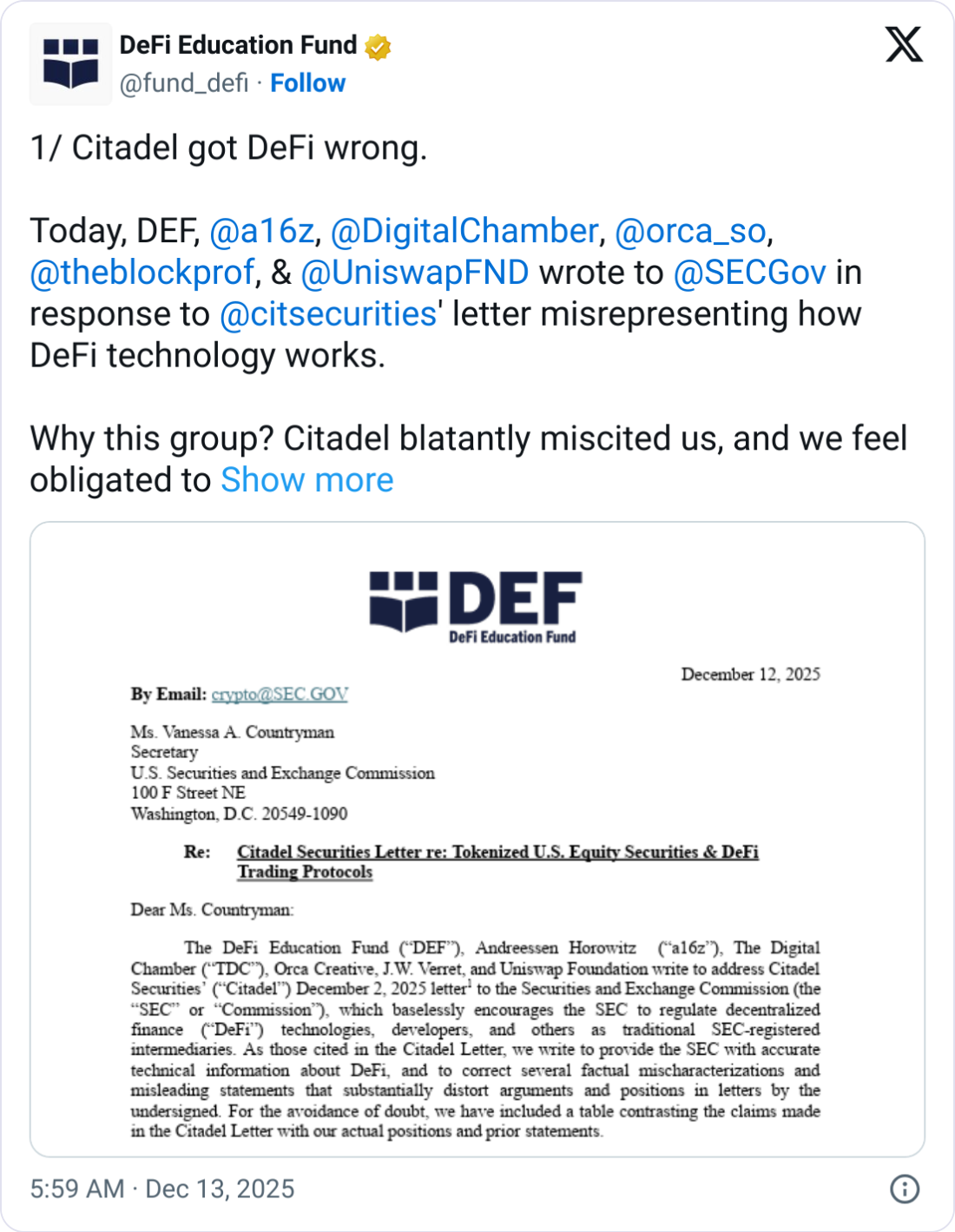
Source: DeFi Education Fund

“DeFi technology is a new innovation that was designed to address market risks and resiliency in a different way than traditional financial systems do, and DeFi protects investors in ways that traditional finance cannot,” the group argued.

Related: SEC’s Crenshaw takes aim at crypto in final weeks at agency

In its letter, Citadel had argued that the SEC giving the green light to tokenized shares on DeFi “would create two separate regulatory regimes for the trading of the same security” and would undermine “the ‘technology-neutral’ approach taken by the Exchange Act.”

Citadel argued that exempting DeFi platforms from securities laws could harm investors, as the platforms wouldn’t have protections such as venue transparency, market surveillance and volatility controls, among others.

The letter initially drew considerable backlash, with Blockchain Association CEO Summer Mersinger saying Citadel’s stance was an “overbroad and unworkable approach.”

The letters come as the SEC looks for feedback on how it should approach regulating tokenized stocks, and agency chair Paul Atkins has said that the US financial system could embrace tokenization in a “couple of years.”

Tokenization has exploded in popularity this year, but NYDIG warned on Friday that assets moving onchain won’t immediately be of great benefit to the crypto market until regulations allow them to more deeply integrate with DeFi.

Magazine: SEC’s U-turn on crypto leaves key questions unanswered
Похожее

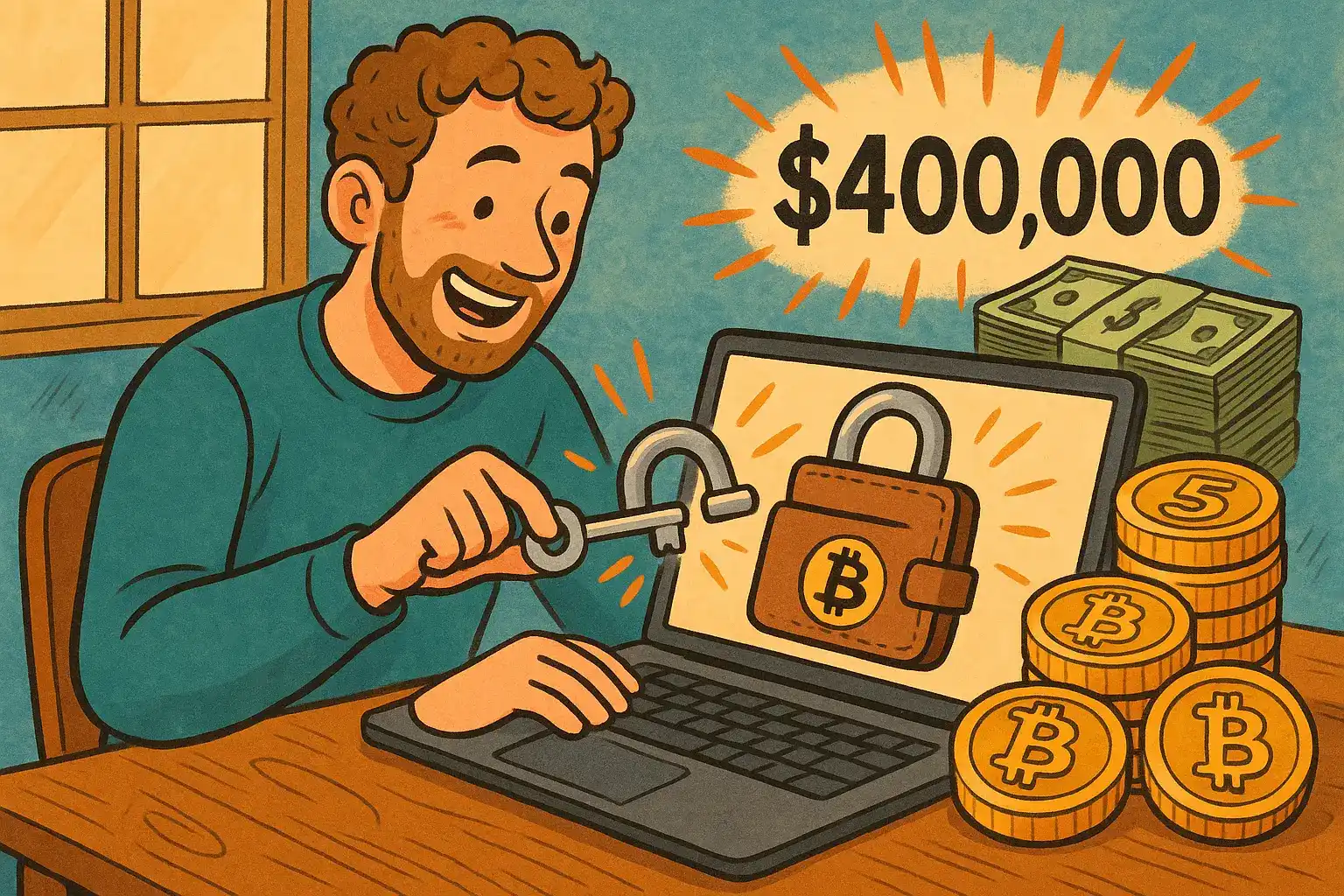
Claude Helps Man Recover 5 Bitcoins Forgotten for 11 Years, Worth Nearly $400,000

AI Chatbot Claude Helps Man Recover 5 Bitcoins Forgotten for 11 Years, Worth Nearly $400,000 A user named Cprkrn recovered a Bitcoin wallet containing 5 BTC (~$400,000), locked for over 11 years, with the help of Anthropic's AI, Claude. The wallet was originally locked after Cprkrn changed its password while under the influence in university and subsequently forgot it. Claude did not crack the password. Instead, after Cprkrn uploaded all files from his old university computer, Claude sifted through the data and located an earlier, pre-password-change version of the encrypted wallet file (wallet.dat). Cprkrn had also recently found a handwritten seed phrase, but it was incompatible with the main wallet file. Claude's key breakthrough was identifying and fixing a bug in the open-source recovery tool `btcrecover`, which had been concatenating the shared key and user password in the wrong order. After correcting this logic error and running the decryption process, Claude successfully extracted the private key, allowing the funds to be accessed and transferred. While the post garnered over 10 million views and sparked excitement, wallet recovery experts noted Claude's role was more akin to AI-assisted digital forensics—organizing unstructured historical data, diagnosing tool issues, and executing a corrected process—rather than true cryptographic password cracking. The recovery relied on pre-existing user-held data fragments: old computer files, a valid seed phrase, and an older wallet file. The story highlights a potential new, lower-cost path for recovering lost crypto assets, dependent on users retaining old data. It also occurs against a backdrop where an estimated one-third of Bitcoin's circulating supply is dormant in long-lost or inaccessible wallets.

marsbit7 мин. назад

Claude Helps Man Recover 5 Bitcoins Forgotten for 11 Years, Worth Nearly $400,000

marsbit7 мин. назад

Has the Winter of Crypto IPOs Arrived? Consensys and Ledger Hit Pause

Crypto IPO Winter Arrives? Consensys and Ledger Hit Pause. Following a boom in 2025, the window for crypto company initial public offerings has narrowed sharply in 2026. Major players like MetaMask developer Consensys and hardware wallet firm Ledger have recently postponed their US listing plans, joining exchange Kraken which paused its process earlier this year. This slowdown follows a strong 2025 where companies like Circle and Bullish went public, raising billions as Bitcoin hit all-time highs. However, in 2026, declining Bitcoin prices and trading volumes have cooled investor risk appetite. Newly listed crypto stocks, including BitGo, have seen significant price drops post-IPO, reinforcing investor caution. The cooling crypto IPO market contrasts sharply with the red-hot AI sector, where companies like SpaceX and OpenAI command massive valuations and investor interest based on "productivity revolution" narratives. Crypto firms, seen as more cyclical and volatile, struggle to compete for capital. The IPO delays are prompting a strategic shift. Companies are focusing on strengthening fundamentals, pursuing private funding, and expanding into more stable revenue streams like institutional services. This phase may accelerate industry consolidation, favoring firms with robust compliance and infrastructure. Analysts suggest a potential second wave of crypto IPOs in late 2026 could depend on a Bitcoin price recovery and clearer regulatory developments.

marsbit12 мин. назад

Has the Winter of Crypto IPOs Arrived? Consensys and Ledger Hit Pause

marsbit12 мин. назад

Торговля

Спот
Фьючерсы
活动图片